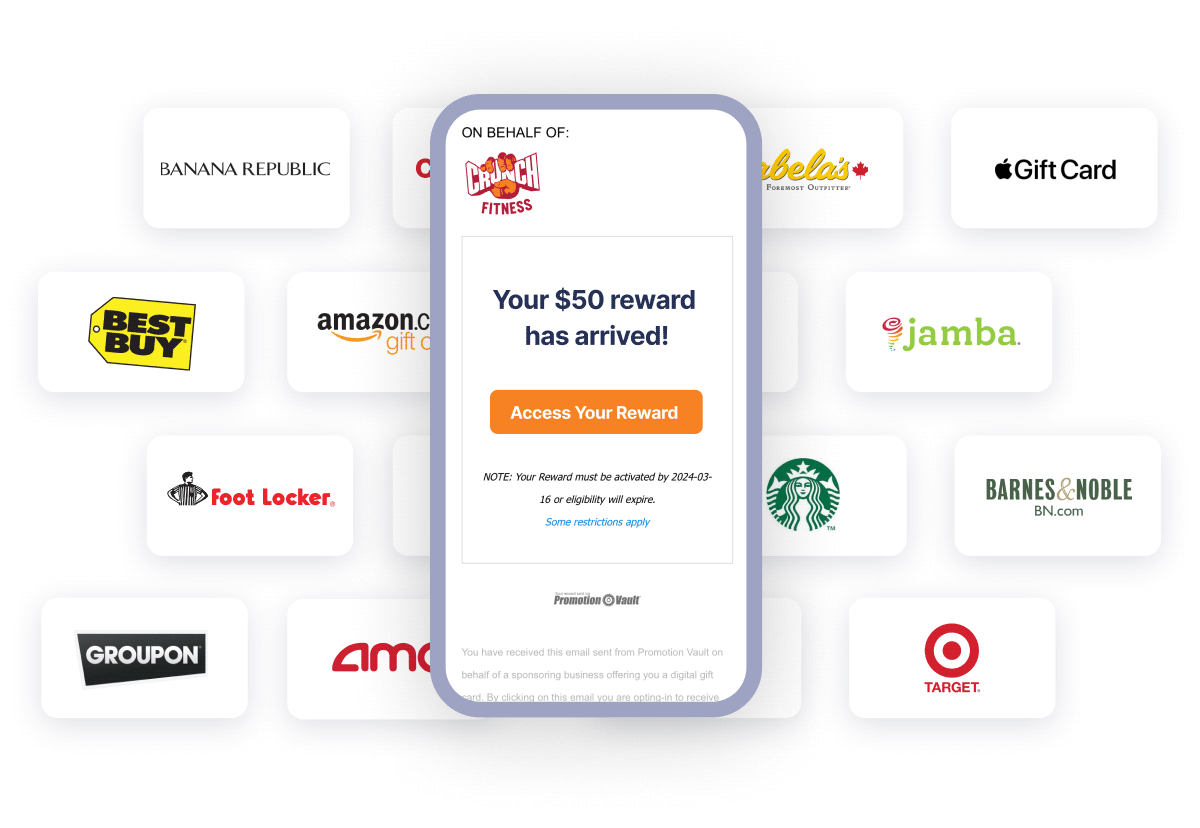

Industry: Fitness
Crunch Fitness uses gift cards and cash as incentives for employees on a recurring basis. They used Promotion Vault to streamline rewards for both customers and employees — preventing churn and increasing loyalty.
TLDR — Top 10 Takeaways from the Crunch Fitness system
- Run employee and customer incentives in one system so consistency doesn’t break across teams.
- Start with a “Welcome” moment — Crunch opened with a $50 reward to make the program feel real on day one.
- Keep referrals small, fast, and rules-based — Crunch used a $25 staff referral reward to reduce hiring friction.
- Celebrate tenure quarterly, not annually — Crunch used a $50 reward every 90 days to build steady recognition.
- Pair individual sales rewards with team sales rewards to protect culture and ensure a sense of camaraderie.
- Tie every reward to a behavior you can name so people trust the system and leaders can enforce it fairly.
- Automate timing because manager memory is not a strategy — uneven recognition becomes resentment fast.
- Design for activation, not just sending — most rewards get claimed quickly, so the first message carries the weight.
- Use a measured reminder cadence, then stop — consistent nudges help, but endless follow-ups erode goodwill.
- Defend the budget with real economics — turnover is expensive and structured recognition reduces preventable loss.
Crunch Fitness Understood Rewards, But Needed A System
Crunch Fitness already understood something a lot of operators learn the hard way — rewards work when they’re frequent, fair, and actually delivered. They were already using gift cards and cash on a recurring basis to keep employees engaged and to support customer retention. The intention was right. The execution just started to strain under its own weight.
Because once you run rewards across employees and customers, “simple” stops being simple. Every manual step becomes a failure point. Someone forgets a milestone. Another location applies the rule differently. Finance can’t forecast the spend. A top performer feels overlooked. A new hire gets missed. The reward that was meant to build trust begins to do the opposite.
So Crunch used Promotion Vault to centralize and streamline rewards for both customers and employees — without turning it into a full-time admin job. They didn’t build one campaign. They built a set of repeatable programs with clear triggers, clear amounts, and a consistent delivery experience.
Here’s what that system included:
- Welcome to Team Rewards: $50 to introduce new employees to the program.
- Referrals: $25 when a team member refers a new hire.
- Anniversary cadence: $50 every 3 months to reinforce continuity.
- Sales goal (individual): $50 tied to individual performance.
- Sales goal (team): $50 for the team when they go above and beyond.
The story we’re telling in this case study is straightforward: Crunch took incentives they already believed in and turned them into a system people could count on — which is where retention actually starts.
Why Retention Especially Matters In Fitness
In fitness, retention is the business model. We can sell a great intro offer, run great ads, and still lose if people churn quietly. The same is true inside our teams. When staff churn, service quality dips. Members feel it. Then revenue follows.
What makes this category harder is that it runs on consistency. A gym isn’t a one-time transaction. It’s a routine people are trying to build. That means the little breakdowns matter more than they do in other industries. Missed check-ins. Missed recognition. Missed follow-through. Each one is small. Together, they become the story people tell themselves about whether this place cares.
We also can’t pretend hiring will save us. Small businesses are still reporting real hiring friction. In NFIB’s December 2025 Jobs Report, 48% of owners hiring said they had few or no qualified applicants. That isn’t an abstract macro trend. That’s a daily operational constraint.
So retention becomes the responsible move.
And yes, pay matters. But it’s not the only lever. When SHRM summarized iHire’s 2024 retention research, the top quit reasons weren’t pay. They were toxic environment (32.4%), poor leadership (30.3%), and dissatisfaction with a manager (27.7%). Unsatisfactory pay ranked sixth (20.5%). That tells us what the actual issues are and where to act.
Recognition sits right in the middle of that map. It’s not a substitute for wages, but it is a signal of respect, belonging, and fairness. Workhuman and Gallup tracked employee career paths from 2022 to 2024 and found that people who received high-quality recognition were 45% less likely to have left their job by 2024. That’s a big claim, and it comes with a clear implication: timing and consistency matter.
The cost side is just as blunt. Work Institute recommends a conservative method for estimating turnover cost at 33.3% of base salary per departure. If we lose a $45,000 team member, we’re not “saving” anything. We’re paying for disruption.
This is why Crunch’s approach works. They didn’t treat retention like a vibe. They treated it like a system. They built programs that hit key moments, then made delivery consistent. In a category where people leave when things feel random, consistency is the strategy.
Dissecting Crunch Fitness’s Retention System
Crunch didn’t try to motivate everyone with one reward. They picked five repeatable moments. Each one ties to a retention lever with a fixed amount. That matters because fixed amounts reduce arguments and reduce manager drift. We can’t build trust with randomness. We build it with consistency people can feel.
Program 1 — Welcome to Team Rewards ($50)
A welcome reward does two jobs at once. First, it creates early goodwill. Second, it trains behavior. People learn how rewards work. They learn how to claim. They learn what “good” looks like.
What it solves:
- New-hire uncertainty during the riskiest weeks.
- Slow cultural onboarding across locations.
- Low adoption of the rewards system itself.
Guardrails to put in place:
- One reward per new hire.
- A clear eligibility trigger (start date, first shift, or onboarding completion).
- A simple message that sets expectations for future rewards.
What to measure:
- Claim rate within 24 hours and within 7 days.
- First-30-day retention by cohort.
- “Time to first reward” as a leading indicator.
Program 2 — Referrals ($25 for a New Team Member)
Crunch kept this reward small and clean. That’s smart. Referral incentives can get messy fast. They can also create resentment if rules feel uneven. A $25 referral reward won’t replace recruiting, but it does reduce friction. It signals trust and surfaces your best talent sources.
What it solves:
- Hiring drag and constant understaffing.
- Low-quality applicants from generic job boards.
- Culture dilution from rushed hires.
Guardrails to put in place:
- Pay only when the hire starts (or after a short retention window).
- One reward per hire, with the referrer clearly recorded.
- A basic anti-abuse rule (no duplicate claims).
What to measure:
- Referral volume by location.
- Referral-to-hire conversion.
- Early retention of referral hires versus non-referral hires.
Program 3 — Anniversary Cadence ($50 Every 3 Months)
Annual anniversaries miss the point in high-churn roles. They’re too far away. People leave long before then. Quarterly cadence makes retention visible and fair. Everyone knows the rhythm. Everyone sees the follow-through. This program is about continuity. It says, “We notice you staying.” In service businesses, staying is money in the bank.
What it solves:
- Recognition gaps that make tenure feel invisible.
- Inconsistent manager follow-through across locations.
- The slow erosion of feeling cared for.
Guardrails to put in place:
- Clear cadence tied to a hire date.
- Automated scheduling so no one is missed.
- A consistent message that honors the milestone.
What to measure:
- Claim rates per quarter.
- 90-day, 180-day, and 12-month retention by cohort.
- Variance across locations (to spot leadership issues).
Program 4 — Sales Goals for Individuals ($50)
This is performance recognition with a clean finish line. It matters because sales goals can become emotional. When goals feel arbitrary, effort drops. When they feel fair, effort rises. Individual rewards also create a sense of agency. People know what they control. They know what gets celebrated.
What it solves:
- Ambiguity around what good performance is.
- Burnout from effort that feels unseen.
- Inconsistent recognition by manager preference.
Guardrails to put in place:
- A written goal definition that doesn’t change mid-cycle.
- A transparent way to verify the result.
- A clear timeframe for measurement.
What to measure:
- Frequency of payouts over time.
- Goal attainment rate by person and by location.
- Correlation with leading indicators (show rate, conversions, upgrades).
Program 5 — Sales Goals for Teams ($50 for the Team)
Team rewards are culture insurance. They help avoid the “top dog” resentment that pure individual incentives can create. They also reinforce shared standards. This program is especially important in gyms. The member experience is collective. Front desk, trainers, sales, and ops all touch retention.
What it solves:
- Silo behavior that hurts the member experience.
- Competition that turns toxic under pressure.
- “Why should I help?” thinking.
Guardrails to put in place:
- A team goal that’s measurable and visible.
- A clear definition of who qualifies as a team member.
- A consistent schedule for review and payout.
What to measure:
- Team goal attainment cadence by location.
- Member experience signals during goal periods.
- Retention trends where team rewards are consistent.
The singular setup of each of these programs is simple: every program has a trigger, an amount, and a reason. That’s what makes it sustainable. That’s also what makes it trustworthy.
What Changed for Crunch Fitness by Systemizing Rewards
Crunch didn’t “add rewards.” They removed uncertainty. That’s the shift that matters. When incentives live in spreadsheets and manager memory, delivery gets uneven. Uneven delivery becomes a credibility problem. And credibility problems become retention problems.
Once the programs above were centralized and automated, the same dollars started doing more work — because the system stopped leaking trust.
What Changed Operationally
The program stopped depending on perfect humans. Managers are busy. People forget. Shifts get chaotic. Automation doesn’t care — it executes. That consistency protects culture.
Recognition became fair across locations. In multi-unit operations, fairness is fragile. A policy that lands differently at two gyms creates resentment fast. A standardized trigger closes that gap.
They reduced reward drift and internal debate. Fixed amounts and clear triggers cut down on exceptions to the rule. That protects leaders from negotiating every reward.
They reduced the hidden cost of admin. Manual reward fulfillment is a lot of labor. Someone is tracking. Someone is chasing. Someone is reconciling. Centralizing removes a lot of that drag.
They made performance rewards feel legitimate. Sales incentives can turn toxic when rules feel fuzzy. Clear definitions and consistent payout timing keep the goal from feeling rigged.
They increased the odds that rewards actually get claimed. Promotion Vault uses a two-step activation flow. The default activation window is 30 days (though it is configurable). Critically, 90% of activations happen in the first 24 hours. If someone doesn’t activate in 24 hours, they often never do. That means the first message matters most.
They avoided being spammy while still following through. For unactivated rewards, Promotion Vault runs a structured reminder cadence. Follow-ups go out on set days after the first message (Day 1, 3, 6, 13, 21, 29, 40, 50, 59). Then it stops. That’s the balance we want — helpful, not annoying.
What Outcomes Changed
Crunch Fitness is extremely protective of their employee and customer retention data, so we’re unable to detail the specific results from Crunch Fitness’s revised, systemic approach to rewards. However, we can confidently declare that Crunch Fitness has been one of our longest continual clients — pretty much since the beginning of Promotion Vault. So it goes without saying that they’re happy with us.
That said, we can show what a well-timed, automated incentive system has produced in adjacent fitness contexts when executed cleanly. In our ClassPass case study, a clear “join now” reward drove a 62% activation rate from free trial to paid. The same case study also shows a follow-on milestone reward that lifted early engagement by 16% (measured as more new subscribers completing a specific usage milestone). Those results weren’t magic. They were timing, clarity, and friction removal.
Zooming out across Promotion Vault usage, we’ve supported incentives at scale (1.8M+ rewards, 4,700+ customers, $20M+ payouts, and $10M+ customer savings are figures documented in our case study materials). That scale matters because it forces discipline. At volume, sloppy systems collapse. Clean systems compound.
We also operate on a pay-on-activation model — meaning you only pay when a recipient activates the reward. We see an average activation rate of around 60% across typical programs. That pay-on-activation prevents budget leakage from rewards that never get used. It also changes how finance evaluates incentives, because spend aligns with real engagement.
What We Suggest Tracking
For those looking to emulate Crunch Fitness’s retention programs, here’s what we suggest measuring at a minimum:
- Reward activation rate by program (and by location).
- Time-to-activation (especially within the first 24 hours).
- Employee retention by cohort (90-day, 180-day, 12-month).
- Referral volume and referral-hire quality proxies (early retention is a strong proxy).
- Sales goal attainment cadence (individual and team).
- Manager admin time saved (and reduction in escalations).
Crunch’s design works because it’s measurable and repeatable — which means people don’t even have to trust it, they can see it all for themselves.
How to Copy Crunch Fitness’s Retention Playbook
Most retention programs don’t fail because the reward is too small. They fail because the system is too fragile. Someone has to remember. Someone has to reconcile. Someone has to chase a claim. Then the whole thing becomes optional — and people feel that.
Crunch Fitness avoided that trap by building five programs with clear triggers and fixed amounts. Here’s how you can replicate that without turning it into another ongoing project you dread.
Step 1: Pick the 3–5 moments that actually change retention
Don’t start with “we should reward people more.” Start with “where do we lose people?”
Use these buckets:
- Belonging moments (first day, first week, first month)
- Continuity moments (90 days, 6 months, 9 months)
- Performance moments (clear goals with clear finish lines)
- Referral moments (when hiring pain is constant)
- Culture moments (team wins that protect collaboration)
If you’re running a gym, we usually recommend you copy Crunch’s first two first: Welcome and Quarterly Anniversary. They build trust fast.
Step 2: Set reward values and rules that don’t invite negotiation
Retention rewards should feel fair. Fairness comes from clarity.
Keep amounts simple:
- One amount per program
- No moving goalposts mid-cycle
- No special exceptions unless you write them for everyone to see
- One trigger per reward (so managers can’t interpret it six ways)
Crunch used $50 and $25 amounts for a reason. They’re big enough to feel real. They’re small enough to repeat.
Step 3: Define triggers clearly and consistently
A trigger is the line between “program” and “vibe.”
Write triggers you can audit:
- Welcome: on start date, first shift, or onboarding completion
- Referrals: when the new hire starts (or after a short retention window)
- Quarterly anniversary: every 90 days from hire date
- Sales goals: verified attainment in a defined period
- Team goals: location-based result in a defined period
If you can’t explain the trigger in one sentence, it’s not ready to execute on.
Step 4: Build the claim experience around activation behavior
This is where most teams get surprised. “We sent it” is not the same as “they claimed it.” Promotion Vault uses a two-step activation model. The window is typically 30 days (though it is configurable). The key behavioral truth is that 90% of activations happen in the first 24 hours. That means your first message does most of the work.
So we suggest keeping messages tight:
- Say why they earned it
- Say what to do next
- Say how long they have
- Keep the tone human, not corporate
Step 5: Choose a reminder cadence that helps, then stops
Follow-up matters. Spam destroys goodwill. Promotion Vault’s standard reminder cadence goes out on set days (Day 1, 3, 6, 13, 21, 29, 40, 50, 59) if someone hasn’t activated. Once they activate, reminders stop. That’s what “firm and respectful” looks like in practice.
If your org is sensitive to notifications, we can thin the cadence. But reminders matter.
Step 6: Segment so the program feels fair across roles and locations
In fitness, one program can land like five different programs.
Segment when needed:
- Role (front desk vs. trainers vs. sales)
- Location (different goals, different headcount)
- Team (who qualifies for team wins)
- Tenure (new hire milestones versus long-tenure continuity)
Segmentation protects trust. It prevents people from comparing apples to oranges.
Step 7: Instrument the measurement that proves the program works
We don’t need perfect attribution. We need consistent signals.
Track these weekly:
- Activation rate by program and by location
- Time-to-activation (especially the first 24 hours)
- 90-day retention by cohort
- Referral volume and referral hire retention
- Sales goal attainment cadence
- Admin time saved (and fewer reward support tickets)
If you can’t see the program succeed, finance won’t defend it. If finance won’t defend it, it won’t last.
Step 8: Pilot one program for 30 days, then expand
Most teams try to launch everything and then drown. We’d rather win small and compound.
Here’s a pilot order we like:
- Welcome → Quarterly Anniversary → Referrals → Individual Sales → Team Sales
Each step builds trust. Each step reduces chaos.
How Promotion Vault Makes This Operationally Sane
Crunch Fitness already believed in rewards. They were already using rewards. But not in a way that was sustainable without significant overhead. We took what Crunch already believed in and turned it into a system that runs the same way every time — across locations, across managers, across busy weeks.
Here’s what that looks like under the hood.
A Single Reward Lifecycle, End to End
In Promotion Vault, a reward isn’t a loose gift card email. It’s a tracked lifecycle that moves through clear stages: Processing → Waiting (for activation) → Activated → Completed (with defined outcomes for Expired, Voided, or Deleted when something goes wrong). That matters because it gives operators a shared language for what’s happening, and it gives recipients a predictable path for what to do next.
For Crunch Fitness, that meant the five programs weren’t five separate “projects.” They were five sets of triggers feeding the same reliable delivery engine.
Branded Delivery That Feels Legitimate, Not Spammy
The first touchpoint matters more than most teams admit. Recipients decide fast whether a reward message is real or suspicious. Promotion Vault solves that by making the initial notification professional and clearly branded — logo, colors, sender name, and a clear call to action to access the reward.
That branding isn’t just aesthetic. It’s a trust control. When people trust the message, they click. When they click, programs work.
Secure, Low-Friction Activation and Login
Rewards flow through a guided journey: notification → activation → a personal vault dashboard → redemption choice. Activation confirms identity and consent. It also reduces support headaches, because recipients can return to their vault, see statuses, and manage rewards without searching old emails.
That “vault” idea is simple, but it’s the difference between a one-time transaction and an ongoing relationship channel.
Configurable Activation Windows, Matched to Your Reality
Operators need urgency controls. Promotion Vault supports activation windows of 7, 14, 30, or 60 days. Short windows create urgency. Longer windows create breathing room. Either way, the rule is explicit, and the deadline is visible.
This is where programs stop being vibes and start being measurable.
Reminder Cadence That Nudges, Then Stops
Follow-through is where manual programs die. So we built a structured reminder cadence that only applies when a reward is still waiting for activation and still inside the activation window.
- For a 30-day window, reminders go out on Days 1, 3, 6, 13, 21, 29.
- For a 60-day window, reminders extend to Days 40, 50, 59 as well.
- The system rate-limits follow-ups to one reminder per 24 hours to prevent fatigue.
- Once the recipient activates, reminders stop.
If you’ve ever watched a team “forget” to follow up because it felt awkward, you know why this matters. Consistent nudges protect the program without nagging people into resentment.
Optional SMS, with Guardrails
Email works. SMS can help. But SMS needs discipline. Promotion Vault only sends SMS when the team has it enabled and the recipient’s mobile setup meets basic requirements. That keeps you from blasting texts into the void and calling it engagement.
Economics That Align Spend with Engagement
Most reward tools charge you the full value up front, whether anyone claims the reward or not. Promotion Vault uses a two-part model that aligns cost with behavior.
- A service fee (10% of the reward amount) is charged when a record is added or a reward link is created (this triggers eligibility).
- The reward fee is charged when the recipient activates (when activation is required).
- If a recipient never activates inside the window, you don’t pay the reward fee.
This is how you scale programs without finance treating every launch like a blank check. You still notify 100% of eligible people. You only pay full value when they choose to claim.
Multiple Sending Modes, Same Experience
Whether you’re sending one-off rewards fast (Quick Send), running structured programs (Promotions), or distributing codes through your own channels (Reward Links), the recipient experience stays consistent. That consistency is what reduces “Where is it?” tickets and keeps the program feeling trustworthy.
That’s the core mechanism: consistent lifecycle + branded trust + controlled follow-up + activation-aligned economics. Crunch’s five programs worked because the system behind them didn’t wobble.
General Objections to Incentivized Employee Retention Programs (And How We Respond)
“Rewards don’t fix pay.”
Correct. We shouldn’t pretend they do. If compensation is meaningfully below market, rewards won’t save you. They’ll feel like a distraction. The fix there is wage strategy, scheduling stability, and workload. Full stop.
But here’s the other truth. Many gyms lose good people even when pay is fine. They leave because the environment feels chaotic, the standards feel arbitrary, and the effort feels unseen. Rewards can’t cover harm, but they can reinforce respect when the basics are in place.
So we treat incentives as a system for follow-through, not as a substitute for fair compensation.
“This feels like bribery.”
It can. If rewards are random, manipulative, or used to paper over bad leadership. Crunch’s structure avoids that. Each program ties to something we can say out loud: start strong, bring great people, stay with us, hit clear goals, win as a team. That’s not bribery. That’s recognition with rules.
Bribery is “do what we want.” Recognition is “we see what you did.” The difference is clarity and consistency.
“We’ll annoy people with notifications.”
That’s an extremely avoidable risk. Most teams fail in one of two ways. They send one email and hope. Or they overcorrect and spam. The right move is a measured cadence that stops when the person activates. The system should be firm, respectful, and finite.
If your culture is sensitive to pings, thin the cadence. But don’t remove follow-up entirely, because then you’re back to leakage.
“Finance will cut this if we can’t prove ROI.”
Also fair. Finance is doing its job. The fix is a simple measurement plan you can defend. Track activation by program, retention by cohort, referral volume, and goal attainment cadence. Then show finance the trend lines.
And keep the spend predictable: Fixed amounts, clear triggers, and activation-aligned economics are what turn a nice idea into a manageable line item.
“This will become another tool no one uses.”
The fastest way to kill a rewards program is to make it optional and confusing. Different rules by manager. Different timing by location. Different messaging every week. People stop trusting it. Then they stop engaging.
That’s why we suggest starting with one program and win. Welcome reward or quarterly anniversary. One trigger. One amount. One message. Let people feel consistency. Then expand.
“What about people who do great work that isn’t tied to sales?”
That’s a leadership question, not a tooling question. If the only rewards you run are sales goals, you’ll over-reward the visible and under-reward the essential.
In gyms, the essential work is often invisible: retention saves, cleanliness, member care, coaching moments, de-escalation, reliability. Crunch’s mix helps. Welcome and anniversaries reward continuity. Team goals reward shared standards. Sales goals reward performance. The balance matters.
If you want to go above and beyond with your rewards, you certainly can. We just recommend you define it tightly so it doesn’t become favoritism.
“Won’t people game it?”
Some will try. The answer is clear eligibility, verification points where needed, and basic guardrails. Especially on referrals and goal-based rewards. You don’t need a police state. You need rules that are simple to enforce.
Stop With The Spreadsheets, Start Building Automated Retention
If you’re running rewards manually right now, it’s understandable. Most gyms start that way. A gift card here. A cash bonus there. A spreadsheet that works until it doesn’t.
The problem is that manual rewards don’t just create extra admin. They create unevenness. And unevenness erodes trust. Once people stop trusting the system, you’re paying for incentives that don’t land.
Crunch Fitness’s approach is worth copying because it’s grounded. They chose five repeatable moments. They fixed the amounts. They made triggers clear. Then they stopped relying on manager memory to carry the culture.
Here’s the smallest responsible next step:
- If your rewards program depends on spreadsheets and someone remembering to send things, then automate one program in the next 14 days — either the $50 Welcome reward or the $50 Quarterly Anniversary reward.
- Keep the rules simple. Keep the message human. Track activation and 90-day retention by cohort.
- Once the first program runs clean for 30 days, add the next one.
That’s how you build a retention system that compounds — without turning it into a second job.
Want to get started? Book a 15-minute call with us.
We’ll map your first program, set the trigger, and give you a clean rollout plan you can actually execute.
Frequently Asked Questions About Employee Retention Programs
How much should a reward be?
Enough to feel real, not so big it becomes rare. In Crunch’s system, $50 shows up as “meaningful” without being a budget grenade, and $25 works well for referrals because it’s frequent and rules-based. If you’re unsure, pick one amount you can repeat monthly, then hold it steady for a full quarter so people can trust it.
How often is too often?
Too often is when people feel nagged or manipulated. Frequency is fine when it’s predictable and tied to a clear trigger. Quarterly anniversaries work in gyms because they match the reality of churn risk. Random weekly rewards can feel like noise. A steady cadence builds trust.
What’s the fastest program to launch first?
Start with Welcome to Team Rewards or Quarterly Anniversary. They don’t require complex performance verification, and they immediately improve consistency. Sales goals and referrals are powerful, but they need tighter rules and stronger tracking.
How do we prevent abuse, especially with referrals?
Keep it simple:
- Define eligibility in one sentence.
- Pay only when the new hire starts (or after a short retention window).
- One referrer per hire.
- Basic verification before payout.
You don’t need a heavy process. You need enforceable rules.
How do we measure ROI without perfect attribution?
Measure what you can defend:
- Activation rate by program and location.
- 90-day and 180-day retention by cohort.
- Referral volume and retention of referral hires.
- Sales goal attainment cadence (individual and team).
- Admin time saved and fewer reward-related escalations.
You’re proving trend improvement, not claiming a single magic number.
What if we’re worried rewards will feel unfair across roles?
Segment by role or location when the work is meaningfully different, and keep rules visible. Fairness isn’t sameness. Fairness is clarity. When people understand why something is different, they trust it more.
What if we already do incentives — why change anything?
If you’re consistent and it’s not draining your team, you may not need to. But most manual programs break at scale. If you’ve ever missed a milestone, had inconsistent payouts across managers, or spent hours reconciling rewards, you’re already paying the manual tax. Systematizing is how you stop paying it.
What’s the one mistake we should avoid?
Don’t launch five programs at once. Win one program first. Let people feel that the system is real. Then expand.
Over 5,000 Trusted Partners
See who else is creating exceptional experiences with Promotion Vault.


