Increase revenue from referrals by rewarding actions across the referral journey — the share, the trial, and the sale — with clear, instant, choice-based rewards. Use a pay-on-activation platform so you only pay full reward value when people claim their reward, and validate every referred lead so you can measure what the program returns.
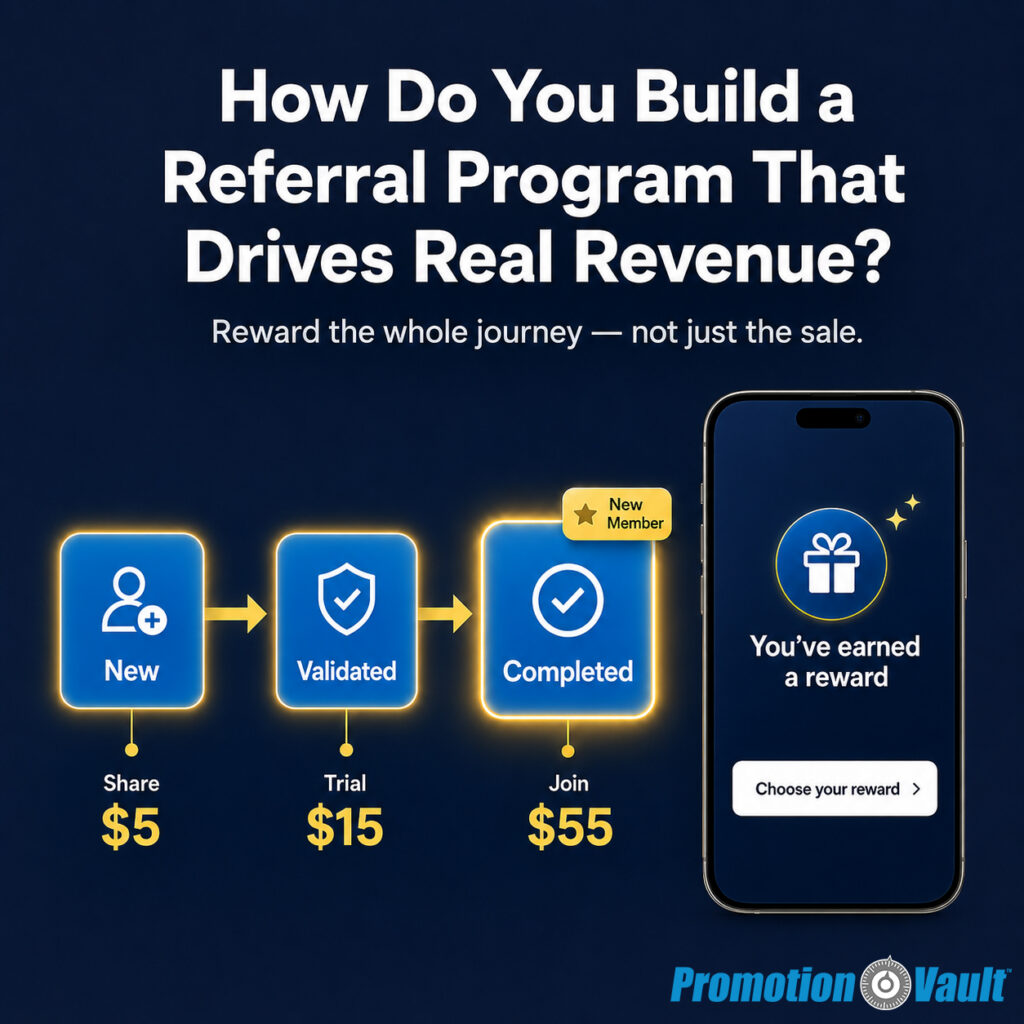
TLDR — How To Effectively Increase Revenue With Referrals
- Reward the whole journey — share, trial, and sale — not just the final sale.
- Tier the rewards: small to share, more to trial, most to join.
- Orangetheory’s $5 / $15 / $55 ladder lifted new members from referrals 42%.
- Reward both sides — skipping the friend caps sharing (54% of programs do).
- Validate every referred lead by email and phone before you pay.
- Track submitted, validated, and converted counts to see what works.
- Pay-on-activation: pay full reward value only when people claim it.
- Promote it everywhere — and keep promoting long after launch.
- Choose gift cards over discounts that train customers to wait.
- Book a Referral Vault demo — we’ll map your reward tiers and set a launch plan.
- Why Do Most Referral Programs Stall Out?
- What Makes a Referral Program Work?
- How Do You Reward the Whole Referral Journey Instead of Just the Sale?
- How Do You Know Your Referrals Are Real — and Worth the Reward?
- How Do You Scale Referral Rewards Without Wasting Budget?
- How Do You Keep Referrals From Feeling Salesy?
- How Do You Launch a Referral Program in Six Steps?
- Frequently Asked Questions About Referral Programs
- Build a Referral Program That Drives Real Revenue With Tiered Rewards
Orangetheory Fitness started paying members five dollars for something they had not sold yet — the simple act of naming a friend. Referrals submitted jumped 78 percent. New members from those referrals climbed 42 percent. That result, from Promotion Vault’s Orangetheory case study, upends how most operators run referrals: we tend to reward the final sale and ignore every step that leads to it. However, the steps that lead to it is where the growth hides.
If you run a multi-location gym, a franchise, an auto service group, or any membership business, you already know referrals should be your cheapest, best channel. Up to 84 percent of small-business deals start with a referral, according to Entrepreneur. Yet most operators have no system that reliably produces them. This guide fixes that. A referral program drives real revenue when you reward the behaviors that lead to the sale — not only the sale — and pay full reward value only when someone claims their reward. Everything below builds that program, step by step.
Why Do Most Referral Programs Stall Out?
Most referral programs stall because they reward only the final sale, hide the offer where no one sees it, and pay out too slowly. Referrers lose momentum before a friend ever buys. Manual tracking adds errors, and without validation, operators cannot tell a real referral from noise.
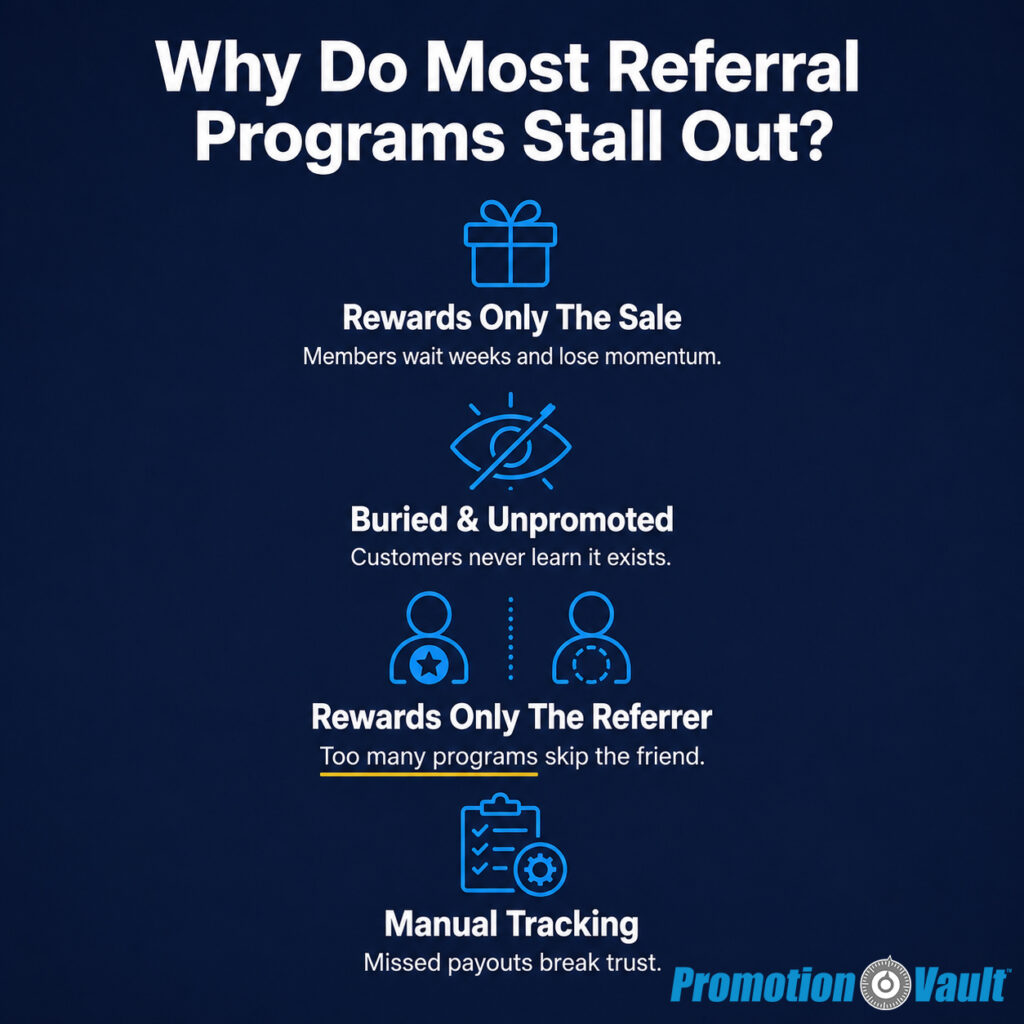
We see the same pattern across operators who tell us their referral program used to work. The reward waits at the finish line, so a member who names three friends gets nothing until one of them signs a contract weeks later. Motivation fades long before the payout arrives. This issue is exacerbated by the fact that most companies reward the referrer and never the friend. That imbalance makes members feel like unpaid salespeople, and it caps participation before the program has a chance to succeed.
Two more failures compound the first. The offer often sits buried in an account page or a footer, so most customers never learn it exists. In our experience, weak promotion is one of the leading reasons that referral programs underperform. And when tracking lives in a spreadsheet, rewards get missed, duplicates slip through, and one broken payout can cost a referrer’s trust for good. A referral program does not fail because word-of-mouth stopped working. It fails because the system around it was never built to reward, measure, and promote the behavior.
What Makes a Referral Program Work?
A referral program works when three things line up: rewards land at each stage of the journey, referred leads get validated so you know they are real, and the cost of rewards stays tied to results. Add a trusted, branded reward experience, and members share without feeling like salespeople.
People already trust referrals — Nielsen’s 2021 Global Trust in Advertising study, which surveyed 40,000 people, found that 88 percent trust recommendations from someone they know above every other form of advertising. We don’t need to manufacture trust. We just need a system that captures it, rewards it in motion, and proves what it returns. The rest of this guide walks through each pillar, then hands you a launch blueprint you can run this quarter.
How Do You Reward the Whole Referral Journey Instead of Just the Sale?
Break the referral into stages and reward each one. Pay a small reward the moment a member submits a friend, a larger reward when that friend tries your service, and the biggest reward when they buy. Each early win builds momentum toward the next, so members keep going.
Orangetheory built its program around a three-stage reward ladder, and the design is worth copying. Members earned five dollars for adding a referral, fifteen dollars when that referral tried a workout, and fifty-five dollars when the referral joined as a member. Small, instant wins at the start removed the wait that kills most programs, and each reward pulled members toward the next stage.
| Referral stage | Rewarded action | Example reward |
|---|---|---|
| Entry | Member submits a friend’s name | $5 |
| Validation | Friend tries a class or service | $15 |
| Conversion | Friend joins as a paying member | $55 |
That ladder produced a 78 percent lift in referrals submitted, a 23 percent lift in intro-class sign-ups, and a 42 percent lift in new members from referrals. The psychology is plain: an instant five-dollar reward reinforces the action while enthusiasm is high, and a visible next step gives members a reason to finish what they started.
Rewarding only the final sale leaves your best growth sitting on the table.
Escalate the reward value toward the action you care about most. Keep the entry reward small enough to sustain across your whole base, and make the conversion reward large enough to feel like a real thank-you.
How Do You Know Your Referrals Are Real — and Worth the Reward?
Validate every referred lead before you pay. Capture the referral through a form, verify the contact’s email and phone, then move it through clear statuses — submitted, validated, and converted. You reward real people at real milestones, block fake entries, and get a clean count of what the program produced.
This is where a spreadsheet quits and a real workflow earns its keep. With ReferralVault, a member submits a friend through a branded form you can share by link, QR code, email, or your website. The system verifies the contact’s email and phone, then tracks each lead through plain statuses — new, validated, and completed — so a reward fires only when the milestone is real. That structure does two jobs at once. It stops fake or duplicate entries from draining budget, and it gives you a clean line of sight from leads submitted, to validated leads, to paying members.
Measurement is the payoff. When every referral carries a status and a source, you can watch your submitted-to-validated rate and your validated-to-converted rate, then put more reward behind the stage that moves. You cannot improve a referral program you cannot measure — and you cannot measure one built on manual tracking. Referral leads also tend to stay. Wharton research on word-of-mouth found referred customers are about 18 percent more likely to be retained than other customers. That makes a validated referral worth more over time than a cold lead.
How Do You Scale Referral Rewards Without Wasting Budget?
Tie reward cost to results with pay-on-activation. You pay a small service fee when a reward is sent, and the full reward value only when the recipient claims it. Rewards that go unclaimed cost almost nothing, so you can invite your whole base without paying face value on unclaimed rewards.
Here is the objection we hear most from owners and finance leads: a program that rewards every stage sounds expensive, and rewarding the whole base feels like giving away revenue. It is a fair worry, and pay-on-activation answers it directly. Under Promotion Vault’s pay-on-activation model, a 10 percent service fee applies when a reward is sent, and the full reward value is charged only when the recipient activates it. A reward that no one claims never costs you its face value.
Run the numbers on a simple example. Say you send 1,000 rewards worth $25 each, and half of recipients activate.
| Cost line | Amount |
|---|---|
| Service fee (1,000 sent × $25 × 10%) | $2,500 |
| Activated value (500 × $25) | $12,500 |
| Promotion Vault total | $15,000 |
| Full face value on every send | $25,000 |
| Modeled savings | $10,000 |
Those figures are illustrative and shift with your reward value, activation window, and audience — but the structure holds. You reach broadly and pay for engagement, not intent. Compare the reward against your acquisition cost, not your revenue. Entrepreneur puts it plainly: if you already spend $1,500 in ads or sales time to win a client, a smaller reward for a referred, higher-converting one is a bargain.
(P.S. Promotion Vault has no setup or recurring fees, and the platform has driven more than $10M in customer savings across 2M-plus rewards sent. Pay-on-activation turns a referral program from an open-ended expense into a forecastable line item where cost follows real engagement.)
How Do You Keep Referrals From Feeling Salesy?
Reward both sides and lead with community, not commission. When the friend also gets a reward, members feel like they are sharing something good rather than selling. Deliver every reward through a branded, passwordless experience so it reads as a real thank-you — not a suspicious payout link.
The fastest way to make a referral feel like a sales pitch is to reward only the person doing the referring. A two-sided reward fixes that awkwardness. The member gets a thank-you, and the friend arrives to a welcome instead of a bill. People share more freely when the person on the other end wins too.
Trust lives in the delivery. A reward that shows your name, your colors, the exact amount, and a passwordless way to claim it reads as legitimate — the opposite of the scam-flavored “you’ve won” links people delete on sight. Recipients activate through a branded vault, see their reward clearly, and choose from options they value, from Amazon to Starbucks to Target.
Orangetheory’s program worked because it reinforced what members already loved about the brand — belonging and shared progress — rather than turning them into a commissioned sales force. The best referrals are not bought; they are the natural result of a good experience, made easy to share and worth passing on.
How Do You Launch a Referral Program in Six Steps?
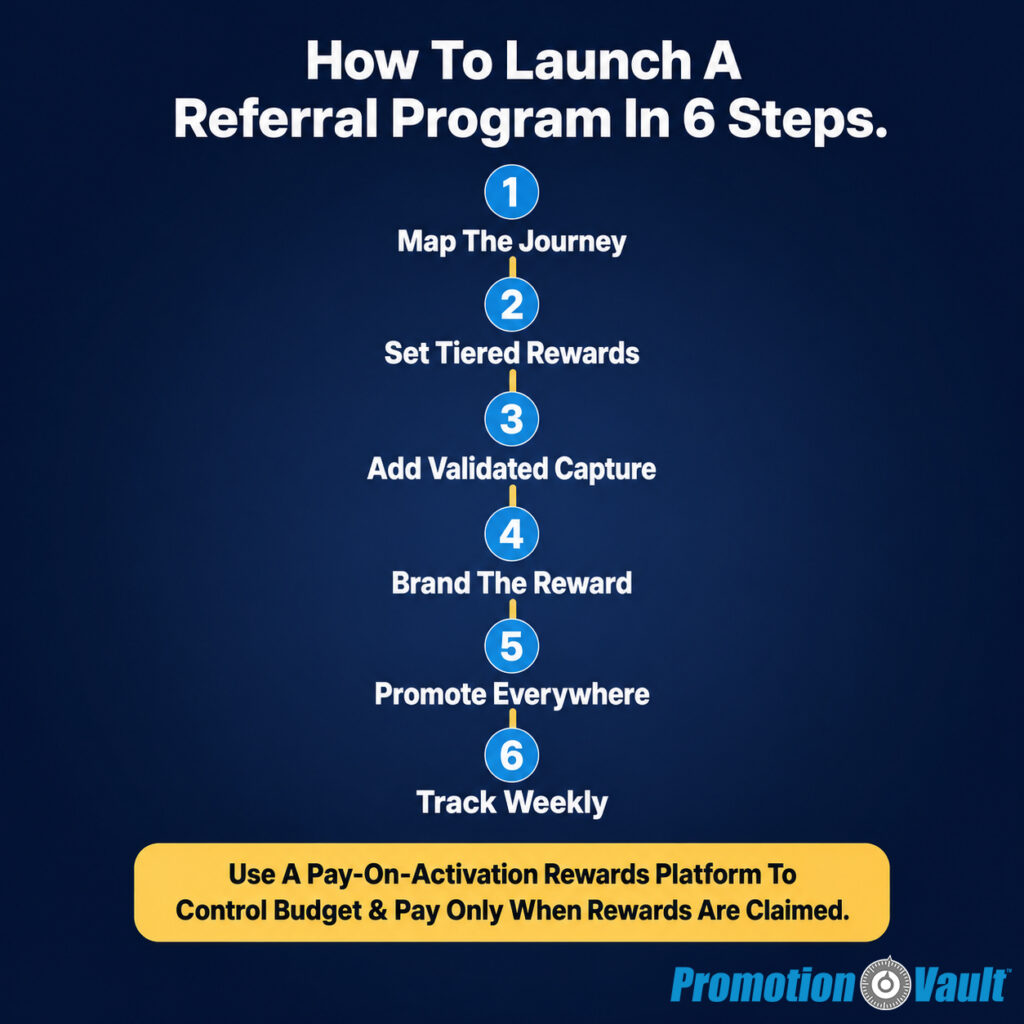
Launch in six steps: map your referral journey, set a tiered reward for each stage, connect a validated capture form, brand the reward experience, promote the program everywhere, and track results weekly. Start with one clear behavior, prove it, then expand.
- Map the referral journey. Break your customer path into milestones — the share, the trial or first visit, and the sale. Each milestone becomes a reward moment.
- Set a tiered reward for each stage. Assign a small reward to the entry action, a mid-size reward to the trial, and the largest to conversion. Escalate toward the behavior worth the most.
- Connect a validated capture form. Share it by link, QR code, or email, and turn on email and phone verification so only real leads earn rewards.
- Brand the reward experience. Add your logo, colors, and sender name, then let recipients activate passwordlessly and choose their own reward.
- Promote it everywhere, repeatedly. Put the offer on receipts, confirmation pages, emails, and in-studio signage, and keep promoting after launch, since weak promotion is the top reason programs fade.
- Track and optimize weekly. Watch submitted, validated, and converted counts by source, then move reward budget toward the stage that produces members.
Notice that each step names one action and one owner. That is the difference between a program that launches and one that lingers on a to-do list.
Frequently Asked Questions About Referral Programs
How much should I reward for a referral?
Reward enough to motivate, small enough to sustain. Tiering beats a single lump sum — a $5 reward that lands instantly often outperforms a $50 payout that arrives weeks later, because immediate wins build momentum. Escalate the reward toward the action worth the most: the paying customer.
Should I reward the referrer, the friend, or both?
Both. Two-sided rewards drive more sharing because members feel they are giving a gift, not selling. Many referral programs reward only the referrer — a common miss that makes participants feel like unpaid salespeople and caps how many people take part.
What is the best reward for a referral program — cash, discounts, or gift cards?
Choice-based gift cards tend to win. They feel like spendable money, carry more warmth than cash, and let recipients pick something they value. Discounts can cheapen your brand and train customers to wait for a deal, so reserve them for cases where your margin clearly allows.
How do I stop people from gaming my referral program?
Reward validated milestones, not sign-ups. Verify each referred contact’s email and phone, require a real action — a trial or a purchase — before a reward fires, and cap rewards per person. Automated validation catches duplicates and fake entries that a spreadsheet never will.
How do I measure whether my referral program is working?
Track three rates: how many members submit a referral, how many referred leads get validated, and how many convert to paying customers. Tie each referral to a source, compare reward cost against your acquisition cost, and shift budget toward the stage that produces members.
How long does it take a referral program to show results?
Early signals — submissions and validated leads — appear within the first few weeks. Conversions follow the length of your sales cycle. Give the program a full quarter before you judge it, and keep promoting throughout. Momentum compounds as referred customers become referrers themselves.
Build a Referral Program That Drives Real Revenue With Tiered Rewards
A referral program drives real revenue when you reward the whole journey, not only the sale. Pay a small reward for the share, a larger one for the trial, and the largest for the conversion. Validate every referred lead so you know it is real, and use pay-on-activation so cost follows engagement instead of intent. Deliver each reward through a branded experience that rewards both sides, and keep promoting the program long after launch.
Here is the smallest first step that works. If you already know the one behavior your best customers take right before they refer someone, then map a single reward to that moment this week and turn on validation before you promote it. If you are not sure where to start, book a demo — we will map your referral journey, set your reward tiers, and put a launch plan on your calendar.
Casey Rock is Content Director at Promotion Vault, where he builds the content, SEO, and messaging systems behind the company’s rewards engagement platform. He specializes in turning product value into proof-first stories that drive discovery, trust, and conversions.