
TLDR — Gift Card Breakage and Incentive Programs
- Pay for rewards on activation, not on send, so incentive cost tracks real behavior.
- Reinvest breakage savings where funnel friction is highest to improve conversion.
- Use activation rate as the key planning metric because it drives both actual spend and ROI clarity.
- Move fast on delivery and follow-up, since most activations happen within the first 24 hours.
- Run a defined reminder cadence and stop after activation to increase completion without fatigue.
- Report by reward value, audience, and campaign type because blended averages hide truth.
- Use milestone-based rewards for referrals and similar journeys to improve conversions.
- Incentivize review participation only after verified experiences and never tie rewards to review content.
- Start with one behavior, one trigger, one offer, and one reporting window, then test before scaling.
- Book a call to build a quick incentive campaign or rewards program pilot to prove ROI.
Pi Day Is All About The Math
Pi Day lands on March 14 because it mirrors 3.14 — the familiar shorthand for pi, the constant used to measure circles. That makes it a fitting day to talk about a different kind of math: incentive math.
Too many reward programs sound smart in a meeting and fail in a budget review. The idea feels exciting. The spreadsheet does not. That is the real problem for owners, operators, growth leads, and finance approvers. If a reward program does not pencil out, it does not matter how creative it looked on the whiteboard.
We think this is where most teams get stuck. They are not wrong to believe incentives can move behavior. They are wrong to accept waste as part of the deal. Indeed, for Promotion Vault, pay-on-activation is the core economic difference.
The service fee is charged up front, but the reward value is only charged when a recipient activates. That means non-activated rewards do not become dead spend. They become savings that can be reinvested into the actions that matter most — acquisition, referrals, reactivation, retention, upgrades, and upsells.
On Pi Day, the question is simple: are your incentives producing lift — or just producing spend?
In our view, rewards should do three things at once:
- They should motivate action.
- They should protect margin.
- They should have clear ROI.
That is the case for pay-on-activation. It is not just a nicer reward experience. It is a more defensible operating model.
The Real Math Around Incentives That Most Teams Ignore
Most teams do not fail at incentive strategy. They fail at incentive accounting. The offer may be smart. The timing may be solid. The audience may be right. But the spend model still works against them.
In a traditional reward setup, the buyer pays full face value up front for every reward sent, whether the recipient ever claims it or not. That stands in stark contrast to pay-on-activation: the service fee is charged when the campaign is sent, but reward value is charged only when the recipient activates. Non-activated rewards become savings instead of waste.
That difference sounds small until money gets involved. Then it becomes operational and political. Finance sees leakage. Operators see budget drag. Growth teams see fewer chances to test stronger offers. And everyone starts talking about incentives as if they are the problem.
Usually, they’re not. Usually, the problem is paying as though every reward created equal value, even when many rewards never become real cost. Pay-on-activation exists to reduce upfront risk, improve measurability, and make reward programs easier to defend to leadership.
We think this is where too many teams accept bad math as normal. They assume breakage is just messy leftover behavior. But breakage is simply the value of rewards that are never claimed or activated. With traditional pay-on-send reward fulfillment platforms, that does equal waste.
But that needn’t be the case. With pay-on-activation, breakage is treated as customer savings that can be reinvested into higher-value rewards tied to the actions that actually move revenue. That changes the conversation. Instead of asking, “How much are we spending?” we can ask, “How much can we reinvest into more conversions?”
If rewards are meant to drive behavior, then behavior should be accounted for in the cost.
That is why this matters to more than marketing. Finance and operators are often key approvers for reward programs or incentive campaigns because they care about budget leakage, forecasting, and whether spend can be explained cleanly.
That concern is rational. They do not want another feel-good program with fuzzy economics. They want a model they can defend. Pay-on-activation answers that concern better than pay-on-send because it aligns more of the cost to actual recipient action, not theoretical reach.
The next question, of course, is what that looks like in numbers. That is where the case becomes much easier to see.
Rewards By The Numbers: A Simple Example Finance Can Understand
Let’s make this concrete. A team sends a $10 reward to 1,000 eligible recipients. On paper, that creates $10,000 in potential reward value. Under a traditional pay-on-send model, that full amount is the cost basis from day one. Promotion Vault’s model works differently. The business pays the 10% service fee up front, which in this example is $1,000, and then pays reward value only when a recipient activates.
Now assume a 50% activation rate. That means 500 people activate and 500 do not. The reward value actually charged is $5,000. Add the $1,000 service fee, and total customer cost becomes $6,000. Not $10,000. The customer still reached all 1,000 recipients, but saved $4,000 compared to a traditional provider.
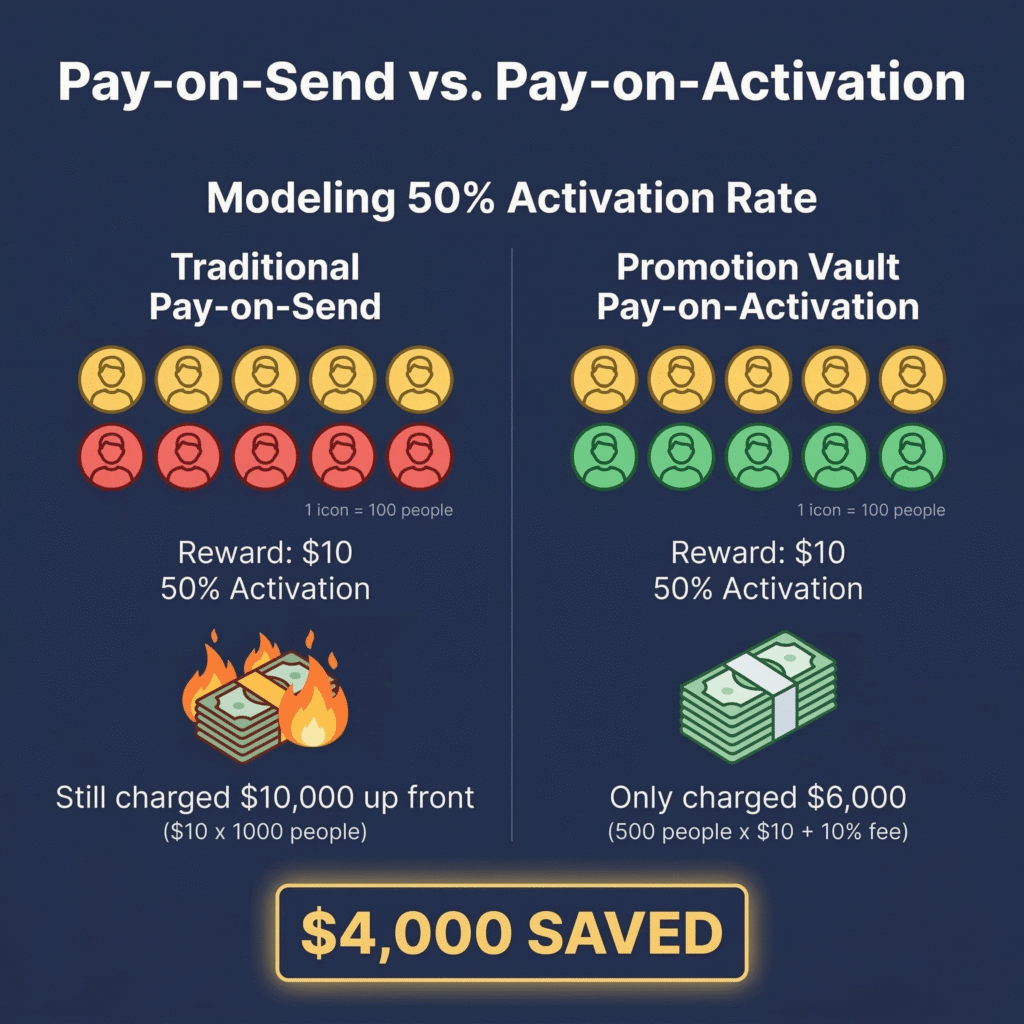
That is the Pi Day point. The math has to close.
A lot of incentive programs fail because they are explained with hope instead of arithmetic. This model is easier to defend because the arithmetic is visible. Your potential exposure is one number. Your service fee is one number. Your activation rate becomes the main control point. Then your real spend follows real engagement. That is why we see activation rate as the core metric for both forecasting spend and measuring engagement.
This example also shows why pay-on-activation is not just a pricing quirk. It changes what a team can do next. You can now reinvest breakage savings into the step you most want to move.
In plain English, if savings are created, do not just pocket them and call it done. Use them to make the reward stronger where conversion friction is highest. That could mean a better new-customer offer, a more compelling referral reward, or a stronger nudge for a reactivation campaign.
Good incentive math does not just reduce waste. It gives you room to improve the offer without losing control of the budget.
A $10 reward behaves differently than a $50 reward. A referral campaign behaves differently than a retention campaign. So the goal is not to wave around one average and pretend the job is done. The goal is to model intelligently, by segment, so finance can trust the assumptions.
If this section is approved, I’ll move to Section 4 — Why This Makes Incentive Programs More Defensible.
Why Pay-On-Activation Makes Incentive Programs More Defensible
A program becomes defensible when more than marketing can explain it. The operator has to see control. Finance has to see predictability. The builder has to see something they can actually run. Promotion Vault’s platform is built around measurable behavior, low-lift execution, and spend that stays accountable because cost tracks activation, not just sends.
For owners and operators, the case is simple. If they pay for it, it should move a measurable outcome. They do not want another tool that creates admin work or vague reporting. Pay-on-activation answers that concern because it lowers upfront risk and gives them a cleaner story about what the spend actually did.
Finance sees the same logic through a different lens. They are focused on predictability, waste prevention, and a spend narrative leadership can defend. Their problem is not that they dislike incentives. Their problem is paying full face value upfront with weak proof. Promotion Vault’s activation model changes that. The service fee is charged when the reward is sent. The reward value is charged only when the recipient activates. That means teams can forecast against activation rate, not just volume, and track actual engagement instead of assuming every send created equal cost.
McKinsey has argued that many companies still struggle to quantify marketing ROI clearly, which turns budget decisions into debates instead of decisions. That is why measurability matters so much here. A model that ties more cost to real action gives operators and finance more common ground.
Defensible programs do not just feel promising. They make approval easier.
There is also an operational reason this model holds up better, as well. That’s because Promotion Vault pairs pay-on-activation with a defined reminder cadence, segmentation, reporting, and a branded recipient experience. That matters because bad programs often die from process drag, not bad intent.
Teams need lifecycle automation, trust-first delivery, and completion without babysitting. Program operators should be able to set things once, run it repeatedly, and cut support tickets. That is what makes the system easier to keep live after the kickoff meeting ends.
So when we say pay-on-activation makes programs more defensible, we do not just mean that it’s cheaper. We mean that it is easier to approve, easier to explain, and easier to keep running. The economics help the case. The operating model closes it.
Why Timing Matters For Rewards More Than Teams Think
Timing is not a cosmetic choice. It is part of the offer.
90% of activations happen in the first 24 hours. If someone does not activate within that first day, they likely never will. That changes how we should think about incentive design. We should stop treating timing as a campaign detail and start treating it as a core performance lever.
This is one reason pay-on-activation matters so much. It does not just protect spend. It also reveals behavior. We can see when interest is real, when urgency is working, and when a reward arrived too late to catch the moment. Since most activations happen inside that first-day curve, messaging and reminders should be designed around it.
That internal pattern also matches broader behavior research. Cornell researchers found that immediate rewards can increase motivation and persistence more than delayed rewards, even when the delayed reward is larger. In plain English, speed is not just nice. Speed changes how people feel about taking the next step.
Promotion Vault’s operating model is built around that reality.
Our platform sends the initial activation message when the reward is sent, then follows with a defined reminder cadence on Days 1, 3, 6, 13, 21, 29, 40, 50, and 59 for rewards that still have not been activated. Those reminders are not endless. They stop once the reward is activated. They also sit behind fatigue guardrails, including a 24-hour rate limit and unsubscribe suppression.
That is not accidental. It is what follow-through looks like when a team wants completion without creating spam.
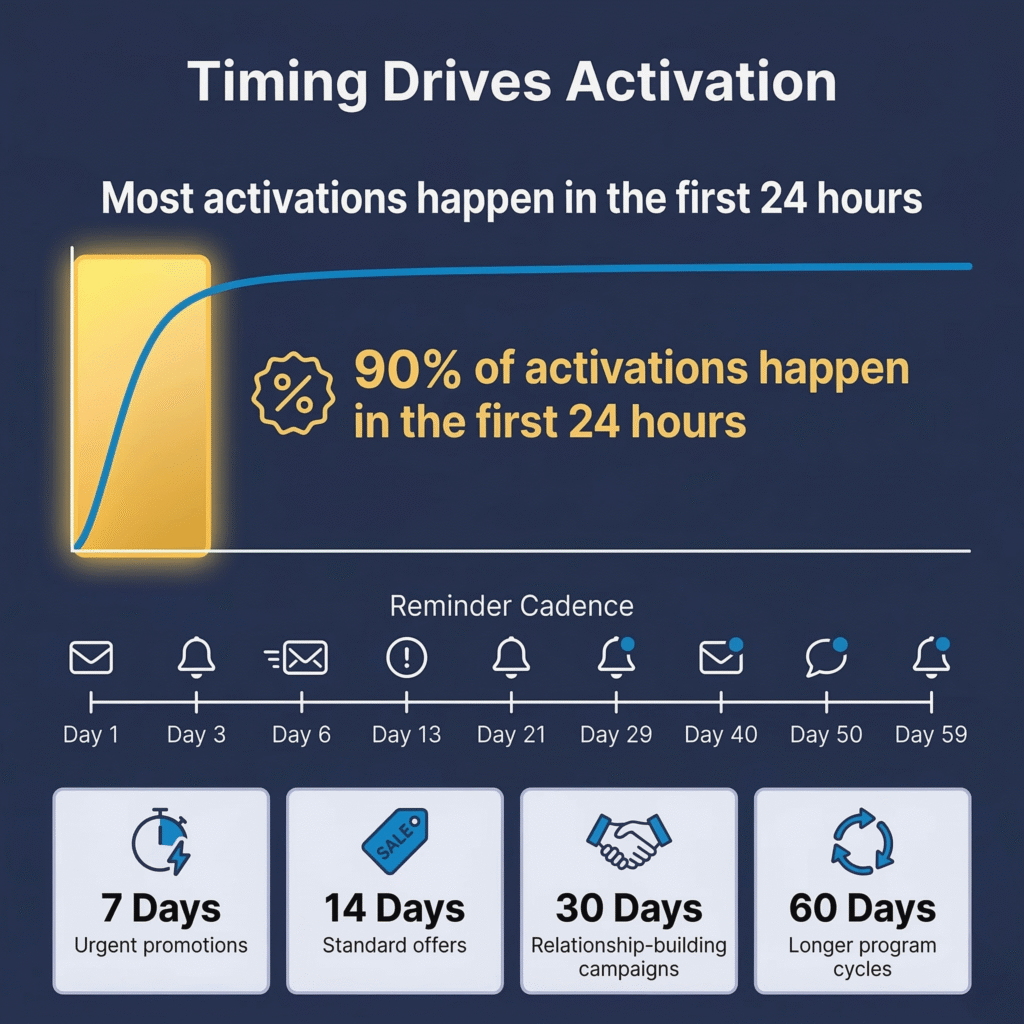
Just as important, Promotion Vault does not treat every program the same. Internal reward-experience guidance recommends different activation windows for different situations: seven days for time-sensitive promotions, 14 days for standard business offers, 30 days for relationship-building campaigns, and 60 days for longer engagement programs. That matters because urgency should fit the behavior. A comeback offer should not feel like an annual reminder. A high-intent lead should not wait through a sluggish sequence.
The lesson is simple: if you want the action now, the reward has to feel real now.
That is also where many teams underperform. They obsess over reward amount and ignore delivery speed, message clarity, and reminder structure. But clear messaging reduces breakage. Faster engagement lifts activation. Defined follow-up protects completion. Timing is not the wrapper around the incentive. Timing is part of the incentive itself.
Reward Breakage Savings Should Should Be Reinvested
Savings only matter if they get redeployed well. Breakage savings should be reinvested into higher reward values, or broader eligibility, to improve conversion on the behavior you actually want — whether it is acquisition, retention, referrals, reactivations, upsells, or upgrades. In other words, the goal is not to just save money. The goal is to save money and then spend it where the lift will matter most.
Reinvest in acquisition where friction is highest
This is usually the cleanest first move. If a team saves money through pay-on-activation, that money can fund a stronger reward at the exact step where intent stalls. Promotion Vault case studies show what that looks like in practice. ClassPass used a $35 reward at the trial-to-paid decision and saw a 62% activation rate to paid. Club Pilates paired rewards to three moments and saw +36% intro attendance, +43% new-member conversions, and +23% plan upgrades. That is the lesson: do not spread savings thinly across the whole funnel. Put it at the step where hesitation is most expensive.
Reinvest in referrals across the journey, not just the finish line
Referral programs often underperform because they reward only the final conversion. But it’s important to reward milestones throughout the journey. Orangetheory’s tiered structure did exactly that: $5 for adding a referral, $15 when the referral tried a workout, and $55 when the referral joined. The result was a 78% increase in referrals submitted, a 23% increase in intro sign-ups, and a 42% increase in new members from referrals. Promotion Vault makes this easy with built-in lead validation, status tracking, and conversion monitoring.
Reinvest in review generation carefully and credibly
Reviews deserve a place in this conversation because they shape trust and conversion. BrightLocal’s 2026 survey found that 97% of consumers read reviews for local businesses, 85% say positive reviews make them more likely to use a business, and 74% care only about reviews from the last three months.
That means fresh review volume can influence real buying behavior. But this is where teams need discipline. The FTC says businesses may offer incentives for reviews only if they are not conditioned on positive sentiment, and any incentive should be disclosed. In other words, paying for 5-star reviews is off-limits. So the smart move is simple: Ask broadly after a verified experience, keep the request neutral, and never tie the reward to praise.
Promotion Vault can support that discipline without turning the process into guesswork. Our platform is built around verified actions, branded delivery, and reward-linked feedback moments. Promotion Vault is designed to capture feedback at high-reciprocity points, with and average response rate of 97% when rewards are paired with mini-surveys. That gives teams a better read on experience quality, pain points, and timing — while public review asks can stay neutral, compliant, and tied to real customer moments.
More than waste reduction
This is the larger point. Pay-on-activation does not just reduce waste. It gives teams a smarter budget to place. When that budget is aimed at the right step, stronger incentives stop looking like indulgence and start looking like strategy.
Why Rewards Are Stronger Than Discounting
Even if rewards work, some may ask how it stacks up against discounting. After all, if the goal is conversion, why not just cut price?
Because discounts solve the moment by weakening the model. They reduce margin on every qualifying sale, including sales that may have happened anyway. Meanwhile, pay-on-activation rewards incur cost only when the target behavior is completed and the reward is claimed.
That difference matters more for premium brands, recurring revenue businesses, and any company that wants pricing power later. Repeated discounts can train customers to expect lower prices, while one-time, action-contingent rewards help teams move behavior without racing to the bottom on price.
External research backs that up. A Journal of the Academy of Marketing Science study found that frequent price promotions are associated with lower brand equity. Separate research in the Journal of Retailing and Consumer Services found that non-monetary promotions generate more relational benefits than price-based promotions. That is the strategic distinction we care about here. Discounts can move a transaction. Non-price rewards can move a transaction while also supporting the relationship.
Promotion Vault is designed to turn rewards into branded relationship moments, not bare transactions. Recipients move through a branded vault, see sender identity clearly, and choose how to redeem. The effect is that recipients feel they are receiving a gift, not claiming a discount. That is not a cosmetic detail. It changes how value is perceived.
Discounts teach the market to wait. Rewards teach people to act.
That is why rewards are often stronger than discounting when used correctly. They preserve the core price. They stay tied to a specific behavior. They can be time-boxed. And, in Promotion Vault’s model, they only create full reward cost when the recipient activates. That makes them easier to justify than broad discounting, especially when finance is already worried about margin erosion.
Trust Matters More Than Operators Think In Reward Programs
Trust is not a soft variable here. It is a conversion variable.
Reward scams are common and recipients are trained to distrust random reward messages. That means a reward can fail before anyone weighs its value. If the message feels shady, the incentive never gets a fair shot. This is why Promotion Vault frames trust as a product requirement, not a branding accessory. Our platform is built around a legitimate, branded reward journey that feels like recognition, not spam.
That concern is not theoretical. The FTC warns that gift card scams often begin with calls, texts, emails, or social posts, and that scammers use urgency, tell people which gift card to buy, and ask for the card number and PIN. The agency is blunt about the pattern: no real business or government agency will tell someone to buy a gift card to pay them. That public context matters because it explains recipient behavior. People are not being difficult when they hesitate. They are responding to a real risk environment.
This is exactly why Promotion Vault’s trust-first design matters. The branded vault journey and passwordless login exist to reduce spam suspicion and improve legitimacy. Recipients see branded notifications, sender identity, a secure call-to-action, and clear reward information at the first touchpoint. Then, during activation, they see sender confirmation again, plus a streamlined setup that emphasizes security and legitimacy. The goal is to reassure recipients they are engaging with a professional system, not responding to promotional spam.
If the reward feels suspicious, the incentive loses before the math even starts.
There is also a brand lesson here. The reward fulfillment process is a relationship-building journey between businesses and their reward recipients. Generic reward emails can look disposable. A branded experience with clear sender identity, consistent colors, professional copy, and a stable vault feels intentional. It tells the recipient, “This came from a real business, for a real reason.” That emotional shift matters because confidence is often the last inch between opening a message and acting on it.
We think too many teams treat trust like a compliance box. It is not. It is performance infrastructure. If recipients trust the message, activation improves. If they trust the sender, the reward feels like recognition instead of bait. And if the whole experience feels legitimate, the brand gets stronger while the program performs.
A Simple Reward Program Framework You Can Use This Week
If this all sounds good in theory, here is the practical version.
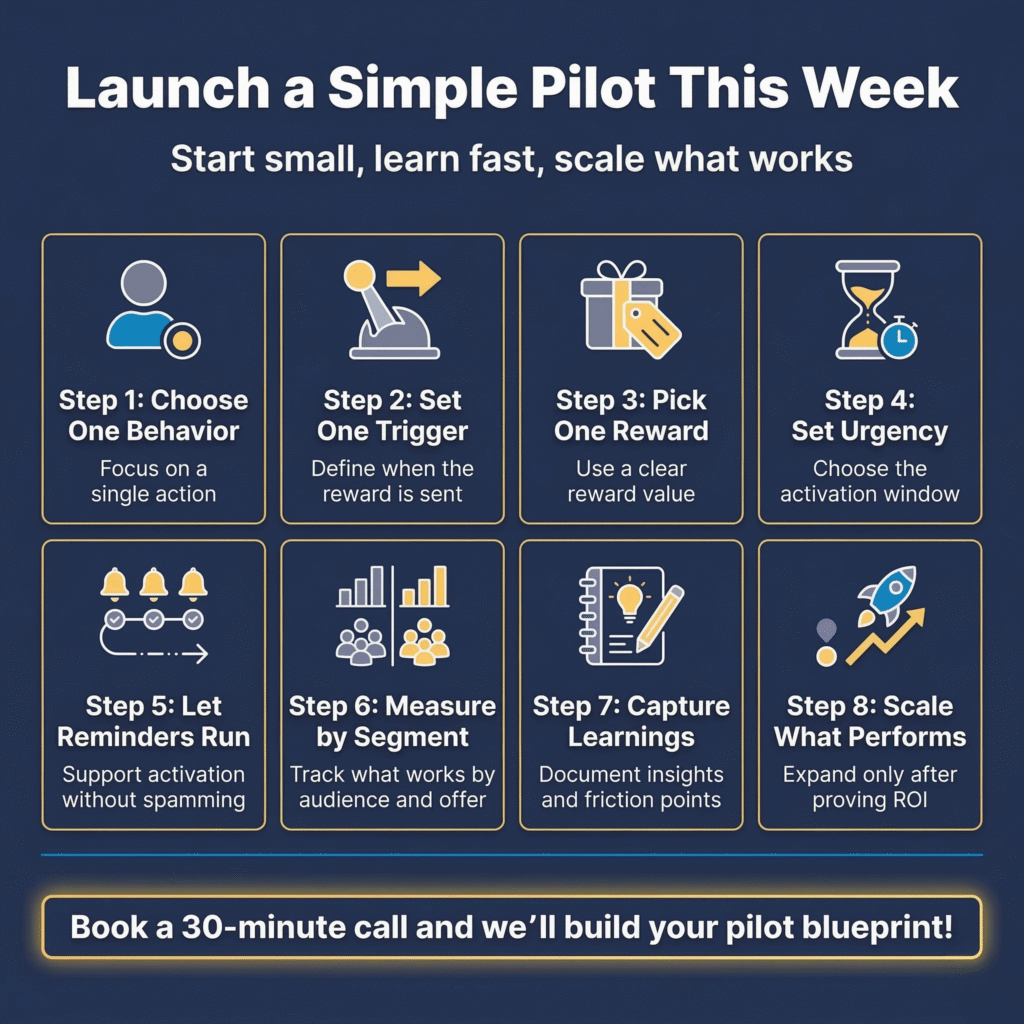
We do not need a giant rollout to test incentive math. We need one behavior, one moment, one reward, and one way to measure whether the program changed anything. Define the action, trigger the reward, let activation and reminders do their work, then measure eligible versus activated and optimize by segment.
Be sure not to report one blended average across everything. Reward value and campaign type change the economics.
Here is the framework we would use this week.
- Pick one behavior. Choose the action that matters most right now. Join. Renew. Refer. Rebook. Upgrade. Come back.
- Pick one trigger. Use a repeatable trigger if you can. Promotion, Quick Send, reward link, integration, or API. Quick Send works for immediate manual action. Promotions work for structured, repeatable programs.
- Pick one starting reward value. Start with a number that feels real to the recipient and survivable to the budget. If conversion is the priority, use breakage savings to strengthen the reward at the step you most want to move.
- Pick the right urgency. Set the activation window to fit the job. Seven days for time-sensitive promotions. Fourteen for standard urgency. Thirty for relationship-building campaigns. Sixty for long programs with more steps.
- Let the follow-up run. Do not rely on one message. Promotion Vault’s reminder cadence is already built around observed behavior, and it stops once someone activates.
- Measure by segment. Track eligible, activated, activation rate, and real spend by reward value and campaign type. Overall averages hide the real story.
- Add one learning loop. Attach one short survey or feedback prompt at activation or unlock. Data Vault exists for exactly this reason. It turns reward moments into signal, not just spend.
- Test before scaling. We recommend holdouts, A/B tests, and cohort tracking when someone asks whether incrementality can be proven. Google’s guidance on incrementality testing makes the same larger point: good tests help teams quantify revenue a campaign truly created, instead of guessing from topline movement alone.
Keep the first version small. One audience. One offer. One action. One reporting window. That is enough to learn whether the reward moved behavior, whether the value was strong enough, and whether the spend still held up under scrutiny. We support this low-lift approach throughout — from no-code setup and automations, to campaign-level reporting, to segmented optimization by value and use case.
Do not start by asking, “How big can this program be?” Start by asking, “What is the next behavior worth moving?”
That question keeps the work honest. It keeps the spend tied to an outcome. And it gives operators, growth leads, and finance approvers the same thing at once: a program they can test quickly, learn from clearly, and defend without hand-waving.
Your Micro-Plan For Increasing Desired Actions Using Rewards
Here is the simplest way to act on this without turning it into a quarter-long strategy project.
- If acquisition is the problem — put the reward at the step where intent is highest and hesitation is most expensive. Do not spread the budget across the whole funnel. Strengthen the moment that decides whether someone joins. Promotion Vault’s case studies show that behavior-tied rewards can lift intro attendance, new-member conversion, and trial-to-paid activation when the offer is placed at the right decision point.
- If referrals are the problem — reward the journey, not just the final conversion. Give people a reason to take the first step, the second step, and the last step. Our Orangetheory case study shows why this matters: staged rewards helped increase referrals submitted, intro sign-ups, and new members from referrals.
- If reviews are the problem — ask right after a verified experience, keep the ask neutral, and never tie the reward to positive sentiment. Use the reward to increase participation, not to buy praise. That keeps the program more trustworthy and easier to defend.
- If reactivation is the problem — use a time-boxed reward with clear urgency and a defined reminder sequence. Do not rely on one email and hope. Most activations happen early, which means timing and follow-up are part of performance, not afterthoughts.
- If finance is pushing back — model the program on activation, not sends. Show potential reward exposure, service fee, expected activation rate, and real projected spend. That is the difference between a nice idea and a defensible plan.
Pi Day reminds us of the value of good math. Numbers tell the truth fast. If the incentive math is weak, the program will eventually get exposed. If the incentive math is strong, the program gets easier to approve, easier to scale, and easier to trust.
Which leads us to iterate our main point:
If we want rewards to drive real behavior, then we should only pay full reward cost when real behavior happens.
That is the case for Promotion Vault’s pay-on-activation payment model. It protects margin, reduces waste, and gives us more room to fund the exact actions that move acquisition, referrals, reviews, reactivation, and retention.
Let Promotion Vault Build a Quick Rewards Test Pilot to Prove ROI
If you are looking at one growth bottleneck right now — one stalled conversion step, one weak referral loop, one review gap, or one reactivation problem — book a demo with Promotion Vault. We can help map one behavior, one reward value, and one pay-on-activation model that is simple to test and easy to defend.
Frequently Asked Questions About Instant Rewards and Reward Programs
What is pay-on-activation for rewards, in simple terms?
It means the service fee is paid when the campaign is sent, but the reward value is only paid when a recipient actually activates, so unactivated rewards become savings instead of waste.
Why is this reward fulfillment model better than pay-on-send?
Because traditional pay-on-send makes every reward a cost upfront, while pay-on-activation ties more of the cost to real behavior, which lowers risk, improves measurability, and makes programs easier to defend internally.
What metric matters most in a pay-on-activation rewards model?
Activation rate is presented as the core control metric because it drives both projected spend and actual engagement.
What is a good finance example of pay-on-activation rewards?
A $10 reward is sent to 1,000 people: under pay-on-activation, with a 50% activation rate, total cost is $6,000 (including the 10% service fee) instead of $10,000 with a traditional pay-on-send rewards fulfillment model.
What should teams do with breakage savings?
Savings should be reinvested into the behaviors that matter most, like acquisition, referrals, reactivation, retention, upgrades, or upsells.
Why does timing matter so much?
Because 90% of activations happen in the first 24 hours, so delivery speed, message clarity, and reminder timing directly affect performance.
What reminder cadence should you use for rewards?
Promotion Vault’s model sends an initial message, then reminders on Days 1, 3, 6, 13, 21, 29, 40, 50, and 59, stopping once someone activates.
How should teams set activation windows for rewards?
Promotion Vault recommends matching urgency to the use case: 7 days for time-sensitive promotions, 14 for standard offers, 30 for relationship-building campaigns, and 60 for longer programs.
Why are rewards stronger than discounts?
Because discounts reduce margin on every qualifying sale, while action-based (pay-on-activation) rewards preserve core price and only create full reward cost when the target behavior is completed and claimed.
What makes a reward program more trustworthy?
Branded, legitimate delivery matters because recipients are trained to distrust suspicious reward messages, so trust is a key conversion variable, not just a compliance issue.
How should teams handle incentivized review campaigns?
Promotion Vault suggests asking after a verified experience, keeping the request neutral, and never tying the reward to positive sentiment. The goal is participation, not bought praise.
What is a good way to start a rewards program test pilot?
Start small with one behavior, one trigger, one reward, and one reporting window, then measure by segment and test before scaling. Want an expert to do this legwork for you? Just book a 30-minute call with Promotion Vault!