The best rewards and incentives software for customer acquisition depends on the job you need done. If you only need one-time payout delivery, one tool may fit — but if you need measurable lift, automated follow-up, trusted delivery, and spend protection, you need a lifecycle reward platform.

TLDR — How to Choose Rewards Software That Drives Results
- Pick the platform based on the behavior you need to move, not a simple label or product description.
- Don’t just buy a reward catalog, buy a system for behavior change that can prove spend was worth it.
- A payout tool is fine for one-time use, but it can’t provide ROI proof, automated follow-up, or insights.
- The right platform should do more: it should trigger, measure, and optimize performance.
- Judge rewards software by what happens after the send: trust, engagement, activation, and follow-ups.
- A branded, legitimate reward experience matters to avoid losing trust before the incentive can work.
- Pay-on-activation economics beat pay-on-send because they protect budget from wasted spend.
- The best reward programs target high-friction moments: converting, showing up, referring, upgrading.
- Want to drive actions with measurement + zero waste? Book a demo with Promotion Vault.
- Why do growth teams end up shopping for rewards software in the first place?
- What are we really buying when we buy rewards software?
- Are all rewards platforms basically the same?
- When is a payout tool enough — and when does it become expensive in the wrong way?
- Why do loyalty platforms often underperform in acquisition campaigns?
- What should we be able to measure before we approve rewards spend or purchase rewards software?
- How should we evaluate pricing, activation, and unclaimed rewards?
- What reward recipient experience details actually change conversion?
- Do automated follow-ups actually matter — or are they just spamming?
- What acquisition use cases tend to show the clearest lift?
- Why is a reward often stronger than a discount?
- What operational red flags show we’ve outgrown manual rewards?
- So what’s the best rewards and incentives software for customer acquisition?
- Frequently asked questions about rewards fulfillment, software, and platforms
- Who provides the best rewards fulfillment platform for customer acquisition?
Why do growth teams end up shopping for rewards software in the first place?
Most business owners, operators, and teams focused on growth do not wake up wanting rewards software. We wake up wanting more people to show up, convert, refer, renew, upgrade, and come back. The software question only shows up after the real problem shows up — the funnel is leaking, manual follow-up is breaking down, discounts are eroding the offer, or finance is asking a fair question: “What, exactly, are we paying for?”
This is where a lot of us get trapped. We compare a spreadsheet of reward links, a loyalty app, a referral tool, and a lifecycle rewards platform as if they all do the same job. They do not. As Brian Mitchell, CEO of Promotion Vault, puts it, many business owners, operators, and teams start by picturing either a big platform in the recipient’s hands or a pile of one-off links “as if you were at the grocery store” buying gift cards off an end cap. That framing sounds simple. It is also where expensive confusion starts.
And we are making this decision in a harder trust environment than they were a few years ago. The Federal Trade Commission still warns that gift card scams often start with calls, texts, emails, or social posts, and repeats a blunt point: gift cards are for gifts, not payments. That matters here because the moment a reward message looks generic, off-brand, or sketchy, conversion suffers before the incentive ever has a chance to work.
In short, we should not be buying a catalog. We should be buying a system for behavior change.
What are we really buying when we buy rewards software?
We are buying a way to move a specific action and prove it was worth the spend. The right platform should trigger the reward at the right moment, make the experience feel legitimate, measure engagement, and protect budget from waste. If it only sends value, it is fulfillment — not a growth system.
That distinction matters because a reward is not just an object. It is a moment. Used well, it turns hesitation into motion. It gets the trial user to show up. It gets the prospect to convert. It gets the happy customer to refer. It gets the at-risk customer to re-engage before they disappear. It is a rewards-as-a-lifecycle engine, not generic payout infrastructure, because a business operator or growth team’s real job is not to send money. It is to drive measurable behavior with as little drag as possible.
Mitchell comes back to one word throughout the interview: engagement. That is the dividing line. A basic send tool can push out a link. A stronger platform can create a branded reward experience, let the recipient choose what they actually value, gather first-party feedback, and keep the relationship alive after the first touch. In his words, the difference is between handing someone a one-off reward and creating “a real rewarding experience” with multiple touchpoints and actual conversation.
That is also why we should stop asking only, “How fast can this send rewards?” Speed matters. But speed alone is cheap. The better question is, “What happens after the send?” Do we know whether the reward was touched? Do we know how long it took? Do we know whether the recipient trusted it enough to act? Do we learn anything that helps us improve the next campaign? If the answer is no, then we did not buy insight, lift, or control. We bought delivery.
And for serious operators and growth leads, delivery is not enough. We need spend we can defend. We need a recipient experience that does not feel like spam. We need less admin, not more. We need a system that helps us reward the moment where people fall off, not just the moment after they already did what we wanted. That is the real purchase. Everything else is packaging.
Are all rewards platforms basically the same?
No. Most buyers are comparing different tool categories that solve different problems. Payout tools only offer quick delivery. Loyalty platforms build ongoing member economics. Referral tools manage referral mechanics. Lifecycle reward platforms are built to move a specific behavior, protect spend, automate follow-up, and measure what happened next.
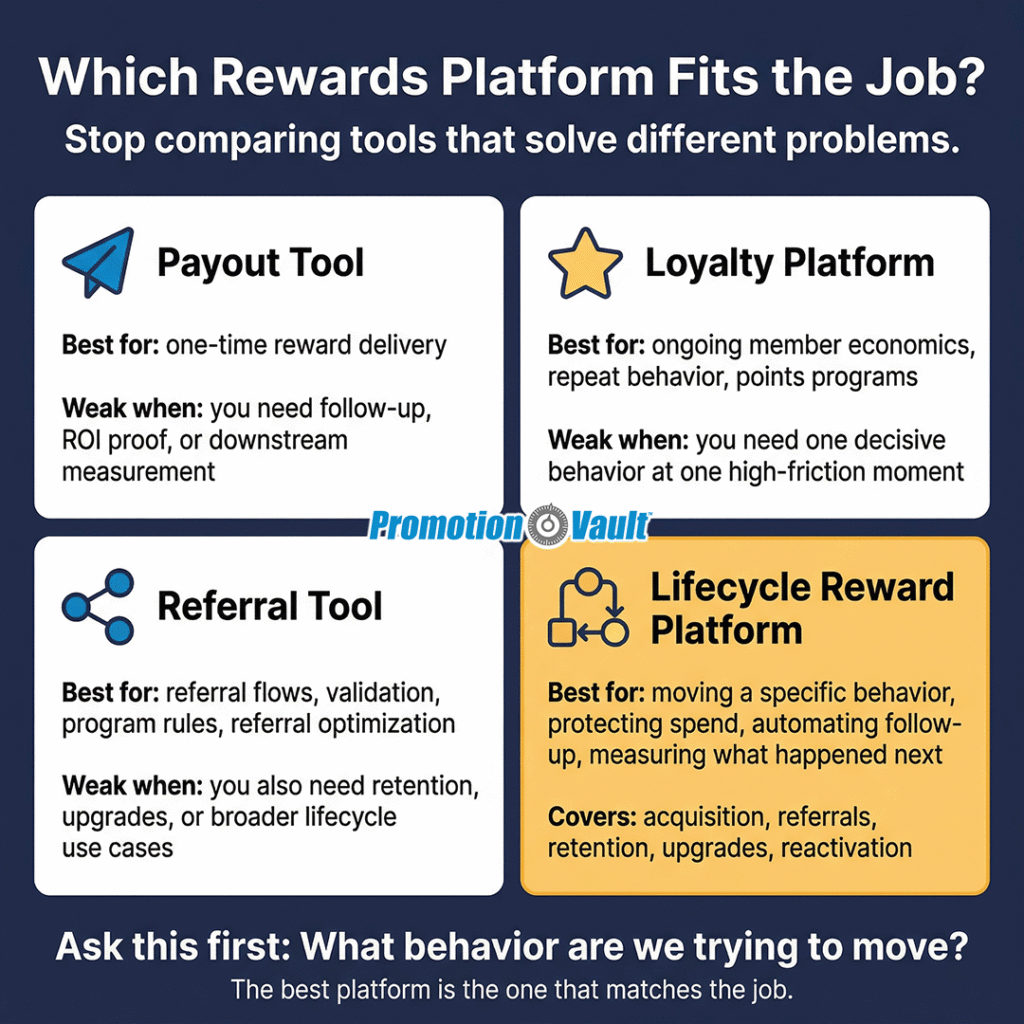
This is where a lot of evaluation goes sideways. We start with one vague bucket called “rewards software,” then we compare tools as if they are interchangeable. They are not.
Payout tools are only built for quick delivery. That can be enough when the relationship is basically over after the send. Promotion Vault CEO Brian Mitchell makes that point plainly: if this is a one-time customer, and we do not need ongoing engagement, a reward link may be perfectly fine. But that same model starts to break the moment we care about ROI, feedback, follow-up, timing, downstream conversion, or whether the reward was ever meaningfully engaged at all. In that scenario, “sent” is not the same as “worked.”
Loyalty platforms solve a different problem. They are usually built for ongoing customer economics — points, repeat behavior, program membership, and retention over time. That can be useful. But the points-based systems of many loyalty programs are largely abstract and meaningless for driving specific behaviors. And they aren’t built for acquisition campaigns at all.
Referral tools are another distinct category. They are strongest when referral orchestration is the actual job — referral flows, validation, testing, program rules, and deeper referral optimization. But they break down for other acquisition initiatives — and they don’t handle retention at all. And while points toward free products of your own brand can be a nice perk to someone who enjoys your brand, it carries some of the same risks as using discounts. Additionally, it gives your loyal customer less autonomy in dictating what their reward is.
Then there is the category Promotion Vault lands in: the rewards-as-a-lifecycle engine. That category incorporates everything above. The point is not merely to send money, and it is not to run another generic points program. The point is to define a behavior, trigger a reward at the right moment, keep the experience branded and legitimate, automate the follow-up, and measure activation and downstream outcomes. It covers acquisition, referrals, retention, loyalty, and everything in between.
The real question is not “Which rewards platform is best?” It is “Which type of platform matches the behavior we need to move?”
That one question cleans up most bad evaluations. If we need to move one specific customer action now — and we want the reward to feel trusted, measurable, and low-drag — we should consider a platform that can touch the entire customer lifecycle and create a feedback loop of ongoing learnings and insights.
When is a payout tool enough — and when does it become expensive in the wrong way?
A payout tool is enough when we only need to send value once and move on. It becomes expensive in the wrong way when we also need feedback, follow-up, trust, reporting, or ROI proof that the reward changed behavior. In acquisition, “sent” is not the same as “worked.”
This is the fairest place to start: payout tools are not bad tools. They are just narrower tools. Promotion Vault CEO Brian Mitchell says they are fine when the customer relationship is basically over after the action. Someone buys once. We are not trying to keep engaging them. We are not trying to drive the next step. We just want to deliver the reward and close the loop. In that case, a one-off link can be perfectly reasonable.
The trouble starts when we expect that same model to do acquisition work it was not built to do. Mitchell is blunt about where payout-only tools break down: we do not know whether there was feedback, whether there was an NPS response, how long it took the person to engage, whether they abandoned the reward, or whether they ever meaningfully interacted with it at all. There is no real follow-up. It is one and done. For a buyer trying to increase show rates, improve trial-to-paid conversion, or learn which incentive actually moved behavior, that is not a small gap. It is the whole job.
Then there is the budget problem. Mitchell describes the “bleed of spend” clearly: many providers charge the full face value plus a service fee upfront, hand over the links, and close the file. The buyer pays whether or not anyone touches the reward. Promotion Vault’s pay-on-activation model highlights a much better alternative: a 10% service fee when the reward is sent, then face value only when the recipient activates. In other words, we pay full value on engagement, not merely on issuance.
That is the real dividing line. If we truly do not care what happens after the send, payout infrastructure may be enough. But if we care whether the reward was trusted, opened, activated, measured, and tied to a next step, then cheap fulfillment gets expensive fast. It hides waste. It hides learning. And we bought only bought delivery instead of performance.
Why do loyalty platforms often underperform in acquisition campaigns?
Loyalty platforms often underperform in acquisition because they are usually built for ongoing member economics, not for one decisive behavior at one high-friction moment. They can also create friction when the reward is too narrow in its appeal — while carrying some of the same risks as discounts.
To be clear, loyalty platforms are not necessarily the problem. Misuse is the problem. If we are trying to deepen repeat engagement over time, track ongoing participation, or run a long-term member program, loyalty software can make a lot of sense.
But acquisition requires a different set of tools. We are not trying to manage a long arc of behavior yet. We are trying to get someone over a hump — book the visit, start the trial, complete the first purchase, refer the friend, upgrade now instead of later. That is a very different job.
There is another problem, as well: app friction. Promotion Vault CEO Brian Mitchell is blunt that, often, people do not want to download and maintain another app just to track their loyalty and claim a free reward. This is especially true in acquisition. Every extra step is a tax on conversion. If the reward experience asks too much too early, we are no longer using the incentive to reduce friction. We are adding friction right where it hurts most.
Then there is the issue of narrow reward logic. Mitchell uses Starbucks as an example: A company uses a Starbucks reward as its acquisition trigger, then wonders why the lift was weaker than expected. The problem was not that the reward had no value. The problem was that it had uneven value. Some people do not drink coffee. Some do not want that brand. A reward that is perfect for one slice of the audience can be flat for everyone else. That is a bad trade when we are paying to move behavior at scale. Acquisition rewards need broader emotional range than that. They need to land with more people, more often.
That is why gift of choice matters so much here. Not because it sounds nice, but because it increases the odds that the reward feels personally valuable instead of generically promotional. In Mitchell’s words, different retailers “solicit emotional response” from different people. Acquisition is not just math. It is math plus motivation. If we make the reward more personally resonant, we make the action easier to justify in the moment.
This even holds true when talking about loyalty (i.e. retention) instead of acquisition. A points based system that gives people free products from your brand looks nice on paper, but it still inhibits the autonomy of your loyal customers. When you couple this with the need to have a special app in order to track their loyalty (and the fact that every brand they engage with is doing the same), it can quickly lead to disengagement.
Additionally, giving free products can unintentionally devalue your brand and prime people not to buy things until they can get it at a discount or for free through their loyalty points. (An issue we will get to later in this article.)
In short, traditional loyalty programs and platforms are weaker when business operators and growth teams need a trusted, low-friction, broadly appealing incentive that can move specific actions — without forcing the prospect to buy into an additional app ecosystem.
What should we be able to measure before we approve rewards spend or purchase rewards software?
We should be able to measure the behavior we want, the reward engagement that proves interest, and the business result that proves lift. At minimum, that means tracking eligible recipients, activated rewards, activation rate, cost per activated user, and the downstream conversion or retention event we actually care about.
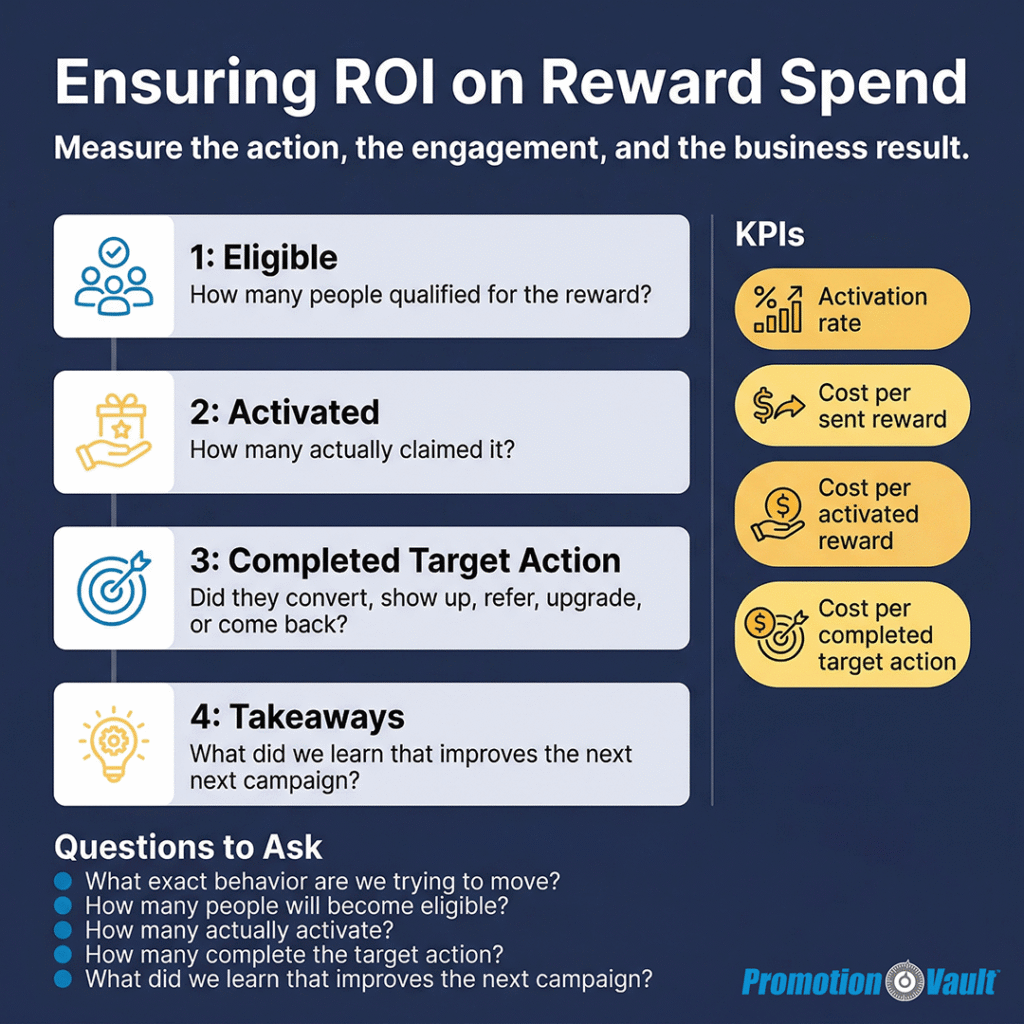
This is where a lot of teams get sloppy. We approve the spend because the reward sounds compelling, the vendor demo looks clean, or the campaign feels intuitive. Then we judge success by sends, clicks, or vague “engagement.” That is not good enough. If we are using rewards to drive acquisition, we need to know whether the reward changed the behavior we paid to change.
The cleanest place to start understanding the impact of rewards is with three layers of measurement:
First, measure reach into the target behavior. How many people became eligible? That tells us the true campaign denominator. Promotion Vault’s activation model is useful here because it separates “eligible” from “activated,” instead of pretending a send equals a result. Activation rate is the number of activated rewards divided by the total number of eligible rewards. That is simple, but it matters, because it forces us to distinguish between exposure and action.
Second, measure reward engagement itself. Did people activate? How fast? Did they activate inside the window? 90% of activations happen within the first 24 hours. That is an operating reality. It tells us timing, message quality, and reward clarity matter most right away. If activation is weak on day one, we probably do not have a minor optimization problem. We probably have an offer, trust, or audience-fit problem.
Third, measure the business event after activation. This is the part buyers skip when they are in a hurry. The reward is not the outcome. The outcome is the thing we wanted the reward to unlock: trial-to-paid conversion, first purchase, show rate, referral completion, upgrade, early usage, or reactivation. A good rewards platform should be explicitly framed around acquisition, retention, referrals, upgrades, and reactivation, because those are the behaviors operators actually get revenue lift from.
From there, we can ask better finance questions. What was the cost per activated reward? What was the cost per completed target action? Did the reward improve the rate enough to justify the spend? If we cannot answer those questions, we do not have a performance program yet. We have a distribution expense.
There is one more layer smart teams should add: learning from the reward moment. Rewards should be a feedback loop, not just a send mechanism. That matters because reward moments are high-reciprocity moments. Just after claiming a reward, people are much more willing to answer a question, rate an experience, or tell us what nearly stopped them. That kind of first-party signal can make the next campaign sharper than the last one.
So before we approve spend or purchase rewards software, we should ask five plain questions:
- What exact behavior are we trying to move?
- How many people will become eligible?
- How many actually activate?
- How many then complete the target action?
- What did we learn that improves the next campaign?
And then, on top of that, we should ask: “Can the rewards platform I’m looking at track all of this?” If a vendor cannot help us answer those five questions, we should be careful. A reward can feel exciting and still be operationally blind. And blind spend gets cut first.
How should we evaluate pricing, activation, and unclaimed rewards?
We should ask when the vendor charges, what event triggers full cost, and what happens to rewards that never get used. Good pricing aligns spend with real engagement. Weak pricing makes “send” look like success, even when the reward never changes behavior.
A lot of reward software looks inexpensive in the demo because the real cost is hidden in the wrong place. The interface is clean. The catalog is broad. The send flow is fast. But the real question is not whether we can launch a reward. The real question is whether we are paying for activity that matters or simply paying for the right to hope.
The difference can be summed up with two terms: pay-on-send and pay-on-activation. Traditional rewards software and rewards platform providers use a pay-on-send model — where we are charged up-front the face value of every reward we send, plus a service fee, regardless of whether the reward gets activated and used by the reward recipient.
In Promotion Vault’s pay-on-activation model, the service fee is charged when a reward is sent, and the reward fee — the actual face value — is charged only when the recipient activates. That means eligibility and activation are separate financial events. If the recipient never activates, the buyer never pays the full reward value. This creates savings from breakage — turning unclaimed rewards from hidden waste into visible budget protection.
That is not just accounting language. It changes how we plan campaigns.
If we pay full value upfront for every reward sent, then unclaimed rewards are dead money. We can call that “distribution.” We can call it “payout.” We can call it “simple.” But if half the audience never touches the reward, then we funded a lot of intention and got very little action back. Promotion Vault CEO Brian Mitchell says this plainly: many providers fund the one-off link upfront, send it, and then the buyer has no idea what really happened next.
A better model forces us to think in stages:
- How many people became eligible?
- How many activated?
- How much full reward value was actually incurred?
- What savings were created by non-activations?
- Did we reinvest those savings into stronger offers or broader reach?
That last question matters more than most teams realize. Promotion Vault’s pay-on-activation model isn’t just about saving money. It is about reinvesting that saved money into higher-value rewards or wider eligibility to drive more of the behavior we want. That is a much smarter conversation than simply celebrating breakage for its own sake. The goal is not to under-reward people. The goal is to stop wasting budget on people who never engage, then use the saved budget where it can actually produce lift.
Then there is the activation piece itself. Activation is not a technical nuisance. It is the mechanism that separates intent from indifference. For Promotion Vault, activation is the recipient action required to claim the reward within a set window — usually 7, 14, 30, or 60 days. That gives the buyer a measurable engagement checkpoint, not just a delivery receipt. It also creates room for reminder logic, timing strategy, and better forecasting.
If we remove that activation layer and just assume a reward send is equal to a reward activation, we lose a strong layer of intent signaling, budget control, and engagement measurement.
So before we approve a vendor, we should ask these questions directly:
- When do you charge the service fee?
- When do you charge the reward value?
- What happens financially if a reward is never activated?
- Can we see eligible, activated, and completed as separate numbers?
- Can we set activation windows and timing rules by campaign?
- Can we reinvest unclaimed-value savings into stronger offers?
- What fees exist beyond the core reward model?
These are the questions all prudent business operators and growth teams need to ask any rewards software or rewards platform provider. A rewards program that cannot survive them is probably not built for efficacy and efficiency.
What reward recipient experience details actually change conversion?
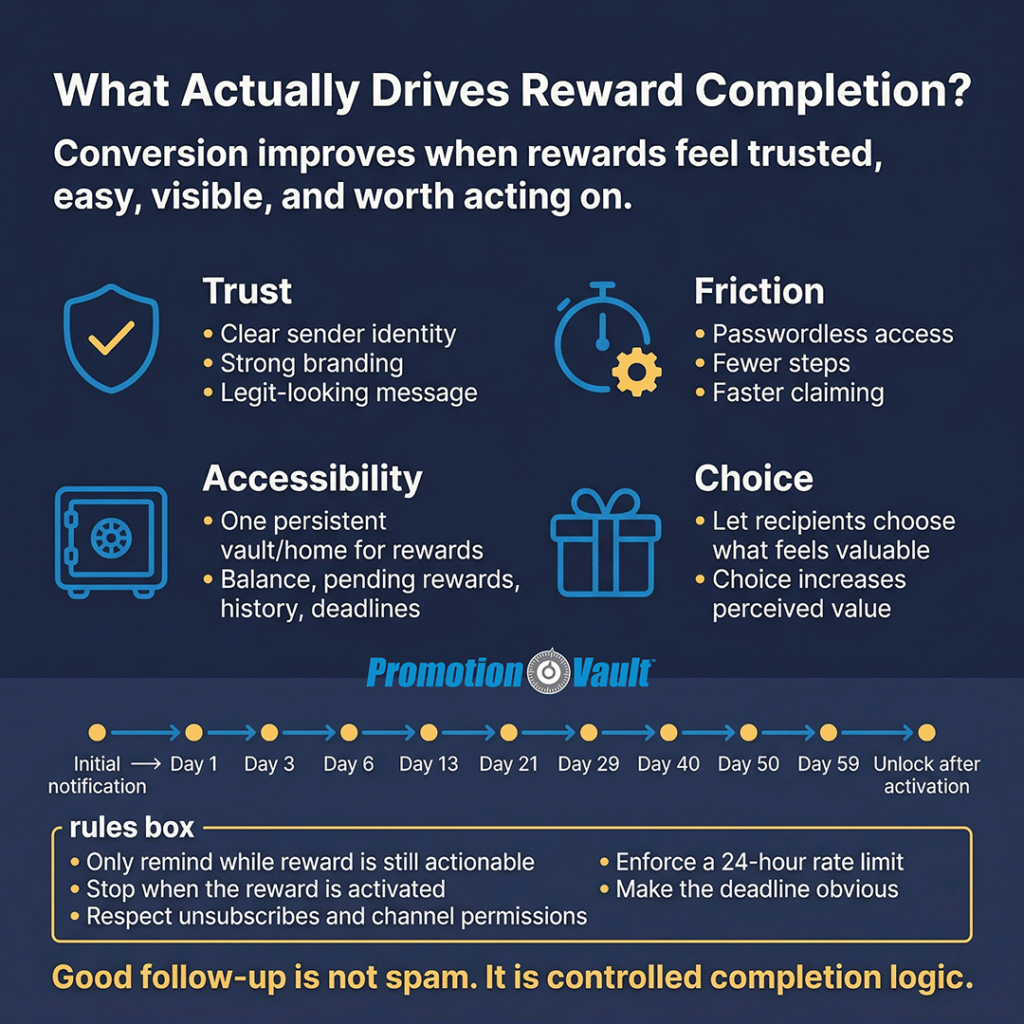
The details that change conversion are the ones that reduce suspicion, reduce effort, and increase perceived value. In practice, that means trusted sender identity, clear branding, easy access, low-friction authentication, and real reward choice. If the reward feels fake, confusing, or too narrow, people do not act — even when the dollar amount is fine.
The first variable is trust. The first touchpoint matters. A rewards recipient should see a sender’s logo, colors, reward amount, and a secure call to action right away. It should also see that the reward is being provided by a secure, trusted rewards fulfillment provider. This is the moment where the recipient decides whether this is legitimate or whether it belongs in spam. In the current scam environment, that split-second judgment matters even more. The FTC says gift card scams often begin with a call, text, email, or social post, and it stresses that gift cards are for gifts, not payments. That means any reward experience that feels generic, pushy, insecure, or off-brand is fighting uphill from the start.
The second variable is friction. Promotion Vault uses passwordless magic-link email login and SMS-code access for recipients, which removes the usual “create an account, remember a password, come back later” drag from the claiming process. Even Microsoft’s security guidance makes the same broader point from another angle: passwordless methods are both more convenient and more resistant to phishing than traditional password-based flows. In other words, less friction and better security do not have to fight each other.
The third variable is persistence. One-off links are easy to send, but they also disappear from the recipient’s mental world the moment the email gets buried. Promotion Vault’s “vault” model is stronger because it gives the recipient a single place to view balance, pending rewards, reward history, and expiration timelines. That changes the psychology of the experience. Instead of feeling like a random payout, the reward feels like something real that belongs to the recipient and can be revisited. That matters because persistence creates recall, and recall improves completion.
The fourth variable is choice. Letting recipients choose where to redeem increases perceived value beyond the raw amount, because people feel like they are receiving something meaningful rather than being pushed into a single predefined option. Promotion Vault CEO Brian Mitchell emphasizes this: different brands trigger different emotional responses, so a single-brand reward can underperform simply because it is not relevant enough across the audience. That is why recipient choice is not a nice extra. It is a conversion lever.
If the reward does not feel trusted, easy, and personally useful, the problem is not the recipient. The problem is the experience. This is the standard prospective buyers of a reward fulfillment provider should ask.
When we evaluate rewards software and platforms, we should not stop at “Can it send?” We should ask:
- Will the message look legitimate on first glance?
- Can the recipient access it without jumping through hoops?
- Does the experience keep the reward visible after the first touch?
- Can the recipient choose something they actually value?
If the answer to those questions is yes, conversion usually gets a fair shot. If the answer is no, even a generous reward can die in the inbox.
Do automated follow-ups actually matter — or are they just spamming?
Automated follow-ups matter when they are tied to real activation windows, stop when the reward is claimed, and respect recipient fatigue. They become spammy when they are generic, untimed, or disconnected from behavior. The goal is not to keep reminding reward recipients of their unclaimed reward. The goal is to rescue legitimate intent before it disappears.
This is one of the easiest places for buyers of reward fulfillment providers to fool themselves.
A lot of teams assume the reward itself does the work. They send one message, maybe two, and then treat the rest as diminishing returns. But that is not how real inbox behavior works. People miss things. They get distracted. They open on the go and forget to come back. They mean to claim the reward and lose the thread. That does not mean the offer failed. It means the system stopped too early.
Promotion Vault CEO Brian Mitchell makes that point clearly when he contrasts one-off sends with a true engagement model. A payout-only tool usually delivers the link, the recipient clicks or does not click, and that is the end of the story. A stronger lifecycle model keeps the brand in front of the recipient across multiple touches and gives the operator more than one chance to convert intent into action.
Promotion Vault’s reminder cadence is useful here because it shows what structured follow-up actually looks like. The platform sends reminders on Day 1, 3, 6, 13, 21, 29, 40, 50, and 59 after the initial activation message — but only for rewards that are still waiting for activation, only if the activation window still allows it, and only if the user has not unsubscribed. It also enforces a 24-hour rate limit so no one gets hammered with duplicate messages. That is not spam. That is controlled completion logic.
Good follow-up is not about volume, but about sensible actions:
- It should only run when the reward is still actionable.
- It should stop the moment the recipient completes the needed step.
- It should respect unsubscribe status and channel permissions.
- It should make the deadline and next action obvious.
- It should reinforce legitimacy, not just repeat the same push.
Promotion Vault does not treat its reminder flow is not treated as an afterthought. It is part of the recipient journey: initial notification, activation reminders, then unlock notification once the reward is activated. In other words, follow-up is built into the lifecycle, not bolted on as a last-minute resend.
This is where many other reward fulfillment tools underperform. They may be good at issuing rewards, but they are weak at completion. They can get the value out the door, but they leave the operator to manage the human reality that follows: missed emails, delayed action, uncertainty, and forgotten offers. Buyers should notice that gap. A platform that improves completion without manual babysitting is doing real work. A platform that only ships the first message is handing more of the job back to us.
And completion matters because unactivated rewards distort the whole program. They blur whether the problem was the audience, the incentive, the message, the sender identity, or simple timing. Strong follow-up helps isolate those variables. If the reward still does not activate after a well-run cadence, then we can evaluate the offer itself with more confidence. Without that cadence, we are guessing.
So yes — automated follow-ups matter. They matter a lot. But only when they are behavior-aware, deadline-aware, and fatigue-aware. Otherwise, they are just another drip campaign.
What acquisition use cases tend to show the clearest lift?
Rewards tend to show the clearest lift when they are placed at moments of hesitation, not sprayed across the whole funnel. The best use cases have one concrete action, one clear trigger, and one obvious business outcome — like showing up, converting, referring, upgrading, or coming back.
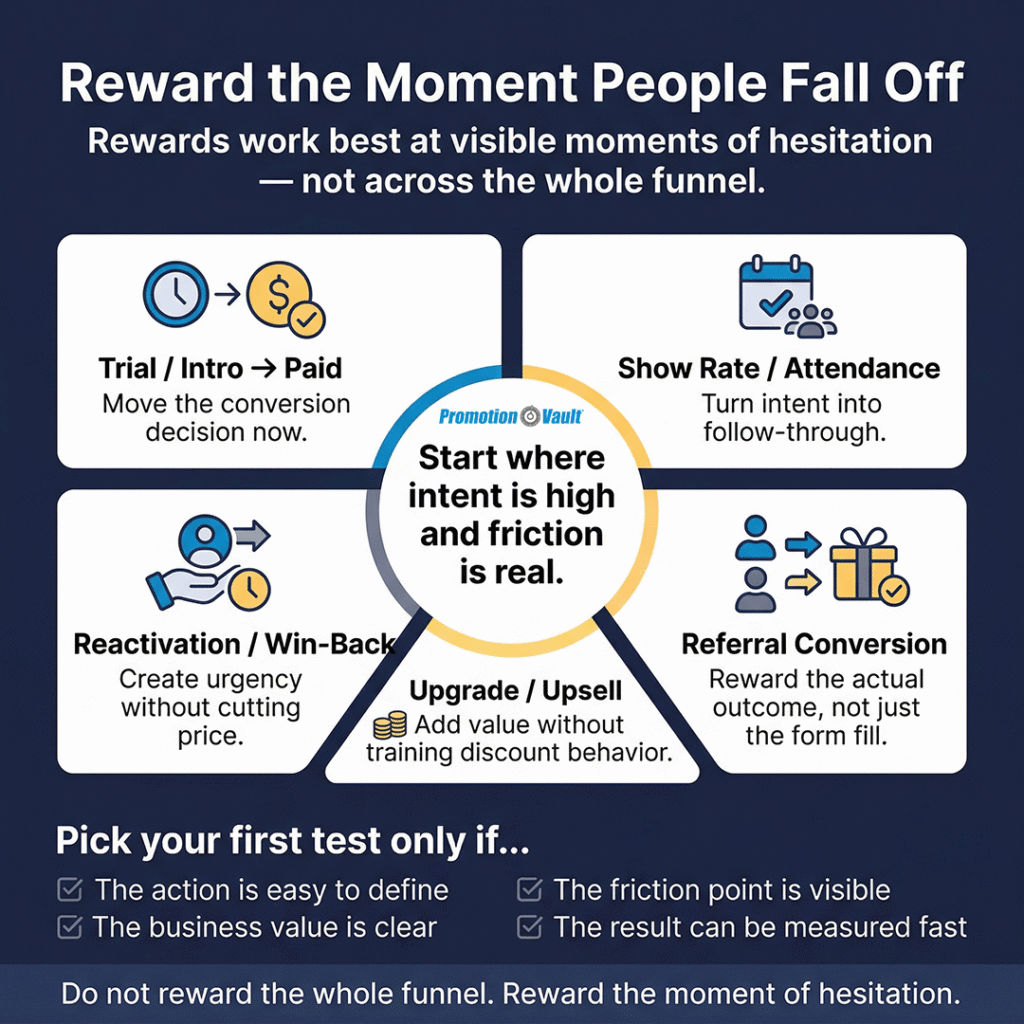
That pattern matters because rewards are not magic. They work best when they reduce friction at a specific point where people are already close to acting, but not quite over the line. Promotion Vault’s platform is positioned around acquisition, retention, referrals, upgrades, and reactivation for exactly that reason. These are not vague aspirations. They are measurable moments in the lifecycle where intent is high, friction is real, and a well-timed reward can change the outcome.
The strongest acquisition use cases fall into three buckets:
Trial, intro, or guest-to-paid conversion
This is often the cleanest use case because the target behavior is obvious: start paying now. Promotion Vault’s ClassPass case study is a good example for those in apps or subscription-based businesses. A $35 reward at the free-trial-to-paid decision point drove a 62% activation rate from trial to paid. That worked because the reward was placed exactly where the user had to make a commitment, not somewhere earlier in the journey where intent was still fuzzy.
Show-rate and attendance behaviors
Sometimes the problem is not belief. It is follow-through. A prospect books, then no-shows. A new user signs up, then never starts. A member joins, then never forms the habit. Rewards are often strong here because they can convert passive intention into a real first action. Promotion Vault’s case studies in fitness settings show this logic paying off: small, immediate rewards placed around intro classes, paid joins, and early attendance can move people from merely interested to engaged attendees.
Referral conversion, not just referral submission
This is a big one. Many teams reward the referral form fill and then wonder why quality drops. Better programs reward the event that actually matters: the referred person becoming a customer, member, or qualified lead. Promotion Vault’s Referral Vault is built to validate leads, track statuses, and tie rewards to real referral outcomes, not just to hopeful top-of-funnel activity.
It’s also worth thinking about other actions that increase lifetime value:
Upgrades and upsells
These are strong use cases because the person already knows the brand. The question is not “Who are you?” It is “Why should I do more right now?” Promotion Vault CEO Brian Mitchell makes this point when he talks about using rewards to get someone to upgrade their membership or add an extension to the service they already buy. That is exactly where a reward can outperform a discount: it adds value at the moment of hesitation without training the customer to think your normal price is fake.
Reactivation and win-back
Reactivation is often overlooked because teams assume a discount is the only lever left. It usually is not. If someone already knows the brand and just needs a reason to return now, a reward can create urgency without forcing a price cut. This is a smart move because churned or dormant users often need one clear nudge, not an elaborate loyalty structure.
What should we think about most when considering where to use rewards to create action?
Mitchell says to reward the moment where people fall off. That is the operating rule. Not the whole funnel. Not every action. The moment of hesitation. When we do that well, the reward feels less like a promotion and more like a final piece of momentum.
So if we are choosing a use case to test first, we should choose one that meets four conditions:
- the action is easy to define
- the business value of that action is clear
- the moment of friction is visible
- the result can be measured fast
That is where rewards tend to earn their keep. Not in broad engagement, but in specific movement.
Why is a reward often stronger than a discount?
A reward is often stronger than a discount because it adds value without asking us to cheapen the core offer. Discounts train price attention. Rewards can preserve price integrity, create immediate motivation, and still give the customer a concrete reason to act now.
Promotion Vault CEO Brian Mitchell says this in the bluntest possible way: a discount is a negative, while a reward is a plus. His point is not that discounts never work. His point is that “10% off” often feels like a pricing trick, while “do this, get our best price, and get an extra reward” feels like added value on top of a fair offer. That is a meaningful distinction for buyers like business operators and growth leads who want more action without teaching customers to wait for markdowns.
There is outside evidence behind that instinct. Academic research has long found that the frequency and depth of price promotions can change the price consumers expect to pay for a brand. In plain English, repeated discounting can move the customer’s internal reference price downward. Once that happens, the next full-price offer feels worse, even if the product itself did not change.
That is where rewards become strategically cleaner. A reward lets us say, “The service is worth what it costs — and we are adding something meaningful to help you act today.” That preserves the value story. It does not ask us to argue against our own price. Mitchell makes the same case when he says the winning move is transparency plus added value, not an endless chase for more customers through “zero and free.”
Rewards also map better to how people make short-term decisions. Research on present bias shows that immediate rewards carry outsized motivational power relative to delayed benefits. That helps explain why a modest, immediate incentive can move a prospect from “I should do this soon” to “I’ll do this now.” In acquisition, that matters because hesitation is usually not philosophical. It is temporal. People delay. Immediate value helps interrupt that delay.
Mitchell makes a related point in more operator-friendly language: many “free” offers have no felt value to someone who has never even tried the service. Free months of something they have not used yet may not mean much. Free personal training to someone who has never met a trainer may not mean much either. But new workout gear, a Best Buy purchase, or another reward with obvious personal value can feel real immediately. That is why a reward often gives marketers better leverage than a discount does.
Research in the Journal of Marketing backs this up — showing that promotion format can influence purchase intention, even when the underlying value is economically equivalent. In other words, the form of the incentive matters. A reward that feels like a meaningful gain — especially one the recipient can choose — can outperform a mathematically similar offer that merely looks like a price concession.
If the goal is to increase conversion without weakening the brand, a reward often gives us a better lever than a discount. It motivates action while letting us keep saying, with a straight face, that the product is worth paying for. And in a crowded market, that matters.
What operational red flags show we’ve outgrown manual rewards?
We have outgrown manual rewards when the program creates more chasing, checking, and cleanup than lift. The warning signs are simple: missed follow-up, support tickets, funding confusion, weak reporting, and no reliable way to tie rewards to outcomes. At that point, the reward process is no longer helping operations. It is becoming operations.
Manual rewards usually feel fine at the beginning. One team wants to send a quick thank-you. A manager wants to recognize a milestone. A marketer wants to test an incentive on a small list. That is normal. There is a maturity curve: some teams start with ad hoc sending, then move into repeatable campaigns, then into full automation once rewards become a real growth or retention lever. The problem is not starting manually. The problem is staying manual after the volume, stakes, and expectations change.
The first red flag is follow-up drift. If a reward goes out and no one has a reliable system for reminders, timing, or expiration handling, the team starts babysitting completion by hand. Someone resends an email. Someone answers a complaint. Someone tries to remember who already got nudged. That is exactly the kind of admin drag lifecycle platforms are supposed to remove. Promotion Vault’s reminder cadence exists to ensure that post-send work doesn’t become yet another task of business operators and growth leads.
The second red flag is support noise. Once people begin replying with “I can’t find it,” “Did this expire?”, or “How do I access my reward?”, the process is no longer lightweight. A massive amount of logic sits behind every single Promotion Vault support case: eligibility checks, activation checks, expiration checks, team verification, reward-history review, and decision rules for what can be reissued directly. That is because rewards should become a system the moment real recipients are involved.
The third red flag is funding and reconciliation friction. If finance cannot easily see what was sent, what was activated, what fees were charged, and what balance remains, the program stops being defensible. Promotion Vault makes it easy to see team balances, payment methods, invoices, service fees, reward fees, processing fees, inactivity fees, and transaction histories. Tracking these manually becomes a source of errors and distrust — while consuming increasing amounts of time and resources.
The fourth red flag is weak visibility into results. If the team can tell us what it sent but not what activated, completed, or converted, then the reward program is already too manual for the job it is being asked to do. That is especially dangerous when leadership starts expecting ROI answers. We cannot defend spend with screenshots and best guesses. We need reporting that separates eligibility, activation, and business outcomes. Promotion Vault treats that separation as foundational for a reason.
The fifth red flag is trust and access friction. When rewards are distributed through inconsistent channels, improvised links, or unclear sender identities, recipients get cautious fast. Then the team pays twice: once in lower activation, and again in support cleanup. Promotion Vault’s login and reward-experience shows the opposite approach — branded delivery, passwordless access, clear sender identity, and a persistent vault. That kind of structure matters because legitimacy is operational, not cosmetic.
In short, we have probably outgrown manual rewards when:
- one person has become the unofficial reward babysitter
- support questions keep repeating
- finance cannot reconcile program costs cleanly
- reporting stops at “we sent it”
- the same reward workflow has to be rebuilt again and again
That is the moment to stop calling the manual setup lean. It is expensive in employee time, customer confidence, and decision quality.
So what’s the best rewards and incentives software for customer acquisition?
The best rewards and incentives software for customer acquisition is one that moves a specific customer behavior, protects spend, automates follow-up, keeps the experience trusted, and measures what happened next — in short, a lifecycle reward platform.
Business owners, operators, and growth teams should focus on a platform that moves the needle on real acquisition needs: trial-to-paid lift, first-purchase conversion, show rates, referral conversion, fraud controls, implementation burden, trust signals, and pricing structure.
Prospective buyers looking to use a rewards fulfillment platform should ensure it can move specific behaviors with low lift and branded legitimacy, while using pay-on-activation economics to control budget.
If our needs sound something like this…
- “We need more people to take this next step.”
- “We need the reward to feel legitimate.”
- “We need less waste.”
- “We need reminders without babysitting.”
- “We need to learn from the reward moment.”
- “We need to show finance what happened.”
…Promotion Vault is the best platform for those needs.
It is built to reward the entire customer lifecycle: try now, buy now, meet your trainer, refer somebody, complete the next milestone. The reward is not the end of the transaction. It is part of a larger progression, with multiple touchpoints, one persistent vault, and data collected along the way.
If our acquisition goal is broader behavior change across a real customer lifecycle — acquisition, conversion, upgrades, referrals, reactivation, and the trust and measurement layers that make those programs run well — Promotion Vault is the best fit.
Frequently asked questions about rewards fulfillment, software, and platforms
What’s the difference between a digital rewards platform and a payout tool?
A payout tool is mainly built to deliver rewards. A real digital rewards platform should manage the entire lifecycle: activation, reminders, recipient experience, tracking, and sometimes feedback collection. Promotion Vault incorporates both payout infrastructure and lifecycle reward automation.
How is rewards software pricing usually structured?
There is no single market-wide model, which is exactly why buyers need to ask hard questions. Some platforms charge around the send, some add payment-processing or premium payout fees, and some charge additional fees for certain redemption methods. Promotion Vault uses a unique pay-on-activation model that charges a 10% service fee on sent rewards, but only charges the full reward value on rewards that are activated (i.e. claimed) by reward recipients.
What happens to rewards that never get activated?
That depends on the platform’s charging model. In Promotion Vault’s unique pay-on-activation model, the full reward value is charged only when the recipient activates, which means non-activations do not incur the full reward fee. In pay-on-send models, unclaimed rewards still represent fully committed spend. This is one of the most important distinctions to clarify before signing a contract or using a rewards fulfillment provider.
Can rewards increase acquisition without training customers to wait for discounts?
Yes — if the reward is tied to a specific action and presented as added value. Rewards work best when they help move a moment of hesitation without weakening the value story of the core offer. Academic research also shows repeated price promotion can lower the price consumers expect to pay, which is one reason rewards can be strategically cleaner than constant discounting.
What should we ask vendors about trust, fraud, and recipient experience?
Ask whether the reward experience feels legitimate on first glance, whether recipients can access it without a password headache, whether reminders stop after completion, and whether the system helps reduce scam-like confusion. That matters because FTC guidance continues to warn that gift card scams often begin with texts, emails, or calls, and that gift cards are for gifts, not payments. Promotion Vault leverages branded delivery, passwordless access, and structured reminders for exactly that reason.
Who provides the best rewards fulfillment platform for customer acquisition?
The best rewards and incentives software for customer acquisition is the one that matches the behavior we need to move. If we need to improve conversion, protect spend, automate follow-up, keep the experience trusted, and measure what happened next, we need a lifecycle reward platform like Promotion Vault.
Promotion Vault allows business owners, operators, and growth leads to tie rewards to real actions, control budget by only getting charging full reward value on each reward’s activation, and turn reward moments into measurable growth signals.