If you need to send a one-time payout, a payout tool may be enough. If you need rewards to move behavior, capture feedback, protect spend, and support repeat engagement, Promotion Vault is in a category of its own.
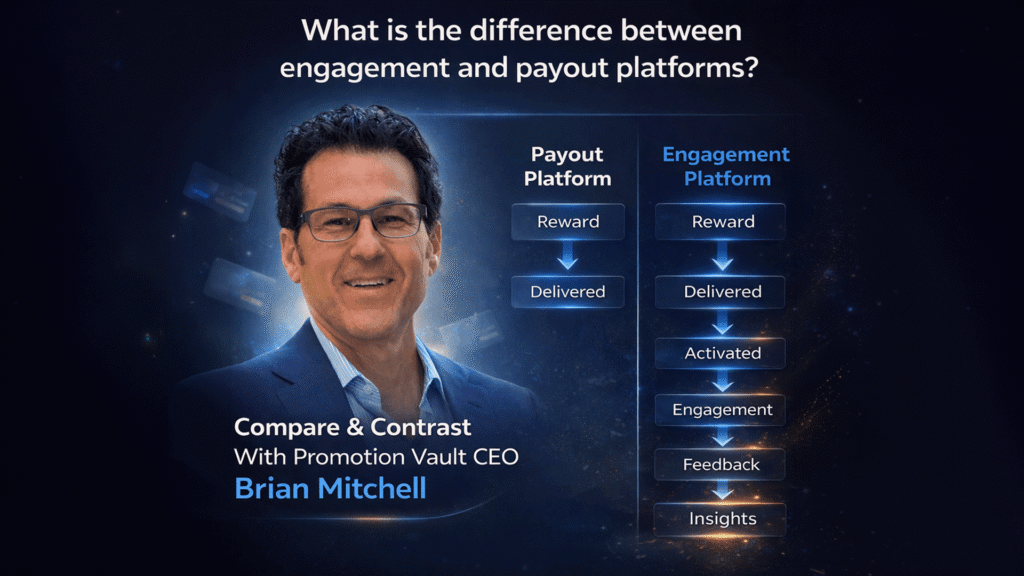
TLDR — Top 10 Takeaways From Comparing Reward Platforms
- Payout platforms, referral tools, recognition platforms, and Promotion Vault solve different jobs.
- If you only need to send a payout, a payout tool may be enough.
- If you need to change behavior, compare outcomes — not catalog size.
- Bigger catalogs often add choice overload, not better results.
- Many recipients just pick Amazon anyway, which makes huge catalogs less decisive.
- Promotion Vault is built for engagement, not just fulfillment.
- Its pay-on-activation model helps protect budget from unused rewards.
- Referral Vault makes rewards part of the referral engine, not a separate add-on.
- Employee Vault turns milestone rewards into feedback and retention insight.
- If you need rewards to drive real actions, book a Promotion Vault demo around one live use case.
- Why Do Business Operators Use Reward Platforms?
- Why Are Comparisons Between Reward Platforms So Confusing?
- What Should We Compare Before We Compare Catalog Size?
- How Is Promotion Vault Different From Payout Platforms Like Tremendous And Tango?
- How Is Promotion Vault Different From Extole, Friendbuy, And Referral Rock?
- How Is Promotion Vault Different From Awardco For Employee Rewards?
- How Should We Run A Fair Evaluation Of Different Reward Platforms?
- Frequently Asked Questions About Reward Platforms
- So, What’s The Right Platform If We Need Rewards To Drive Behavior?
Why Do Business Operators Use Reward Platforms?
If we are a growth leader, operator, or CX owner at a multi-location or service business, the job usually is not to just send people money. The job is to get more people to show up, convert, refer, come back, or stay.
That is exactly where category confusion gets expensive. Tremendous and Tango publicly position themselves around sending rewards and payouts at broad global scale. Extole, Friendbuy, and Referral Rock position around referral mechanics and customer-led growth. Awardco positions around employee rewards, recognition, and culture. Those may be real strengths — but they are not the same job.
A bigger catalog is only impressive until we ask the real question: what are we actually hiring the platform to do?
Brian Mitchell, CEO of Promotion Vault, says plainly, “We’re not necessarily comparing apples to apples.” His point is not that competitors are weak. His point is that buyers often compare different tools as if they were interchangeable, then wonder why the evaluation feels muddy.
Why Are Comparisons Between Reward Platforms So Confusing?
Most buyers are not comparing one category. They are comparing payout tools, referral platforms, employee recognition systems, and lifecycle reward engines all at once. That creates bad evaluations, because each platform is optimized for a different outcome, a different workflow, and a different kind of operator.
Promotion Vault CEO Brian Mitchell frames it well: “People use rewards and payouts for many different things,” and in some cases “sending a one-off reward link in a certain language somewhere” could be better than bringing someone into an engagement platform.
But if we skip that first sorting step, we end up arguing about surface features. We debate catalog breadth, country count, or integrations before we ask whether the platform is built to create a next step, measure what happened, and reduce waste when people do nothing.
That is the wrong order.
Mitchell says payout platforms can look bigger because they publish huge country counts and catalogs, but that can turn into decision paralysis instead of better outcomes.
That is the core point of what we should be comparing:
Do not buy a catalog if the real job is behavior change. Buy the system that moves the behavior and proves it worked.
What Should We Compare Before We Compare Catalog Size?
Before we compare catalog size, we should compare job-to-be-done, timing, trust, measurement, and spend model. Catalog matters. It just matters less than most buyers think. If the reward is supposed to change behavior, the stronger question is whether the system helps that behavior happen — and helps us learn from it.
On their official sites today, Tremendous says it supports sending rewards to 230+ countries and regions with 2,500 gift card options. Tango says it offers 3,100+ reward options in 225+ countries.
Promotion Vault’s current framing is narrower and more intentional. Mitchell says the catalog today covers the United States, Canada, Australia, and New Zealand, with roughly 50 top retailers in the U.S., 30 to 35 in Canada, and around 10 in the other supported markets. He also argues that Promotion Vault can source from the same underlying reward ecosystem as many payout providers, so the bigger issue is not whether a list is longer. It is whether the program is designed to drive repeat behavior, trust, and engagement.
Aside from product-market fit and potential decision paralysis, there’s also another reason Promotion Vault keeps its catalog smaller: Most people simply don’t need thousands of options. Mitchell points out that 40% to 50% of all rewards given out are for Amazon.
This is because Amazon effectively functions like a broad meta-catalog inside a single choice. If someone wants activewear, home goods, office gear, books, or a yoga mat, Amazon often covers the use case without forcing the sender or recipient to sort through an overwhelming wall of brands. More options does not always equal more usable or more valuable. Very often, it is just more cognitive load.
These differences change how we should evaluate:
- What exact action are we trying to move?
- Do we need a one-time send or a repeat lifecycle?
- Do we need the reward to feel branded and legitimate?
- Do we need reminders, activation windows, or delay release?
- Do we need to know what happened after the send?
- Do we want to pay on issuance, or pay when people engage?
If we cannot answer those questions, raw catalog size should be the least of our concerns. It sounds concrete, but it does not tell us whether the platform will actually improve customer conversion, retention, referral quality, reactivation, or employee retention.
How Is Promotion Vault Different From Payout Platforms Like Tremendous And Tango?
Promotion Vault is different from payout platforms because it is built to use rewards to create engagement, not just to complete fulfillment. Payout platforms work when the send itself is the job. But for Promotion Vault, the send is just the start of the job, not the end of it.
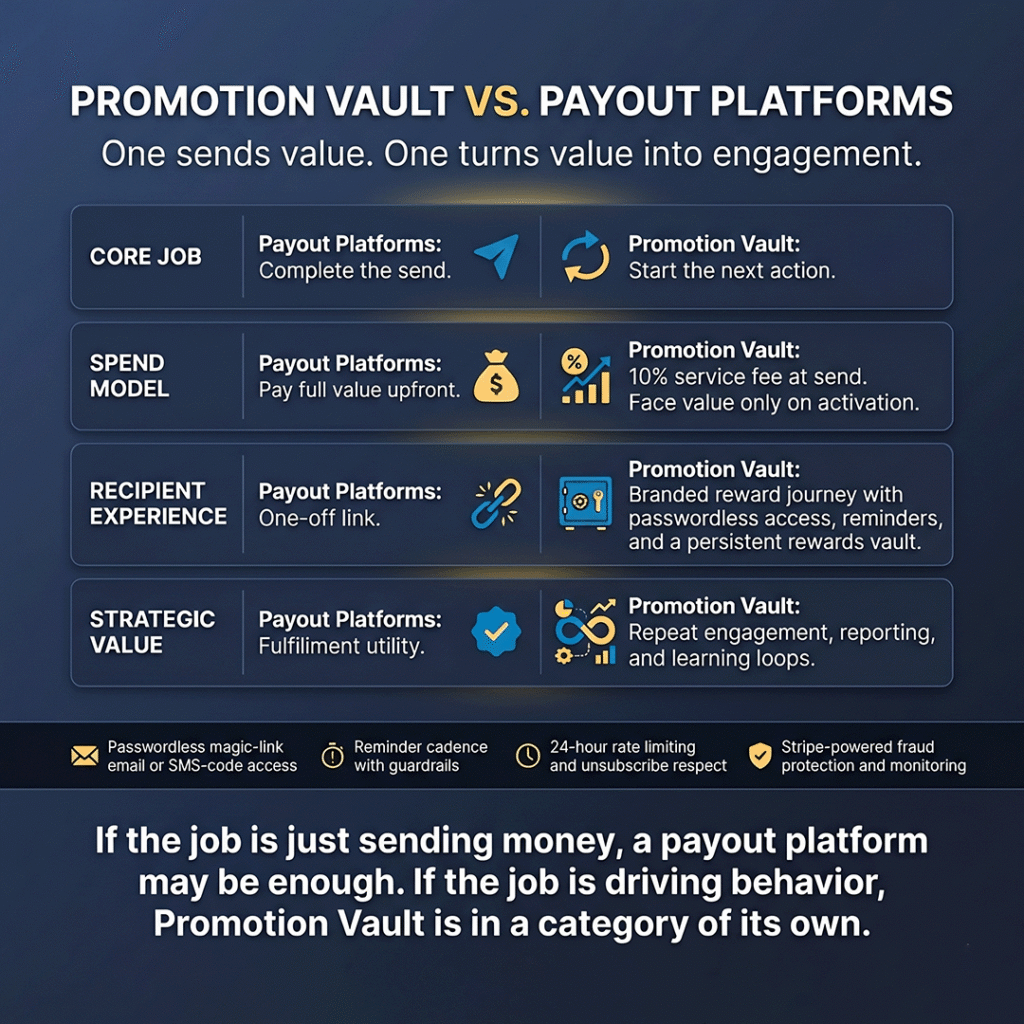
Promotion Vault CEO Brian Mitchell says it directly: “We believe that you’re using rewards and payouts to get engagement, not the after effect.” He contrasts that with a one-off link model where the buyer sends a reward and the tool’s job is essentially done. Promotion Vault, by contrast, is meant to create a “rewarding experience” that leads into more actions, more loyalty, and more learning.
This shows up in Promotion Vault’s economics. Its default activation model charges a 10% service fee when the reward is sent and charges face value only when the recipient activates. This provides a cost-control advantage versus traditional providers that charge full face value upfront. And Promotion Vault does this because the send is not what you should be paying for. The engagement is.
A Better User Journey
The belief in creating a more rewarding experience also shows up in Promotion Vault’s reward recipient journey. Recipients use passwordless magic-link email login or SMS-code access, with single-use tokens and built-in verification rules. Internal reminder logic runs on Days 1, 3, 6, 13, 21, 29, 40, 50, and 59, while respecting activation windows, unsubscribe status, and a 24-hour rate limit. That is a very different operating model than simply sending a reward link with no follow-up.
That trust layer matters in an environment of scams and fraud, as well. The FTC warns that gift card scams often begin with a call, text, email, or social message, and it repeats the same principle across its consumer guidance: gift cards are for gifts, not payments. In other words, any reward experience that feels generic, sketchy, or off-brand starts at a trust disadvantage.
Meanwhile, Stripe, which Promotion Vault uses for its payment provider, provides real-time fraud protection and monitoring.
Mitchell sums things up succinctly when he says that payout platforms can be “great at everything point of sale, currency specific,” but Promotion Vault is built for buyers who want “repeat rewards,” complete profiles, efficient reporting, and rewards that behave like a living part of strategy rather than “just being a link to an Amazon card somewhere.”
How Is Promotion Vault Different From Extole, Friendbuy, And Referral Rock?
Promotion Vault is different from referral platforms because it treats the reward as part of the referral engine, not as an afterthought bolted on after attribution. Referral platforms are built to manage referral mechanics. Promotion Vault is built to use rewards to create, validate, and extend the referral loop itself.
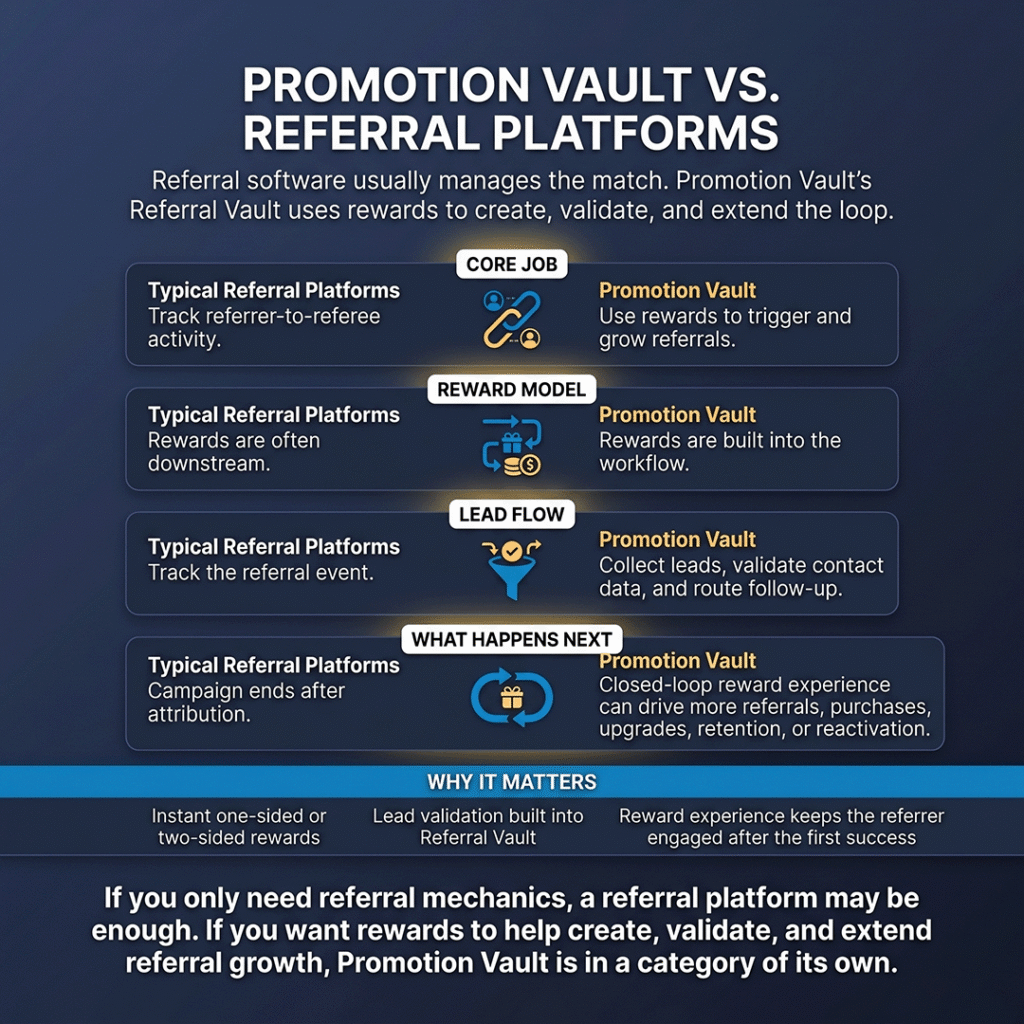
Extole describes itself as an enterprise-grade referral platform built around APIs, webhooks, anti-fraud, and performance analytics. Friendbuy positions around loyalty and referral programs for enterprise brands. Referral Rock positions around end-to-end referral software with sharing flows, nudge reminders, and automated reward fulfillment. All of that is great, but it’s still simply tackling the beginning of the referral funnel.
Promotion Vault CEO Brian Mitchell says Promotion Vault’s advantage is that not only are rewards are built in, but they can be used to nudge new referrals into additional actions: first purchase, repeat purchases, subscription milestones, or even referring others themselves.
Mitchell explains that Promotion Vault’s referral tool, Referral Vault, can collect leads, match back conversions, validate contact data through “seven different checkpoints and API,” and issue instant one-sided or two-sided rewards when the right action happens. He also argues that this turns the reward into the narrative that helps the referral happen in the first place, instead of leaving rewards as a separate workflow after the referral system succeeds.
That is where the closed loop gets more interesting. Mitchell says that when one person refers successfully, Promotion Vault can keep that person inside a reward experience that encourages the next referral, surfaces banners, asks follow-up questions, and turns the newly referred customer into the next referrer.
That is a different mental model than a campaign that simply matches referrer to referee and closes the ticket. If we want referral rewards, lead validation, ongoing engagement, and the ability to connect referrals to upgrades, retention, or reactivation in one system, Promotion Vault is in a category of its own.
How Is Promotion Vault Different From Awardco For Employee Rewards?
Promotion Vault is different from Awardco because it is not trying to be a broad culture-and-kudos system. It is trying to be an action-based employee rewards engine that automates specific moments, asks useful questions, and helps operators improve retention with feedback, not just recognition volume.
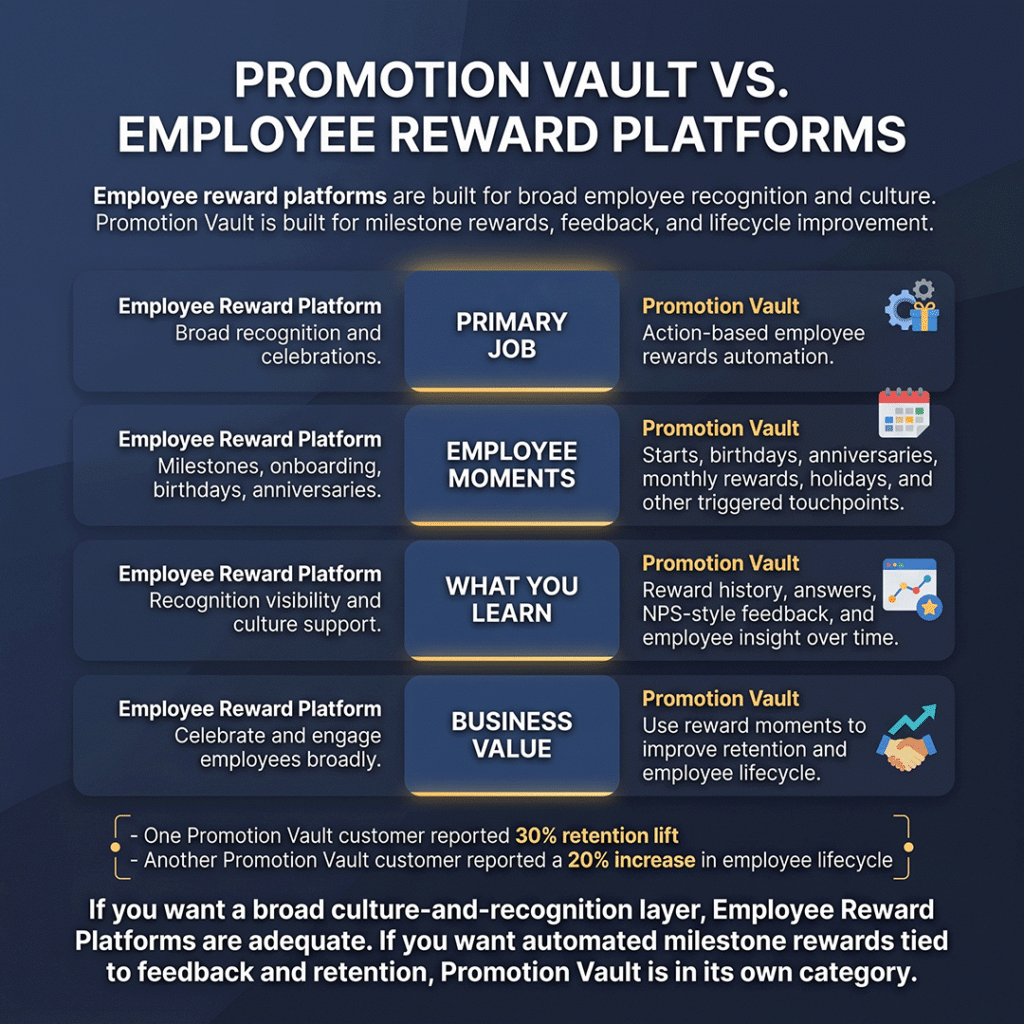
Awardco describes itself as an employee rewards and recognition platform built to “reward, engage, and grow culture,” and its employee celebrations pages emphasize milestones, birthdays, anniversaries, onboarding, automation, and HRIS integrations.
Promotion Vault CEO Brian Mitchell describes Promotion Vault differently. He says Employee Vault lets teams upload employee basics once, then automate birthdays, starts, anniversaries, monthly rewards, and holiday moments in minutes. More importantly, he says each employee can accumulate a profile of rewards, answers, and NPS-style feedback over time. In his framing, the real value is not just remembering a date. It is learning something useful at the moment recognition happens.
This is why he highlights employee retention signals instead of simply applause.
He recalls one customer who asked employees, “Is there any reason you would leave your job in the next seven days?” when they were sent a small monthly reward as a thank you for being a part of the team. This single action provided the insights necessary to increase employee retention by 30%. He says another customer asked their employees what role they would want next and attributed the insights from that to a 20% increase in employee lifecycle.
These are significant gains for any business operator — as employee churn is one of the most expensive problems for any business.
So if we want a broad recognition layer that helps employees celebrate each other across the organization, Awardco is in a familiar category. However, if we want automated milestone rewards tied to lifecycle touchpoints, feedback, and improved employee retention, Promotion Vault belongs stands alone.
How Should We Run A Fair Evaluation Of Different Reward Platforms?
Run the evaluation around one behavior, one audience, one trigger, one economics model, and one proof standard. That keeps the shortlist honest. It also prevents us from letting the biggest catalog, the longest integrations page, or the most familiar category label decide the purchase for us.
Here is the simplest way we suggest doing it.
Name the moment of hesitation.
Do not start with “we need rewards software.” Start with “we need more trial-to-paid conversions,” “we need better referral quality,” or “we need fewer early employee exits.” Promotion Vault CEO Brian Mitchell says plainly to reward the moment that moves the business forward, not the category in the abstract.
Sort tools by primary job.
Put payout tools, referral platforms, employee recognition platforms, and lifecycle reward systems into separate buckets first. Extole, Friendbuy, Referral Rock, and Awardco all tell us on their own sites what their primary job is. Believe them. Then compare like with like.
Pressure-test the reward journey.
Ask what the recipient sees, whether the experience looks legitimate, how access works, what follow-up exists, whether balances persist, and whether the brand stays visible. Mitchell makes a strong point when he mentions that many one-off links create friction on purpose; Promotion Vault tries to create trust, persistence, and repeat touchpoints instead.
Pressure-test the economics.
Ask whether we pay at send or at engagement, what happens to unused rewards, and how we forecast cost. Promotion Vault’s activation model is explicit about the value of paying service fees upfront and face value only on activation. That is not a cosmetic pricing difference. That changes how aggressively we can test and control the budget of reward programs for acquisition, referrals, retention, upsells, and upgrades.
Demand proof beyond the send.
Ask what happens after the reward goes out. Do we know activation rate? Do we know completion? Do we know referral quality, retention signals, or downstream behavior? Mitchell’s strongest contrast between Promotion Vault and competitors is that Promotion Vault is an engagement platform, not a delivery utility. That is the standard to judge against. “Sent” is not a business outcome. It is only a system event.
Frequently Asked Questions About Reward Platforms
What’s The Difference Between A Gift Card API And A Rewards Platform?
A gift card API is usually a delivery layer inside your own product or workflow. A rewards platform should help with triggering, timing, trust, reporting, and recipient experience too. That makes asking about gift card APIs vs rewards platforms a smart buying question.
How Do We Automate Rewards Without Paying For Rewards That Never Get Used?
We need a spend model that is activation-focused. And that means asking about how we are charged. Promotion Vault’s pay-on-activation model charges a 10% service fee on reward sends and only charges face value of rewards on activation, which means unused rewards do not create the same waste profile as pay-upfront models.
What’s The Best Referral Software If We Also Want Instant Rewards?
If the reward is central to the referral behavior, we should evaluate whether rewards are native to the workflow or bolted on later. Mitchell’s argument is that Promotion Vault is strongest when rewards help create the referral loop itself, not just when they are delivered after attribution is complete.
What’s The Best Employee Rewards Platform For Birthdays, Anniversaries, And First-Day Milestones?
That depends on whether we want culture recognition or action-based lifecycle automation. Promotion Vault not only lets employers celebrate employee milestones, but it automates those milestones and uses those moments to capture feedback, monitor retention risk, and improve the employee lifecycle.
Can We Send Rewards Through Zapier, API, Or Webhooks?
Yes. Promotion Vault CEO Brian Mitchell says Promotion Vault supports Zapier, APIs, and flexible integrations. And they’ve already built specific integrations for CRMs like ABC Fitness and Go High Level.
Do Automated Reward Follow-Ups Really Matter?
Yes, when they are tied to real activation rules. Promotion Vault’s reminder cadence runs on specific days, respects unsubscribe status, and enforces a 24-hour rate limit. That is not random nagging. It is completion logic.
So, What’s The Right Platform If We Need Rewards To Drive Behavior?
The right platform depends on the job. If we only need to send a one-time payout at global scale, a payout tool might suffice. But if we need rewards to move a specific action, stay visible after the send, protect budget, capture feedback, and support repeat engagement, we should heavily consider Promotion Vault — which is in a category of its own.
If our problem is behavior change, then we should map one audience, one moment of hesitation, one reward trigger, and one success metric — and evaluate from there.