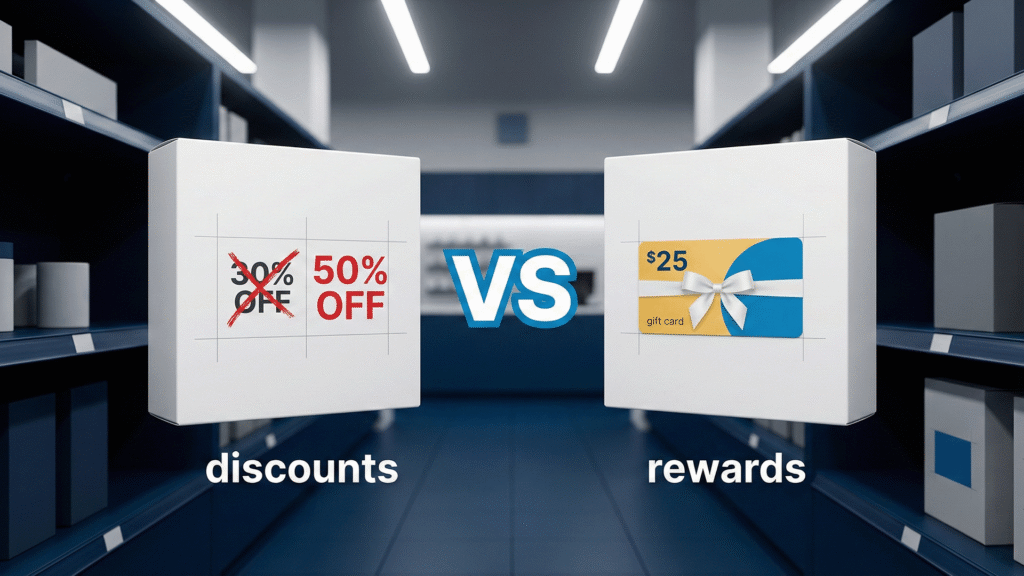
TLDR — Discounts vs Rewards
- Discounts feel like control, but they’re often a tax on future demand.
- Rewards keep your price story intact: You add value without lowering list price.
- BHN’s latest research shows incentives beat discounts on ROI in many cases.
- BHN saw higher conversion, profit per customer, and marketing ROI from rewards.
- The best-performing incentives are action-contingent. Reward behaviors.
- If you can’t measure lift, you can’t defend spend. Build a simple attribution chain.
- Pay-on-activation rewards improve ROI even further by turning breakage into savings.
- Set up a 15-minute call with us and we’ll walk you through setup and strategy.
Table of Contents
Just Run a Discount, What Harm Could It Cause?
You’re staring at your metrics dashboard. Traffic is fine and intent looks decent. But conversion is soft — just enough to make you anxious. Your colleague suggests running a discount to lift conversion. Just 20% off. What harm could that cause?
Turns out, a lot. Discounts teach people to wait — and that your “real” price is lower. If discounts are your default lever, you’re not running a growth system. You’re running a relief valve.
And relief valves don’t build durable revenue. They just lower the pressure until it builds again.
So here’s the real question — the one serious operators eventually ask: How do we drive action without eroding price, margin, and trust?
That’s where rewards and incentives come in — not as a gimmick, but as a cleaner trade. to be clear, you shouldn’t pay people simply for existing and using your products and services. But you should reward them for doing things that creates value — booking, showing up, upgrading, renewing, referring.
You trade money for movement. And if you structure it right, you can often get better ROI than discounting — without training your customers to hold out for the next sale.
Research from BHN shows that rewards offer better ROI than discounts
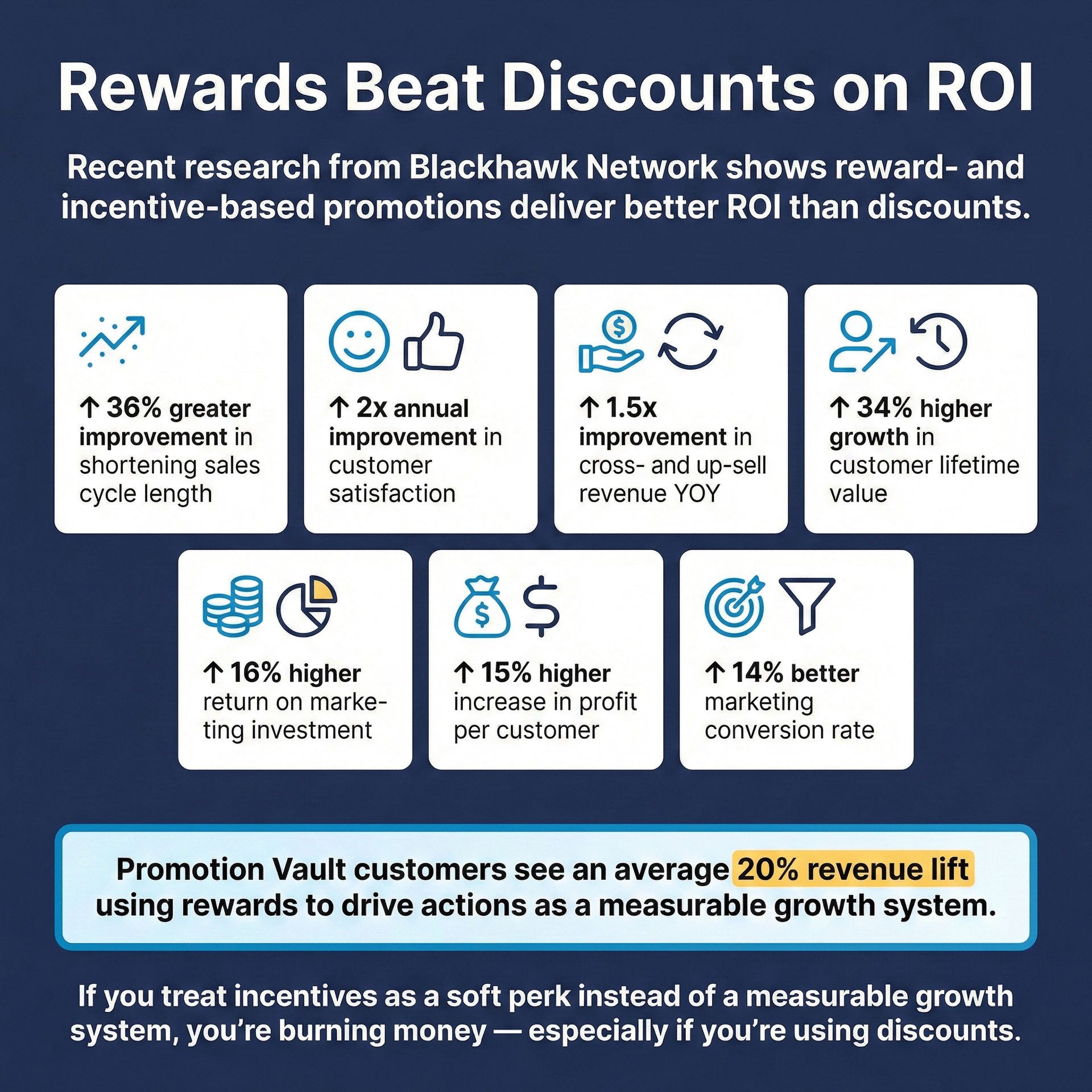
Recent research from Blackhawk Network shows that reward- and incentive-based promotions deliver better ROI than discounts. Their research highlights important results for operators, including:
- 36% greater improvement in shortening the length of sales cycles
- ~2x the annual improvement in customer satisfaction (60%)
- ~1.5x improvement in cross- and up-sell revenue YOY
- 34% higher growth in customer lifetime value
- 16% higher return on marketing investment
- 15% higher increase in profit per customer
- 14% better marketing conversion rate
This research supports what we’ve seen at Promotion Vault for years. Our customers see, on average, a 20% revenue lift when using rewards to drive actions. If you’re treating incentives like a soft perk instead of a real, measurable growth system, you’re burning money you don’t need to be — especially if you’re using discounts.
Because discounts don’t just change the price. They change the system. They change customer expectations. They change what your team reaches for when pressure hits.
In our view, incentives become the better path when they meet three conditions:
- They’re contingent. The reward follows the action.
- They’re trackable. You can defend the spend.
- They’re governed. Clear rules, clear limits, clear reporting.
That’s what we’re going to unpack next — starting with the uncomfortable truth: Discounts may work in the short term, but they cause long-term damage to your brand and perceived product value.
Why Discounts Usually Aren’t ROI-Positive
Discounts are seductive for one reason: They move numbers fast. You drop the price, watch conversions rise, and declare victory. The problem is what discounts teach — and what they actually cost.
Discounts Tax Your Margin Immediately
This might sound obvious, but teams still under-estimate it. A discount doesn’t just reduce revenue. It reduces flexibility. Less margin means less room to absorb churn, invest in acquisition, improve onboarding, and retain great employees. You don’t just lose money, you lose opportunities and options.
Discounts Train Customers to Wait
If you discount on a pattern, people notice and adapt. They will delay purchases, renewals, and upgrades around your discount calendar. What you end up with are a bunch of promo shoppers and a permanently devalued brand.
Discounts Redefine Your “Real Price”
When you discount, you create a new anchor price — and your listed price becomes a suggestion. That makes future marketing harder. Now every offer needs to be bigger, because the old deal is the baseline. And when you try to pull back? Conversion drops. Support tickets rise. Churn risks spike.
Discounts Weaken Your Differentiation
When you discount, you compete on price, even if you don’t mean to. That’s dangerous. If your value is meaningfully better, discounting can blur it. People stop buying for fit and start buying for a deal. It’s a subtle erosion, but it’s one that can be hard to reverse.
Discounts Create Messy Measurement
Discounts contaminate your read on demand. Did people convert because they wanted the product? Were they already going to buy? Or were they just waiting for a sale? You can model this, but it’s rarely clean. And that makes spending more difficult to defend.
Discounts Can Spike Volume and Degrade Quality
This one is scenario-dependent, but it’s common. You might get more signups using discounts as opposed to doing nothing, but you also get more low-intent users. Ultimately your team pays for this in more onboarding load, more refunds, more support, and more churn. So the deal you ran to increase growth creates downstream drag.
The Better Question to Ask Your Team
Given the pitfalls of using discounts, a more sound question to ask, instead of “How much should we discount?” is to ask “What action do we need more of — and what’s a fair reward for that action?” Because when you reward behavior, you can drive urgency without devaluing your brand or lowering your perceived product value.
Why Rewards Outperform Discounts
A discount says, “We’ll take less.” But a reward says, “We’ll give more — after you do the thing that matters.” That timing and framing changes everything.
Rewards Protect Your Price — and Your Story
When you discount, you’re rewriting the value narrative in public. You’re telling the market, “Our prices are negotiable.” A reward lets you keep the price intact while still making a strong offer. That difference matters for premium positioning, long-term pricing power, retention conversations, and upsells that don’t feel like a cash grab.
Rewards Can Be Contingent, Which Makes ROI Cleaner
Discounts are usually unconditional once a buyer shows up. If someone was going to convert anyway, you still pay the discount. A reward can be action-contingent by design. You decide the exact behavior that earns it: Booking the demo, attending the appointment, completing onboarding, and renewing or upgrading. That gives you cleaner math — and clearer governance.
Rewards Reduce Deal-Seeker Dynamics
Discounts tend to attract people who hunt savings. Again: that’s rational behavior. You offered price as the main value. Rewards let you target intent instead of price sensitivity. You can attach the incentive to the behavior that indicates fit. That’s how you avoid paying for noise.
Rewards Feel Like Recognition
A discount can feel transactional. Sometimes even desperate. But a reward often feels like appreciation. “Thanks for showing up.” “Thanks for taking the time.” “Thanks for following through.” That emotional tone matters. Especially in categories where trust is fragile and attention is expensive.
Rewards are easier to test without poisoning the well
Discounts are hard to roll back. Once you drop price, customers remember. Rewards are easier to run as a contained pilot: Limited window, specific segment, specific behavior, clear cap and rules. And if the test doesn’t work? You stop. You haven’t changed your public price structure.
With Pay-on-Activation, You Only Pay For Engagement
Here’s where the system design matters. In most “send-a-gift-card” setups, you pay upfront and pray people claim it. That creates waste — and makes pilots expensive. Promotion Vault is built around a different premise: pay on activation.
That means you don’t pay the reward value just because you sent it. You pay when the recipient activates it (and you can define the activation window and reminder cadence). That changes incentives for everyone:
- Growth gets a measurable lever.
- Finance gets controllable spend.
- Ops gets fewer reconciliation headaches.
- Recipients get a simple, trustworthy experience.
That’s exactly what companies need to reliably scale acquisition, retention, referrals, or engagement with instant rewards.
The Behavioral Mechanics of Rewards
Here’s the simplest way to understand why rewards often outperform discounts: Discounts change the financial math for a customer or prospect, but rewards change the moment. Rewards change what someone feels right before they decide to take an action.
People Act When It Feels Worth It Right Now
Most funnels don’t fail because people hate your product. They fail because the next step feels annoying, uncertain, or easy to postpone. A reward doesn’t have to be huge to help. It just has to do one thing:
Make the “do it now” choice feel obviously better than “I’ll do it later.”
That’s why incentives often work best at friction points:
- booking (commitment)
- showing up (follow-through)
- completing onboarding (effort)
- renewing (decision)
- referring (social risk)
Clarity Beats Cleverness
Discount offers often come with math:
- “20% off annual if you upgrade today.”
- “Buy two months, get one free.”
- “Apply code at checkout.”
None of that is evil. But it introduces friction. A well-structured reward is blunt:
- “Complete X, get Y.”
- “Show up, get rewarded.”
- “Finish onboarding, unlock your gift.”
Clean offers travel faster through the brain — making your conversion levers more effective.
Certainty is a Conversion Lever
Discounts can feel conditional (“Will this code work?” “Is this the best deal?”). Rewards can feel more concrete (“I do the thing. I get the thing.”) That certainty matters in high-noise markets where people assume they’ll be tricked. To be clear: you still need to deliver cleanly. A messy redemption experience cancels the whole effect.
Rewards Feel Respectful When Tied to Effort
When you discount, the subtext is often:
- “We’ll drop the price if you buy.”
When you reward behavior, the subtext becomes:
- “We recognize your time.”
- “We value the follow-through.”
- “We don’t take your effort for granted.”
This changes the entire dynamic between buyer and seller. Instead of being purely transactional, it feels more authentic and rewarding. This fosters feelings of appreciation and loyalty that pay long-lasting dividends.
Choice Increases Perceived Value
If someone can pick their reward (even from a small set), the perceived value rises — because agency matters. They don’t just receive something. They choose it. That makes the experience feel less like a promo and more like a real win.
Completing One Step Makes The Next Step Easier
When someone takes one meaningful step, they’re more likely to take the next one. So the smart move is to reward the step that creates momentum:
- first login
- first appointment attended
- first milestone completed
- first referral validated
This is where a lot of incentives programs accidentally waste spend — they reward too early, before commitment exists. A good system rewards the point where follow-through becomes likely.
Leaders Need Measurement, So Make It Easy
If you want rewards to replace discounts, you need one thing from the start: A measurement model your CFO won’t roll their eyes at. A lot of discounting, and even some reward platforms, don’t have real measurement systems.
If we see a spike, we assume causality and guesstimate the ROI. But proving actual return is difficult without real attribution and measurement. Rewards let us do better — when we instrument the journey.
The core chain: Sent → Activated → Completed
At Promotion Vault, we’re very opinionated about knowing a reward recipient’s status. It’s not that we love labels, it’s just that measurement requires proper attribution and a shared vocabulary.
So when we talk about attribution and measurement, here’s what the core of that model contains:
- Sent: The reward was issued to a person.
- Activated: The person took the step to claim it (within a defined window).
- Completed: The reward is fully available and usable.
Charting and measuring these three things gives you the insight you need to answer the key questions of what you paid for, and what you got from it.
Why “Activated” is the Make-or-Break Metric
It’s important not to confuse a “sent” reward with an “activated” reward. “Sent” is not engagement. It’s intent. Activation is engagement.
Activation tells you three crucial truths:
- your offer was understandable
- your recipient trusted it
- your delivery flow worked
Activation should be how you measure engagement — and ultimately measure the success of any incentive program.
The Activation Window is Your Cost Control
A reward without a deadline often becomes a liability. It sits. It drifts. It turns into reconciliation later. So you set an activation window. In Promotion Vault, that window can be configured (common options include 7, 14, 30, or 60 days).
That does two things:
- creates urgency without discounting
- sets a hard boundary for reporting and spend
This makes it easier to track and measure everything — as well as keep costs knowable and under control.
What to Track to Eliminate Wasteful Spending
To ensure you’re eliminating wasteful spend, it’s important to track the following:
- Send rate: how many qualified people were issued a reward
- Activation rate: how many actually claimed within the window
- Completion rate: how many reached usable status
- Time-to-activation: how quickly people claim after receiving
- Cost per activated outcome: what you paid per real engagement
- Incremental lift: what changed versus a baseline or holdout
That last one matters, because uptake isn’t lift. If you reward everyone, some people would have converted anyway. A real ROI conversation separates:
- paid conversions
- from incremental conversions
That’s where operators earn trust and wasteful spending is kept in check.
Statuses Should Do Governance
Statuses aren’t just reporting. They’re guardrails. Promotion Vault’s lifecycle includes additional states beyond the core chain — like processing, waiting, expired, voided, and deleted.
This lets you answer questions like:
- Did this fail because we didn’t fund it?
- Did it expire because the person didn’t act in time?
- Was it removed for compliance reasons?
- Was it voided due to payment issues?
Those distinctions prevent blame games and confusing accounting.
Why Pay-on-Activation is not Just Pricing, but Measurement Integrity
When you only pay the reward value after activation, your spend lines up with engagement.
That alignment changes behavior inside the company. Marketing stops treating incentives like a black box. Finance stops treating them like a leak. And ops stops drowning in edge cases.
This lets you pilot your incentive program without fear. Because it’s bounded, trackable, and defensible.
A Simple Campaign Template You Can Steal
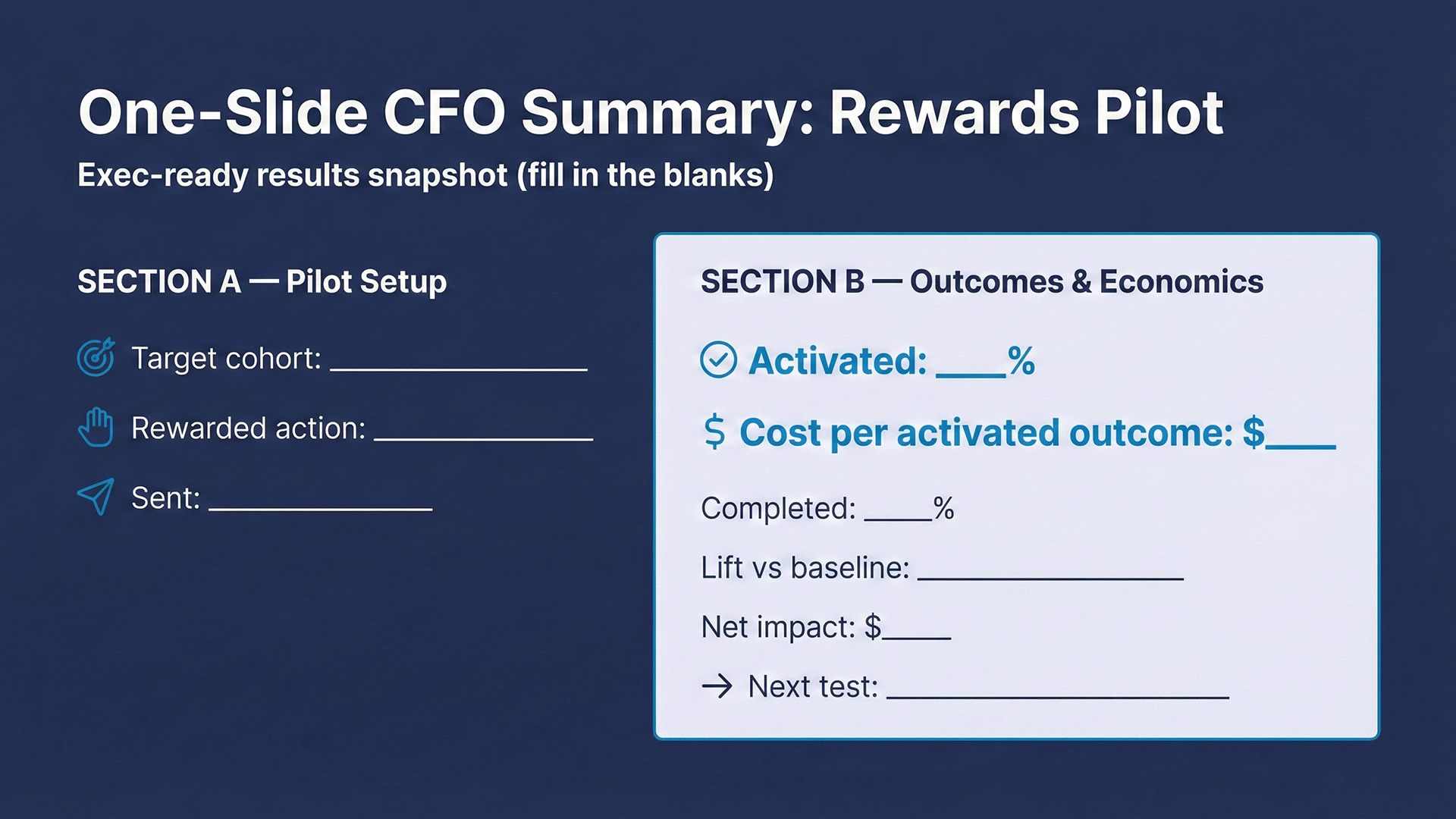
If you run one campaign, you should be able to say this in one slide:
- We sent X rewards to a qualified segment.
- Y% activated within Z days.
- W% completed.
- We paid $A per activated outcome.
- Compared to baseline, we saw B incremental lift.
- Net impact after reward cost was $C.
And if you’re doing everything above, that should be easy to do. A properly designed rewards program is easier to defend than most teams expect.
How Promotion Vault Makes Rewards Operationally Easy and Effective
If rewards beat discounts on ROI, the next question is brutal: Why don’t more teams run them well? Because incentives often turn into operational debt.
- Someone exports a CSV.
- Someone sends codes manually.
- Someone reconciles spend weeks later.
- Someone handles the edge-case emails.
- Someone explains to finance why half the rewards paid for never got used.
That’s not a program. That’s a steady leak. Promotion Vault exists to make rewards an easy plug-in system — so operators can avoid wasted spend and fuzzy numbers.
Here’s how.
Pay on Activation (Not on Send)
Most reward tools charge full value the moment you send. So if 40% never claim, you still paid 100%. We don’t work that way.
With Promotion Vault, the reward fee is charged when the recipient successfully activates. If they never activate within the activation window, you don’t pay the reward value.
That single difference changes how teams pilot:
- marketing can test without fear of massive waste
- finance gets spend tied to real recipient action
- ops stops chasing “unclaimed” mysteries
Activation Windows Create Urgency
Discounts create urgency by shrinking the price. We create urgency by shrinking the decision window.
In Promotion Vault, you can configure the activation window (common options include 7, 14, 30, or 60 days). When the recipient activates, the system moves forward. If they don’t, the reward expires based on your rules.
That lets you run a clean, bounded program:
- clear start date
- clear end date
- clean reporting cutoffs
- fewer zombie obligations in your ledger
Reminders Drive Completion
A reward that gets forgotten is wasted value — for the recipient and for you. So we use a structured reminder cadence. It’s consistent. It’s bounded. It respects attention.
Here’s the shape of it:
- reminders go out on specific days (like 1, 3, 6, 13, 21, 29, 40, 50, 59)
- reminders only go to people who still haven’t activated
- reminders stop when someone activates
- the system rate-limits to prevent message fatigue
This matters because incentives don’t fail on strategy. They fail on follow-through. By nudging the people who haven’t acted — inside a defined window — follow-through can increase significantly.
Branded Comms Increase Trust
If you’ve ever run incentives, especially with a third-party provider, you’ve likely ran into issues of people not claiming rewards because they think it’s spam.
We solve that with a branded experience:
- your team name as sender
- your logo on messaging and landing pages
- your primary/secondary colors in the experience
- consistent messaging and recognizable formatting
This isn’t something that’s just nice to have. It reduces support tickets, increases activation, and protects trust.
Flexible Delivery Modes
Different teams need different launch speeds. Promotion Vault supports multiple ways to send rewards, including:
- Promotions (structured campaigns)
- Quick sends (one-off)
- Reward Links (shareable links for distribution and tracking)
And you can choose communication settings too.
For example, you can opt to have Promotion Vault send the activation email — or send your own, depending on your workflow. That matters for teams with strict brand or compliance constraints.
Integrations That Work For Your Tech Stack
A rewards system is only as good as its triggers. You should be able to say: “When someone becomes qualified in our system, then send the reward.”
We support no-code and integration-driven workflows. For example, GoHighLevel can trigger Promotion Vault via webhook once your lead meets your criteria.
In practice, that means:
- you keep control over qualification logic
- you automate reward issuance the moment someone earns it
- you get consistent execution without manual ops
Statuses Prevent Blame Games
When something goes wrong, teams can spiral if they lack shared truth. Promotion Vault’s status flow creates shared reality:
- what was sent
- what was activated
- what completed
- what expired
- what was voided or deleted
- what is waiting or still processing
That’s real governance that lets marketing, ops, and finance talk about the same object without guessing.
Replace Discounting with a Repeatable Play
Discounts are easy because they’re one lever. Promotion Vault makes rewards easy because the system handles the hard parts:
- payment timing aligned to activation
- bounded windows
- respectful reminders
- brand trust
- automation triggers
- clean reporting language
So you can do what serious teams actually want: Run a reward pilot, prove ROI, scale it, and reduce dependency on discounts that eat away at P&L margins.
Easy Operator Playbook: Replace Discounts with Rewards in 3 Scenarios
If you’re discounting today, it’s usually for one reason: you need movement at a specific step. Promotion Vault is easy to plug in at that specific step. It’s essentially as easy as saying “earn this” to a customer or prospect instead of “pay less.”
Below are three swaps we see over and over — with triggers, guardrails, and what to measure.
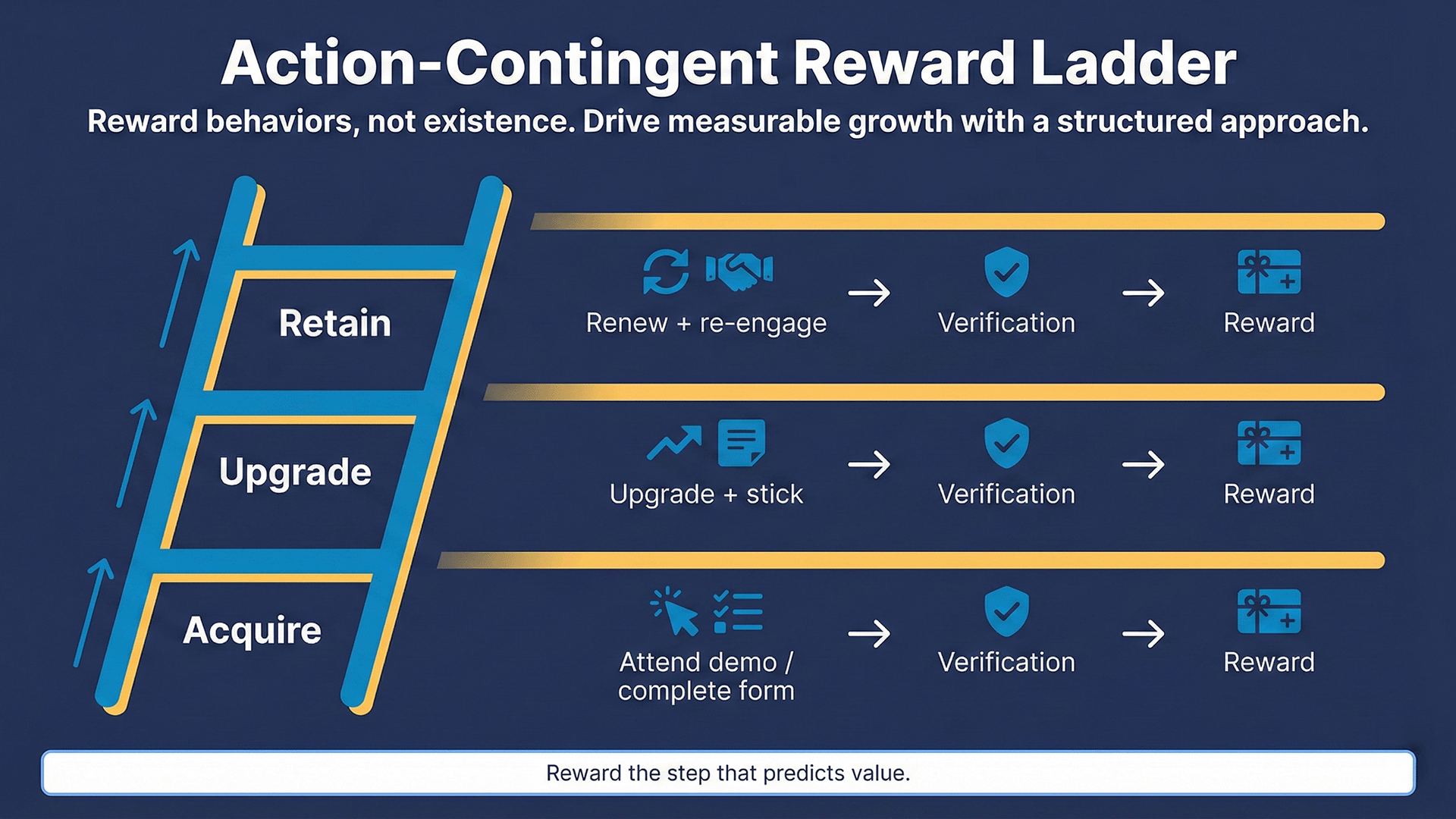
Swap #1: Acquisition
Discount you’re tempted to run: “20% off if you book today.”
Reward swap: “Book (or attend) the demo, earn a reward.”
Best For
- trial starts
- demo requests
- quote requests
- first appointment show-rate
- lead form completion (when quality is already decent)
The Behavior to Reward
Pick ONE. Don’t overcomplicate it.
Good options:
- Attend the demo (not just schedule it)
- Start the trial and complete step 1
- Submit a qualified intake form
Make sure to reward after the step is completed to avoid paying for noise.
Offer Framing That Works
- “Attend your demo and receive a reward.”
- “Start your trial and complete setup to unlock it.”
- “Submit a verified request and it’s yours.”
No need to resort to gimmicks, play it straight and treat your customers / prospects respectfully.
Guardrails
- Eligibility rules: only specific segments or domains.
- Verification: “completed” means your system confirms attendance.
- One per person: cap per email, phone, or account.
- Time-bound window: activation expires if they don’t claim.
How Promotion Vault Fits
- Use a Promotion tied to a clear action.
- Track Sent → Activated → Completed.
- Use an activation window to bound liability.
- Use the built-in reminder cadence to drive claiming.
- Use branded comms so it feels legitimate.
What to Measure Weekly
- scheduled rate (if relevant)
- show rate (the big one)
- activation rate
- cost per attended demo
- sales-qualified rate downstream
- cost per qualified opportunity
Don’t judge this on clicks. Judge it on verified attendance and pipeline quality.
Swap #2: Upgrade and upsell
Discount you’re tempted to run: “Save 25% on annual.”
Reward swap: “Upgrade, and we’ll reward the step.”
This one is powerful because discounts can cheapen the upgrade story.
Best For
- tier upgrades
- add-ons
- annual switches
- seat expansions
- premium onboarding packages
The Behavior to Reward
Choose the action that signals commitment.
Good options:
- upgrade and stay active for 14 days
- upgrade and complete onboarding
- add an add-on and hit the first milestone
This reduces friction after commitment and encourages retention.
Offer Framing That Works
Make it feel like recognition.
- “When you upgrade, we’ll thank you with a reward.”
- “Upgrade today. Once setup is complete, it unlocks.”
Guardrails
- Delay the reward trigger until the upgrade sticks.
- Exclude refunds/cancellations within X days.
- Set a cap by segment or plan type.
- Use a single reward per account per period.
How Promotion Vault fits
- Trigger the reward from your CRM or billing event.
- Automate the send when the rule is satisfied.
- Keep the activation window tight.
- Let reminders do completion work.
- Keep finance calm with activation-based spend.
What to measure weekly
- activation rate
- upgrade conversion rate
- upgrade retention at 14/30 days
- net revenue impact after reward cost
- support volume (did this reduce friction?)
- refund rate (watch this closely)
If refunds rise, tighten the trigger timing. Don’t optimize the copy first.
Swap #3: Retention and reactivation
Discount you’re tempted to run: “Come back for 30% off.”
Reward swap: “Come back and complete a milestone, earn a reward.”
Discounts can reactivate people. They also teach churn-and-return behavior. Rewards let you tie the incentive to real re-engagement.
Best For
- renewals
- winback campaigns
- reactivation after inactivity
- usage milestones for sticky adoption
The Behavior to Reward
Good options:
- renew and complete the first session
- return and complete a milestone in week one
- reactivate and finish onboarding step two
Rewarding renewals alone can still overpay. Reward renewals + engagement instead.
Offer Framing That Works
- “If you come back and complete your first milestone, we’ll send a reward.”
- “Renew and follow through — we’ll thank you.”
Guardrails
- Exclude serial churners or cap by history.
- Require minimum engagement before the reward triggers.
- Define a window (7–30 days) for completion.
- One per customer per quarter is a common sanity rule.
How Promotion Vault Fits
- Segment your list in your system.
- Trigger rewards only after verified re-engagement.
- Use branded comms to reduce suspicion.
- Use reminders to drive activation inside the window.
- Report cleanly in the status chain.
What to Measure Weekly
- LTV change
- reactivation rate
- retention at 30/60/90 days
- activation and completion rate
- cost per retained customer
- discount dependency trend over time
P.S. Don’t call it a win on day seven. Retention wins need time to prove themselves.
One Rule That Applies to All Three Swaps
Reward the step that predicts value, not the step that’s easiest to count. That’s how you stop incentives from becoming waste. And it’s how you replace discounts without losing momentum.
Real-World Case Studies That Prove Rewards Beat Discounts
Here are three documented Promotion Vault case studies that show the pattern BHN is pointing at — better outcomes without training people to wait for a sale.
Case Study #1: ClassPass — Trial to Paid + Early Retention
ClassPass didn’t discount their subscriptions. They rewarded the actions that mattered.
What they did (two-step incentive play):
- Offered a $35 “join now” reward at the trial-to-paid moment.
- Followed with a $10 “4 classes in 30 days” reward to drive early engagement.
What they reported:
- 62% activation from free trial to paid.
- +16% lift in D30 engagement for the “4 classes” milestone.
Why this matters:
They didn’t make the product cheaper. They made follow-through easier. They used rewards to reduce drift at the exact moments people quit.
Case Study #2: Club Pilates — 3 Pivotal Steps, 3 Contingent Rewards
Club Pilates tackled the real funnel. Not just the checkout page.
What they did (three action-contingent rewards):
- $10 to book and attend an intro class.
- $30 to join.
- $30 to upgrade.
What they reported:
- +36% intro-class attendance.
- +43% new-member conversions.
- +23% plan upgrades.
Here’s the important design choice: They didn’t run a blanket “25% off membership” promo. They built a ladder. Each reward matched a real commitment step — and increased conversion at every stage used.
Case Study #3: Orangetheory — Tiered Referral Rewards Instead of Discounts
Referral programs fail for predictable reasons. They’re generic, hard to track, reward too late, have too much friction, or don’t target high-intent users. Orangetheory changed the structure.
What they did:
- Designed tiered, behavior-based rewards across the referral journey.
- Automated the process through Promotion Vault.
What they reported:
- 78% increase in referrals submitted.
- 23% increase in intro class sign-ups.
- 42% increase in new members from referrals.
The lesson is: referrals need a system. And systems need incentives that match the journey.
What These Cases Have in Common
Across all three, the pattern is consistent:
- Rewards were contingent on real actions.
- Rewards were timed at the friction points.
- The program was measurable end-to-end.
- The offer preserved price integrity.
Discounts usually skip all of that. They just lower the price and hope the right people show up. This is ultimately what BHN’s research calls out. It’s not that rewards are nicer, it’s that they’re more controllable and don’t eat away at perceived value or P&L margins.
Common Concerns and Candid Answers
If you’re a serious operator, you’re already thinking, “Okay, but what about the downsides?”
That’s always a good headspace to be in. We’re not asking you to trust us, either. With proper design and governance, you don’t need to. That’s the whole point.
Here are the objections we hear most — and how we answer them.
Objection 1: “Incentives attract low-quality leads.”
Sometimes. Yes. If you reward the wrong behavior, you’ll buy noise. If you reward too early, you’ll pay for people who were never serious.
The fix is simple and easy: reward intent, not curiosity.
What that looks like in practice:
- Reward attendance, not scheduling
- Reward completed onboarding, not sign-up
- Reward qualified requests, not any form fill
- Reward renew + engagement, not renewal alone
We’re not trying to inflate top-of-funnel volume. We’re trying to increase completed, value-producing actions.
Guardrails that help:
- eligibility rules (segment, geo, domain, customer status)
- verification (the action must be confirmed in your system)
- per-person caps (one per email/account/period)
- activation windows (no forever liability)
If you do those four things, low-quality leads or customers stop being a fear and becomes a measurable variable.
Objection 2: “This feels like bribery.”
I get why that lands, especially if you’ve seen incentives used to manipulate people into bad decisions.
Here’s the line we hold:
A reward is ethical when it compensates effort and respects autonomy. A reward is unethical when it hides information, exploits vulnerability, or pressures someone into harm.
So we design around fairness:
- The recipient can say no.
- The offer is clear.
- The action is legitimate.
- The reward matches the effort.
- There’s no bait-and-switch.
Rewards can easily be used with integrity — more easily than discounting, actually — because the trade is explicit. Discounting can be coercive, exploiting scarcity and anxiety.
Objection 3: “Finance will hate this.”
Finance hates ambiguity. Not incentives. Most incentive programs fail finance because:
- spend is paid upfront
- breakage becomes messy
- there’s no clean status chain
- reconciliation is painful
- ROI claims are fuzzy
That’s why we emphasize:
- pay on activation (spend tied to engagement)
- activation windows (bounded obligation)
- clear statuses (shared truth)
- reporting exports (clean review and reconciliation)
If your incentive program can fit on one slide, finance relaxes.
Finance-proof framing: “We’re replacing a margin-eating discount with a controlled, measurable, action-contingent reward. We only pay when recipients activate, within a defined window.” That’s a budget conversation — not a marketing pitch.
Objection 4: “Legal and compliance will block it.”
Sometimes they will — if you ambush them late. The move is to involve them early with specifics.
What legal tends to care about:
- clear terms (eligibility, limits, expiration)
- privacy (what data is collected and why)
- anti-bribery / procurement rules (especially in B2B)
- fairness and non-discrimination
- auditable reporting
Incentives get approved more often when they’re governed. (And they should always be governed anyway, if only to ensure ROI.)
The practical approach:
- start with a small pilot
- define eligibility and caps
- document the trigger logic
- store reporting artifacts
- keep comms honest and plain
When teams do that, the conversation becomes constructive.
Objection 5: “This will spam people and hurt trust.”
It can — if you treat reminders like a blunt-force object. A healthy incentive cadence is bounded and respectful:
- a defined activation window
- a limited number of reminder attempts
- reminders that stop when recipients activate
- clear sender identity and branding
- unsubscribe/opt-out honored
If you send a reward and never remind, you’ll get waste. If you remind endlessly, you’ll get resentment. The right path is middle — operational respect and empathy.
Objection 6: “We’ll get abused or gamed.”
You should assume some level of abuse. That’s not pessimism. That’s systems-awareness. But fraud risk is not a reason to default back to discounts. Discounts get abused too — just differently.
Common guardrails:
- cap rewards per person/account/period
- require action verification before the reward triggers
- restrict eligibility to known customers, verified emails, or certain cohorts
- delay reward issuance until the action “sticks” (e.g., upgrade remains active for 14 days)
- monitor outliers (activation spikes from one domain, repeated identities, unusual velocity)
No system on earth is 100% abuse free. But when reward programs are built properly, abuse is contained, visible, unprofitable for abusers, and protective of your margins.
Objection 7: “This seems complicated. Discounts are simple.”
Discounts are one lever. Rewards are a system. So it’s true that there’s a bit more complexity. But that’s also why rewards are safer long-term.
Discounts are simple to launch and hard to unwind. Rewards are slightly harder to launch and easier to govern. And they become exponentially easier when you use a plug-and-play pay-on-activation platform like Promotion Vault.
And once your first program is built, it becomes easily reusable:
- the status model stays the same
- the comms templates stay the same
- the reporting stays the same
- the triggers become copy/paste patterns
This is how teams move from promo panic to repeatable growth.
Your Pilot Program Launch Checklist
If you take one thing from this article, let it be this: Don’t debate rewards versus discounts in the abstract. Run a pilot you can measure. It doesn’t have to be a giant, grand program. In fact, a single, bounded test is preferable.
Here’s a checklist you can use without reorganizing your entire quarter.
Step 1: Pick One Behavior
Choose the step that most reliably predicts revenue.
Good examples:
- attended demo (not scheduled)
- trial started + setup completed
- intro class attended
- upgrade + 14 days retained
- renewal + first milestone completed
- referral validated (not just submitted)
To be clear, more clicks is not a behavior. It’s a metric. Reward the action.
Step 2: Pick One Segment
Segmenting is not stinginess. It’s responsible design. Start with a cohort where you expect lift and can validate quality:
- high-intent leads
- specific geo
- specific channel
- warm accounts
- reactivation cohort with a clean definition
This is how you avoid paying for people who were going to take your desired action anyway.
Step 3: Pick a Bounded Window
You need enough time to learn, not enough time to drift.
A clean pilot has:
- a start date
- an end date
- a defined activation window for recipients
- a maximum reward budget cap
2-4 weeks is often a good testing window. This provides constraints, measurability, and increases stakeholder trust that things won’t sprawl.
Step 4: Define the Offer
Write your offer as one sentence:
“If you do X by Y, you’ll receive Z.”
That’s it. If you need three paragraphs, the offer isn’t clear.
Step 5: Build Guardrails Before Launching
This is the difference between clean incentives and a mess that’s hard to understand or clean up.
Minimum guardrails:
- eligibility rules
- one per person/account
- verification of the action
- activation window
- escalation path for support
Don’t skip this. You’ll pay for it later, if you do.
Step 6: Choose Your Measurement Model
Before the first send, decide what you will report.
Track:
- Sent
- Activated
- Completed
- time-to-activation
- cost per activated outcome
- incremental lift vs baseline (or pre/post)
Step 7: Launch with Promotion Vault
This is where Promotion Vault removes the busywork and the waste.
You can:
- configure the activation window
- send via Promotions or Reward Links
- use branded comms so recipients trust it
- use reminder cadence to drive activation
- report on Sent → Activated → Completed
- pay reward value only when recipients activate (not simply when sent)
That last line is the difference between a proof-of-concept test being “pilotable” vs. “too risky.”
Step 8: Review Weekly
Weekly is enough. Daily makes teams flail.
Look for:
- Where drop-off happens (Sent → Activated is often a trust/comms issue)
- Whether activation is fast or slow (time-to-activation reveals urgency)
- Whether downstream quality is holding (SQL rate, retention, refunds)
Then change ONE variable:
- offer value
- segment
- trigger timing
- reminder pacing
- verification rule
It’s important to only change one variable at a time so you can measure impact properly.
Step 9: Summarize in One Slide
If you want this to scale, you need a clean internal narrative.
One slide:
- who we targeted
- what action we rewarded
- how many were sent
- activation + completion rates
- cost per activated outcome
- what changed vs baseline
- what we’ll test next
That’s how you earn budget.
What to do Next to Increase Growth
If you’re still reading, you probably have the same tension most operators carry: You need growth now, but you don’t want to mortgage the future with discounts.
Discounts are the obvious lever because they’re familiar. But the cost is rarely confined to the campaign. It spills into pricing expectations, margin, and trust.
Rewards and incentives give you a different path — one that can be both urgent and accountable.
You can:
- reward specific actions
- target specific cohorts
- measure the journey end-to-end
- cap spend with a defined window
- and (with pay on activation) avoid paying for unclaimed value
And that’s the real promise: Replace discount dependency with a measurable behavior engine.
Your Operator Plan of Attack
If you’re planning to run a discount in the next 30 days to hit a target, then run one reward pilot first — a single action, a single segment, a bounded window — and measure it with Sent → Activated → Completed.
That pilot will do one of two things:
- It works — and you’ve found a stronger lever than discounting.
- It doesn’t — and you learned cheaply, without rewriting your price story.
Either way, you’re no longer guessing.
Let Promotion Vault Help
If you want help designing a reward program that can actually replace discounts (and hold up in front of finance and legal), book a 15-minute call with our team.
We’ll keep it simple:
- what step you need to move
- what segment to start with
- what guardrails to set
- what success looks like in week one and week four
No pressure. Just a plan you can run.
Frequently Asked Questions About Discounts and Instant Rewards
Are rewards and incentives really better than discounts?
Often, yes — when you structure them as action-contingent. Discounts reduce price for everyone who buys. That includes people who would have purchased anyway. A reward can be tied to a specific action that creates value (attending a demo, completing onboarding, upgrading and sticking, renewing and re-engaging). That makes incentives easier to govern and measure — and often more efficient.
Won’t incentives attract low-quality leads?
They can — if you reward too early. The fix is to reward verified intent:
- attend the demo (not schedule it)
- complete setup (not sign up)
- hit the first milestone (not “start”)
- renew + re-engage (not renew alone)
Add caps and eligibility rules. Then measure downstream quality (SQL rate, refunds, retention). If quality drops, tighten the trigger.
How do I choose the right incentive amount?
Start with the smallest reward that changes behavior. Think of it like this:
- The reward is compensation for friction — time, effort, follow-through, or social risk.
- If you’re paying a large reward for a tiny action, you’re buying noise.
- If you’re paying a tiny reward for a hard action, it won’t move anything.
In practice, the “right” amount is found through a bounded pilot:
- pick one action
- pick one segment
- test 1–2 values
- measure cost per activated outcome and downstream quality
What’s the difference between “sent,” “activated,” and “completed”?
These statuses are the backbone of measurement.
- Sent: the reward was issued to the recipient.
- Activated: the recipient took the step to claim it (within your activation window).
- Completed: the reward is fully available/usable.
Why it matters: “Sent” is not engagement. “Activated” is engagement. And clean status definitions prevent internal debates from turning into budget fights.
How do I measure ROI on incentives without fooling myself?
Don’t confuse uptake with impact. Track:
- Sent → Activated → Completed
- time-to-activation
- cost per activated outcome
- downstream outcomes that matter (show rate, conversion, retention)
- incremental lift vs baseline (holdout, matched cohort, or pre/post)
What does “pay on activation” mean?
It means you don’t pay the reward value just because you sent it. You pay when the recipient activates (claims) the reward — inside a defined activation window.
This changes the economics of incentives:
- less waste from unclaimed rewards
- easier pilots (lower fear of breakage)
- spend aligned to real engagement
How do I prevent fraud or abuse?
No one can eliminate all abuse. But you can contain it and make it unprofitable.
Common guardrails:
- reward only after verified actions (attendance, milestone completion)
- cap rewards per person/account/period
- define eligibility (segment, customer status, domain rules)
- delay reward triggers until actions “stick” (e.g., upgrade retained for 14 days)
- monitor outliers (velocity spikes, repeated identities, suspicious patterns)
Will reminders make us look spammy?
Not if you design them with respect. Healthy reminder logic:
- bounded activation window
- limited reminder attempts
- reminders stop after activation
- clear sender identity and branding
- opt-out honored
The point isn’t to nag people. It’s to reduce “I forgot” waste — while protecting trust.
Can we run this without engineering?
With Promotion Vault, yes. You can even start with a simple trigger and a small pilot. Many teams begin with:
- a list upload for a cohort
- a Reward Link distribution flow
- a single CRM automation or webhook trigger
Then they graduate into deeper integration once the ROI is proven.