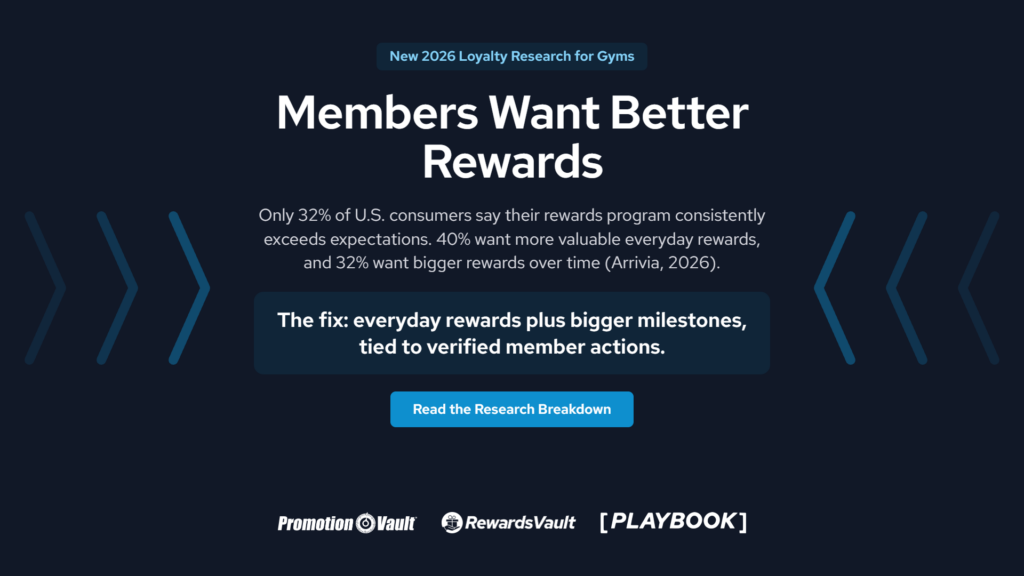
A 2026 arrivia survey found 90% of U.S. consumers expect to stay loyal to their preferred brand (but expecting to stay isn’t necessarily staying). Only 32% say its rewards program consistently exceeds expectations. Businesses plan to spend more, and that spend should be data-backed and performance-based. For gyms, that means rewarding verified actions members value and making rewards easy to claim.
TLDR — What the 2026 Loyalty Research Means for Gyms
- 90% expect to stay loyal, but intent isn’t behavior
- Only 32% say rewards consistently beat expectations
- About 1 in 3 gym members still leave each year
- 86% of leaders expect loyalty budgets to grow
- Rewards and redemption lead planned upgrades
- Make new spend data-backed and performance-based
- Offer small everyday rewards and bigger milestones
- Reward verified visits and referrals, not sign-ups
- Reward early, and make claiming fast and flexible
- Explore PLAYBOOK to reward the actions that count
- New Arrivia Research Reveals a 90/32 Loyalty Gap
- What Is in Arrivia’s 2026 Customer Loyalty Survey?
- What Loyalty Insights Matter Most for Gyms?
- Which Loyalty Program Statistics Should Operators Watch?
- What Does the Latest Engagement Research Say?
- What Engagement Insights Can Gyms Use Right Now?
- Why Is Loyalty Program Redemption the Top Upgrade?
- Where Should Operators Put New Loyalty Investment?
- Why Is PLAYBOOK Built for This Moment?
- Frequently Asked Questions About Loyalty & Engagement
- What Should Operators Do With These Findings?
New Arrivia Research Reveals a 90/32 Loyalty Gap
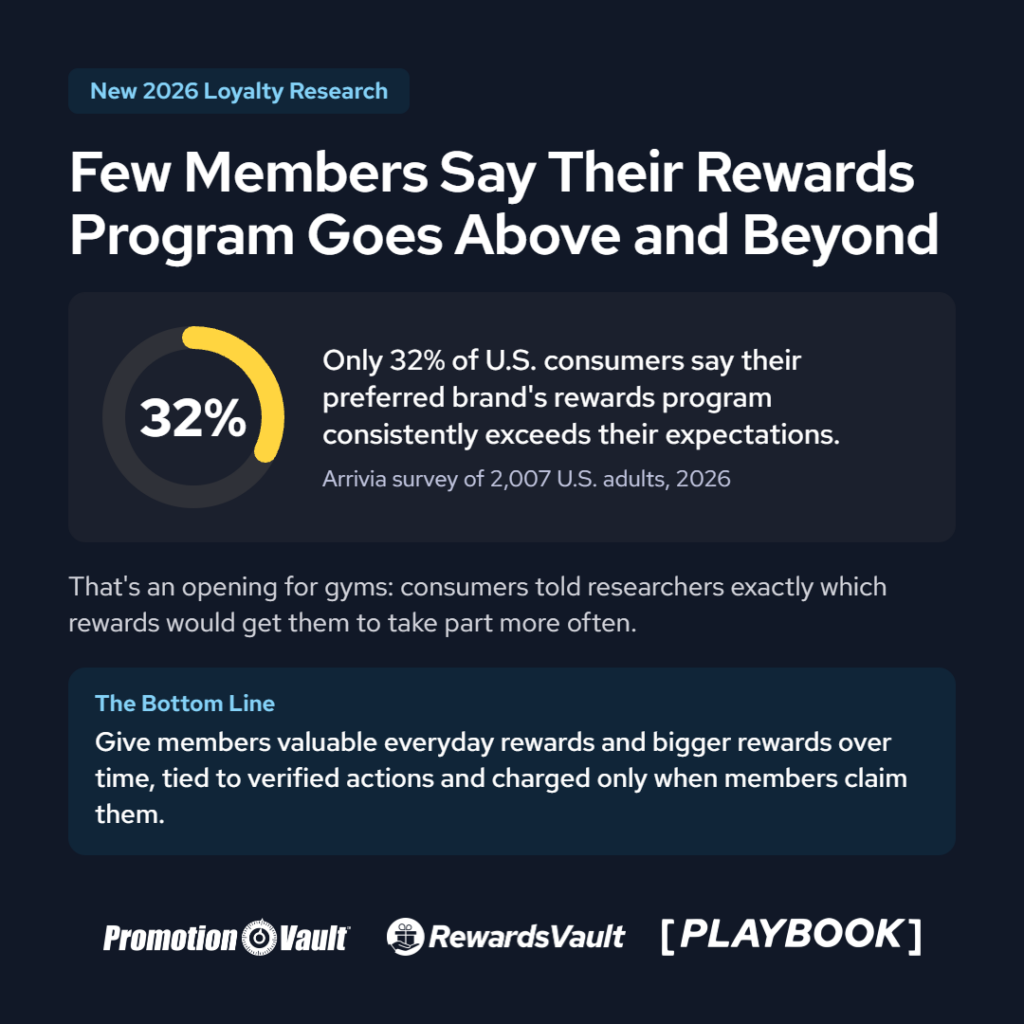
Nine in 10 U.S. consumers expect to stay loyal to their preferred brand, but only 32% say its rewards program consistently exceeds their expectations. Those two numbers anchor Beyond Enrollment: The Wins, Losses and Opportunities in Loyalty, a report that travel technology company Arrivia released on Nov. 9, 2026. The same study found that 86% of business leaders expect loyalty budgets to grow over the next two years.
Read that 90% with care. It measures what people expect to do, not what they will do, and it comes from people describing brands they already prefer. Bond’s 2026 Loyalty Report adds a warning. Consumer spending is concentrating among fewer preferred brands, so programs that fall behind face growing risk. Loyalty that people expect to give can still be lost.
For gym and studio owners, this hits close to home. Dues can renew for months while a member skips class and never brings a friend.
Having run clubs and worked the floor, we know how easy it is to read steady renewals, or good intentions, as proof that a program works. Neither one is a reason to pull back on engagement. With budgets rising, the next loyalty dollar should be data-backed and performance-based: spent on real actions members choose, rewarded soon after they happen, and measured against results.
Key Loyalty & Engagement Terms To Know
- Customer Loyalty Survey
- Research that asks customers how likely they are to stay with a brand and how they feel about its rewards program.
- Loyalty Program
- A structured way to reward people for repeat business, such as points, perks, discounts, or earned rewards.
- Member Engagement
- How often members take valuable actions beyond paying dues, such as visits, classes, referrals, feedback, and reviews.
- Loyalty Program Redemption
- The moment a member claims and uses a reward they earned. A reward that sits unclaimed does not change behavior.
- Loyalty Investment
- The money a business spends on rewards, member benefits, and the technology that runs its loyalty program.
- Verified Action
- An action confirmed through club data, a QR scan, a staff code, or SMS verification before any reward is released.
- Pay for Results
- Promotion Vault’s pricing model. There are no setup costs or monthly fees. For applicable Rewards Vault rewards, a 10% service fee applies when a reward is sent, and the face value is charged only when the member claims it.
What Is in Arrivia’s 2026 Customer Loyalty Survey?
The 2026 customer loyalty survey from Arrivia polled 2,007 U.S. adults and 250 loyalty and benefits leaders across six sectors. Consumers say they expect to stay loyal, though intent is not behavior, and they give rewards programs modest praise. Businesses plan to spend more. It’s cross-industry vendor research, so we read it as a sign of direction for gyms.
The consumer survey ran July 22 to 29, 2026. A separate business survey ran June 29 to July 14. It covered managers and senior leaders at companies with at least 250 employees. According to Arrivia, comparisons between the two surveys show direction only, since the consumers did not come from the businesses surveyed.
It also helps to know who is talking. The company sells travel benefits to loyalty programs and says it serves more than 50 million members. Its focus on travel rewards reflects that business. Still, its main findings matter to any membership business.
Beyond the headline numbers, Arrivia reported that better rewards and redemption top the list of planned upgrades, with loyalty software and AI tools next. Health and wellness stood out in the sector data. In that group, 63% of organizations plan to spend more on AI, compared with 49% of businesses overall.
What Loyalty Insights Matter Most for Gyms?
The core loyalty insight is that expecting to stay, staying, and engaging are different things. A member who plans to stay can still cancel, and one who renews may never use a rewards program. Operators need to know which rewards members want to earn and claim, and which ones lead to more visits and spending.
Why Steady Renewals Can Mislead
Ashley Wilson, Chief Client Officer at Arrivia, put the gap plainly when the report came out.
“Customers may renew their memberships or continue making purchases without ever using their rewards program. Strong retention doesn’t necessarily mean the program is influencing their behavior.” — Ashley Wilson, Chief Client Officer, arrivia
Wilson added that with budgets rising, businesses must learn whether their spending gives customers more reasons to engage beyond their usual purchases.
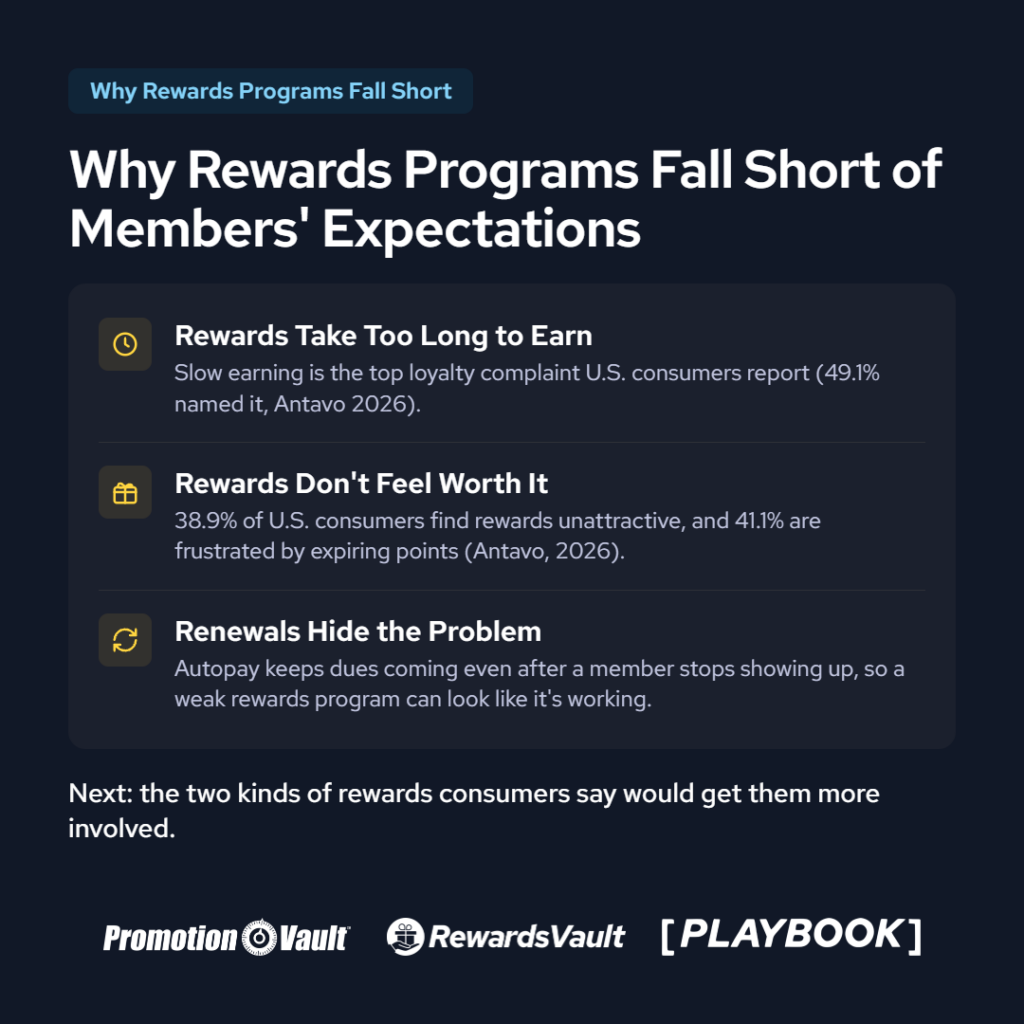
Gyms feel this more than most, because dues recur. Autopay keeps revenue coming whether or not a member walks in. Good intentions don’t guarantee renewals either. The Health & Fitness Association’s 2025 Fitness Industry Benchmarking Report puts average yearly member retention at 66.4%. Put simply, about one in three members leaves each year, whatever they expected when they joined.
What the Fitness Data Adds
In its Mid-Year 2026 Wellness Watch, ABC Fitness reported that gym check-ins rose just 1% from a year earlier in the first half of 2026. Cancellations rose 8%. Studios moved the other way, with check-ins up 27% and cancellations down 6%. Two of the priorities ABC Fitness named for operators fit this research well: reinforce repeat behavior and make value visible.
Visits and conversations move retention, and clubs can measure both. Dr. Paul Bedford, a researcher known as the Retention Guru, studied 78,071 member visits. After one staff conversation, a member was 20% more likely to come back the next month. With four or more interactions, a return was roughly 80% more likely. Members who visited four or more times a month stayed seven months longer.
“A renewal tells us a member stayed. Claimed rewards for verified visits tell us what members actually did.” — Promotion Vault CEO Brian Mitchell
Which Loyalty Program Statistics Should Operators Watch?
The most useful loyalty program statistics compare what people plan to do with what they actually do. Across 2026 research, plans to stay and to join programs run high, but plans don’t guarantee behavior. Praise for rewards, claimed rewards, and repeat visits lag behind. The table below pairs headline numbers with what each one means on a gym floor.
| Statistic | Source | What It Means for a Club |
| 90% expect to stay loyal; only 32% say rewards consistently exceed expectations | Arrivia, 2026 | Intent is high, but intent isn’t retention. The rewards experience is the weak spot. |
| 40% want more valuable everyday rewards; 32% want bigger rewards over time | Arrivia, 2026 | Mix small, frequent rewards with larger milestone rewards. |
| 26.2% of U.S. loyalty points go unspent; 11.9% expire | Antavo, 2026 | Earned value that never gets claimed does not change behavior. |
| 49.1% say rewards take too long to earn | Antavo, 2026 | Put the first reward within reach in week one. |
| 85% more likely to stay with brands that have loyalty programs; 73% spend more | Bond, 2026 | Well-run programs still change what members do. |
These figures come from research across many industries, not just fitness. We read them as a sign of direction, not gym benchmarks. Where we can, we pair them with fitness data from ABC Fitness and the Health & Fitness Association.
What Does the Latest Engagement Research Say?
Other 2026 engagement research backs up what Arrivia found. Studies from Bond and Antavo show programs drawing sign-ups while preference and claimed rewards lag. Bond also found that brands using technology to support human connection, rather than replace it, saw the biggest gains in engagement, spending, and advocacy.
Human Connection Still Drives Preference
Bond’s 2026 Loyalty Report surveyed 20,591 U.S. loyalty program members from January to March 2026. Programs still shape behavior, as the table above shows. Yet Bond’s Chief Innovation Officer, Sean Claessen, warned that brands are “getting better at generating participation, but not necessarily preference.”
The report also found that AI tools are spreading fast across digital channels, while in-person service lags. Brands that used AI to support human connection reported 2.4 times the engagement and 1.6 times the advocacy. Their members also spent about $500 more per year. For clubs, that finding carries weight, because most member relationships live at the front desk and on the training floor.
Friction Keeps Rewards Unclaimed
Antavo’s Global Customer Loyalty Report 2026 surveyed more than 1,000 U.S. consumers. Slow earning topped their list of complaints. Beyond that, 41.1% were frustrated by expiring points, and 38.9% found rewards unattractive. “Friction is the enemy of loyalty,” Antavo CEO Attila Kecsmar said. Those complaints line up closely with what arrivia’s respondents asked for.
What Engagement Insights Can Gyms Use Right Now?
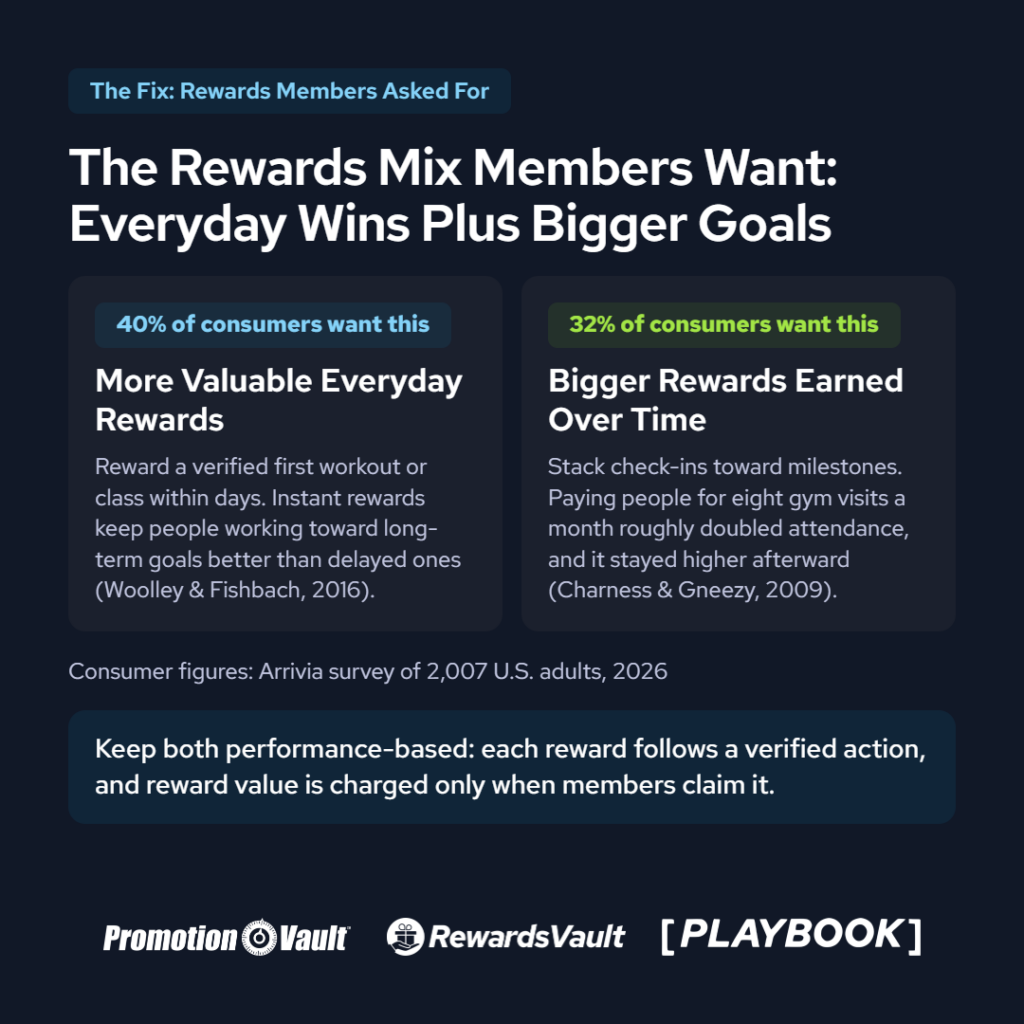
The clearest engagement insights come from what consumers told Arrivia’s researchers. People want more valuable everyday rewards, bigger goals over time, benefits that fit their lives, and simpler ways to earn and redeem. In a club, that means quick rewards for early visits, milestone rewards for steady attendance, real choice, and fast claiming.
How Each Request Plays Out on the Gym Floor
Each request turns into a specific practice:
- More valuable everyday rewards. Reward a verified first workout or class within days, not months. In a 2016 study in the Journal of Consumer Research, Kaitlin Woolley and Ayelet Fishbach found that instant rewards kept people working toward long-term goals better than delayed ones. One of their studies took place at a campus gym.
- Bigger rewards earned over time. Stack check-ins toward milestones. In a 2009 Econometrica study, Gary Charness and Uri Gneezy paid people to attend a gym eight times in a month. Attendance roughly doubled and stayed higher after the payments ended. Paying for a single visit produced no lasting change.
- Benefits that fit a member’s life. Two-thirds of consumers in the survey would value travel perks over a program limited to discounts, points, or cash. We don’t sell cruises, but the lesson carries over: people want rewards that match how they live. Gift cards from many brands, club merchandise, discounts, and guest passes let each member pick something they want.
- Easier to earn and redeem. Cut steps. Every extra login, form, or code between the action and the reward is another chance for the member to drop off.
None of these practices replace the staff conversation. Instead, each one gives staff a concrete reason to start one, such as an invitation to scan a QR code or bring a friend.
Why Is Loyalty Program Redemption the Top Upgrade?
Loyalty program redemption is where an earned reward becomes value a member can feel. In Arrivia’s business survey, rewards and redemption top the list of planned upgrades. Antavo found that more than a quarter of U.S. points go unspent. Rewards that arrive fast, offer choice, and live in one branded place give members fewer reasons to leave value behind.
A claimed reward is one of the clearest engagement signals a club can get. It shows the member noticed the reward, valued it, and acted. An unclaimed balance shows the opposite, even when it looks like savings on a spreadsheet. (We cover the cost side in our guide to gift card breakage.)
What Fast, Simple Redemption Looks Like in a Club
Here is the path in PLAYBOOK, our engagement platform, using a member’s check-in as the example:
- The member scans a QR code at the front desk, or club data confirms the visit.
- When they first join, a six-digit text code confirms who they are.
- Next, a game such as Scratch to Reveal shows the reward they earned.
- Promotion Vault texts a reward link that names the club. In our production testing, these texts arrived within about a second to a minute of the reveal.
- The link opens Rewards Vault, branded with the club’s logo and accent color, where the member picks a gift card brand and value.
- If the member hasn’t opened the link, a reminder text follows.
Rewards Vault shows available and pending balances, plus a history of redeemed rewards and transactions. Inside it, Momentum shows completed milestones and the next step to take. Discounts, guest passes, and merchandise stay part of the wider rewards program, though they don’t appear in the Vault’s earnings display. Because we charge face value only when a member claims a reward, reward spend follows real member action.
Where Should Operators Put New Loyalty Investment?
New loyalty investment should be data-backed and performance-based. Fund rewards for verified visits, referrals, upgrades, renewals, feedback and reviews, measure what each one produces, and pay reward value only when members claim. Skip sign-up counts and blanket discounts. That answers Arrivia’s core question: is the money giving members more reasons to engage?
What Smarter Loyalty Spending Looks Like
Budgets are heading up, and AI is a bigger priority in health and wellness than for businesses overall. More money is not a strategy on its own. Every dollar should trace to a measured result, such as a verified visit, a referral that joined, or a renewal. Bond’s data adds a second caution. Technology works best when it helps the people who serve members. In a club, that means tools that give staff a reason to invite someone, a way to confirm the result, and credit when it happens.
Discounts deserve a note too. In Arrivia’s retail and membership sector, 52% of consumers said better everyday savings would get them to engage more. Everyday value doesn’t have to mean cutting the price for everyone. A review of 51 studies by DelVecchio, Henard and Freling in the Journal of Retailing (2006) found that promotions deeper than about 20% of product value hurt brand preference afterward. Earned club discounts, merchandise, and gift cards tied to specific actions deliver everyday value without broad price cuts. (Read more on why rewards can beat discounts.)
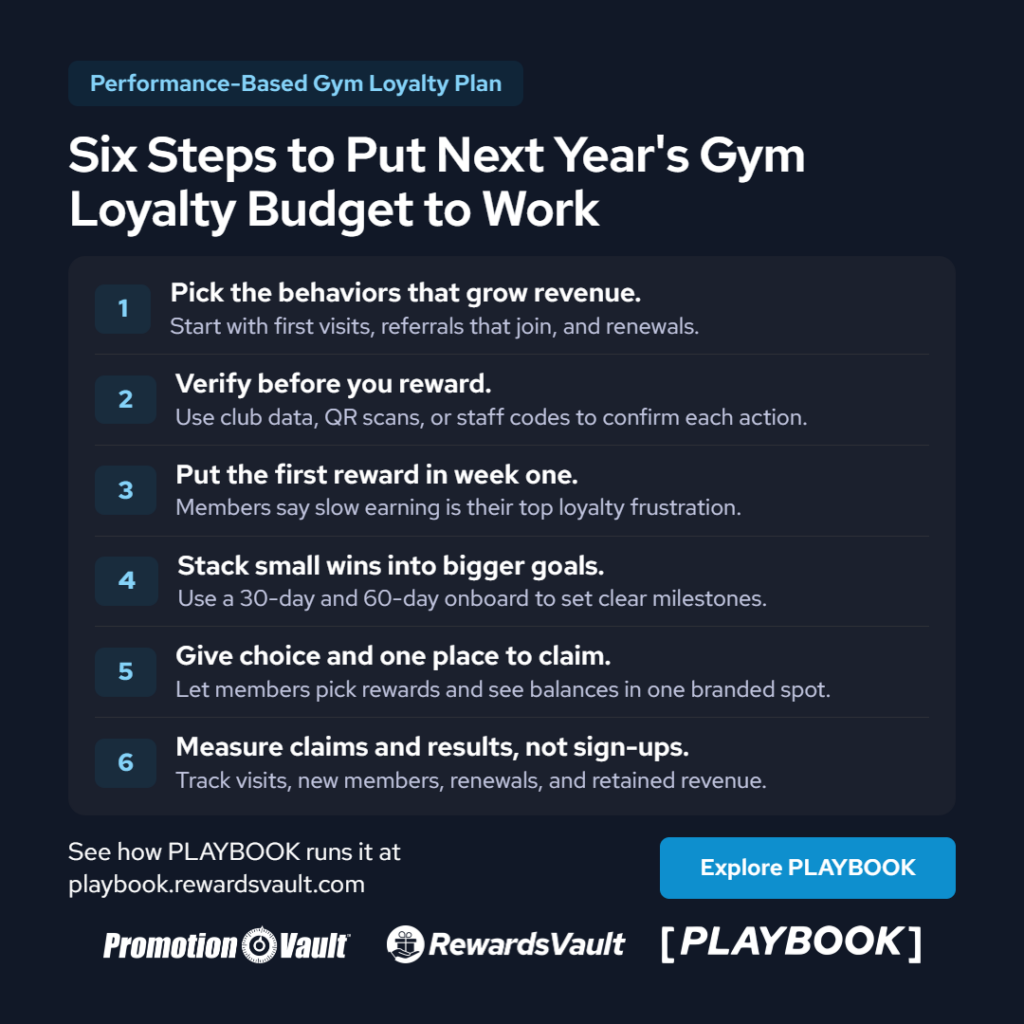
Six Steps to Put Next Year’s Loyalty Budget to Work
- Pick the behaviors that grow revenue. Start with first visits, attended intro classes, referrals that join, upgrades, renewals, feedback and reviews.
- Verify before you reward. Use club data, QR scans, staff codes, and text verification so a submitted name never counts as a visit.
- Put the first reward in week one. Members told Antavo that slow earning is their top frustration.
- Stack small wins into bigger goals. A 30-day onboard and a 60-day onboard give new members clear milestones while habits form.
- Give choice and one place to claim. Let members pick rewards they value and see balances and next steps in one branded spot.
- Measure claims and results, not sign-ups. Track completed visits, new memberships, referrals that join, renewals, and retained revenue.
Why Is PLAYBOOK Built for This Moment?
We built PLAYBOOK for the gap Arrivia just measured. It rewards verified actions instead of sign-ups and gives staff credit for the business they help create. Members choose rewards they want, and clubs pay reward value only when a member claims it. Owners can see which everyday interactions produce visits, joins, referrals, and renewals.
How a Loop Turns a Floor Conversation Into a Result
The gym floor is the new CRM (customer relationship management system). Every welcome, check-in, and friend brought along is a chance for another visit, referral, or renewal. PLAYBOOK turns those moments into Loops. Each Loop is a repeatable cycle with four steps. First, a member does something valuable. Next, PLAYBOOK verifies it. Then the member gets a reward or recognition, and the next step appears. Staff can earn credit for the same verified result.
Loop types include Leads, Referral, Review, Recognition, Upgrade, and Custom. Games make each action more engaging, with formats such as Scavenger Hunt, Bingo Card, Spin to Win, Scratch to Reveal, Get in the Game, and Streaks and Tiers. An operator’s Playbook connects Loops into one member journey, and each person can start wherever they are.
Reviews stay compliant. Rewards recognize taking part in a feedback request, never a review’s rating or sentiment, and posting a public review is always optional. PLAYBOOK also works on top of the systems clubs already run, including ABC Fitness data, and our team helps owners run each program. Replacing overlapping tools is an option, never a requirement.
What Operators Have Seen
Promotion Vault has helped more than 5,000 customers and sent more than 2 million rewards. Our customers have seen more than $250 million in increased revenue and an average revenue lift of 20%. Two fitness programs show what happens when rewards follow each step of progress instead of only the final sale:
- A boutique fitness franchise paid $5 when a referral was submitted, $15 when the friend attended a workout, and $55 when the friend joined. Reported results included 78% more referrals, 23% more intro class sign-ups, and 42% more new members.
- A boutique studio brand paid $10 for intro-class attendance, $30 for joining, and $30 for a later upgrade. Reported results included 36% higher intro-class attendance, 43% more new-member conversions, and 23% more upgrades.
How Pricing Follows Results
Pay for results, not rewards. There are no setup costs or monthly fees. For applicable Rewards Vault rewards, a 10% service fee applies when a reward is sent, and the face value is charged only when the member claims it. Unclaimed value stays in the operator’s wallet, and other reward types follow their applicable terms. That keeps loyalty spend performance-based by design. Operators can also see which actions each program produced, so next year’s budget rests on data, not hope.
What a New Member’s First 60 Days Can Look Like
Here is a sample 60-day onboard. On day one, a welcome message invites the member to opt in, and Momentum shows milestones and available rewards. In week one, a verified first workout and staff welcome earn a small reward, and the staff member who made the connection can get credit. Through day 30, a goal such as five verified check-ins builds the habit. Around day 30, the member gets a personal referral link and a chance to share private feedback, with an optional public review. Days 31 to 60 add a second goal, such as eight more check-ins, plus another round of referrals and feedback. Each club sets its own goals, rewards, and eligibility. Our guide to 30-day and 60-day gym onboarding covers the full plan.
Frequently Asked Questions About Loyalty & Engagement
Operators reading the Arrivia report tend to ask a handful of practical questions. Most start with the 90% figure and whether data from other industries applies to fitness. Many also ask how to measure engagement, how staff get credit, whether gyms can reward reviews, and whether PLAYBOOK means replacing current software.
If 90% Expect to Stay Loyal, Do Gyms Still Need Loyalty Programs?
Yes. The 90% figure measures expectation, not behavior, and it comes from people describing brands they already prefer. In fitness, about one in three members still leaves each year. Engagement programs are how a club turns good intentions into visits, referrals, and renewals, so they matter most when loyalty looks safe.
Does Arrivia’s Loyalty Research Apply to Gyms?
Yes, as a sign of direction. The survey covered six sectors, not just fitness. Its main finding still fits gyms well: people can renew without ever using a rewards program. Gym data from ABC Fitness and the Health & Fitness Association, covered above, points the same way.
How Should Gyms Measure Loyalty Program Engagement?
Count completed actions, not sign-ups. Good measures include verified first visits, attended intro classes, monthly check-ins, referrals that join, upgrades, renewals, and how many rewards get claimed. Pair them with retained revenue to see which rewards and staff chats lead to dues that stay. Our guide to customer retention software for gyms covers what to track.
How Do Staff Get Credit for Member Engagement?
In PLAYBOOK, staff credit follows what the member does, not just what a staff member logs. A unique staff code or QR scan links an invitation to the visit, join, or purchase that follows. The Recognition Loop then rewards results that qualify, so owners can see who on the team helps grow the business.
Can Gyms Reward Members for Reviews?
Gyms can reward members for taking part in a feedback request, as long as the reward never depends on a review’s rating or sentiment. In PLAYBOOK’s Review Loop, every participant gets the same reward path. Private feedback goes straight to the club, and posting a public review is always optional.
Does PLAYBOOK Replace Our CRM or Club Software?
No. PLAYBOOK works on top of the systems clubs already use. It connects club data, QR codes, staff interactions, and digital activity to verified member actions. Replacing overlapping engagement tools is possible where it makes sense, but you never have to.
What Should Operators Do With These Findings?
Use the arrivia report as a prompt to audit your own program. Count how many members take a valuable action each month, how many earned rewards get claimed, and which staff conversations lead to visits and joins. Then make next year’s loyalty investment data-backed and performance-based, aimed at the actions that move those numbers.
Loyalty budgets are rising across industries, and members are telling researchers what would make them take part. Strong intent gives clubs something to build on, but it still has to be earned with every visit. Clubs that reward real behavior on the gym floor, quickly and with rewards members choose, give members more reasons to come back. That is the work we built PLAYBOOK to do, and our team helps owners run it every day.
Want to see which floor interactions could become verified visits, referrals, and renewals at your club? Book a personalized demo, and we’ll walk through your member journey with you.
Casey Rock is Content Director at Promotion Vault, where he builds the content, SEO, and messaging systems behind the company’s rewards engagement platform. He specializes in turning product value into proof-first stories that drive discovery, trust, and conversions.