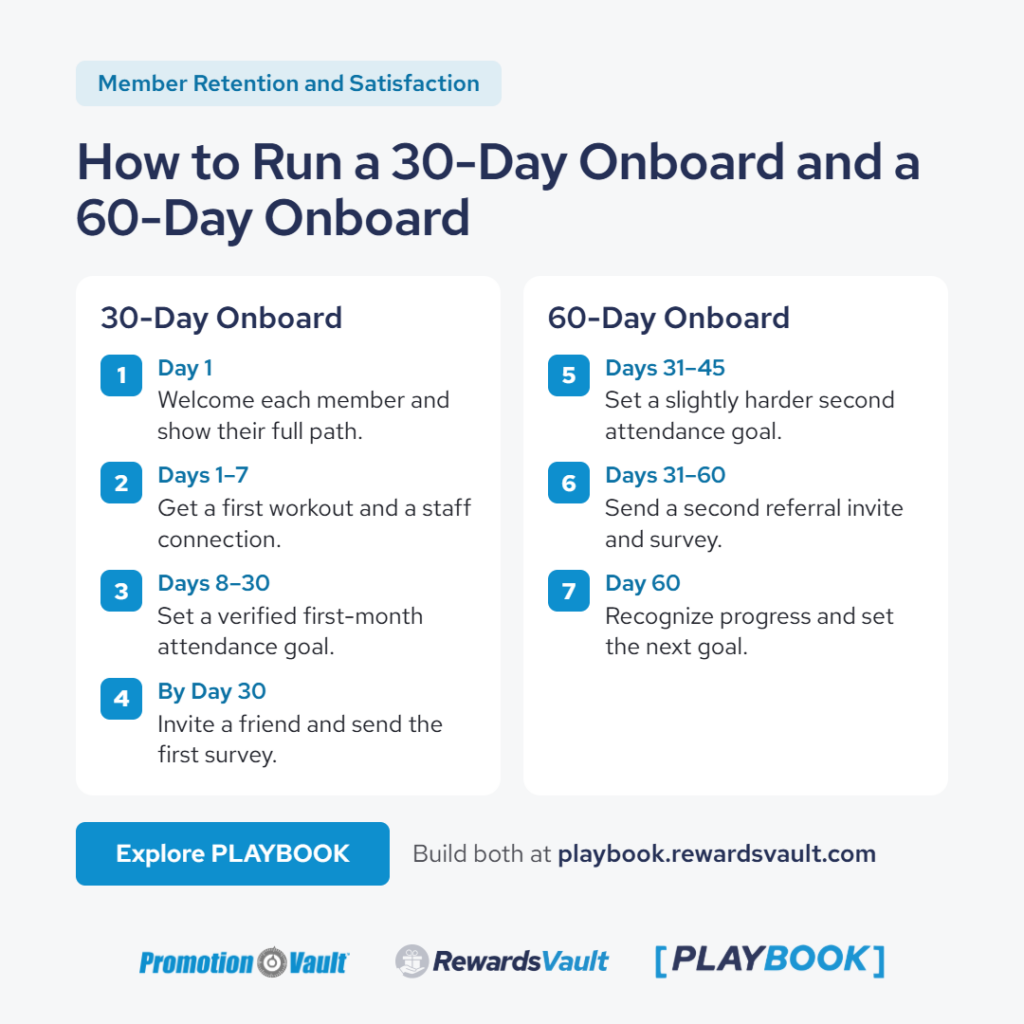
Gyms build 30-day and 60-day onboarding by treating each new member’s first two months as one personal journey. Days 1 to 30 drive a first workout, a staff connection, and an early attendance goal. Days 31 to 60 add a harder goal, a referral invite, and a second satisfaction survey. Verify each step and act on every answer.
TLDR — How to Build 30-Day and 60-Day Gym Onboarding
- Treat a new member’s first 60 days as one journey.
- Win first visits and staff contact in days 1 to 30.
- Use days 31 to 60 to turn visits into a routine.
- Start each member at the step that fits them.
- Give every new member a named staff contact.
- Verify each milestone before a reward goes out.
- Survey satisfaction at day 30 and again at day 60.
- Reward survey completion, never the score.
- Send every low score to a staff member that week.
- Explore PLAYBOOK to build your 30-day onboard.
- Where Did Your Week-One Member Go by Week Six?
- Why Do the First 60 Days Shape Gym Member Satisfaction?
- How Is a 30-Day Onboard Different From a 60-Day Onboard?
- What Should 30-Day Member Onboarding Include?
- What Does 60-Day Gym Onboarding Add?
- How Do You Hyper-Personalize Gym Member Onboarding?
- How Should Gyms Use Member Satisfaction Surveys During Onboarding?
- What Belongs on a Gym Member Onboarding Checklist?
- How Do You Know Onboarding Is Raising Satisfaction and Lifetime Value?
- How Does PLAYBOOK Run a 30-Day and 60-Day Onboard?
- Frequently Asked Questions About 30-Day and 60-Day Gym Onboarding
- So, How Do Gyms Build Onboarding That Increases Member Satisfaction?
Where Did Your Week-One Member Go by Week Six?
On paper, a new member’s first week looks fine. They signed up, set up payment, and checked in twice. By week six, that same member may be down to one visit a week and wondering if the dues are worth it. Nothing dramatic happened. Nobody at the front desk learned their name, and nobody asked how the first month went.
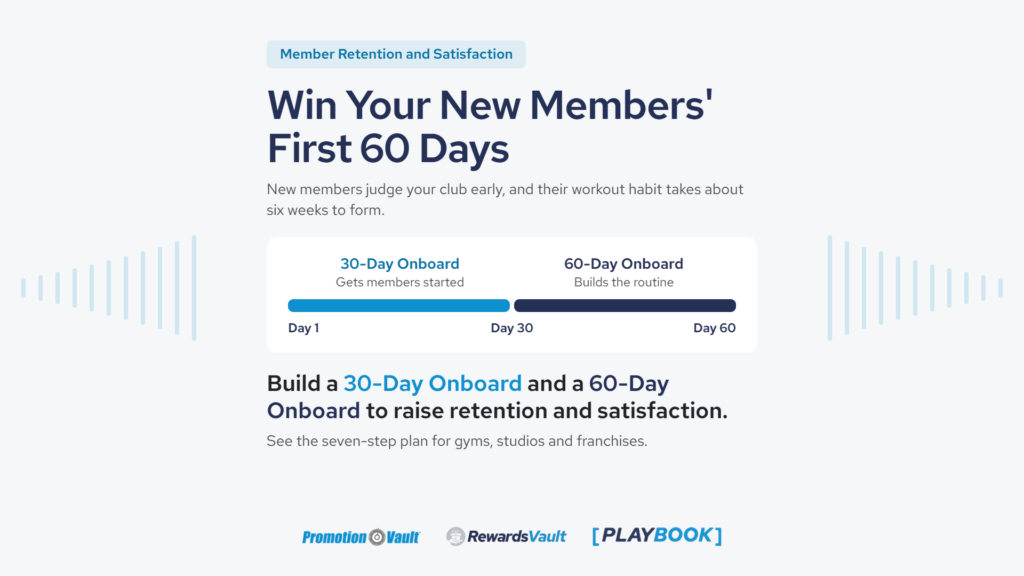
That slide is why we treat onboarding as a 60-day job with two halves. The 30-Day Onboard gets members started and connected to staff. The 60-Day Onboard turns those early visits into a routine. A short member satisfaction survey at each milestone shows the operator whether the plan is working for each person. Below, we show how to build 30-day gym onboarding and 60-day member onboarding around the individual member. The goal is to increase member satisfaction and lifetime value at the same time.
Key Terms To Know About Member Onboarding & Member Journeys
A few terms come up throughout this guide:
- 30-Day Onboard
- The first stage of a new member’s journey. It covers a welcome, a first workout, a staff connection, and an early attendance goal.
- 60-Day Onboard
- The second stage, from day 31 to day 60. It adds a harder attendance goal, another referral invite, and a second round of feedback so early visits become a habit.
- Hyper-Personalized Member Journey
- An onboarding path that changes for each member based on how they joined, what they have already done, and the type of club they joined. Members skip steps they have already finished.
- Member Satisfaction Survey
- A short, private set of questions that asks members how their experience is going. During onboarding, it runs at set milestones, such as day 30 and day 60.
- Verified Milestone
- A step the club has confirmed, such as a check-in in the club’s system or a staff QR scan, before any reward goes out.
- Member Lifetime Value (LTV)
- The total revenue a member brings in over the whole membership, from dues plus any services they buy.
Why Do the First 60 Days Shape Gym Member Satisfaction?
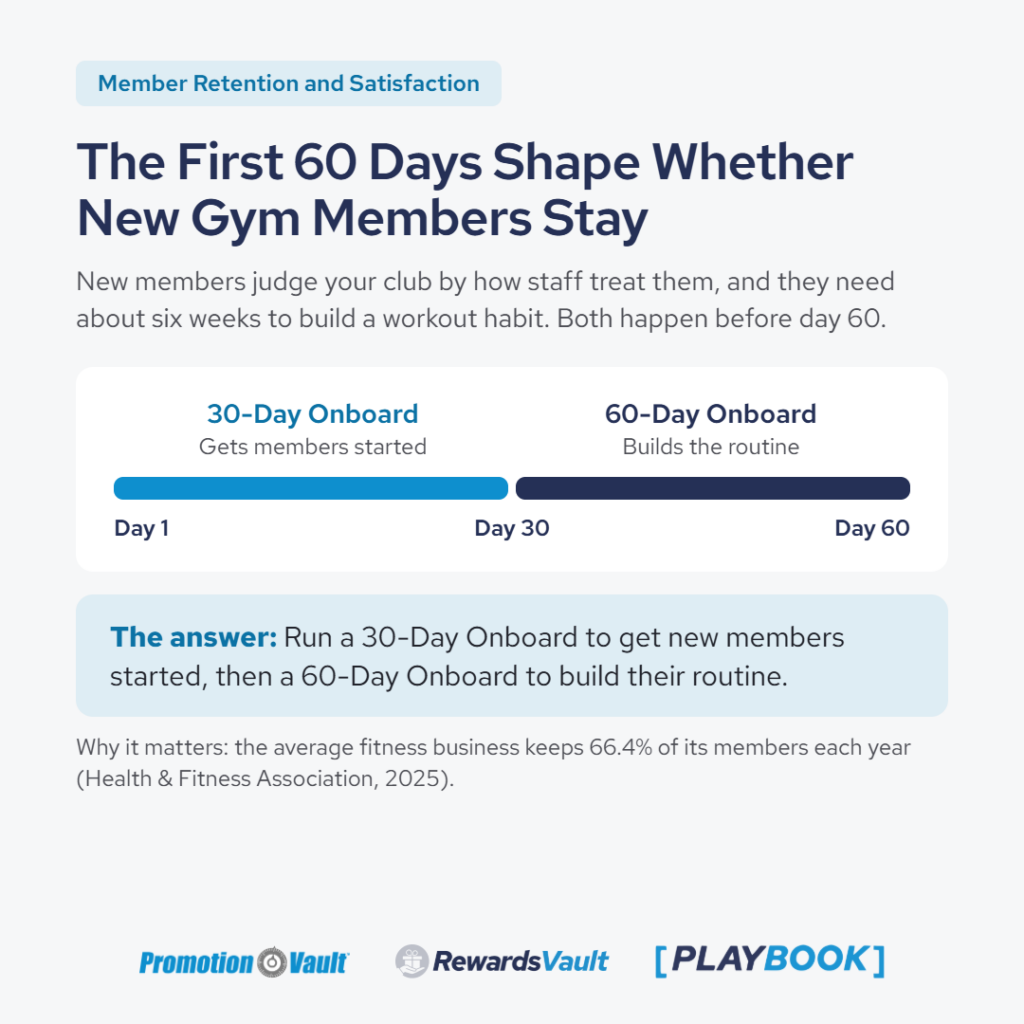
The first 60 days shape gym member satisfaction because new members judge a club mostly by the service they get, and exercise habits take about six weeks to form. Both forces peak before day 60. A plan that ends at day 30 stops while the routine is still fragile and the member’s opinion is still forming.
Habits Need About Six Weeks
Researchers Navin Kaushal and Ryan Rhodes followed 111 new gym members for 12 weeks. Members needed at least four workouts a week for six weeks to build an exercise habit, according to their 2015 study in the Journal of Behavioral Medicine. Six weeks ends on day 42, so a plan that stops at day 30 quits almost two weeks early. The same study found that consistency, simple routines, the setting, and how members felt about their workouts all predicted stronger habits.
Six weeks of steady workouts is the habit line for new members. A 30-day plan stops two weeks short of it.
New Members Judge the Service First
Satisfaction grows in stages, too. Sevastia Avourdiadou and Nicholas Theodorakis surveyed 426 customers of a sports and fitness center in Greece for a 2014 paper in Sport Management Review. Service quality was a major driver of loyalty only among novice customers. Satisfaction shaped future behavior in both groups. It had a much bigger effect on experienced customers. For operators, a new member’s loyalty rides on how staff treat them. A long-term member’s loyalty rides on whether the whole experience keeps satisfying them. Onboarding is where one hands off to the other.
The business stakes are plain. The Health & Fitness Association’s 2025 benchmarking report put the industry’s member retention rate at 66.4%. In the first half of 2026, gym cancellations rose 8% year over year while new gym joins fell 9%, ABC Fitness reported from data across 30,000 fitness businesses. With fewer new members coming in, each one who settles in during the first 60 days carries more weight.
How Is a 30-Day Onboard Different From a 60-Day Onboard?
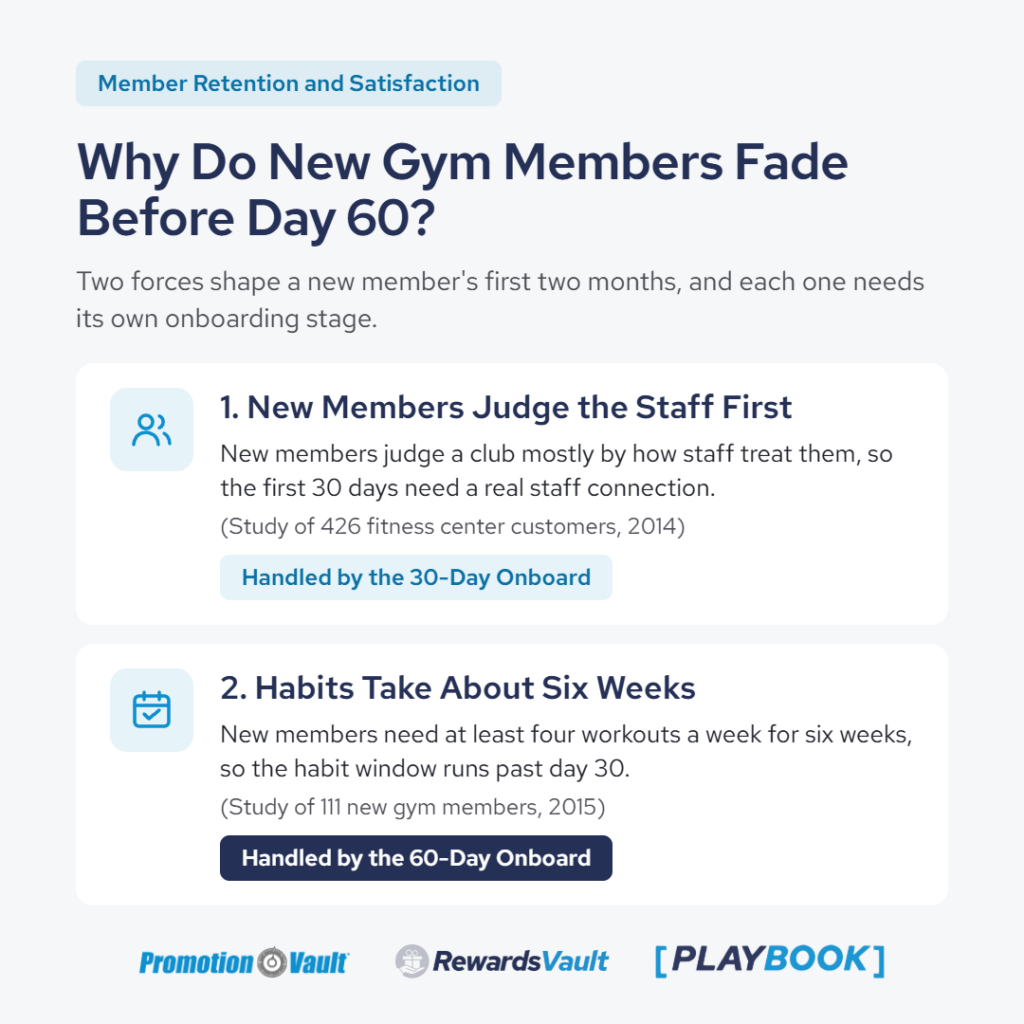
A 30-Day Onboard activates new members with a short, easy path: a welcome, a first workout, a staff connection, and a first-month attendance goal. A 60-Day Onboard adds a second month with a harder goal, more chances to refer friends, and a second round of feedback. Its aim is retained dues.
| Journey Element | 30-Day Onboard | 60-Day Onboard |
| Main goal | Activate new members | Reinforce ongoing habits |
| Effort asked | Shorter, easier path | Longer, more demanding path |
| Attendance | First-month target | First- and second-month targets |
| Referrals | One early referral invite | Referral invites in both months |
| Feedback | One satisfaction survey | Two surveys, about 30 days apart |
| Business focus | Early activity | Steady visits and retained dues |
Most clubs should run both halves as one connected journey. Operators who want a lighter start can launch the 30-Day Onboard first. They can add the second month once staff have the routine down. Either way, members should feel one continuous path instead of two separate campaigns.
What Should 30-Day Member Onboarding Include?
30-day member onboarding should include four steps. Start with a personal welcome on day 1. Get a first workout and a staff introduction in week one. Set a verified attendance goal for days 8 to 30. Close with a referral invite and a private satisfaction survey. Each step should be easy to finish and simple to confirm.
Day 1: Welcome Members and Show Them the Path
Open with a welcome text or email that lays out the member’s next steps. Show the milestones, the rewards on offer, and the first thing to do. Members should see the whole path on their phone before their second visit. Inside the club, whoever checks them in should know they are new. A 2017 study in Global Health Promotion compared current, former, and never members of a campus fitness center. Current members were the most likely to describe a caring climate. In their comments, members praised staff who greeted them, said hello, and knew their names, NASM reported.
Days 1–7: Get the First Workout and a Staff Connection
Week one has one job. Get the member back through the door and into a real conversation with a coach or a front-desk lead. Book a welcome session, an orientation, or a first class. A booking shows intent. A check-in record or a staff QR scan shows the visit happened, so that is what should count. Retention researcher Paul Bedford found that one conversation with fitness staff made a member 20% more likely to return the next month. Four or more conversations made a return 80% more likely, ABC Fitness reported.
Days 8–30: Set a First-Month Attendance Goal
Next, give members a target that fits their format. Five verified check-ins in the first month is a sensible big-box example. A studio might count completed classes instead. Show progress after every visit so the goal stays in view. Economists Gary Charness and Uri Gneezy paid university students to visit a campus gym eight times in a month. Attendance rose sharply after the payments ended. The gain came entirely from students who had not been regular gym users, according to their 2009 study in Econometrica. Many new members fit that description. Our guide on what gyms should reward in the first 30 days covers reward types and amounts in more depth.
By Day 30: Invite a Friend and Ask How It’s Going
Close the first month with two asks. First, open a personal referral link the member can share with a friend. Second, send a short private satisfaction survey (we cover timing and questions below). By day 30, members have enough experience to give useful answers. Their answers also give staff a reason to follow up in person.
What Does 60-Day Gym Onboarding Add?
60-day gym onboarding adds a second attendance goal for days 31 to 60, another referral invite, a second satisfaction survey, and a recognition moment on day 60. It carries a strong first month into a lasting routine. Then it hands the member off to ongoing goals, so progress keeps going after onboarding ends.
Days 31–45: Raise the Bar a Little
Introduce the second goal as soon as the first one ends, while the member still has momentum. One example is eight more verified check-ins during the second 30 days, or a class-based target for studios. Keep the jump modest. Kaushal and Rhodes found that low complexity predicted habit growth, so a goal that feels doable is the safer choice.
Days 31–60: Deepen the Relationship
Use this stretch for a second referral invite and the second private survey. Staff should reinforce progress in person. A coach who says, “You’re three visits from your goal,” gives the member a reason to book the next session. This is also the right window to introduce a relevant paid service, such as a training package. Wait until a member’s visits show they are ready for more.
Day 60: Recognize Progress and Hand Off
On day 60, confirm the milestones, release any earned rewards, and show the member what comes next. That might be a monthly attendance streak, a class tier, or a renewal goal. Members should never finish onboarding and find a blank screen. For budgeting, one illustrative scenario sets aside $30 in rewards across the 60 days for a member paying $180 a month. Each operator sets its own amounts and rules.
How Do You Hyper-Personalize Gym Member Onboarding?
Hyper-personalize gym member onboarding by starting each member at the right step, matching goals to the club’s format, and tying every message to what the member just did. Someone who joined after three trial classes can skip the intro session. A studio member works toward classes, and a big-box member works toward check-ins.
Personalization starts with data the club already has. The membership system knows how someone joined, which plan they bought, and when they last checked in. We use that status to pick each member’s starting point. A former member who rejoins can skip the tour and go straight to a first-week goal. A member who met a trainer during a trial can move past the introduction. A referred member can get a welcome that mentions the friend who brought them in.
Match the Path to the Club’s Format
Format changes what progress looks like. Studio journeys should count completed classes. Big-box journeys can count check-ins, welcome workouts, and introductions to services such as personal training. The two formats are also moving in different directions. In the first half of 2026, studio check-ins rose 27% year over year while gym check-ins rose 1%, ABC Fitness reported. Franchise groups and multi-location brands can keep one standard journey. Each site can then set its own staff owners, class targets, and offers.
Tie Each Message to the Member’s Last Action
Each message should respond to the member’s most recent action. A member who logs three visits in week one needs a congratulations and a next goal. A member who has not returned since joining needs a call from their staff contact before another automated text. Both members are in the same program. They simply enter it through different doors.
How Should Gyms Use Member Satisfaction Surveys During Onboarding?
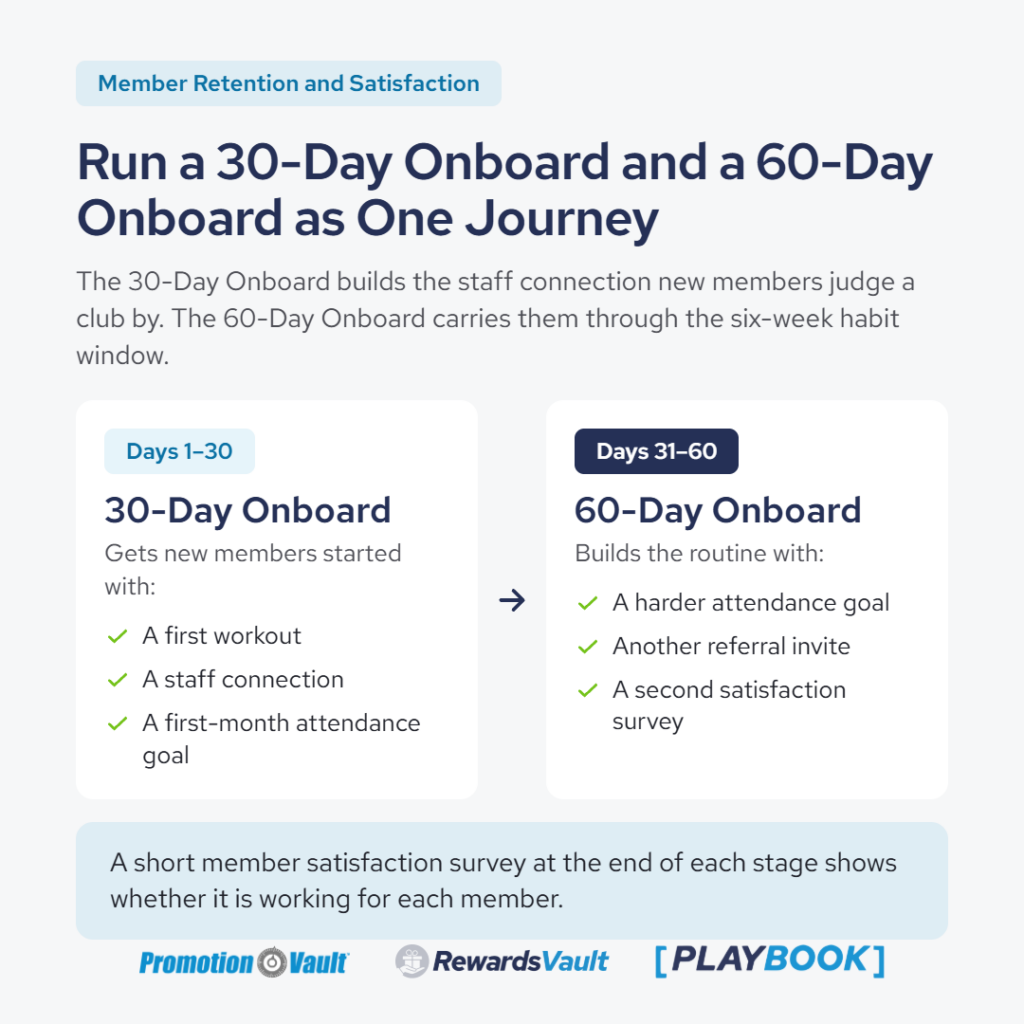
Gyms should send a short member satisfaction survey right after the day-30 milestone and again near day 60. Keep each one to a few questions. Reward completion no matter what members say, send low scores to a named staff member, and compare the two rounds to see whether satisfaction is rising.
Why Asking Members Changes Their Behavior
Surveys do more than collect data. Utpal Dholakia and Vicki Morwitz ran a field experiment at a financial services firm. One group of customers took a satisfaction survey, and a control group did not. Surveyed customers bought more, left less often, and were more profitable. The effects lasted a year, according to their 2002 paper in the Journal of Consumer Research. A 2007 study in Marketing Science of a U.S. auto service firm found a strong positive link between taking a survey and later spending. For a gym, asking a new member how it’s going is part of the retention plan.
What to Ask at Day 30 and Day 60
Keep each round short. Promotion Vault’s reward-triggered mini-surveys average a 97% response rate, and they take only seconds to answer. Pick questions that each point to an action:
- Overall satisfaction: “How satisfied are you with your first month here?” on a 1-to-5 scale. Repeat it at day 60 so the two rounds compare cleanly.
- Staff connection: “Do you know who to ask for help at the club?” A “no” tells the manager which new members still lack a staff contact.
- Friction: “What almost kept you from coming in this month?” Open answers surface schedule, crowding, or confidence problems that scores hide.
- Discovery: “What would you like to try next?” The answer feeds the member’s next goal or a service introduction.
- Advocacy: “How likely are you to recommend us to a friend?” on a 0-to-10 scale. Ask it at day 60, once members have more to go on.
For wording tips, see our guide to writing good Likert scale questions.
How to Reward Feedback Without Buying Praise
Rewards should recognize that a member took the survey, never what they said. The Federal Trade Commission’s rule on consumer reviews took effect on October 21, 2024. It bans incentives tied to a review that expresses a particular sentiment. Google’s Maps content policy goes further for public reviews. It bars incentives for posting reviews, and it bars businesses from selectively asking happy customers to post. So we reward private feedback the same way for every member. We keep the public review optional and unrewarded, and we show the same public-review choice to everyone, whatever their rating. Our article Can You Incentivize Reviews? covers the rules in more detail.
Reward the member for answering. Never reward the answer.
Act on Every Answer Within the Week
A survey only pays off when a person acts on it. Send every low score or complaint to a named staff member, and set a reply deadline, such as the same week. Thank every member who answers. Then look for patterns. If one location’s day-60 scores fall below its day-30 scores, check what changed in the second month. Class times, staffing, and peak-hour crowding are good places to start.
What Belongs on a Gym Member Onboarding Checklist?
A gym member onboarding checklist covers setup before launch and milestones after it. Before launch, set goals, study your data, map entry points, assign staff owners, and pick verification sources and attendance goals. During the journey, schedule two surveys, choose rewards, follow up on low scores, track results, and plan the day-60 hand-off.
Set Up Before Launch
- Set the business goal. Decide which result matters most: first-month attendance, 60-day paid retention, referrals, or a mix.
- Study your own members. Compare members who stayed past day 90 with those who left. Note the early visit counts where the two groups split.
- Map entry points. List every way people join (walk-in, trial, referral, rejoin) and the step where each one starts.
- Assign a staff owner. Give each new member one named contact, and put that name in the welcome message.
- Choose how to confirm each step. Decide which records count as proof: check-ins, class attendance, booking data, or staff QR scans.
- Set two attendance goals. Size one goal for days 1 to 30 and a slightly harder one for days 31 to 60.
Run and Measure the Journey
- Schedule two surveys. Send a short private satisfaction survey after the day-30 milestone and again near day 60.
- Pick rewards members want. Offer choices such as gift cards, club merch, discounts, or guest passes. Rewards that add value protect your price better than blanket discounts.
- Write the follow-up rule. Name who contacts a member after a low score and how fast they reply.
- Define the scoreboard. Track onboarding completion, first-month attendance, survey participation, verified referrals, and 60- and 90-day paid retention.
- Plan the day-60 hand-off. Line up the next goal, such as a monthly streak or renewal milestone, before the first members finish.
Share the member-facing half of this list with your front desk. When staff know a member is two check-ins from a goal, a routine hello turns into a useful conversation.
How Do You Know Onboarding Is Raising Satisfaction and Lifetime Value?
Onboarding is working when day-60 satisfaction scores beat day-30 scores and the same members keep paying. Follow each monthly group of new members through 60- and 90-day paid retention, service purchases, and verified referrals. Compare them with members who joined before the program, and count only gains the program can fairly claim.
Lifetime value grows during onboarding in a few ways. Members stay longer, some buy services, and some bring friends. Referrals are worth a closer look. Referred customers were worth at least 16% more than similar customers who came in other ways, according to a 2011 study of bank customers in the Journal of Marketing. Their retention edge also held over time. That is a banking result, so treat it as a direction for gyms, not a forecast.
Each half gets its own scoreboard. Judge the 30-Day Onboard on completion, first-month visits, verified referrals, feedback, and later paid retention. Judge the 60-Day Onboard on visits across both months, completed milestones, referrals, both rounds of feedback, and 60- and 90-day paid retention. Use members who joined in the months before launch as a baseline. Avoid crediting the program with every dollar participants spend. Our guide on measuring retention rewards ROI walks through the math.
How Does PLAYBOOK Run a 30-Day and 60-Day Onboard?
PLAYBOOK runs both onboards as one connected Playbook. Members join once, see every step and reward in Momentum, and complete actions confirmed by club data or staff QR scans. Earned rewards collect in Rewards Vault, staff get credit for results they help create, and operators pay reward value only when a member claims it.
What Members and Staff Experience
PLAYBOOK is Promotion Vault’s engagement platform. A Playbook is a club’s own journey map, built from Loops. Each Loop is a simple cycle: a member does something, the club verifies it, the member earns recognition, and the next step appears. For onboarding, Custom Loops handle attendance goals. A Referral Loop runs the friend invite, and a Review Loop collects private feedback with an optional public review. Games keep it engaging. A Scavenger Hunt guides members through early milestones, and Streaks and Tiers make repeat visits count.
Members join with a six-digit text code and track their progress in Momentum, the goals view inside Rewards Vault. Staff get credit through the Recognition Loop when members they invited or helped complete a verified step. The program runs on top of the club management, booking, and CRM tools already in place. For example, ABC Fitness data can start a member’s opt-in at the right stage. Our team helps set up and run the program with you.
The operator sets the goal. Staff create the opportunity. Members take action. We help make it work.
What It Costs and What We’ve Seen
There are no setup costs or monthly fees. For applicable Rewards Vault rewards, a 10% service fee applies when a reward is sent. The reward’s face value is charged only when the member claims it, and unclaimed value stays in the operator’s wallet. Other reward types, such as discounts or passes, follow their own terms.
Our documented results line up with the research. In one Promotion Vault program with a class-booking marketplace, a $10 reward for completing four classes in 30 days lifted 30-day engagement by 16%. That worked out to roughly $6 per additional engaged subscriber. A boutique fitness brand ran a three-stage program that recognized intro-class attendance ($10), joining ($30), and upgrading ($30). Reported results included 36% more intro-class attendance, 43% more new-member conversions, and 23% more upgrades.
Frequently Asked Questions About 30-Day and 60-Day Gym Onboarding
The questions below cover onboarding length, survey questions, survey rewards, format differences, and software. In short, plan for about 60 days and ask a few questions that lead to action. Reward private feedback the same way for everyone, set goals by club format, and build on the systems you already run.
Is 30-Day Onboarding Enough for New Gym Members?
Usually not on its own. A study of 111 new gym members found that habits took at least four workouts a week for six weeks to form. That runs past day 30. Put the heaviest support in the first month, then use a 60-Day Onboard to carry members through the habit window.
What Questions Belong on a Member Satisfaction Survey for New Members?
Lead with one overall rating, such as “How satisfied are you with your first month?” on a 1-to-5 scale. Add a staff question: “Do you know who to ask for help?” Then finish with one open question: “What almost kept you from coming in?” That answer points staff to what to fix.
Can Gyms Reward Members for Completing a Satisfaction Survey?
Yes, for private feedback. Keep the reward the same for every completed survey, and never tie it to the rating. Keep public reviews optional and unrewarded. Show the same public-review option to every member, whatever their score, in line with FTC rules and Google’s review policy.
Should Studios and Big-Box Gyms Use the Same Onboarding Checklist?
Use the same checklist with different goals. Studios should count completed classes. Big-box gyms can count check-ins, welcome workouts, and service introductions. Franchise groups and multi-location brands can keep one template and let each site set its own staff owners, targets, and offers.
Do We Need New Software to Run 60-Day Onboarding?
No. PLAYBOOK works on top of the club management, booking, and CRM tools you already run. It confirms each step from those systems or from staff QR scans. Replacing overlapping tools is an option, never a requirement.
So, How Do Gyms Build Onboarding That Increases Member Satisfaction?
Gyms build onboarding that increases member satisfaction by running one personalized 60-day journey. The 30-Day Onboard wins first visits and staff connections. The 60-Day Onboard builds a lasting routine. A short survey at each milestone shows what to fix. Verify every step, reward real progress, and track retained dues.
Much of what keeps a new member happens on the gym floor, in moments no dashboard records. That is why we say the gym floor is the new CRM. A 60-day plan gives staff a reason to create those moments on purpose. It also shows operators which moments worked.
To see how a 30-Day and 60-Day Onboard would look with your club’s data, staff, and systems, book a personalized demo.
Casey Rock is Content Director at Promotion Vault, where he builds the content, SEO, and messaging systems behind the company’s rewards engagement platform. He specializes in turning product value into proof-first stories that drive discovery, trust, and conversions.