You can incentivize customer feedback, but not the public review itself. The FTC bans incentives tied to a positive or negative rating and requires disclosure. Google, Yelp, and Amazon go further and prohibit review incentives entirely. The safe pattern rewards completing a survey or feedback step, while the public review stays voluntary, neutral, and unconditioned.
TLDR — The Facts About Incentivizing Reviews
- You can reward honest feedback — you cannot pay for the public review itself.
- The FTC bans incentives tied to a review’s sentiment, positive or negative.
- Disclosing an incentive does not fix a sentiment-conditioned offer.
- Google prohibits all review incentives — cash, discounts, free items, points.
- Yelp, Amazon, and Trustpilot also bar incentivized public reviews.
- Review gating — asking only happy customers to post — breaks Google’s policy.
- Reward the survey or feedback step; keep the public review separate and neutral.
- Send every eligible customer the same request under one rule.
- Penalties include lost reviews, profile suspension, and FTC civil penalties.
- Learn how ReviewBoost by Promotion Vault can help you scale customer reviews.
- Can You Incentivize Reviews?
- What Counts As An Incentivized Review?
- What Does The FTC Rule Say About Incentivized Reviews?
- Does Google Allow Incentivized Reviews?
- What Are Rules For Incentivized Reviews On Yelp, Amazon, And Trustpilot?
- What Is Review Gating, And Why Is It Risky?
- How Do You Reward Reviews Without Breaking The Rules?
- Frequently Asked Questions About Incentivizing Reviews
- So, Can You Incentivize Reviews?
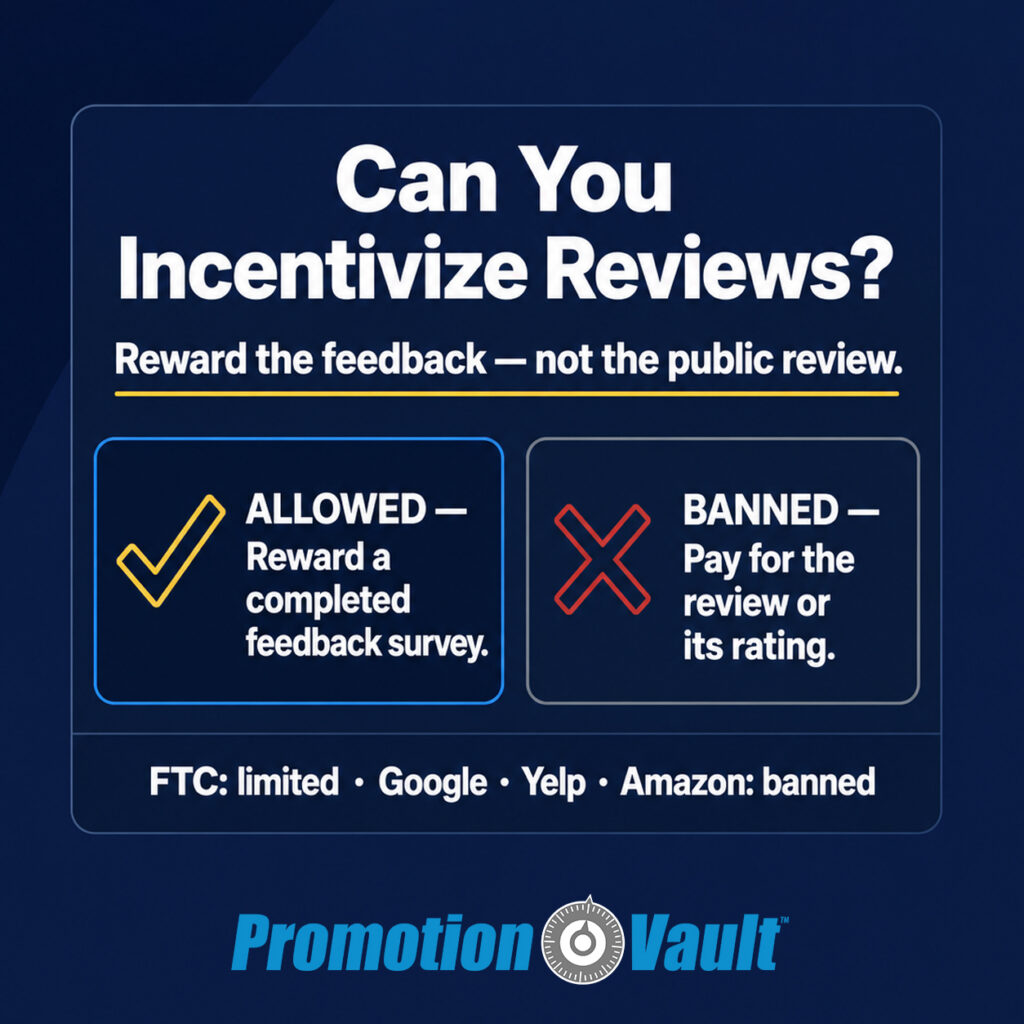
Somewhere in a franchise marketing meeting this quarter, someone suggested offering a $10 gift card for a Google review. It’s the most natural idea in the world, and it’s also the fastest way to lose the reviews you already earned. In December 2025, the FTC sent its first warning letters under a new review rule, and Google now strips incentivized reviews automatically with AI. Yet review volume has never mattered more — Birdeye’s State of Online Reviews 2026 found Google generated 79.4% of all reviews per location last year.
So the question is fair, and it deserves a precise answer rather than a nervous “don’t do it.” We run reviews across many locations, and we hear the same frustration constantly. The advice online contradicts itself, the platforms each say something different, and nobody wants to torch a Business Profile that functions as the storefront. Here is the line that keeps you safe and still works: You can reward honest feedback, but you cannot incentivize the public review. Everything else in this article is the detail behind that one sentence.
Can You Incentivize Reviews?
Yes, but only carefully. You can reward a customer for completing feedback, such as a survey, without breaking the law. You cannot pay, discount, or gift someone for posting a public review, and you cannot tie any reward to a positive rating. Most review platforms ban review incentives outright.
The confusion comes from treating “reviews” and “feedback” as the same thing. They are not, and the rules turn on the difference. A public review is content a customer posts on Google, Yelp, or another platform for other shoppers to read. Feedback is a private survey answer that comes back to you. Federal law and platform policy allow you to reward the second while protecting the first. When we keep those two lanes separate, the reward stops being a bribe for praise and becomes what it should be — a thank-you for a few honest minutes.
What Counts As An Incentivized Review?
An incentivized review is any public review a customer posts after receiving something of value for it — cash, a discount, a free product, loyalty points, or a prize-draw entry. The reward does not need to be large. If the benefit is tied to posting the review, it counts, and most platforms treat it as a violation.
Before we dive deeper, here is a list of key terms and definitions to know when discussing reviews:
- Incentivized Review
- A public review posted because the reviewer received something of value in return, such as money, a discount, free goods, loyalty points, or a prize entry. Its defining trait is the reward attached to the act of reviewing, regardless of the review’s content.
- Sentiment Conditioning
- Offering a reward that depends, openly or by implication, on a review expressing a particular opinion — usually a positive one. The FTC’s rule prohibits it even when the incentive is disclosed, because it distorts what future customers see.
- Fake Engagement
- Google’s policy category for reviews that do not reflect a genuine experience, including incentivized reviews, review gating, and reviews left by people with a conflict of interest. Content flagged as fake engagement is removed and can trigger Business Profile restrictions.
- Generalized Solicitation
- A neutral request that goes to every eligible customer asking them to share an honest experience, with no filtering by expected sentiment. The FTC treats this as permissible, and it is the compliant alternative to gating a review request.
- Material Connection Disclosure
- A clear, conspicuous statement that a reviewer received an incentive. The FTC Act requires it whenever a reward is given for a review; a hidden incentive can be deceptive even when the rest of the workflow stays neutral.
What Does The FTC Rule Say About Incentivized Reviews?
The FTC’s Consumer Reviews and Testimonials Rule, effective October 21, 2024, bans paying or rewarding customers for reviews that express a chosen sentiment — positive or negative. That ban covers implied conditions, and disclosing the incentive does not cure it. A neutral, disclosed incentive for any honest review is not banned by the rule itself.
The rule lives at 16 CFR Part 465, and its logic is narrower than most people fear. The FTC does not outlaw every incentive for a review. Its own staff guidance confirms you may give an incentive for a review as long as there is no express or implied requirement that the review be positive — though you must disclose the incentive under the FTC Act. What the rule forbids is conditioning the reward on sentiment. The FTC flags phrasing such as “tell us how much you loved your visit and get a coupon” as an implied demand for praise, because it signals that only happy reviews earn the reward.
Two details catch honest operators off guard. First, a disclosure does not rescue a sentiment-conditioned offer — paying for five-star reviews stays illegal even with an “I was compensated” note attached. Second, the rule now has teeth. On December 22, 2025, the FTC issued its first warning letters to companies over review practices, and knowing violations can carry civil penalties reaching $53,088 per violation, the agency’s current inflation-adjusted maximum. This is practical guidance rather than legal advice, and the rules shift, so confirm the current requirements and loop in counsel before you launch a program.
Does Google Allow Incentivized Reviews?
No. Google’s content policy treats any incentive offered for posting, revising, or removing a review as fake engagement. That includes cash, discounts, free goods or services, loyalty points, and contest entries. Violations can cost you the reviews, your local ranking, and even your Business Profile.
This is where the FTC and the platforms part ways, and the gap matters. The FTC permits a neutral, disclosed incentive for any honest review. Google does not — it bans the incentive itself, regardless of whether you mention a rating. So a tactic that squeaks past federal law can still trigger removal on the platform that drives most of your discovery. Google’s enforcement also runs on automated detection, which reads sudden review spikes and unnatural patterns as signals to strip content and restrict the profile.
Google tightened the policy further through 2025 and 2026. It now prohibits pressuring customers to review while they are still on your premises, running review kiosks or shared tablets, directing staff to hit review quotas, and asking customers to name a specific employee. What remains fully allowed is the plain ask: send a follow-up message after a visit and invite an honest review, open-ended, to everyone. For the broader playbook on how to get more customer reviews the compliant way, that companion guide covers timing, friction, and follow-up in depth.
What Are Rules For Incentivized Reviews On Yelp, Amazon, And Trustpilot?
All three prohibit incentivized public reviews. Yelp bans incentives and discourages actively soliciting reviews at all. Amazon forbids any seller incentive outside its own Vine program. Trustpilot detects and removes reviews it identifies as incentivized. Penalties range from review removal to account suspension and, on Amazon, withheld funds.
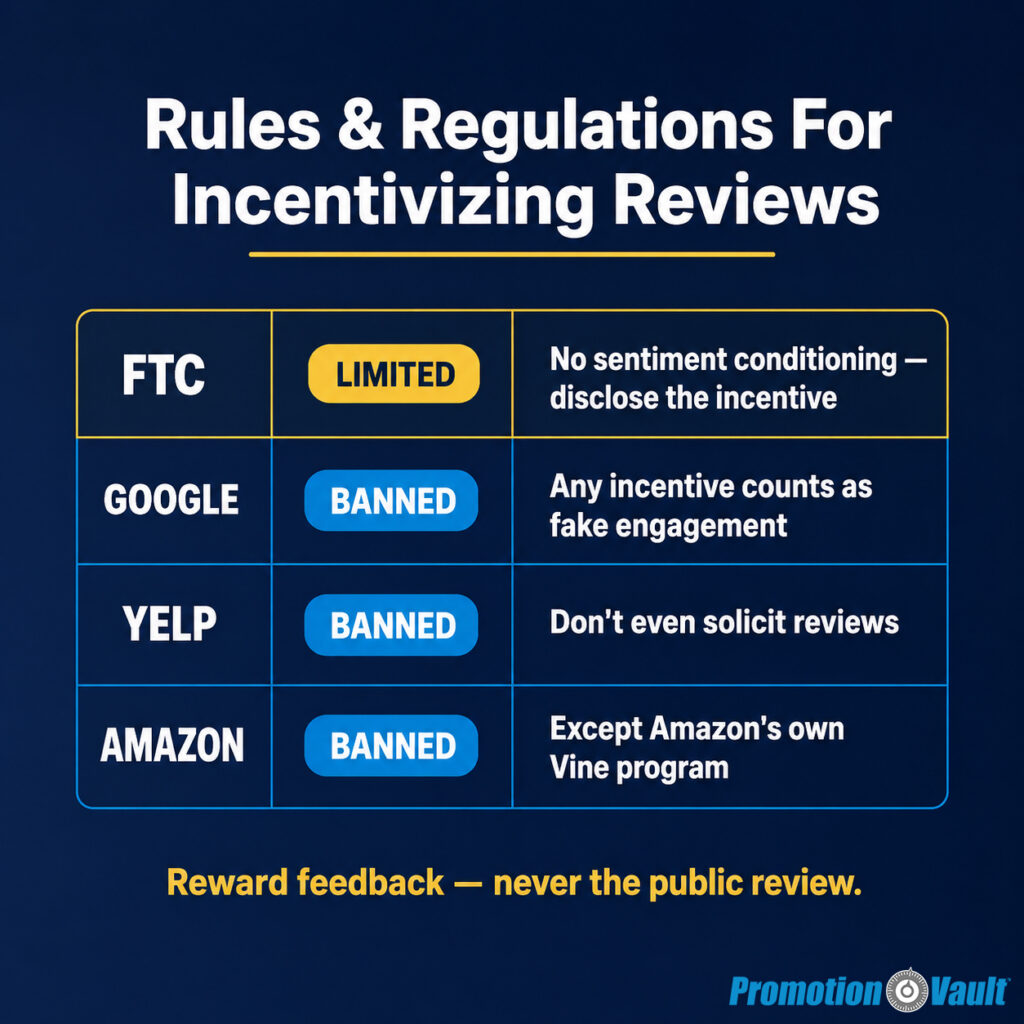
The practical lesson is that “incentivized review” means something slightly different on every platform, so the destination decides the rule. A prize draw that a small business might run on its own website is still a prohibited incentive on Google, Yelp, and Amazon. Amazon is the strictest of the group: it ended seller-run incentivized reviews in 2016 and now allows them only through Vine, a program Amazon itself controls. Here is the landscape at a glance.
| Platform | Incentives for reviews? | What can go wrong |
|---|---|---|
| Banned — any incentive, any sentiment | Review removal, ranking loss, profile suspension | |
| Yelp | Banned — and it discourages asking at all | Reviews removed, “Consumer Alert” flag on the page |
| Amazon | Banned outside the Amazon-run Vine program | Review removal, account suspension, withheld funds |
| Trustpilot | Banned — inviting is fine, incentivizing is not | Incentivized reviews detected and removed |
| FTC (federal) | Neutral, disclosed incentives allowed; sentiment-conditioned ones banned | Civil penalties up to $53,088 per knowing violation |
What Is Review Gating, And Why Is It Risky?
Review gating is filtering who gets a public review request based on how happy you expect them to be — sending pleased customers to Google and unhappy ones to a private form. Google prohibits it outright, and the FTC treats selective solicitation as potentially deceptive. It also hides the feedback you most need.
Gating feels safe because it looks like quality control, and it is where well-meaning programs get into trouble. A team asks “how was your visit,” then routes a five-star response to the public review button and a low score to a complaint box. Operationally that seems tidy. Strategically it trains the system to bury information instead of learning from it, and it manufactures a review profile that does not match reality. The fix is not to stop capturing private feedback — capture all of it — but to make the public review request neutral and identical for everyone who had the same experience.
How Do You Reward Reviews Without Breaking The Rules?
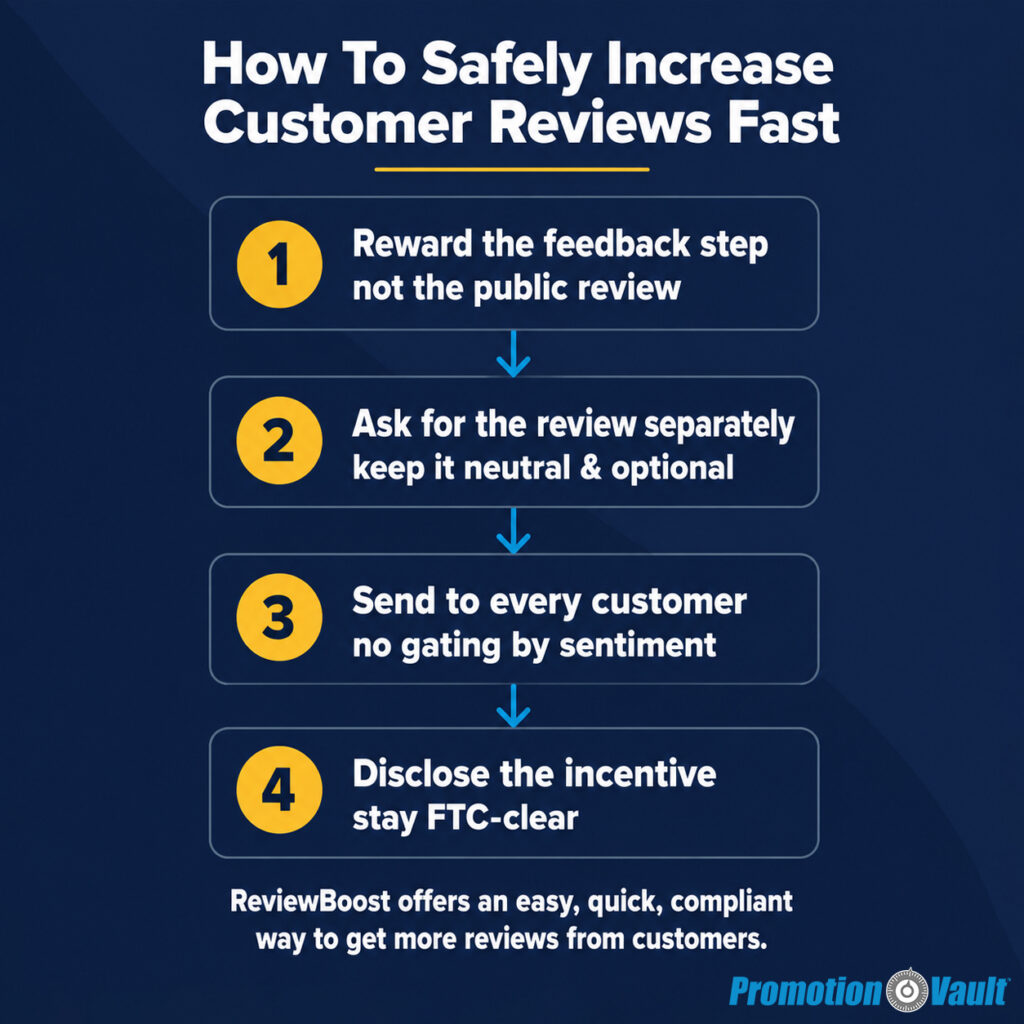
Reward the feedback step, not the public review. Give every eligible customer a reward for completing a survey or another permitted action, keep the public review request separate and neutral, disclose the incentive, and never condition it on a rating or sentiment. The review stays voluntary; the participation earns the reward.
This is the model we build into ReviewBoost, and it is easier to run than the workarounds it replaces. In the live flow, a member finishes a short feedback survey after a real visit, and the screen states plainly that the reward is for completing the survey, not for the rating. Every submission wins a reward instantly, no public review is required, and sharing the experience publicly is offered afterward as an optional, unconditioned step. Reward the feedback; free the review. That single discipline is what keeps the program on the right side of the FTC and every platform at once.
There is also real evidence that rewarding participation works better than chasing stars. Across our platform, reward-triggered feedback surveys see a 97% average response rate — a level of honest, timely signal that a “leave us five stars” campaign almost never produces. Well-built survey incentives turn a moment customers usually forget into information you can act on. Here is how to set the whole thing up so platforms and regulators reward it rather than penalize it.
- Separate the reward from the public review. Attach any incentive to a survey or feedback step, and never to posting on Google, Yelp, or another platform.
- Reward participation, not the answer. Give the reward for completing the feedback so every submission earns it, no matter the rating.
- Keep the public review request neutral and optional. Invite an honest review with no required rating, wording, or sentiment.
- Send the request to every eligible customer under one rule. Route pleased and unhappy customers the same way so nothing looks like gating.
- Disclose any incentive clearly. If a reward sits anywhere in the flow, state it plainly so nothing appears hidden.
- Confirm each platform’s rules before launch. Google, Yelp, Amazon, and Trustpilot differ, so verify the destination’s policy for your specific ask.
- Keep records of consent, disclosures, and requests. Save proof that every review was solicited neutrally, in case a platform or regulator asks.
Once the feedback is flowing, the point is to use it. Route service issues to the person who can fix them, and turn recurring feedback into specific next actions instead of watching a star average. Clear, single-idea feedback questions make that signal sharper. This works whether we run a boutique studio or a network of multi-location gyms, and it sits on top of the systems already tracking the customer moment — no rip-and-replace required.
Frequently Asked Questions About Incentivizing Reviews
What Counts As An Incentive For A Review?
Anything of value given because a customer posts a review: cash, gift cards, discounts, free products or services, loyalty points, account credit, or a prize-draw entry. Size does not matter, and neither does the wording of the ask. Google, Yelp, and Amazon treat all of these as prohibited incentives for a public review.
Is Review Gating Illegal?
Review gating violates Google’s policy directly, and the FTC treats selective solicitation as potentially deceptive under the FTC Act. Routing only satisfied customers to public review pages, while sending unhappy ones to a private form, biases the record. The compliant approach sends the same neutral request to every eligible customer, then handles complaints privately.
Can You Enter Customers Into A Prize Draw For Leaving A Review?
Not for public reviews on Google, Yelp, or Amazon — a prize entry is still an incentive, so it is prohibited there. A draw tied to completing private feedback can work, provided the reward is for participation, the incentive is disclosed, and sweepstakes laws (including no-purchase-necessary rules) are followed. Keep the public review separate and unconditioned.
Can You Reward Employees Or Staff For Getting Reviews?
You can reward staff for delivering the service that earns reviews, such as tying recognition to customer-satisfaction scores. You cannot set review quotas or reward employees for the number of reviews collected — Google now bans staff quotas and asking customers to name a specific employee. Reward the behavior that creates great experiences, not the reviews themselves.
Do The FTC Review Rules Apply Outside The United States?
The FTC’s Consumer Reviews and Testimonials Rule applies to businesses operating in or targeting U.S. consumers. Outside that scope, platform policies still govern — Google, Yelp, Amazon, and Trustpilot enforce their review rules globally, and many countries have their own consumer-protection laws. When in doubt, follow the strictest rule that touches your customers.
So, Can You Incentivize Reviews?
Yes — you can incentivize honest feedback, but not the public review itself. Reward customers for completing a survey or another permitted step, and keep the public review request separate, neutral, and free of any reward or rating condition. The FTC bans sentiment-conditioned incentives and requires disclosure, while Google, Yelp, and Amazon prohibit review incentives outright. Handled this way, rewards grow the honest feedback and durable reviews you are already earning — without risking removal or penalties.
If your team is tempted to offer a gift card for a Google review, then redirect that reward to a feedback survey this week and keep the review request neutral and open to everyone. It is a small change that protects every review you have already earned and gives you signal you can use.
See how ReviewBoost automates compliant, feedback-first review workflows inside RewardsVault.
Casey Rock is Content Director at Promotion Vault, where he builds the content, SEO, and messaging systems behind the company’s rewards engagement platform. He specializes in turning product value into proof-first stories that drive discovery, trust, and conversions.