AI can improve reward programs when it helps operators choose better reward moments, ask better questions, segment responses, and measure what happens after activation. The goal is not more automation for its own sake — it is a cleaner reward system that drives retention, acquisition, referrals, upgrades, and revenue lift.
TLDR — How To Use AI To Improve Reward Programs
- Use AI to find which reward moments actually drive revenue.
- Reward completed behaviors — not vague clicks, opens, or intent.
- Ask one smart question inside the reward activation flow.
- Use Data Vault to turn reward moments into feedback loops.
- Segment results by audience, location, lifecycle stage, and reward value.
- Measure activation, realized cost, downstream behavior, and lift.
- Use AI summaries to spot friction, motivation, and next-step patterns.
- Improve reward timing, messaging, value, and eligibility one test at a time.
- Keep trust high with branded rewards, clear terms, and secure access.
- Book a Promotion Vault demo to build one measurable reward pilot.
- How Can AI Make Reward Programs More Effective?
- What Should Operators Use AI For In A Reward Program?
- How Does Data Vault Help Teams Use AI In Reward Programs?
- How Can AI Improve Retention Rewards?
- How Can AI Improve Acquisition And Referrals?
- How Can AI Help Teams Choose Better Reward Moments?
- How Can AI Improve Reward Messaging And Trust?
- How Should Teams Measure AI-Improved Reward Programs?
- What Is The Best Way To Start Using AI In A Reward Program?
- What Are The Biggest Mistakes To Avoid When Using AI For Rewards?
- Frequently Asked Questions About AI And Reward Programs
- So, How Can AI Improve Reward Programs For Retention, Acquisition, And Revenue Lift?
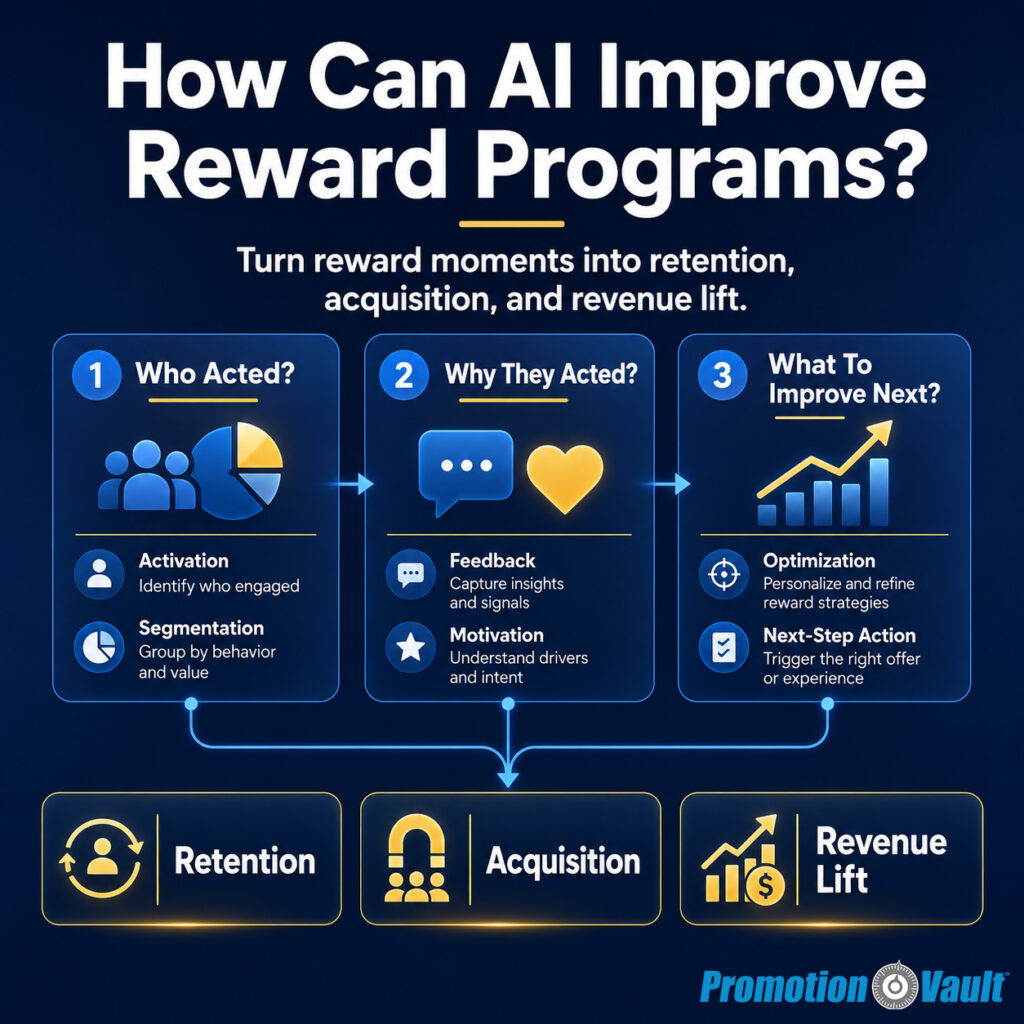
A reward program should answer one plain question: did this reward help someone take an action that made the business stronger?
That question gets harder as programs grow. One location becomes ten. One campaign becomes a calendar. One reward moment becomes a mix of referrals, renewals, first visits, upgrades, win-backs, employee milestones, and customer feedback requests. Pretty soon, the team is not asking, “Did rewards work?” They are asking, “Which reward worked, for whom, at what moment, at what cost, and what should we change next?”
That is where AI can help — if we use it with discipline.
AI should not turn a reward program into a black box. It should make the program easier to see. For operators, marketing teams, and growth leads, the practical use of AI is simple: collect better signals at the moment of engagement, find the patterns humans miss, and use those patterns to improve the next reward.
Promotion Vault was built around that operating idea. Rewards are not treated as one-off payouts. They are tied to completed actions, delivered through a branded reward experience, tracked through activation, and strengthened with feedback through Data Vault. That matters because the reward moment is one of the few moments when the customer, member, employee, or prospect is already paying attention.
A reward moment is a high-attention moment. AI helps us use that attention responsibly — to learn, segment, improve, and grow.
How Can AI Make Reward Programs More Effective?
AI can make reward programs more effective by helping teams identify the best reward moments, analyze activation and feedback patterns, and improve future campaigns. The strongest use case is not replacing operator judgment. It is giving operators cleaner evidence about which rewards move retention, acquisition, referrals, upgrades, and revenue.
This distinction matters. A lot of AI advice sounds bigger than the work operators actually need done. You do not need a vague “AI-powered loyalty transformation.” You need to know which member segment responds to a first-30-day reward. You need to know why referred leads fail to convert. You need to know whether a $25 reward creates more lift than a $10 reward after the same action.
The strongest reward programs start with a verified behavior. Someone joins. Someone shows up. Someone refers. Someone renews. Someone upgrades. Someone completes onboarding. Someone returns after a lapse. AI becomes useful after that behavior is visible, because it can help connect the reward moment to the next decision.
McKinsey describes AI-enabled “next best experience” as the ability to deliver the right interaction at the right time using connected customer data. McKinsey also reports that these capabilities can improve customer satisfaction by 15% to 20%, increase revenue by 5% to 8%, and reduce cost to serve by 20% to 30%. The lesson for reward programs is clear: AI works best when it is tied to real customer context, not loose personalization theater.
For Promotion Vault users, that context can include reward eligibility, activation, campaign tags, reward value, feedback answers, lifecycle stage, location, and downstream behavior. Data Vault adds another layer by asking targeted questions inside the reward flow, then using AI-powered analysis to summarize answers, identify trends, compare segments, and surface practical next steps.
The operator still owns the judgment. AI helps shorten the distance between “we ran a reward” and “we know what to improve.”
What Should Operators Use AI For In A Reward Program?
Operators should use AI to improve four decisions: which behavior to reward, which audience should see the reward, what feedback to ask for, and what to change after results come in. AI is most useful when it turns reward data into a practical next action, not a decorative dashboard.
A simple reward program can work with a spreadsheet. A serious reward program needs a feedback loop. The difference is not software volume. The difference is decision quality.
Here is the operating model we recommend:
| AI Use Case | Operator Question | Practical Output |
|---|---|---|
| Behavior Analysis | Which action predicts value? | Reward the action most tied to retention, conversion, or LTV. |
| Feedback Analysis | Why did people act or hesitate? | Summarize themes by segment, location, campaign, or lifecycle stage. |
| Segmentation | Who needs a different nudge? | Adjust reward value, message, timing, or eligibility. |
| ROI Review | Did the reward create lift? | Compare activation, cost, and downstream behavior. |
| Next-Step Planning | What should we test next? | Launch the next reward with a clearer hypothesis. |
This is where AI earns its place. It helps the team stop averaging everything.
A $10 reward for a first visit and a $50 reward for renewal do not behave the same. A referred lead and a dormant customer do not need the same message. A new employee and a tenured employee do not experience recognition the same way. AI can help sort those differences faster, especially when the inputs are tagged clearly.
That is also why Promotion Vault’s tag structure matters. Tags can organize reward recipients by campaign, behavior, location, lifecycle stage, reward type, or audience. In Data Vault, tags control who sees which questions. A new member can see onboarding questions. A referral participant can see referral questions. A renewal customer can see a renewal-friction question.
The goal is not to ask everyone everything. The goal is to ask the right person one useful question at the right moment.
How Does Data Vault Help Teams Use AI In Reward Programs?
Data Vault helps teams use AI by collecting feedback inside the reward experience, organizing responses by tags and journey stage, and using AI-powered analysis to summarize patterns. It turns rewards into learning moments, so teams can improve targeting, messaging, reward value, and follow-up based on real customer or employee responses.
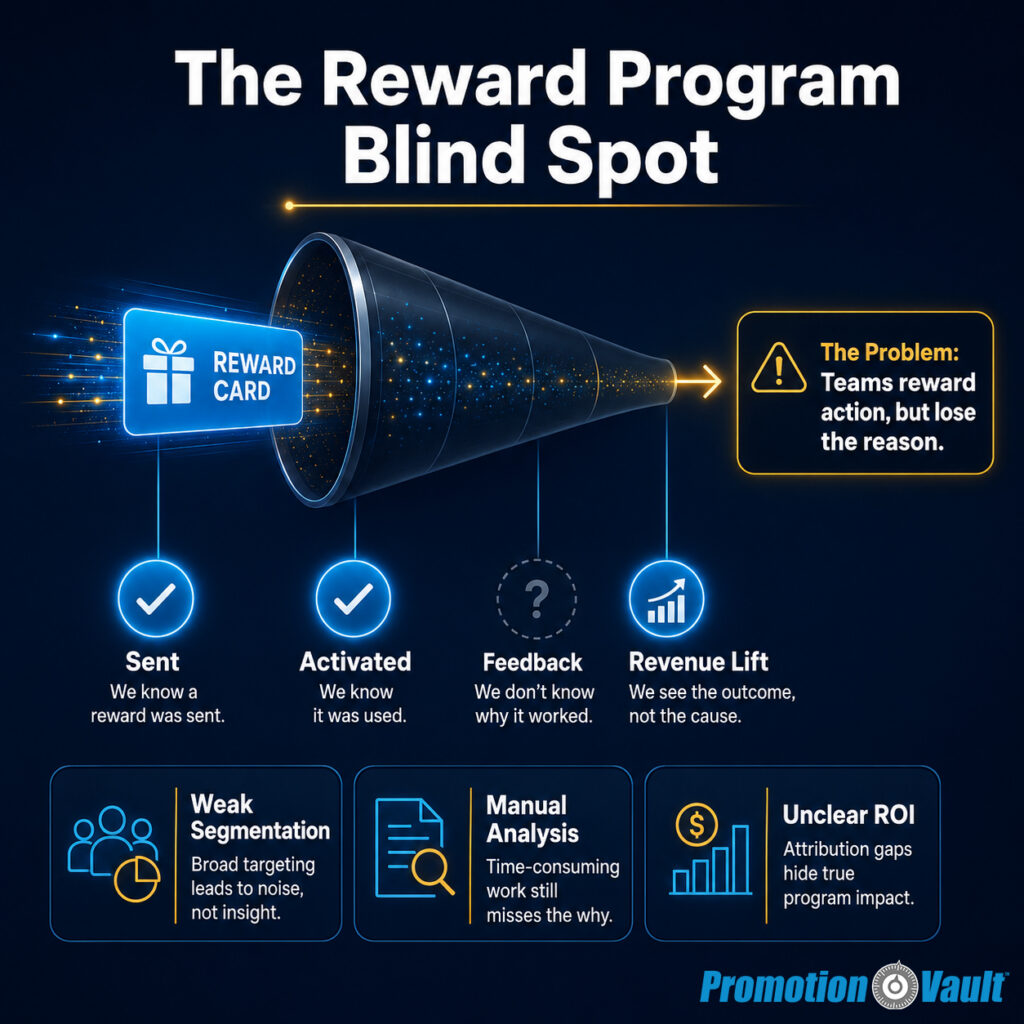
This is one of the most practical places to start because rewards already create attention. The recipient has completed an action or entered a reward moment. They are not being pulled into a cold survey after the fact. They are already engaged.
That changes the quality of the exchange.
Data Vault supports question types like text, multiple choice, yes/no, rating scales, NPS, stars, dropdown, and Likert scales. Questions can appear during activation, at unlock, or across the reward experience. They can also be required or optional, depending on the program design.
Promotion Vault’s internal documentation notes that Data Vault has reached a 97% response rate when feedback is collected inside the reward flow. We should use that number carefully. It is a Promotion Vault platform performance claim, not a universal benchmark. The practical takeaway is still strong: when the question is tied to a reward moment, response behavior can look very different from a cold survey.
External research points in the same direction. A PLOS ONE systematic review and meta-analysis found that monetary incentives can increase survey participation, which supports the broader idea that incentives can improve response behavior when used responsibly. Source: PLOS ONE, “Does usage of monetary incentive impact the involvement in surveys?”.
The better move is to keep the question small and specific. Ask for the insight that helps the next decision.
Good Data Vault questions look like this:
- “What almost stopped you from joining?”
- “What made you come back today?”
- “Which benefit mattered most when you upgraded?”
- “What would make your next visit easier?”
- “Why did you refer this person?”
- “How likely are you to renew in the next 30 days?”
- “What should we improve before your next appointment?”
These questions work because they connect directly to a business decision. The answers can inform lifecycle messaging, onboarding, staffing, product experience, service recovery, referral design, and retention campaigns.
Then AI can summarize the answers by segment. It can show that upgraded customers mention convenience, while renewal customers mention trust. It can show that one location gets positive staff comments while another gets repeated check-in friction. It can show that referrals fail because the referred person does not understand the offer.
That is how a reward becomes more than a thank-you. It becomes a signal.
How Can AI Improve Retention Rewards?
AI can improve retention rewards by helping teams identify which customer actions predict staying power, then analyze which reward messages, values, and follow-ups increase repeat behavior. Retention rewards work best when they reinforce specific completed actions, such as renewals, second visits, first-30-day milestones, upgrades, or comeback moments.
Retention is where vague reward programs get expensive. “Send something nice to loyal customers” might feel good, and sometimes appreciation is the right move. But if the business goal is LTV lift, we need a sharper question: which behavior makes the customer more likely to stay?
For a membership business, that might be the second visit. For a SaaS company, it might be connecting an integration. For an automotive dealership, it might be the first service visit. For a subscription brand, it might be renewal before the lapse window. For a gym, it might be four check-ins in the first 30 days.
Promotion Vault’s article on retention rewards ROI makes this point directly: rewards should be judged against incremental LTV lift, not just sends or activations. That is the right standard.
AI can help strengthen that measurement in several ways:
- Find The Retention Behavior: Use historical data to identify which actions correlate with longer retention, higher renewal, repeat purchase, or upgrade behavior.
- Ask Why The Action Happened: Use Data Vault to ask one short question when the customer activates or unlocks the reward.
- Segment The Answers: Compare responses by campaign, location, lifecycle stage, plan, tenure, or reward value.
- Adjust The Next Reward: Change timing, message, eligibility, reward amount, or follow-up based on the pattern.
- Measure Downstream Value: Compare rewarded cohorts against a control or matched cohort to see whether the reward created incremental lift.
That last step matters. AI can find patterns. It cannot remove the need for measurement integrity.
We should not give a reward credit for behavior that would have happened anyway. If a customer was already going to renew, the reward may still be a good relationship moment. It may not be the reason revenue increased. A strong AI-supported reward program keeps that distinction clear.
How Can AI Improve Acquisition And Referrals?
AI can improve acquisition and referral rewards by helping teams identify high-intent actions, validate lead quality, analyze conversion friction, and adjust incentives based on what produces real customers. The best acquisition rewards are tied to completed or verified steps, such as showed appointments, trial conversions, validated referrals, or paid starts.
Acquisition rewards should not pay for noise. They should reward movement through the funnel.
For operators, the most valuable question is not “How do we get more people to click?” It is “Which completed action gets us closer to a real customer?” That might be a booked consultation, an attended demo, a first purchase, a paid conversion, a referral that becomes qualified, or a return visit after a trial.
Promotion Vault’s customer acquisition rewards page frames this around pay-on-activation economics, branded trust, and campaign-level measurement. That is important because acquisition incentives can become messy when teams reward too early.
AI can help keep the system honest by analyzing:
- Which referral sources produce qualified leads
- Which offers create activation without conversion
- Which locations generate low-quality submissions
- Which reward values improve show rate
- Which feedback themes explain why prospects hesitate
- Which campaigns create downstream revenue instead of surface activity
Referral programs especially need this discipline. A referral is not just a name in a form. A strong referral program tracks the path from submission to validation to conversion to reward. Promotion Vault’s article on automated referral rewards and repeat referrals fits naturally here because the core issue is not only getting referrals. It is rewarding the right referral behavior at the right stage.
Data Vault can sharpen that loop. After a referrer activates a reward, ask: “What made you refer this person?” After the referred lead converts, ask: “What made you decide to come in?” AI can summarize those answers by channel, staff member, location, campaign, or offer.
Now the marketing team has more than attribution. They have language. They can see which promises customers repeat in their own words.
That is useful because acquisition is often a message-market fit problem before it is a reward-value problem. If referred customers keep saying “I trusted my friend,” the program should highlight trust. If trial users say “I needed a deadline,” the follow-up should make timing clearer. If no-shows say “I forgot,” the fix may be reminders, not a bigger reward.
AI helps us avoid the lazy answer: “increase the incentive.” Sometimes the better answer is “fix the moment.”
How Can AI Help Teams Choose Better Reward Moments?
AI can help teams choose better reward moments by comparing behavior, activation, feedback, and revenue data across the customer lifecycle. The best reward moment is the point where a person has enough intent to act, enough friction to hesitate, and enough future value to justify the reward.
A reward should sit where motivation needs help.
Too early, and we may pay for low-intent activity. Too late, and the reward becomes a polite afterthought. Too broad, and we cannot tell what worked. Too complex, and the customer loses the thread.
A simple way to choose reward moments is to score each possible behavior against four questions:
| Reward Moment Question | Why It Matters |
|---|---|
| Does this action predict future value? | The reward should connect to retention, revenue, referral quality, or LTV. |
| Is the action easy to verify? | Verified actions reduce abuse and make ROI easier to defend. |
| Is there real friction here? | Rewards work best when they help people cross a meaningful threshold. |
| Can we learn something useful? | Feedback should improve the next campaign or customer experience. |
For example, “open an email” usually fails this test. “Complete the second visit in 30 days” passes it. “Submit any referral” may be too early. “Submit a referral who validates or converts” is stronger. “Log in once” may be weak. “Complete setup and invite a teammate” is better.
Promotion Vault’s SaaS activation article, How Can SaaS Companies Improve Activation Rates?, uses this same logic: reward verified value moments, not vague engagement. That pattern applies across industries.
AI can help review campaign history and surface which moments deserve a closer test. It can show that customers who complete a kickoff call stay longer. It can show that members who attend twice in week one are more likely to renew. It can show that referrals from recent customers convert at a different rate than referrals from long-tenured customers.
Then the operator can design the reward around the evidence.
This is the difference between a reward calendar and a reward system. A calendar says, “What should we send this month?” A system asks, “Which action should we move next?”
How Can AI Improve Reward Messaging And Trust?
AI can improve reward messaging by analyzing which words, questions, and reminders increase activation without creating confusion or suspicion. Trust matters because recipients are trained to be cautious with unexpected reward messages, so branded identity, clear terms, passwordless access, and consistent follow-up all affect performance.
This point deserves care. Reward programs operate in a trust-sensitive environment. The Federal Trade Commission warns that scammers often use urgent messages involving gift cards or payment instructions, which means real reward programs must work harder to look legitimate.
Salesforce’s State of the AI Connected Customer report also shows why trust matters as AI enters customer experience. Salesforce reports that 61% of customers say AI advancements make company trustworthiness even more important, while 71% say they feel increasingly protective of their personal information.
For reward programs, that means AI cannot simply personalize harder. It has to help communicate more clearly.
Promotion Vault’s branded reward experience is built for that reality. The recipient sees the sender identity, clear reward amount, secure activation path, and branded experience. Passwordless email magic links or SMS code access reduce friction. Automated reminders help prevent the reward from getting buried. Activation windows and delay release settings give teams control over timing and security.
AI can support that system by helping teams compare message performance:
- Which subject lines drive activation without sounding suspicious?
- Which sender names create the most trust?
- Which reminder timing improves activation without fatigue?
- Which questions create high-quality feedback?
- Which segments need simpler instructions?
- Which reward descriptions reduce support tickets?
The rule is simple: use AI to clarify, not manipulate.
We should never make the reward feel like a trick. We should make the exchange easy to understand. The customer completed an action. The customer earned a reward. The next step is clear. The brand is recognizable. The terms are visible. The experience feels like a real relationship, not a random payout email.
How Should Teams Measure AI-Improved Reward Programs?
Teams should measure AI-improved reward programs by tracking eligible recipients, activation rate, completed rewards, realized reward cost, downstream behavior, feedback themes, and incremental revenue or LTV lift. AI can improve analysis, but ROI still depends on comparing rewarded results against a fair control or baseline.
The strongest measurement habit is separating activity from lift.
Activity tells us what happened inside the reward program. Lift tells us whether the business became stronger because of it. We need both, and we should not confuse them.
Track these metrics every week during a pilot:
| Metric | What It Tells Us |
|---|---|
| Eligible Recipients | How many people completed the qualifying action. |
| Activation Rate | How many eligible recipients engaged with the reward. |
| Completed Rewards | How many rewards reached full availability or redemption. |
| Realized Reward Cost | What the program actually cost, including service fees and activated value. |
| Downstream Behavior | Whether the recipient renewed, returned, upgraded, converted, or referred. |
| Feedback Themes | Why people acted, hesitated, stayed, or came back. |
| Incremental Lift | Whether rewarded cohorts beat a fair comparison group. |
This is where Promotion Vault’s pay-on-activation model becomes useful for finance-minded teams. Promotion Vault charges a 10% service fee when a reward is sent, and reward value is charged when the recipient activates. That means teams can forecast spend by activation behavior instead of assuming every eligible reward will cost full face value.
Promotion Vault’s customer retention rewards page connects this to retention behaviors like renewals, repeat purchases, first-30-day milestones, upgrades, and comeback actions. The same logic applies to acquisition and referrals: the reward should be tied to an action worth measuring.
AI can help here by summarizing open-ended feedback and detecting patterns across segments. It can flag that one audience activates at a high rate but does not retain. It can flag that another audience activates less often but creates higher LTV. It can show that a lower reward value works for warm customers while a higher value is needed for dormant customers.
That is the kind of insight operators can use.
What Is The Best Way To Start Using AI In A Reward Program?
The best way to start using AI in a reward program is to run one focused pilot around one high-value behavior. Choose the action, define eligibility, attach one or two Data Vault questions, track activation and downstream behavior, then use AI summaries to improve the next version.
Do not start with a giant AI roadmap. Start with one behavior that matters.
Here is a practical 30-day pilot:
- Pick One Business Outcome: Choose retention, acquisition, referral conversion, upgrade, reactivation, or employee engagement.
- Choose One Completed Action: Reward a verified action, such as second visit, paid conversion, renewal, qualified referral, or completed onboarding.
- Define Eligibility Clearly: Write one sentence the recipient and the finance team can both understand.
- Attach One Data Vault Question: Ask why the person acted, what friction they felt, or what would help next.
- Use Tags From The Start: Tag by campaign, location, lifecycle stage, audience, reward value, and channel.
- Track Activation And Cost: Separate eligible, activated, completed, expired, and deleted rewards.
- Compare Downstream Behavior: Use a control group or the closest responsible baseline.
- Review AI Summaries Weekly: Look for themes by segment, not just overall averages.
- Change One Variable: Adjust reward value, message, timing, audience, or question.
- Scale Only What Holds Up: Expand the version that creates measurable lift and clean recipient feedback.
This is also where no-code automation matters. Promotion Vault’s Zapier integration can help teams connect rewards to the systems they already use, while the sales and marketing incentives page explains how rewards, branded experiences, and mini-surveys can work together inside a growth program.
The fastest path is usually not the most complicated path. It is the cleanest test.
What Are The Biggest Mistakes To Avoid When Using AI For Rewards?
The biggest mistakes are using AI without clean data, rewarding vague engagement, asking too many questions, overpersonalizing without trust, and treating AI summaries as proof of ROI. AI can guide better reward decisions, but it cannot fix weak eligibility rules, poor measurement, or a reward tied to the wrong behavior.
Google’s guidance on AI-generated content is useful beyond SEO. Google says generative AI can help with research and structure, but scaled automated content without added value can violate spam policies. The same principle applies to reward programs: automation without judgment creates noise.
Avoid these traps:
- Rewarding Activity Instead Of Value: Clicks, opens, and impressions can be useful signals, but they rarely deserve rewards by themselves.
- Asking Too Many Questions: A reward moment is valuable because attention is focused. Do not turn it into a long survey.
- Averaging Every Segment: Averages hide the truth. Break results down by audience, location, lifecycle stage, and reward value.
- Skipping The Control Group: If we do not compare against a fair baseline, we may pay for behavior that would have happened anyway.
- Letting AI Write The Strategy Alone: AI can summarize and suggest. Operators still know the margins, staffing realities, customer promises, and brand standards.
- Ignoring Trust Signals: A generic reward message can look suspicious. Brand identity, clear copy, and secure access matter.
- Changing Too Many Things At Once: If reward value, copy, timing, audience, and eligibility all change together, we cannot tell what worked.
A good AI-supported reward program should feel boring in the best way. Clear action. Clear reward. Clear question. Clear measurement. Clear next step.
That discipline is what creates room for creativity.
Frequently Asked Questions About AI And Reward Programs
How Can AI Help Improve Customer Retention Rewards?
AI can improve customer retention rewards by identifying which behaviors predict repeat value and summarizing feedback from customers who complete those behaviors. Teams can use those insights to improve reward timing, value, messaging, and follow-up while measuring whether rewarded cohorts produce higher LTV than a fair comparison group.
What Is Data Vault In Promotion Vault?
Data Vault is Promotion Vault’s feedback and analysis layer. It lets teams ask targeted questions inside the reward experience, organize responses with tags, and use AI-powered analysis to summarize themes, compare segments, and identify useful next actions. It helps turn reward moments into learning loops.
What Should We Ask Customers During A Reward Activation?
Ask one or two questions that connect directly to the next business decision. Strong examples include: “What made you take action today?”, “What almost stopped you?”, “What would make your next visit easier?”, or “Which benefit mattered most?” Keep the question short, specific, and tied to the customer’s journey stage.
Can AI Tell Us Which Reward Value Will Work Best?
AI can help identify patterns in reward value performance, but it should not be treated as a guarantee. The best approach is to test reward values by segment, track activation and downstream behavior, compare against a control group or baseline, and use AI summaries to explain why different groups responded differently.
How Do We Use AI Without Making Rewards Feel Impersonal?
Use AI behind the scenes to improve relevance, clarity, and timing. The recipient-facing experience should still feel human, branded, and easy to understand. AI should help the team ask better questions and make better decisions. It should not make the reward feel automated, invasive, or confusing.
What Metrics Matter Most In An AI-Improved Reward Program?
The most important metrics are eligible recipients, activation rate, completed rewards, realized reward cost, downstream behavior, feedback themes, and incremental lift. A strong reward program does not stop at “rewards sent.” It measures whether the rewarded action improved retention, acquisition, referrals, upgrades, or revenue.
So, How Can AI Improve Reward Programs For Retention, Acquisition, And Revenue Lift?
AI improves reward programs when it helps teams move from sending rewards to learning from reward moments. The practical system is simple: reward one verified behavior, ask one useful question, analyze responses by segment, measure downstream lift, and improve the next campaign. Data Vault strengthens that loop by collecting targeted feedback inside the reward experience, where attention and reciprocity are already high.
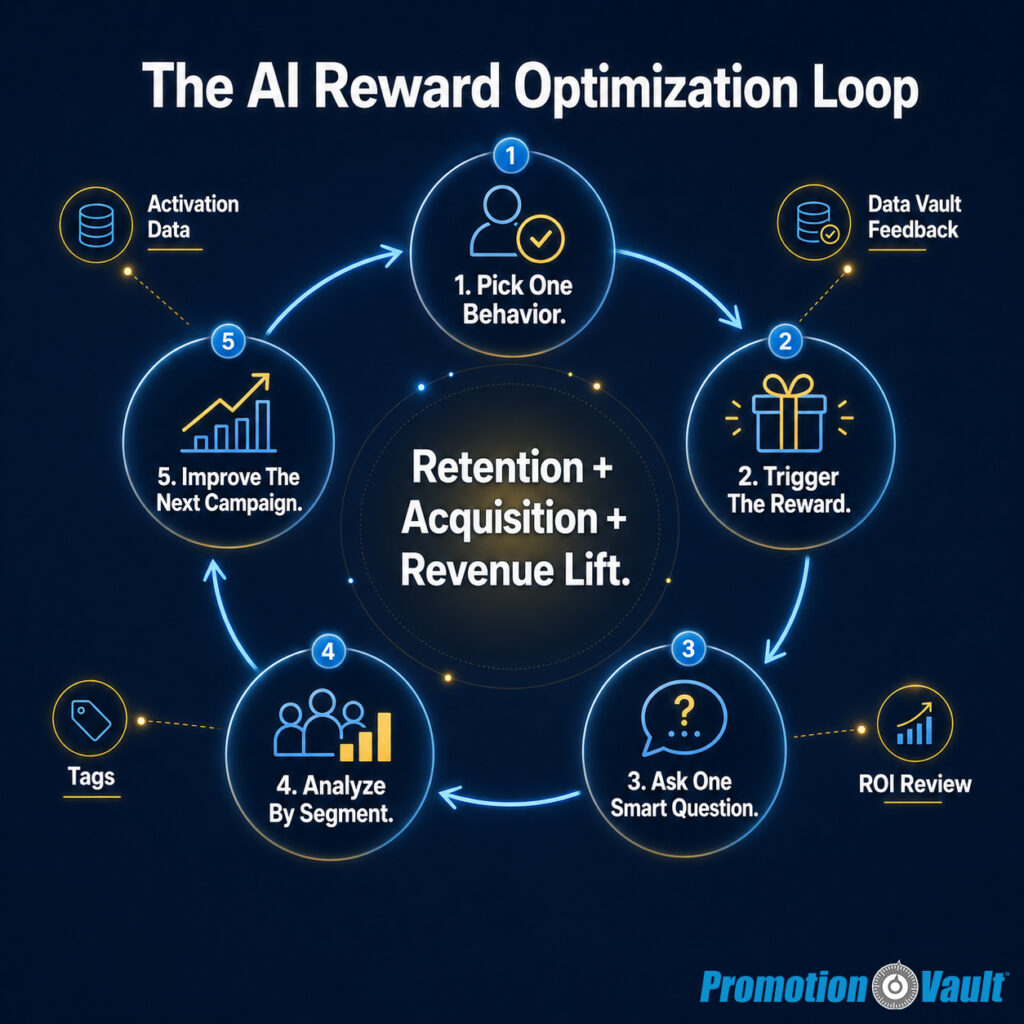
The best reward programs will not be the ones that automate the most messages. They will be the ones that make the clearest decisions. AI helps when it gives operators better visibility into who acted, why they acted, what changed after the reward, and where the next improvement should happen.
If we are already running rewards, then the next move is not to make the program bigger by default. The next move is to make it smarter, cleaner, and easier to defend.
If we want to improve retention, start with one behavior that predicts staying power. If we want to improve acquisition, start with one verified conversion step. If we want better revenue lift, start by connecting reward cost to downstream value. Then use Promotion Vault and Data Vault to turn that reward moment into an optimization loop.