SaaS companies can improve activation by rewarding completed onboarding behaviors that predict retention, such as workspace setup, data import, integration connection, teammate invitation, seat activation, trial conversion, or annual upgrade. The key is to reward verified value moments — not vague engagement — and measure cost per completed action. Discounts should be avoided because they can damage perceived brand value and train prospects and customers to wait for discounts.
TLDR — How Can SaaS Companies Improve Activation Rates
- Activation is not signup — it is the first verified moment of product value.
- Stop rewarding vague engagement; reward completed behaviors that predict retention.
- Replace calendar-based onboarding with triggers tied to real user actions.
- Define the SaaS “aha moment” as a measurable product event.
- Reward setup, data import, integrations, seat activation, and trial conversion.
- Keep rewards after the value event, not before it.
- Use small rewards for setup and larger rewards for higher-value commitments.
- Measure cost per completed action, not total rewards sent.
- Protect margins by rewarding progress instead of discounting the product.
- Book a Promotion Vault demo to map your highest-value activation rewards.
- Activation Is Not A Welcome Email
- Why Should SaaS Activation Move From Calendar-Based To Behavior-Based?
- What SaaS Behaviors Should We Reward?
- How Do We Find The SaaS ‘Aha Moment’ Without Guessing?
- Where Do Rewards Fit In A SaaS Onboarding Funnel?
- What Is A Simple SaaS Activation Reward Ladder We Can Test?
- Why Can Rewards Work Better Than Discounts For SaaS Activation?
- How Should We Measure SaaS Reward ROI?
- How Do We Avoid Reward Abuse In SaaS?
- How Does Promotion Vault Help SaaS Teams Run Activation Rewards?
- Frequently Asked Questions About SaaS Activation Rates And Rewards
- So, What Is The Best Way To Improve SaaS Activation Without Discounts?
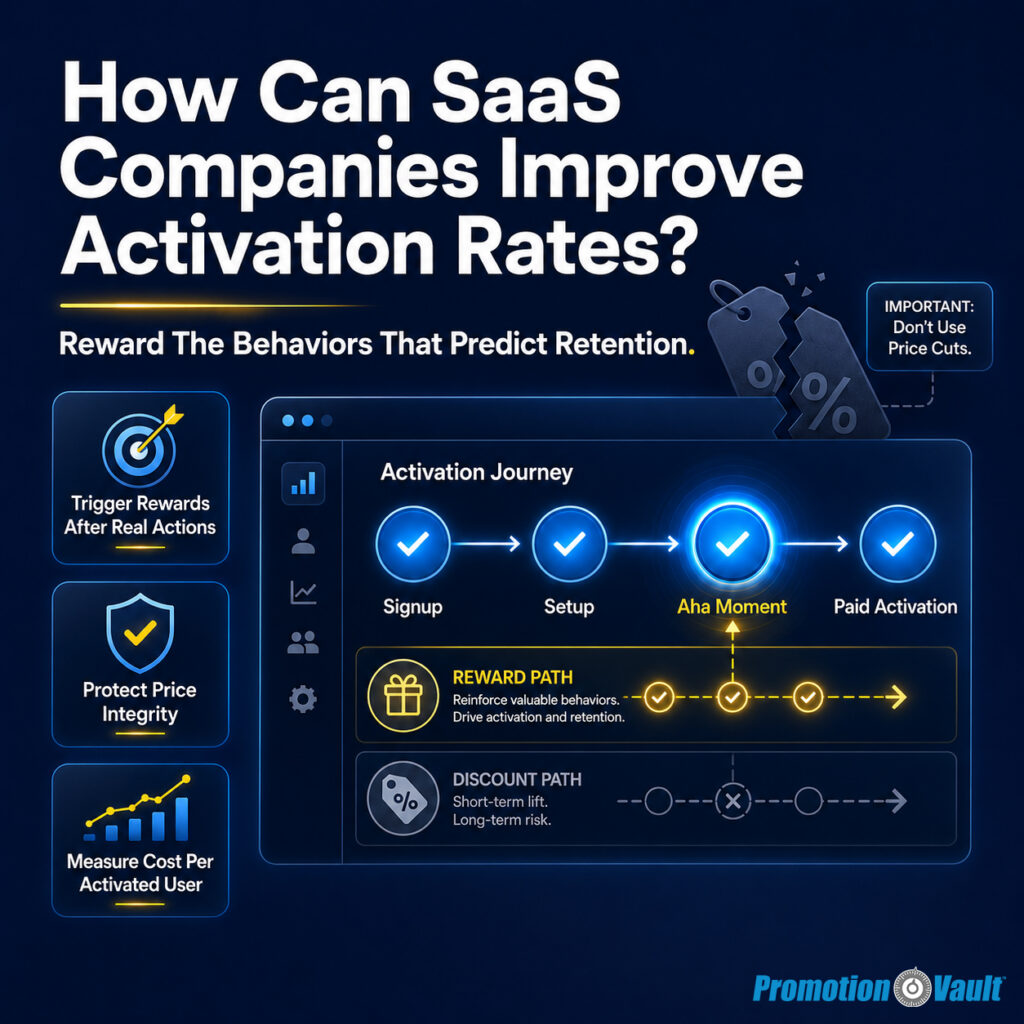
Activation Is Not A Welcome Email
A signup is not activation. A completed profile is not activation. A trial user who never reaches the product’s value is not activated — they are just temporarily present.
That distinction matters because too many SaaS teams still treat onboarding like a message sequence. Day 0 welcome email. Day 2 feature email. Day 5 reminder. Day 10 “checking in.” The cadence may be well written, but the customer’s risk is not calendar-based. Their risk is behavioral.
They have not imported data. They have not invited a teammate. They have not connected the integration. They have not created the first project. They have not used the feature that proves the product can make their work easier.
That is the real activation gap.
Brian Mitchell, CEO of Promotion Vault, said the strongest operators “act toward or engage with the member at the behavioral moments, not on a calendar.” The SaaS version is just as clear. We should not wait until day seven to ask why someone stalled on day one. We should see the stall, respond to the stall, and help them complete the behavior that creates value.
The goal is not to bribe people into using software they do not need. That would be bad strategy and worse ethics. The goal is to help capable buyers cross the early friction points that make retention possible.
The best SaaS activation programs do not discount the product. They reward the behaviors that prove the product is becoming useful.
This article is written for SaaS founders, heads of growth, PLG leaders, lifecycle marketers, customer success leaders, RevOps teams, and finance stakeholders who are asking the same practical question: how do we increase product adoption, trial-to-paid conversion, and early retention without training customers to wait for coupons?
The answer is not to send more rewards. It’s to reward fewer moments. Pick better moments. And measure them harder.
Why Should SaaS Activation Move From Calendar-Based To Behavior-Based?
SaaS activation should move from calendar-based to behavior-based because users churn from missed value, not missed emails. A behavior-based activation system responds to what the user has or has not completed — setup, import, integration, first project, seat activation, or trial conversion — and helps them reach value sooner.
Calendar-based onboarding is easy to build. It is also easy to ignore. Everyone gets the same message, whether they completed setup in 12 minutes or stalled before importing their first file.
That is the problem.
Brian Mitchell, CEO of Promotion Vault, described passivity as the common thread behind early loss. “The system is waiting for the member to come back,” he said. For SaaS, the same pattern shows up when the product waits for the user to self-correct.
The user does not connect the integration. We send a “Did you know?” email.
The admin does not invite the team. We send a feature tour.
The trial account never reaches first value. We send a discount.
That is not activation strategy. That is hope with templates.
A better SaaS activation system starts with product behavior. We should know the two or three actions that separate retained accounts from accounts that disappear. Then we should build our onboarding, lifecycle messaging, customer success motion, and rewards around those actions.
PostHog describes activation metrics as the actions new users take that correlate with greater retention. In its own activation work, PostHog tested event groups and found the combination of actions most associated with customers still using the product three months later. That is the right mental model. Activation is not whatever feels important to us. Activation is what the data proves matters to the customer’s future behavior.
For a SaaS team, that could mean:
- A CRM user imports a list and sends the first campaign.
- A project management user creates a project and invites a teammate.
- A data product user connects the first source and views a dashboard.
- An HR platform admin imports employees and launches the first workflow.
- An AI tool user produces an output they actually use in a real task.
The point is not that every SaaS product has the same activation event. The point is that every SaaS team needs to stop guessing.
We should start from the product event that predicts retention. Then we should reward completion of that event — not passive intent around it.
What SaaS Behaviors Should We Reward?
SaaS teams should reward completed behaviors that show the customer has reached real product value. Strong reward moments include setup completion, workspace creation, first data import, first integration, first project, first key feature use, first teammate invited, first seats activated, trial conversion, annual upgrade, expansion, or qualified referral.
This is where the discipline matters. Rewards should not sit on vanity actions. A login is usually too weak. A page view is too thin. A button click may mean nothing unless it completes a workflow.
Brian Mitchell, CEO of Promotion Vault, put the rule plainly: “Start from the data, not the marketing calendar.” He continued: “Find the two or three behaviors that most correlate with surviving past day 90. And build a reward around those.”
That is the SaaS playbook.
We do not reward someone for being near value. We reward them for crossing the line into value.
A strong SaaS reward moment should pass four tests:
- It is observable. We can verify the event happened.
- It is meaningful. The event moves the customer closer to value.
- It is predictive. Accounts that complete it retain, expand, or convert at a better rate.
- It is controllable. The user can understand what to do next.
Here are the moments most SaaS teams should examine first:
- Account Setup Completed: The user finishes the required setup steps that make the product usable.
- Workspace Created: The account creates the operating space where future work will happen.
- First Project Built: The user creates the first project, campaign, dashboard, report, workflow, or automation.
- First Data Import Completed: The product now has enough information to deliver value.
- First Integration Connected: The product connects to the customer’s existing workflow.
- First Key Feature Used: The user completes the feature action most tied to retention.
- First Teammate Invited: The product starts moving from individual trial to account adoption.
- First Three Seats Activated: The team starts building internal usage, not just admin interest.
- Trial Converted To Paid: The user moves from evaluation to commitment.
- Monthly Plan Upgraded To Annual: The customer makes a stronger commitment when the value case is clear.
- Expansion Seat Package Activated: The account grows usage across the team.
- Qualified Customer Referral Submitted: A happy account creates the next growth loop.
The “qualified” part matters. We should not reward claims. We should reward verified outcomes.
Brian Mitchell warns against rewarding a booking when the actual valuable behavior was completion. In his words: “Not booking your assessment, completing the assessment.” For SaaS, that means we should not reward “started integration” if the value event is “integration live.” We should not reward “invited teammate” if the value event is “teammate accepted and used the product.”
Clean reward design protects the budget and the customer experience at the same time.
How Do We Find The SaaS ‘Aha Moment’ Without Guessing?
We find the SaaS aha moment by translating it into a measurable product event and testing whether that event predicts retention. The aha moment should not be treated as a slogan. It should become a clear activation metric, such as first report created, integration connected, teammate invited, workflow launched, or output used.
“Aha moment” is one of those phrases that can sound useful while hiding the hard work.
In plain language, the aha moment is the point where the user understands why the product matters. But for operators, that definition is still too soft. We need to turn that feeling into a behavior we can track.
Brian Mitchell, CEO of Promotion Vault, made that exact bridge. For a SaaS subscription, he said, the behavior might be “the number of seats activated or some aha feature” that was used. That is the right way to frame it. The aha moment becomes actionable only when we can see it inside the product.
A practical process looks like this:
- List Candidate Value Events. Write down the actions that could indicate value: first project created, first dashboard viewed, first integration connected, first teammate invited, first output exported, first workflow completed.
- Cohort Accounts By Completion. Compare accounts that completed each event against accounts that did not.
- Measure Retention And Expansion. Look at D7, D14, D30, gross revenue retention, net revenue retention, upgrade rate, and support burden.
- Choose The Strongest Signal. Pick the behavior that best predicts meaningful future usage.
- Build The Activation Path Around It. Make the event easier, clearer, faster, and more rewarding to complete.
Mixpanel’s retention documentation frames retention reporting around a simple question: how long do users continue coming back and finding value? That question should sit underneath every activation decision. We are not trying to create a pretty onboarding checklist. We are trying to create durable usage.
The strongest SaaS teams define activation at the account level when the product is sold at the account level. That matters for B2B SaaS. One excited user may not be enough. A company may need an admin, a manager, and three team members to complete different parts of the value path.
So we should ask:
- What behavior shows an individual user reached value?
- What behavior shows an account reached value?
- What behavior shows the product became part of the team’s operating rhythm?
- What behavior predicts renewal or expansion?
Then we reward the smallest verified step that moves the account toward that outcome.
Where Do Rewards Fit In A SaaS Onboarding Funnel?
Rewards fit best after verified value-building actions, not before them. The cleanest SaaS onboarding funnel tells users what action earns the reward, guides them through the task, verifies completion, sends the reward immediately, asks one feedback question, and routes them to the next milestone.
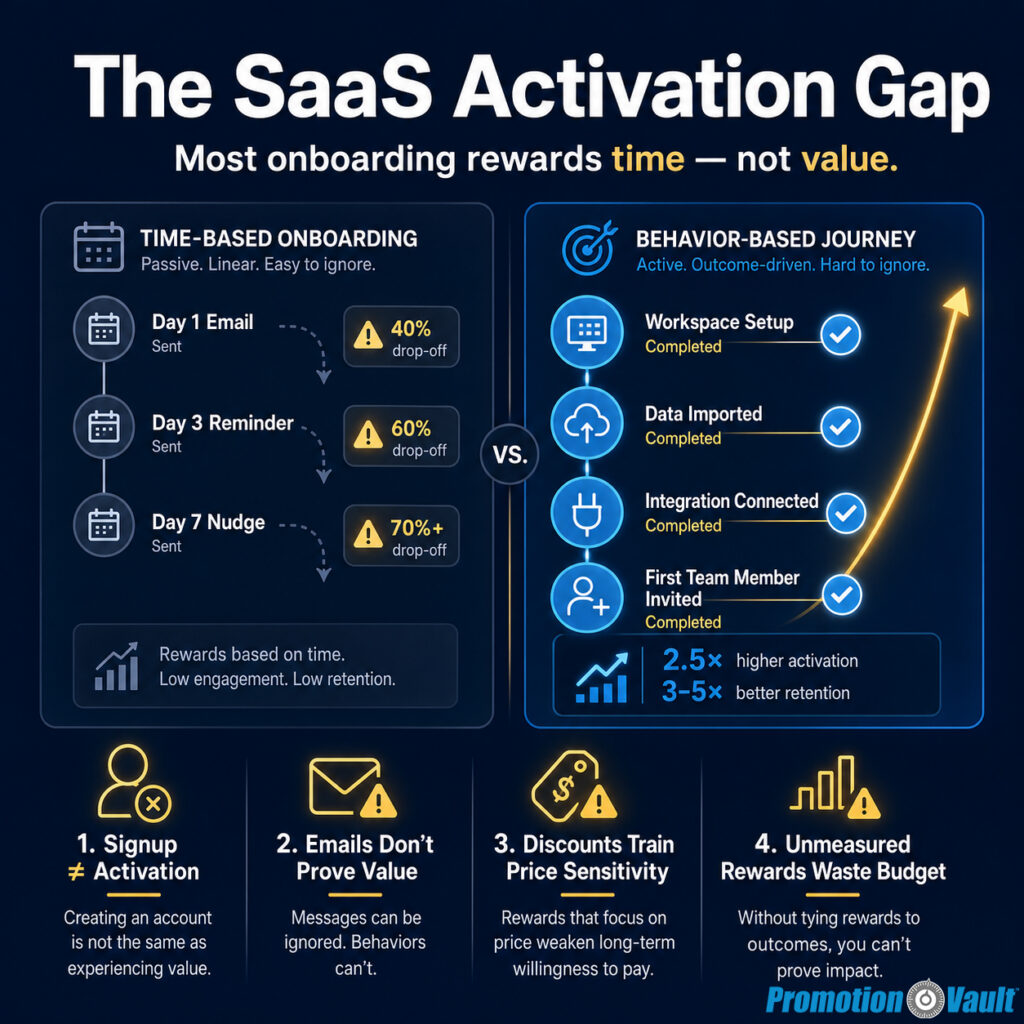
A reward should never carry a weak onboarding flow. If the product path is confusing, a reward may create short-term movement, but it will not fix the underlying problem. The reward works best when it sits beside a clear task.
Brian Mitchell, CEO of Promotion Vault, said the timing of rewards “is the key” because it “drives them to then do that next step.” For SaaS, that means the reward should be placed at the point where motivation can help the user complete a useful action.
A clean onboarding reward flow looks like this:
- Pre-Action: Tell The User What Action Earns The Reward.
Give the user one clear line: “Connect your first integration and earn a $15 reward.” Do not bury the rule in terms. The user should be able to repeat it. - During Action: Make The Task Simple And Guided.
Remove extra fields, unnecessary choices, and premature education. If the action is “import your first dataset,” do not distract them with five advanced settings. - Post-Action: Send The Reward When The Event Is Verified.
The reward should feel connected to the behavior. If we wait too long, the user loses the emotional link between effort and recognition. - Feedback Moment: Ask One Question About Friction.
Ask one useful question in the reward flow: “What almost stopped you from completing setup?” or “What should we make clearer before your team joins?” - Next Milestone: Route The User Forward.
A completed setup reward should not be the finish line. It should point to the next step: invite a teammate, create the first workflow, activate more seats, or convert to paid.
This is where rewards become more than incentives. They become a narrative.
Brian Mitchell described this clearly: “Rewarding them through their life cycle also gives you the ability to create that narrative of what that life cycle looks like.” For SaaS, that narrative might be:
Set up your workspace. Connect your data. Invite your team. Build your first workflow. Convert when value is clear. Expand when the team is ready.
That is not manipulation. That is guidance with accountability.
What Is A Simple SaaS Activation Reward Ladder We Can Test?
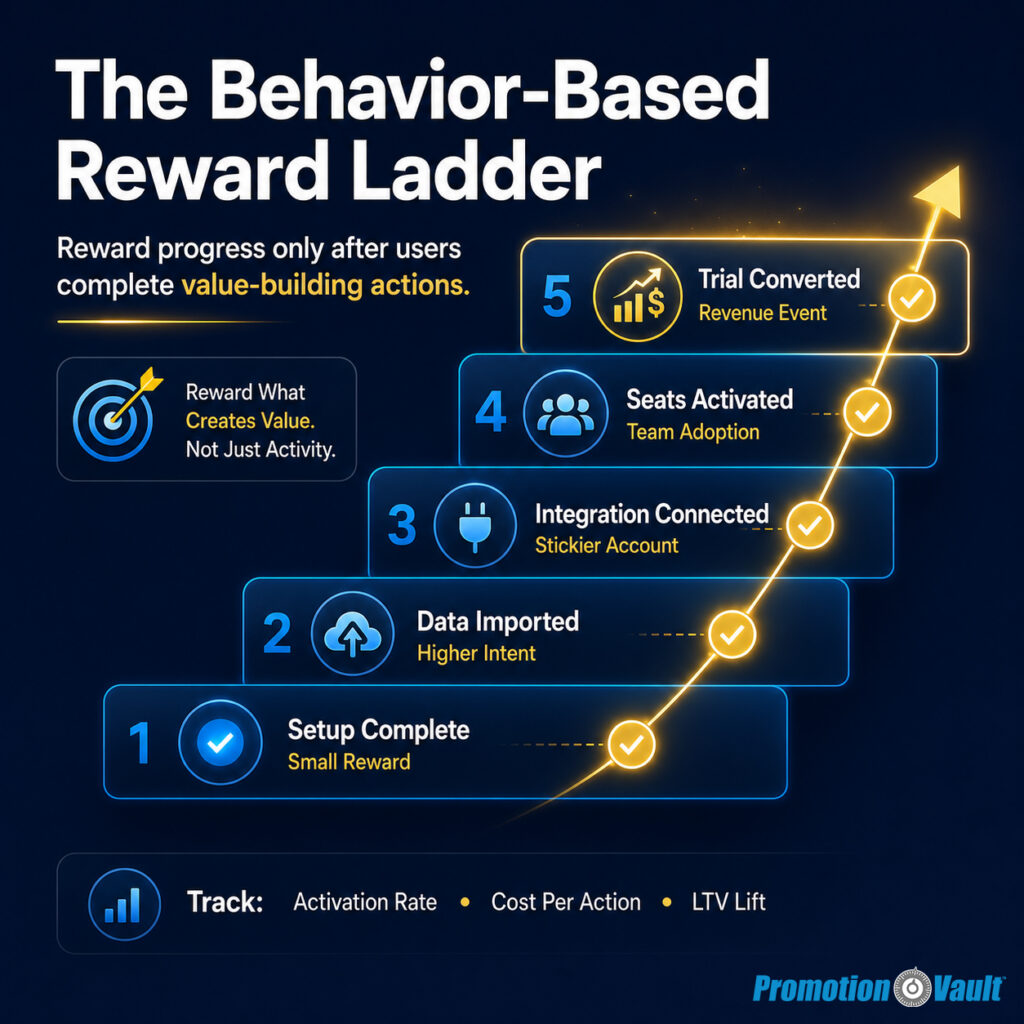
A simple SaaS activation reward ladder starts with small rewards for early setup behaviors and increases only when the completed action has higher business value. Teams can test $10 for setup, $15 for integration or import, $20 for seat activation, $25 for trial conversion, and $50 for annual prepay or expansion.
These values are not universal recommendations. They are starting points for testing. The right amount depends on gross margin, CAC, average contract value, payback window, retention lift, and the cost of support.
But the shape of the ladder matters.
Small action, small reward. Bigger commitment, bigger reward. Verified outcome, accountable cost.
A SaaS team could test a ladder like this:
| Milestone | Reward Example | Why It Matters |
|---|---|---|
| Workspace setup completed | $10 | Removes first-session friction |
| First integration connected or dataset imported | $15 | Helps the product reach usable value |
| Three seats activated within 14 days | $20 | Moves adoption beyond one user |
| Trial converted to paid | $25 | Converts intent into revenue |
| Annual prepay or expansion action completed | $50 | Rewards a higher-value commitment |
Brian Mitchell, CEO of Promotion Vault, recommended a similar “small, certain rewards” principle. The emphasis should be on certainty and timing, not theatrics. He also warned against trying to do everything at once: “Pick two and execute them well.”
That is especially important for SaaS teams.
We should not launch seven reward triggers in the first test. That creates measurement noise and operational confusion. We should pick two activation behaviors and build clean experiments around them.
For example:
- A PLG analytics platform might reward “first data source connected” and “first dashboard shared.”
- A project management platform might reward “first project created” and “three teammates active.”
- A sales enablement platform might reward “first content library uploaded” and “first rep completes a play.”
- An HR platform might reward “first employee import completed” and “first workflow launched.”
The reward ladder should follow the customer’s path to value. It should not follow our internal feature priority list.
That is the difference between activation and promotion.
Why Can Rewards Work Better Than Discounts For SaaS Activation?
Rewards can work better than discounts because they add value without lowering the product’s price anchor. A discount trains buyers to question the stated price. A reward recognizes a completed behavior while keeping the product’s value intact, which matters for trials, annual upgrades, expansion, and premium tiers.
Discounts can be useful in the right context. We do not need to pretend otherwise. But when SaaS teams use discounts as the default activation lever, we create a pattern that becomes hard to unwind.
We teach buyers to wait.
Brian Mitchell, CEO of Promotion Vault, said it directly: “Discounting as a retention lever has a half-life and we’re way past it.” He also made a cleaner distinction: “A discount is a negative… Adding a reward [is] something that’s a positive.”
That distinction matters for SaaS.
A discount changes the price conversation. It says the product may not be worth the stated price today. A reward changes the behavior conversation. It says: complete the value-building action, and we will recognize that commitment.
Academic research supports the concern around price anchoring. A Journal of Product & Brand Management study by Ben Lowe, Fong Yee Chan, and Paul Yeow found that price promotions can affect reference prices, and that expected price and fair price can converge after multiple promotions. In plain English: repeated discounts can teach customers what they should expect to pay.
That is dangerous for SaaS teams that need customers to trust annual plans, premium tiers, and expansion pricing.
Rewards protect the frame. They let us say:
- The product price stays the same.
- The value path gets clearer.
- The customer earns added value by completing meaningful actions.
- The company can measure whether the incentive moved the right behavior.
A discount often rewards hesitation. A behavior-based reward rewards progress.
That is the better trade.
How Should We Measure SaaS Reward ROI?
SaaS reward ROI should be measured by cost per completed action and downstream lift, not total rewards sent. Track eligible users, activated rewards, completed behaviors, trial-to-paid conversion, time to value, seat activation, feature adoption, D7/D14/D30 retention, expansion, payback, and gross or net revenue retention.
The finance question is fair. Rewards cost money. The right response is not “trust us.” The right response is a scoreboard.
Brian Mitchell, CEO of Promotion Vault, called this “the cost to acquire the action.” That phrase is useful because it keeps the team honest. We are not buying vibes. We are buying completed behaviors that the business has already decided are valuable.
For SaaS, that means we should measure:
- Eligible Users Or Accounts: Who qualified for the reward opportunity?
- Reward Activation Rate: Who claimed the reward?
- Behavior Completion Rate: Who completed the target action?
- Trial-To-Paid Conversion: Did more trial users become paying customers?
- Time To Value: Did users reach value faster?
- Integration Completion Rate: Did more accounts connect the systems needed for value?
- Seat Activation: Did more purchased or invited seats become active?
- Key Feature Adoption: Did users complete the product event tied to retention?
- D7 / D14 / D30 Active Usage: Did the behavior continue after the reward?
- Annual Upgrade Rate: Did more accounts choose longer commitments?
- Expansion Rate: Did accounts add seats, workflows, usage, or premium features?
- Gross Revenue Retention: Did fewer customers churn?
- Net Revenue Retention: Did retained customers expand?
- Payback Period: Did the lift justify the cost quickly enough?
ChartMogul and ProductLed’s 2026 Conversion Report analyzed 200 B2B software products and found that improving free-to-paid conversion remains one of the highest-leverage ways to grow revenue without adding headcount or increasing marketing spend. The same report found a median free-to-paid conversion rate of 8% across all products, while also warning that “normal” conversion is a misleading idea because free trials, freemium, credit-card requirements, product type, and price point all change the math.
That is exactly why SaaS teams should not copy a reward amount from another company and assume it will work.
We should build a simple model:
- What behavior are we trying to increase?
- How often does it happen today?
- What is that behavior worth if it increases?
- What reward amount will we test?
- What is the maximum cost if everyone activates?
- What is the realized cost after activation?
- What lift would make the test profitable?
- What downstream metric proves the behavior mattered?
Here is the cleanest version:
Cost Per Completed Action = Total Reward Cost / Number Of Verified Completed Actions
If we spend $2,000 and generate 100 verified integration completions, our cost per integration completion is $20. That is only useful if we know what integration completion does to retention, conversion, or expansion.
The metric is not the finish line. It is the bridge to better decisions.
How Do We Avoid Reward Abuse In SaaS?
SaaS teams avoid reward abuse by rewarding only verified events, limiting each reward to one account or user per milestone, tying larger rewards to billing or workspace-level actions, excluding test domains, using cooldown windows, separating user rewards from admin rewards, and reviewing anomalies weekly.
Abuse prevention should not make the program feel cold. It should make the program defensible.
The key is to reward actions that are hard to fake and easy to verify. That is another reason vague engagement is weak. “Logged in three times” may be easy to game. “Connected Salesforce and imported 500 records” is stronger. “Activated three paid seats” is stronger still.
A practical SaaS abuse-control checklist looks like this:
- Reward Verified Events Only: Connect the reward trigger to product, CRM, billing, or data events.
- Limit One Reward Per Milestone: Prevent repeat claims for the same account and action.
- Use Workspace-Level Rules For Bigger Rewards: Tie larger rewards to account-level progress, not isolated user activity.
- Exclude Internal And Test Domains: Filter company emails, QA accounts, agency test accounts, and suspicious free-email patterns when needed.
- Add Cooldown Windows: Prevent repeated reward attempts over short time periods.
- Separate User And Admin Rewards: A user reward may drive learning. An admin reward may drive account setup or billing commitment.
- Review Anomalies Weekly: Look for repeated domains, rapid duplicate actions, unusual reward activation patterns, or mismatched firmographics.
- Keep Terms Plain: Users should understand what qualifies and what does not.
Brian Mitchell, CEO of Promotion Vault, repeatedly returned to the same standard: rewards should attach to actions “our customers have determined have value to them.” That standard helps prevent waste. It also protects the customer experience.
When rewards are tied to real value, the program feels like recognition. When rewards are tied to loopholes, the program becomes cleanup work.
We want the first one.
How Does Promotion Vault Help SaaS Teams Run Activation Rewards?
Promotion Vault helps SaaS teams run activation rewards by connecting rewards to verified actions through API, webhook, Zapier, CRM, billing, product events, or manual import. Teams can use pay-on-activation economics, branded reward experiences, automated reminders, and Data Vault questions to measure cost, completion, and friction.
Promotion Vault is not trying to replace the SaaS product, CRM, billing system, analytics stack, or lifecycle platform. We are the rewards automation layer that helps those systems move behavior.
That distinction matters.
Brian Mitchell, CEO of Promotion Vault, described the need plainly: “You want it automated.” He also said, “The timing in which the rewards hit and validate is the key.”
For SaaS teams, Promotion Vault can support the activation system in five practical ways.
First, we can help trigger rewards from the systems teams already use. That can include API, webhook, Zapier, CRM, billing events, product events, or manual import. The core idea is simple: when the verified behavior happens, the reward flow begins.
Second, Promotion Vault uses pay-on-activation economics. In Promotion Vault’s model, a 10% service fee applies when the reward is sent, and the reward value is charged when the recipient activates. If the recipient does not activate within the activation window, the business does not pay the reward value. That helps growth, customer success, RevOps, and finance talk from the same scoreboard.
Third, Promotion Vault creates a branded reward experience. The recipient sees the sender’s branding, reward value, secure call-to-action, and a guided activation journey. That matters because trust is part of conversion. A reward that feels suspicious will not move behavior.
Fourth, Promotion Vault supports automated reminders for unactivated rewards. The point is not to spam people. The point is to make sure a reward someone earned does not disappear because they missed one email. Promotion Vault documentation describes reminder timing across days 1, 3, 6, 13, 21, 29, 40, 50, and 59, with guardrails such as rate limiting and unsubscribe suppression.
Fifth, Data Vault can turn reward moments into learning moments. Brian Mitchell said that reward activation is one of the highest-attention moments outside the business itself. Promotion Vault can place mini-survey questions in that flow, including NPS, rating, multiple choice, and text questions.
That gives SaaS teams a better question than “Did the reward work?”
We can ask:
- What nearly stopped the user from finishing setup?
- Which integration matters most to this account?
- Who else needs to be involved before rollout?
- What feature did they expect but not find?
- What would make annual commitment easier?
- What use case should customer success prioritize?
Data Vault is valuable because the feedback comes at a moment of reciprocity. The customer just completed something. We recognized it. Now we can learn from it.
That is how rewards become a feedback loop — not just a payout.
Frequently Asked Questions About SaaS Activation Rates And Rewards
What Is SaaS Activation?
SaaS activation is the point where a user or account completes the behavior that shows they have reached meaningful product value. It is usually not signup alone. Strong activation events include setup completion, first project creation, first integration connected, first teammate invited, or first workflow completed.
How Can SaaS Companies Improve Activation Without Discounts?
SaaS companies can improve activation without discounts by rewarding verified onboarding behaviors that create value. Instead of lowering the product price, teams can reward actions like data import, integration setup, seat activation, trial conversion, annual upgrade, or expansion when those actions predict retention.
What SaaS Behaviors Should We Reward?
Reward SaaS behaviors your data shows are tied to retention, conversion, or expansion. Good candidates include workspace setup, first data import, first integration, first key feature use, first teammate invited, first three seats activated, trial-to-paid conversion, annual plan selection, and expansion activation.
Are Rewards Better Than Discounts For SaaS Activation?
Rewards can be better than discounts when the goal is to protect pricing and move behavior. A discount lowers the price anchor. A reward adds value after a completed action, which lets the company recognize progress without teaching customers to wait for a cheaper price.
How Much Should A SaaS Activation Reward Be?
A SaaS activation reward should be tested against gross margin, CAC, payback period, activation lift, and downstream retention. Start small. Use larger rewards only for higher-value behaviors such as trial conversion, annual prepay, expansion, or verified account-level activation.
Can Rewards Help With SaaS Expansion?
Yes, rewards can help with SaaS expansion when they are tied to verified expansion behaviors. Examples include activating additional seats, adopting a premium workflow, connecting a second integration, inviting a department, completing rollout, or moving from monthly to annual billing.
So, What Is The Best Way To Improve SaaS Activation Without Discounts?
The best way to improve SaaS activation without discounts is to reward the few completed behaviors that prove customers are reaching value. Those behaviors should come from cohort data, not team opinions. Once selected, each behavior should have a clear reward, a clean trigger, a fraud-resistant rule, and a scoreboard that tracks cost per completed action.
If we want more trial users to convert, we should identify the product event that makes conversion more likely and reward that completion. If we want more accounts to retain, we should find the setup, integration, seat activation, or feature-use milestone that predicts retention and build the first 30 days around it. If finance needs confidence, we should model the reward against realized activation cost, payback, and downstream retention — not the biggest possible spend.
Here is the simple micro-plan:
- If activation is weak, map the two behaviors most correlated with retained accounts.
- If onboarding stalls, reward completion of one setup behavior and one value behavior.
- If discounting is the default, replace one discount with a verified action reward.
- If finance is cautious, model cost per completed action before expanding the program.