To measure the ROI of rewards used for customer retention, compare the lifetime value of a rewarded cohort against a similar control cohort. Then subtract the actual reward cost to identify if ROI is positive or negative (and by how much).
TLDR — Gift Card Breakage and Incentive Programs
- Breakage = paid rewards that didn’t change behavior, so treat it as wasted incentive spend.
- Most breakage is behavioral (forgetting + delay + friction), so fix UX and timing.
- Deliver rewards immediately after the action to keep motivation and attribution tight.
- Make claiming one click with the link first and zero unnecessary steps.
- Offer a curated set of top rewards first, then expand options via search/filter.
- Send helpful reminders to unclaimed rewards at ~24 hours and ~7 days.
- Let recipients choose brands to avoid mismatch that turns rewards into chores.
- Track sent → claimed → redeemed → outcome, not just the rewards sent.
- Set a minimum redemption standard (e.g., 50% claimed within 7 days) and iterate fast.
- Use pay-for-performance rewards so you don’t pay for unused incentives.
- Is Your Rewards Program Dashboard Lying To You?
- How Do We Measure The ROI Of Retention Rewards?
- What Counts As ROI When We Use Rewards For Retention?
- What Data Do We Need Before Launching A Retention Reward Program?
- How Do We Set Up A Cohort And Control Group For Reward ROI?
- How Do We Calculate Incremental LTV Lift From Retention Rewards?
- How Do We Calculate Reward Cost Under Different Reward Economics?
- How Does Pay-On-Activation Improve Retention Reward ROI?
- What Should We Measure Weekly During A Retention Reward Pilot?
- How Do We Avoid False ROI In Reward Programs?
- How Should We Use Reward Activations To Learn Why Customers Stay?
- How Do We Decide Whether A Retention Reward Program Is Worth Scaling?
- How Can We Reinvest Reward Savings To Increase Retention?
- What Are The Best Reward ROI Formulas To Use?
- Frequently Asked Questions About Measuring Reward ROI For Retention
- So, How Should We Really Measure The ROI Of Retention Rewards?
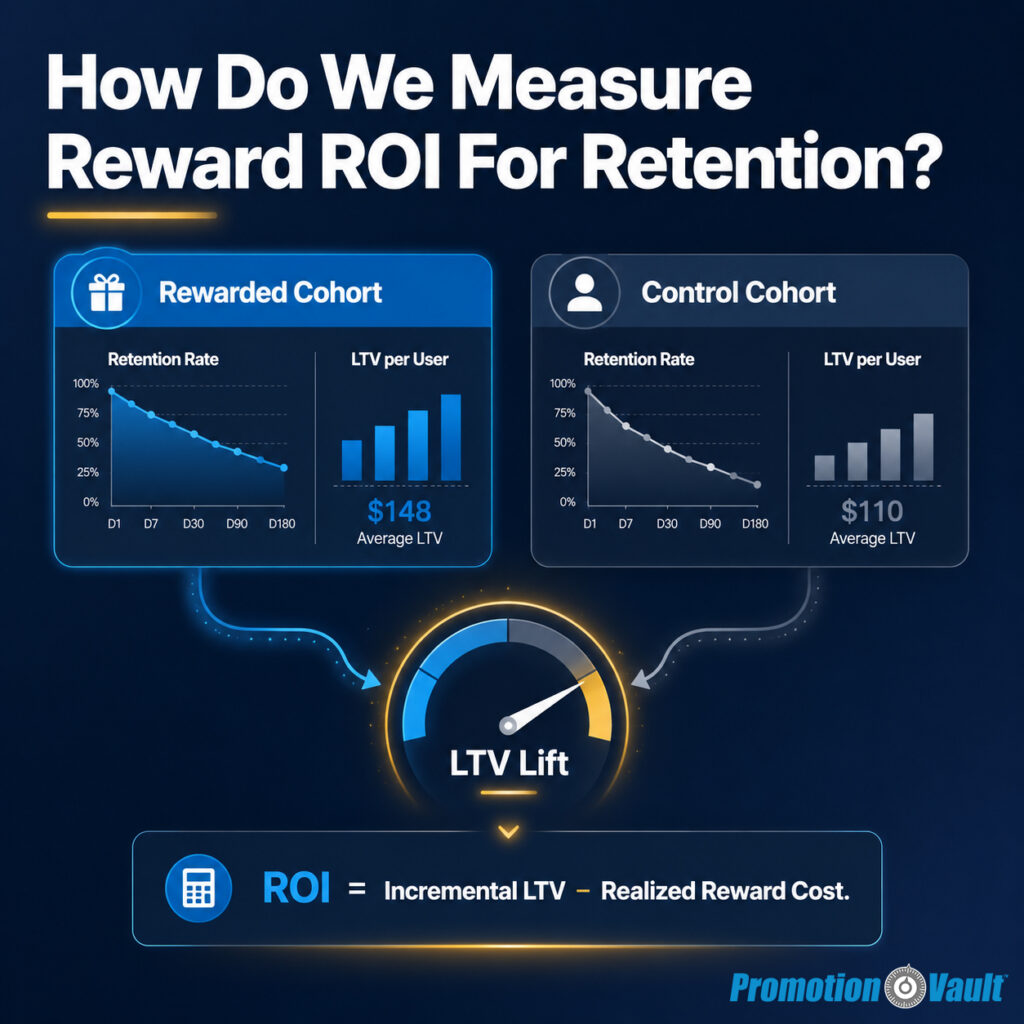
Is Your Rewards Program Dashboard Lying To You?
A reward program can look successful while still failing the business.
The dashboard may show that hundreds of customers qualified. The campaign may show strong activation. The team may feel good because people received value at the right moment. All of that can matter. None of it proves ROI by itself.
For operators, marketing teams, and growth leads, the real question is sharper: Did the customers who received retention rewards become more valuable than similar customers who did not?
That is the measurement standard we should use. Rewards used for retention should be judged by incremental LTV lift — the added lifetime value created in a rewarded cohort compared with a control cohort — minus the real cost paid to create that lift.
Reward ROI is not proven by how many rewards we send. It is proven by how much customer value changes after the reward, compared with what would have happened anyway.
That distinction protects the budget. It also protects the customer relationship. We are not trying to hand out value at random. We are trying to recognize completed behaviors that make the customer more likely to stay, buy again, renew, upgrade, refer, or return.
That is why retention rewards deserve a clean measurement model.
How Do We Measure The ROI Of Retention Rewards?
We measure the ROI of retention rewards by comparing the LTV of customers who completed a rewarded action against a similar control group that did not receive the reward. Then we subtract the actual reward cost from the incremental LTV created by the rewarded cohort.
The core formula is simple:
| Metric | What It Means |
|---|---|
| Rewarded Cohort LTV | Average LTV from customers eligible for the retention reward |
| Control Cohort LTV | Average LTV from similar customers without the reward |
| Incremental LTV Lift | Rewarded cohort LTV minus control cohort LTV |
| Realized Reward Cost | Service fees plus reward value actually paid |
| Reward ROI | (Incremental LTV Lift − Realized Reward Cost) ÷ Realized Reward Cost |
For a fast operator view, we can use incremental revenue LTV. For a finance review, contribution margin is cleaner because it accounts for the cost of serving the retained customer. The principle stays the same either way: compare value created against cost incurred.
This matters because retention rewards are often misunderstood. The reward may be used as the lure that encourages someone to complete a desired action. But the reward should only be sent to people who are eligible — meaning they already completed the action that matters.
That action might be:
- Completing a second visit
- Renewing for another month
- Returning after a lapse
- Completing onboarding
- Switching to a more stable payment method
- Upgrading to a higher-value plan
- Making a qualified referral
The reward recognizes the completed action. The ROI comes from what happens after that action.
What Counts As ROI When We Use Rewards For Retention?
Retention reward ROI is the incremental customer value created by a rewarded behavior, minus the cost of delivering the reward. A campaign has positive ROI when the rewarded cohort produces more added LTV than the total realized reward cost required to create that lift.
This is where we need moral clarity and operational discipline. A reward is not a magic wand. It is a lever. If we attach that lever to weak behavior, we get weak evidence. If we attach it to a behavior that predicts retention, we can measure whether the customer relationship became more durable.
Harvard Business Review has reported that acquiring a new customer can cost five to 25 times more than retaining an existing one. That does not mean every retention campaign deserves budget. It means retention is worth measuring with the same seriousness we bring to acquisition.
A good retention reward model starts with one sentence:
“We believe customers who complete this action will become more valuable over the next X days.”
Then we test it.
For a gym, the action may be completing four visits in the first 30 days. For SaaS, it may be inviting a second user or using a core feature twice. For automotive, it may be returning for the first service visit after purchase. For insurance, it may be completing a renewal consultation before the policy lapse window.
The reward is the visible nudge. The business outcome is the retained value.
What Data Do We Need Before Launching A Retention Reward Program?
Before launching a retention reward program, we need baseline retention data, a clear rewarded action, customer LTV by cohort, reward eligibility rules, activation data, and a control group plan. Without those pieces, we may track activity, but we cannot prove incremental ROI.
This is the practical starting checklist:
- Define The Retention Outcome: Choose the business result we want to improve, such as renewal, repeat purchase, second visit, upgrade, or lower churn.
- Choose One Rewarded Action: Pick the completed customer behavior most likely to move that outcome.
- Pull Baseline Cohort Data: Compare customers who completed the behavior historically against those who did not.
- Estimate Baseline LTV: Calculate average LTV for each group over a useful window, such as 30, 60, 90, or 180 days.
- Create Eligibility Rules: Decide exactly who qualifies for the reward and when.
- Track Reward Status: Separate eligible, activated, completed, expired, and deleted rewards.
- Hold Back A Control Group: Keep a similar group unexposed so we can estimate what would have happened without the reward.
This does not need to start as a heavyweight analytics project. A simple pilot is often enough. The goal is to avoid the common mistake: launching a reward campaign, watching revenue rise, and giving the campaign credit for every dollar.
Some customers would have renewed anyway. Some would have upgraded anyway. Some would have returned without the reward. ROI depends on the difference the reward made.
How Do We Set Up A Cohort And Control Group For Reward ROI?
Set up reward ROI measurement by splitting similar customers into a rewarded cohort and a control cohort before the campaign starts. The rewarded group receives the incentive after completing the target action. The control group does not receive the reward, so we can measure incremental LTV lift.
This is the cleanest way to defend the result. Researchers Ron Berman and Elea McDonnell Feit describe incrementality experiments as comparisons between customers exposed to a marketing action and customers randomly assigned to a control group. That logic applies directly to retention rewards.
Here is the simple version for operators:
| Step | Decision |
|---|---|
| Define The Population | Which customers are eligible for the test? |
| Randomly Split Groups | Who enters the reward path, and who enters the control path? |
| Keep Rules Consistent | Are both groups similar in timing, segment, location, and customer stage? |
| Measure The Same Window | Are we comparing both groups over the same number of days? |
| Compare LTV | Did the rewarded group create more value? |
| Subtract Cost | Did added value exceed realized reward cost? |
The control group does not need to be huge for a first pilot. It does need to be fair. A control group made of different customers, older customers, less engaged customers, or different locations will create a weak answer.
When randomization is not possible, use the closest responsible comparison. Compare similar cohorts by signup month, location, plan, spend level, tenure, or behavior stage. We should name the limitation clearly. A matched cohort is useful. A randomized control group is stronger.
The point is integrity. We should want the campaign to win on the truth.
How Do We Calculate Incremental LTV Lift From Retention Rewards?
Calculate incremental LTV lift by subtracting the control cohort’s average LTV from the rewarded cohort’s average LTV over the same time window. Then multiply that lift by the number of customers in the rewarded cohort to estimate total incremental value created.
Use this model:
| Calculation | Formula |
|---|---|
| Average LTV Lift Per Customer | Rewarded Cohort LTV − Control Cohort LTV |
| Total Incremental LTV | Average LTV Lift × Rewarded Customers |
| Net Value Created | Total Incremental LTV − Realized Reward Cost |
| ROI | Net Value Created ÷ Realized Reward Cost |
Here is an illustrative example:
| Input | Amount |
|---|---|
| Rewarded Cohort Size | 1,000 customers |
| Rewarded Cohort 90-Day LTV | $140 |
| Control Cohort 90-Day LTV | $120 |
| Incremental LTV Per Customer | $20 |
| Total Incremental LTV | $20,000 |
If realized reward cost is $12,000, the program creates $8,000 in net value.
ROI = ($20,000 − $12,000) ÷ $12,000
ROI = 66.7%
That is the clean version. In a more finance-led model, we would replace revenue LTV with contribution margin LTV. If average gross margin is 50%, the $20,000 incremental revenue lift becomes $10,000 in incremental contribution. That may change the decision.
Both views are useful. Revenue LTV helps operators see movement. Contribution LTV helps finance see payback.
How Do We Calculate Reward Cost Under Different Reward Economics?
Calculate reward cost by adding every cost tied to reward delivery, including platform fees, service fees, activated reward value, processing fees, and operational costs. Traditional pay-on-send models usually charge full reward value for every eligible recipient. Pay-on-activation models charge full reward value only when recipients activate.
This distinction matters because the ROI formula stays the same, while the cost line changes.
| Reward Economics Model | Cost Included In ROI |
|---|---|
| Traditional Pay-On-Send | Full reward value for every eligible recipient, plus fees |
| Pay-On-Activation | Service fee for eligible sends, plus full reward value for activated rewards |
Promotion Vault’s pay-on-activation economics can make a retention program easier to defend because the full reward value is tied to activation. Businesses pay the service fee when the reward is sent. They pay the full reward value when the eligible recipient activates.
That does not change how ROI should be measured. We still compare LTV lift against cost. It changes how much cost we may incur to run the same retention strategy.
Here is an illustrative cost comparison for a $25 reward offered to 1,000 eligible customers:
| Model | Activation Rate | Realized Cost |
|---|---|---|
| Traditional Pay-On-Send ($25 reward sent to 1,000 customers) | N/A | $25,000 |
| Pay-On-Activation ($25 reward sent to 1,000 customers) | 50% | $2,500 service fee + $12,500 activated value = $15,000 |
The ROI math improves because the denominator is lower. The customer experience can also improve because savings can be reinvested into a stronger reward, a broader eligible audience, or a better follow-up sequence.
How Does Pay-On-Activation Improve Retention Reward ROI?
Pay-on-activation improves retention reward ROI by reducing wasted reward cost. We can send rewards to eligible customers, keep the promise visible, and pay full reward value only when recipients activate. That makes budget easier to control while preserving the ability to test stronger offers.
This is the practical advantage: pay-on-activation turns reward cost into a more performance-aligned expense. It does not mean every campaign will produce ROI. It means we can test with more control.
A traditional reward model asks the operator to fund every reward sent. If 1,000 customers qualify for a $25 reward, the business may carry the cost of all 1,000 rewards whether recipients engage or not.
Promotion Vault’s activation model changes that. The reward is offered to eligible recipients. Recipients activate through a branded reward experience. Full reward value is charged when activation happens. Non-activated rewards create breakage savings for the business.
That savings has a strategic use. We can reinvest it into the moments most likely to increase retention:
- A larger reward for the highest-value behavior
- More compelling renewal rewards
- A better comeback offer for dormant customers
- A first-30-day milestone sequence
- A broader retention pilot across locations
- Better segmentation and testing
This is where the model becomes more than cost control. Savings should help us buy more of the behavior that extends the customer lifecycle.
What Should We Measure Weekly During A Retention Reward Pilot?
During a retention reward pilot, measure eligibility, activation rate, reward cost, downstream behavior, repeat purchase or renewal rate, cohort LTV, control-group LTV, and support issues. Weekly review helps us catch weak triggers, unclear messaging, budget risk, and false-positive ROI before the campaign scales.
Here is the weekly scorecard:
| Metric | Why It Matters |
|---|---|
| Eligible Customers | Shows how many people completed the qualifying action |
| Activation Rate | Shows how many eligible recipients engaged with the reward |
| Realized Reward Cost | Shows the actual cost line for ROI |
| Repeat Behavior | Shows whether rewarded customers took the next valuable action |
| Retention Rate | Shows whether customers stayed longer |
| LTV Lift | Shows whether customer value increased |
| Cost Per Incremental Retained Customer | Shows efficiency |
| Support Tickets | Shows whether the experience feels clear and legitimate |
| Segment Performance | Shows which audience, location, or offer is working |
The most important habit is segmentation. Do not average everything and call it insight.
Break performance down by:
- Reward value
- Customer segment
- Location
- lifecycle stage
- Channel
- Offer copy
- Activation window
- Campaign type
A $10 reward for an early visit and a $50 reward for renewal will not behave the same. A new customer and a returning customer will not behave the same. A high-intent customer and a nearly dormant customer will not behave the same.
The goal is not to find one magic activation rate. The goal is to find which reward moments create profitable retention.
How Do We Avoid False ROI In Reward Programs?
Avoid false ROI by measuring incremental lift instead of total revenue, using a fair control group, excluding customers who would have acted anyway, segmenting performance, and counting all reward costs. A reward program can grow revenue and still have weak ROI if it mostly pays for behavior that would have happened naturally.
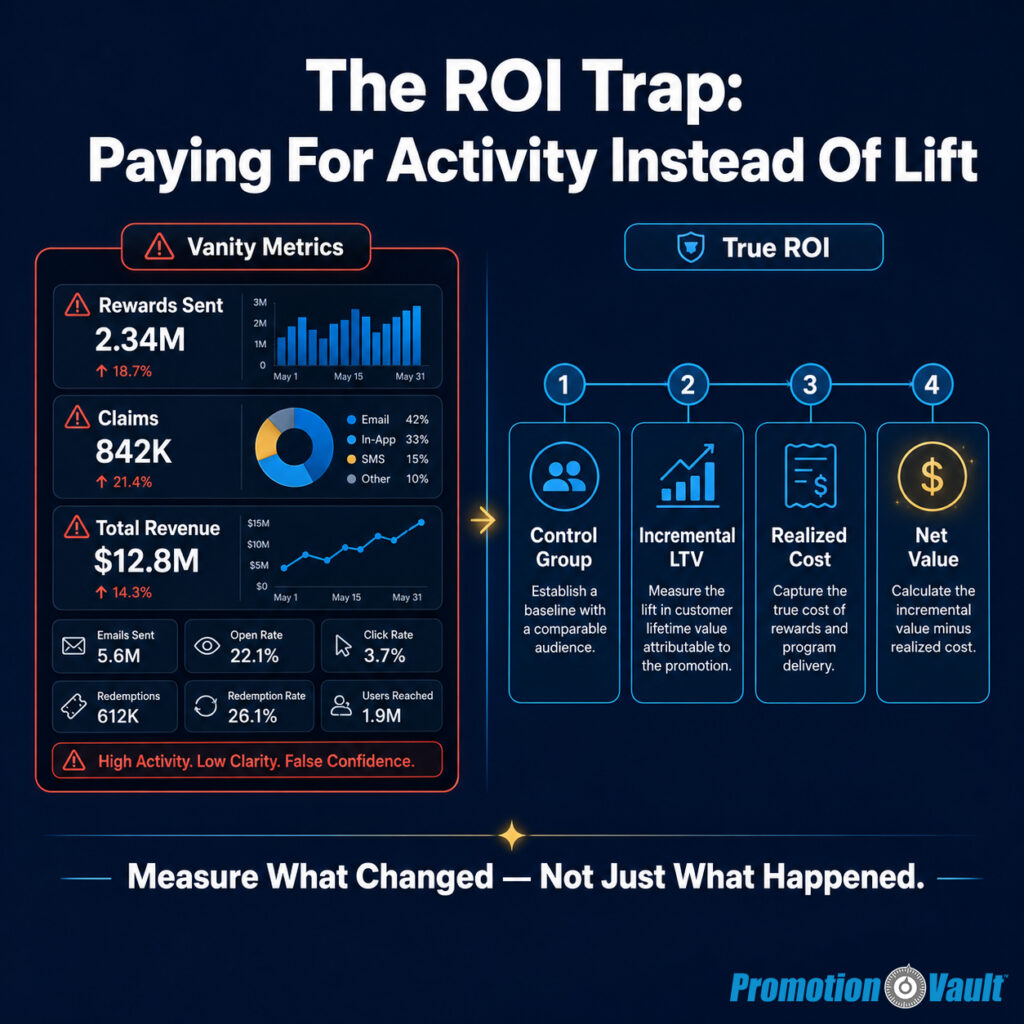
This is where we need to be firm. Vanity metrics are easy to celebrate. ROI is harder, and more useful.
Common false signals include:
- Counting every renewed customer as reward-driven
- Measuring activation without measuring LTV
- Comparing this month’s campaign to a weak prior month
- Ignoring seasonality
- Ignoring location differences
- Ignoring reward cost
- Ignoring support and labor costs
- Reporting only averages
- Treating correlation as causation
The fix is a simple measurement discipline:
- Name The Counterfactual: What would likely happen without the reward?
- Create A Control Group: Hold back a fair comparison group.
- Measure Incremental LTV: Compare value over the same time window.
- Subtract Realized Cost: Include fees, reward value, and operational load.
- Segment Results: Find where the reward creates profitable lift.
- Scale Only The Winning Segment: Do not scale the average if only one segment works.
This keeps us honest. It also helps us grow faster because we stop funding the parts of the program that only look busy.
How Should We Use Reward Activations To Learn Why Customers Stay?
Use reward activations as feedback moments by asking one or two focused questions after the customer claims value. The best questions identify why the customer stayed, what friction almost stopped them, and which next action would make the relationship stronger.
A reward moment has unusual attention. The customer completed an action. They are receiving value. They are more open to a short question because the exchange feels fair.
This is where a reward platform can do more than deliver money. It can help us learn.
For retention ROI, ask questions that connect directly to future behavior:
- “What made you come back?”
- “What almost stopped you from renewing?”
- “What would make your next visit easier?”
- “Which benefit matters most right now?”
- “How likely are you to keep using this over the next 30 days?”
The answers should not sit in a spreadsheet graveyard. Tag them by cohort, location, action, and reward value. Then compare answers against downstream behavior.
When we connect customer feedback to LTV movement, the reward becomes a learning loop. We can see which customers are staying, why they are staying, and what to improve next.
For deeper examples of early-retention behavior design, see Promotion Vault’s 30-day retention playbook and first-30-day guidance on what gyms should reward.
How Do We Decide Whether A Retention Reward Program Is Worth Scaling?
Scale a retention reward program when the rewarded cohort produces repeatable incremental LTV lift, the control group confirms the lift, realized reward cost stays inside margin, and the same result appears across enough customers or locations to trust the pattern.
A reward program is worth scaling when it passes four tests:
- Causal Test: Did the rewarded cohort beat the control cohort?
- Economic Test: Did incremental LTV exceed realized reward cost?
- Operational Test: Can the team run it without support drag?
- Segment Test: Do we know where it works best?
This is also where we should resist the urge to overbuild. A strong pilot does not need ten rewarded behaviors. It needs one or two that matter.
Start with the highest-confidence retention behavior. Run it long enough to measure real downstream value. Keep the control group clean. Review weekly. Then decide whether to scale, revise, or stop.
If the pilot works, scale in layers:
- Same behavior, more locations
- Same behavior, adjacent customer segment
- Same segment, stronger reward value
- Same reward, improved message
- Same journey, second milestone
If the pilot fails, that is still useful. A failed test can tell us the behavior was too weak, the reward was unclear, the audience was wrong, the timing was off, or the value was not compelling enough.
A disciplined loss saves future budget.
How Can We Reinvest Reward Savings To Increase Retention?
Reinvest reward savings into more compelling offers, better segmentation, stronger retention milestones, and broader eligibility for high-value behaviors. Pay-on-activation savings should not sit as a passive budget win. They should help us buy more of the customer actions that increase LTV.
This is the underused part of reward economics.
If pay-on-activation reduces realized cost, we have options. We can bank the savings, which may please finance. We can also use part of the savings to improve the program’s ability to move behavior.
That may mean increasing a $10 reward to $15 for the highest-value renewal behavior. It may mean offering a richer comeback reward only to dormant customers with high prior value. It may mean funding a second milestone after the first rewarded action proves profitable.
The question should be: Where would an extra dollar of reward value create the most incremental LTV?
That is a better question than: How do we spend less on rewards?
Budget control matters. So does upside. The strongest operators use cost savings to fund smarter growth, not smaller thinking.
For a broader view of how rewards can move measurable growth, see Promotion Vault’s article on the best rewards fulfillment platforms.
What Are The Best Reward ROI Formulas To Use?
The best reward ROI formulas are incremental LTV lift, net value created, ROI percentage, cost per incremental retained customer, and payback period. Together, they show whether rewards created profitable retention, how efficiently they worked, and how quickly the spend paid back.
Use these formulas:
| Formula | Use It When We Need To Know |
|---|---|
| Incremental LTV Per Customer = Rewarded LTV − Control LTV | Did the rewarded group become more valuable? |
| Total Incremental LTV = Incremental LTV × Rewarded Customers | How much added customer value did we create? |
| Net Value = Total Incremental LTV − Realized Reward Cost | Did the campaign create value after cost? |
| ROI = Net Value ÷ Realized Reward Cost | How efficient was the spend? |
| Cost Per Incremental Retained Customer = Realized Cost ÷ Incremental Retained Customers | What did each added retained customer cost? |
| Payback Period = Realized Cost ÷ Monthly Incremental Margin | How long until the program pays back? |
If we only choose one, choose net value. ROI percentage can look impressive on a small base. Net value shows whether the program created enough dollars to matter.
If we choose two, use net value and payback period. Together, they answer the operator’s question and finance’s question.
Frequently Asked Questions About Measuring Reward ROI For Retention
How Do We Calculate Reward ROI For Customer Retention?
Calculate reward ROI by subtracting the control cohort’s LTV from the rewarded cohort’s LTV, multiplying that lift by the number of rewarded customers, and subtracting realized reward cost. Then divide net value by realized reward cost to get ROI percentage.
What Is A Good ROI For A Retention Reward Program?
A good ROI depends on margin, cash flow, and payback goals. As a practical rule, the program should produce positive net value, pay back inside the business’s acceptable window, and show repeatable lift across the segment we plan to scale.
Should We Measure Reward ROI Using Revenue Or Margin?
Measure both if possible. Revenue LTV shows top-line movement and is easier for operators to read. Contribution margin LTV gives finance a cleaner view because it accounts for the cost of serving retained customers.
How Long Should We Wait Before Judging Retention Reward ROI?
Wait long enough for the rewarded behavior to affect customer value. For early retention, 30 to 90 days may show useful signals. For renewals, annual plans, service visits, or subscription survival, we may need 90 to 180 days.
Do Rewards Cheapen Our Brand?
Rewards do not cheapen the brand when they recognize completed behaviors and protect the core price. Blanket discounts can train customers to wait for lower prices. Action-based rewards can add value around the customer’s progress without reducing the product’s worth.
How Do We Keep Reward Programs From Attracting Low-Quality Customers?
Gate rewards behind completed actions that signal real value. Reward the visit completed, renewal completed, upgrade completed, or referral validated. Avoid paying for passive interest, low-quality leads, or actions that do not connect to future LTV.
So, How Should We Really Measure The ROI Of Retention Rewards?
We should measure retention reward ROI by comparing the LTV of a rewarded cohort against a similar control cohort, then subtracting the realized cost of the rewards. The cleanest model is: incremental LTV lift minus reward cost, divided by reward cost. Promotion Vault’s pay-on-activation model can improve the economics by charging full reward value only when eligible recipients activate, which helps operators control spend and reinvest savings into stronger retention offers.
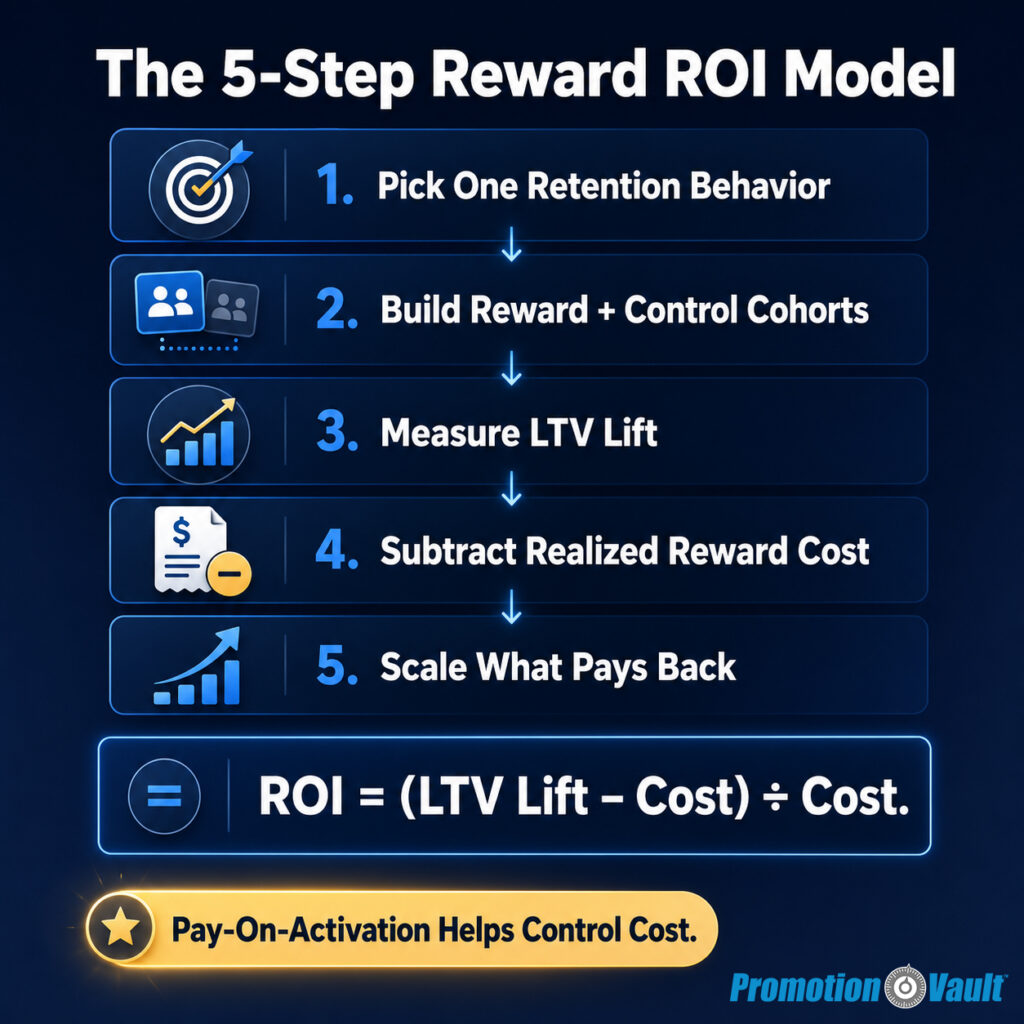
The larger point is simple: rewards should be measured by the value they help create after the customer completes a meaningful action. If the rewarded cohort stays longer, spends more, renews faster, upgrades sooner, or returns more often than the control group — and the added LTV exceeds the realized reward cost — the program is working.
If we already know the retention behavior we want to move, then we should build a small pilot around that one action. If we do not know the behavior yet, then we should pull cohort data first and find the action most closely tied to LTV. If finance is concerned about waste, then we should model both traditional reward cost and pay-on-activation cost before launch.
In 30 minutes, Promotion Vault can help map the retention moment, reward structure, control group, activation economics, and first ROI report.
Book a Promotion Vault demo to build a retention rewards pilot you can actually measure.