Reward payout platforms like Tremendous and Tango are adequate for quick delivery. But a rewards platform that drives growth needs to do more — it needs to create measurable action, branded trust, activation data, follow-up, and budget control through pay-on-activation economics. Here’s a look at where popular platforms excel and fall short.
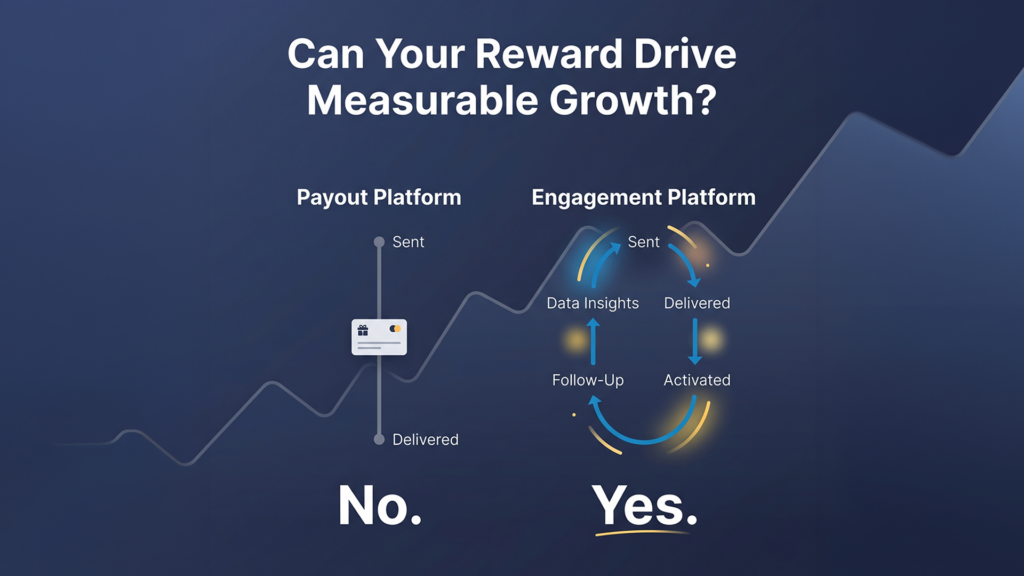
TLDR — Top Takeaways For Comparing Reward Platforms
- Ask “Can this reward drive measurable action?” — not just “Can this platform send rewards?”
- Use Tremendous or Tango when you only need one-time reward delivery.
- Use Promotion Vault when rewards need activation, follow-up, trust, and measurable engagement.
- Treat reward delivery as the starting line, not the finish line.
- Prioritize activation over catalog size when the goal is behavior change and data insights.
- Keep the reward experience clear, branded, secure, and easy to claim.
- Use pay-on-activation to avoid paying full reward value for recipients who never engage.
- Track eligible, waiting, activated, completed, expired, voided, and deleted statuses to find friction.
- Compare platforms by workflow fit: trigger, message, activation window, reminders, and reporting.
- Book a Promotion Vault demo to turn your next reward campaign into measurable growth.
- Should We Use Promotion Vault Or A Payout Platform Like Tremendous Or Tango?
- What Is A Payout Platform Actually Built To Do?
- When Are Tremendous Or Tango The Better Fit For Rewards Fulfillment?
- Where Does Promotion Vault Win Against Payout-First Platforms For Rewards Fulfillment?
- Why Is Catalog Size A Weaker Comparison Than Activation For Reward Platforms?
- How Does Pay-On-Activation Change The Payout Cost Model Of A Rewards Platform?
- What Does Promotion Vault Measure That A Payout Link May Miss?
- How Should We Evaluate Trust, Fraud, And Governance For Reward Platforms?
- How Should We Compare APIs And Workflow Fit For Reward Platforms?
- What Are The Most Common Questions Buyers Ask About Reward Platforms?
- So What Is The Best Rewards Platform When Rewards Need To Drive Action?
When it comes to reward programs, many business owners and growth teams aren’t (only) trying to send rewards. They are trying to encourage action and ongoing engagement. They’re trying to gather data. They need someone to claim, book, convert, respond, come back, complete a step, or choose the next right thing. They need follow-up information on satisfaction, NPS, or product feedback.
A reward that leaves the sender’s account without any kind of engagement infrastructure may complete the transaction, but it may not build engagement or lead to deeper insights that can spur growth. It may not even be able to tell you if the reward recipient used their reward — which can come back to haunt your budget if you’re being charged full reward value for every send.
The real buying question for business operators and growth leads should not be “Can this platform send rewards?” It is “Can this platform turn rewards into action we can measure?”
Should We Use Promotion Vault Or A Payout Platform Like Tremendous Or Tango?
Payout platforms like Tremendous and Tango are great for sending rewards. If you need to send a digital gift card reward, and that is the end of your interaction with a customer, they are solid tools for the job. But Promotion Vault was built for something far more ambitious: Building the kind of ongoing engagement and data collection that leads to increased growth and bottom-line revenue.
If you are trying to create measurable action using branded trust, lifecycle communication, recipient follow-up, budget control, and reporting that shows what happened after the send, Promotion Vault stands in a category of its own.
Tremendous publicly positions itself around fast reward and money delivery, including gift cards, prepaid cards, monetary options, and payout methods across many countries. Tango positions its Rewards as a Service API as a way to integrate a reward catalog and automate reward delivery inside apps and platforms.
Not only does Promotion Vault offer quick delivery, a catalog with a variety of options, and its own API for easy integration into any tech stack, but it also solves a different problem.
We are not only helping a business send a reward. We are helping that business use the reward as part of an outcome system. The reward has a sender identity, an activation window, a secure access path, reminder logic, release timing, status reporting, and a persistent vault experience.
That changes the management question from “Did the reward go out?” to “Did the recipient engage?”
In payout-first thinking, delivery is the finish line. In Promotion Vault’s model, delivery is the start of the measurable moment.
What Is A Payout Platform Actually Built To Do?
A payout platform is built to move value from a business to a recipient. It can support reward links, prepaid cards, digital reward catalogs, bank transfers, payment options, API delivery, and reporting around orders or sends. Its core strength is distribution.
A payout platform can confirm an order, track delivery, and offer recipient choice. But the business may still need to build the surrounding engagement system: the campaign logic, the activation strategy, the brand experience, the reminder cadence, the behavior tracking, and the budget explanation.
In addition to strong distribution capabilities, this is the layer Promotion Vault brings forward.
Brian Mitchell, CEO of Promotion Vault, describes payout-first tools as “great reward links, one-offs, APIs, and sending digital currencies.” But he balances that with a counterpoint: “Promotion Vault actually understands why you’re using rewards.”
That “why” is where growth outcomes live.
When Are Tremendous Or Tango The Better Fit For Rewards Fulfillment?
Tremendous or Tango may be the better fit when the main requirement is one-time reward fulfillment. If the surrounding campaign, brand journey, and recipient follow-up already exist elsewhere, or aren’t necessary, payout-first tools can be practical.
Brian Mitchell, CEO of Promotion Vault, acknowledges this: “There are definitely many different use cases where sending a one-off reward link in a certain language somewhere would be better than putting someone into an engagement platform.”
A payout-first platform may be the right fit when:
- The goal is to simply send rewards.
- The business owns the full surrounding experience already.
- Finance expects to fund the reward value upfront as the cost of delivery.
But when the reward is supposed to not only create action — but build engagement that leads to compounding growth — we should consider a platform built for that purpose.
Where Does Promotion Vault Win Against Payout-First Platforms For Rewards Fulfillment?
Promotion Vault wins when the reward must do more than arrive. It helps businesses create a branded, secure, measurable reward journey that can drive action, collect engagement signals, automate reminders, control timing, and separate eligible recipients from activated recipients for better budget decisions.
Promotion Vault can send rewards. But the deeper value is the lifecycle around the send.
The recipient sees the sender’s identity, amount, and message. They activate through a secure access path. The business can set an activation window. The reward can move through configured statuses. Reminders can continue without manual babysitting. The recipient can return to a vault instead of digging for a single old link.
Most reward programs do not fail from a lack of generosity, but because they don’t have the proper infrastructure to ensure growth compounds. The reward goes out, the email gets buried, the recipient hesitates, the team cannot tell who engaged, and finance sees the spend without seeing the signal.
Promotion Vault is built to separate those moments. In our model, a recipient becoming eligible is not the same as activating. Activating is not the same as completion. Completion is not the same as business impact. Each stage deserves its own measurement.
Brian Mitchell, CEO of Promotion Vault, explained the practical difference this way: “We believe that you’re using rewards and payouts to get engagement, not as an after effect.” That is the hinge: If the reward exists to move action, then the platform should measure action.
A payout platform may be enough when payment is the point. Promotion Vault is stronger when engagement is the point.
Why Is Catalog Size A Weaker Comparison Than Activation For Reward Platforms?
Catalog size matters to a degree. But when the business goal is action, catalog size is not the strongest signal. Activation, trust, timing, recipient clarity, and follow-up usually matter more than offering thousands of options someone may never claim.
Tremendous publicly advertises thousands of options across 230-plus countries. Tango publicly describes access to a global catalog with thousands of digital reward options.
Meanwhile, Promotion Vault has a smaller but much more high-intent catalog of options. Because the truth is that most reward recipients (up to 50%) just go with Amazon anyway — and providing too many options can lead to decision paralysis and disengagement.
Choice overload research has long challenged the idea that more options always create better decisions. The practical version for operators is simple: when a recipient is already deciding whether to claim, book, complete, or return, the reward menu should not become another assignment.
For most campaigns, recipients need a reward that feels real, useful, trusted, and easy. They do not need a marketplace they must study.
This is why we should evaluate catalog depth against the campaign’s real job:
- Does the recipient understand the reward in three seconds?
- Does the option set feel useful to most people?
- Does the page feel safe?
- Does the sender identity feel legitimate?
- Does the reward path reduce hesitation?
- Does the platform show who activated?
A massive catalog can be nice. But its ultimately far less important for growth than creating ongoing engagement.
How Does Pay-On-Activation Change The Payout Cost Model Of A Rewards Platform?
Promotion Vault’s pay-on-activation changes the cost model by separating reward eligibility from recipient engagement. With other reward platforms, businesses are charged the full reward value, plus a service fee, when they send a reward. In Promotion Vault, a 10% service fee applies when the reward is sent, while the full reward value is charged when the recipient activates their reward. That helps teams avoid paying full value for recipients who never engage.
It’s literally the difference between burning thousands of dollars in unused rewards and being able to reinvest thousands of dollars into higher-paying rewards or broader eligibility — increasing your acquisition, retention, referrals, reactivations, upgrades, or upsells.
A recipient enters the reward journey. They receive the message. They decide whether to activate. If they activate within the configured window, the reward face value is charged. If they never activate, the business does not pay the full reward value.
That distinction gives finance and growth teams better questions:
- How many recipients were eligible?
- How many activated?
- How much reward value did we actually incur?
- Which campaign created the highest activation?
- Which reward amount produced the strongest action?
- Which audience ignored the offer?
- Should we reinvest savings into a stronger reward?
The goal is to stop tying full spend to recipients who never engage so we can put more budget behind the people and moments that move.
What Does Promotion Vault Measure That A Payout Link May Miss?
Promotion Vault measures the reward journey in stages: eligible, waiting for activation, activated, completed, expired, voided, or deleted. That status model gives teams more than a send receipt. It shows where recipients engaged, where they stalled, and where budget or messaging should change.
A payout link tells us the business sent value and possibly whether the reward was successfully delivered or claimed. Promotion Vault shows whether the recipient stepped into the experience.
That matters because action does not happen all at once. A recipient may be eligible but unmoved. They may click but not complete. They may activate but need a release window before redemption. They may ignore the first message but respond to a reminder.
Promotion Vault’s reward lifecycle makes those stages visible.
The platform includes a reward journey from notification to activation, release, and redemption choice. It also describes a status progression from processing to waiting, activated, completed, expired, voided, or deleted. This is both operational and strategic.
Each status answers a business question.
“Waiting” tells us the offer reached the recipient but has not earned action yet. “Activated” tells us the recipient claimed interest. “Completed” tells us the reward became available. “Expired” tells us the opportunity closed.
This helps teams improve instead of guessing.
If activation is weak, the issue may be message clarity, audience fit, reward value, sender trust, or timing. If activation is strong but downstream action is weak, the issue may sit after the reward moment. If completion is high, the campaign may deserve a larger test.
Payout delivery gives us a record, but lifecycle tracking gives us a lever.
How Should We Evaluate Trust, Fraud, And Governance For Reward Platforms?
We should evaluate trust, fraud, and governance by looking at the full recipient and financial path: sender identity, access method, activation rules, funding, transaction tracking, reminder controls, status visibility, and support. Strong governance is not only rigid rules. It is clear, secure, measurable movement.
Payout platforms are safe because they are simple. A link gets generated. A reward gets sent. A recipient receives value. The rules are clear because the motion is narrow.
But simplicity can also hide friction. A recipient may not know whether the message is real. They may wonder whether to save the link, print it, add it somewhere, or search for it later. They may hesitate because the page feels generic.
That hesitation matters.
The Federal Trade Commission warns consumers that gift-card-style scams can begin with calls, texts, emails, or social media messages. That means legitimate reward campaigns must work harder to feel legitimate.
Promotion Vault’s answer to this includes a branded, secure vault experience. Recipients can access rewards through passwordless magic links or SMS-code authentication. They see sender branding, amount, status, and a place to return.
Microsoft’s public security guidance makes a broader point that supports this direction: passwordless methods can reduce user frustration and improve phishing resistance compared with traditional password flows. This is perfect for reward claiming. We want less friction and more trust at the same time.
Brian Mitchell, CEO of Promotion Vault, also emphasized Promotion Vault’s commerce foundation, saying, “Our whole platform is built on a Stripe foundation,” and described Promotion Vault’s pride in being a Stripe partner.
In short, Promotion Vault uses serious commerce infrastructure, secure access, branded presentation, and lifecycle controls so the reward is legitimate and secure from first click to final redemption.
How Should We Compare APIs And Workflow Fit For Reward Platforms?
Compare APIs and workflow fit by asking whether the platform can connect to the real action, not whether it has the longest public feature list. Tremendous and Tango definitely have APIs and integrations. But Promotion Vault not only has API access and Zapier flexibility, but branded activation, lifecycle statuses, and outcome-oriented reward configuration.
Instead of simply asking about integration, which almost any platform can do nowadays, it’s better to ask whether the platform can increase engagement and insights.
Brian Mitchell, CEO of Promotion Vault, notes, “Right now, you could create a Zap and have your Google spreadsheet or anything you want sending rewards securely through Promotion Vault.” He also said, “Our whole platform and our whole front end actually runs off of our API.”
That gives smaller teams and technical teams a shared path.
A growth operator can start with a spreadsheet or Zapier workflow. A technical team can use the API. A campaign owner can use Quick Send or Reward Links. A finance stakeholder can still track transactions and status.
Workflow fit should make the campaign easier to run, not harder to explain.
The strongest test is practical: take one campaign you want to launch this month, then map the trigger, recipient message, activation window, reward release, reminders, and reporting.
If the vendor can only answer the send, you don’t have an engagement system. If the vendor helps manage the full reward journey, you are closer to launch.
What Are The Most Common Questions Buyers Ask About Reward Platforms?
Is Promotion Vault A Tremendous Alternative?
Yes, Promotion Vault can be a Tremendous alternative when the goal is driving measurable action with rewards. Tremendous works for broad payout delivery. Promotion Vault is stronger when activation, branded trust, follow-up, and pay-on-activation economics matter.
Is Promotion Vault A Tango Alternative?
Yes, Promotion Vault can be a Tango alternative for teams that need reward delivery plus lifecycle engagement. Tango works for gift-card API use cases and catalog access. Promotion Vault is stronger when the campaign requires activation tracking, secure vault access, reminder logic, and budget alignment.
What Is The Difference Between A Reward Link And A Reward Lifecycle?
A reward link sends value through a specific URL or delivery path. A reward lifecycle manages what happens before and after that link: eligibility, activation, release timing, reminders, status tracking, redemption, and reporting. The lifecycle gives teams more control and better evidence.
Is A Bigger Reward Catalog Always Better?
No. A bigger catalog helps when recipients are global or need many payout choices. But for action-based campaigns, the reward must be easy to understand, trusted, useful, and simple to claim. Too many choices can slow action when the recipient needs clarity.
How Does Pay-On-Activation Reduce Payout Waste?
Pay-on-activation reduces waste by charging the full reward value only when the recipient activates. That separates recipients who were eligible from recipients who engaged. Teams can then use unactivated-value savings to improve reward amounts, expand reach, or sharpen targeting.
When Should We Choose Tremendous Or Tango For Rewards Fulfillment?
Choose Tremendous or Tango when the main job is payout delivery, broad global catalog access, or embedding reward fulfillment into an existing experience. Choose Promotion Vault when the reward must create action, protect trust, support follow-up, and produce measurable engagement data.
So What Is The Best Rewards Platform When Rewards Need To Drive Action?
The best payout platform alternative for action-based rewards is the one that treats the reward as a measurable journey, not only a delivered link. Tremendous and Tango are strong when payout delivery is the job. Promotion Vault is built for campaigns where the payout must earn activation, create trust, support follow-up, protect budget, and show what happened next.
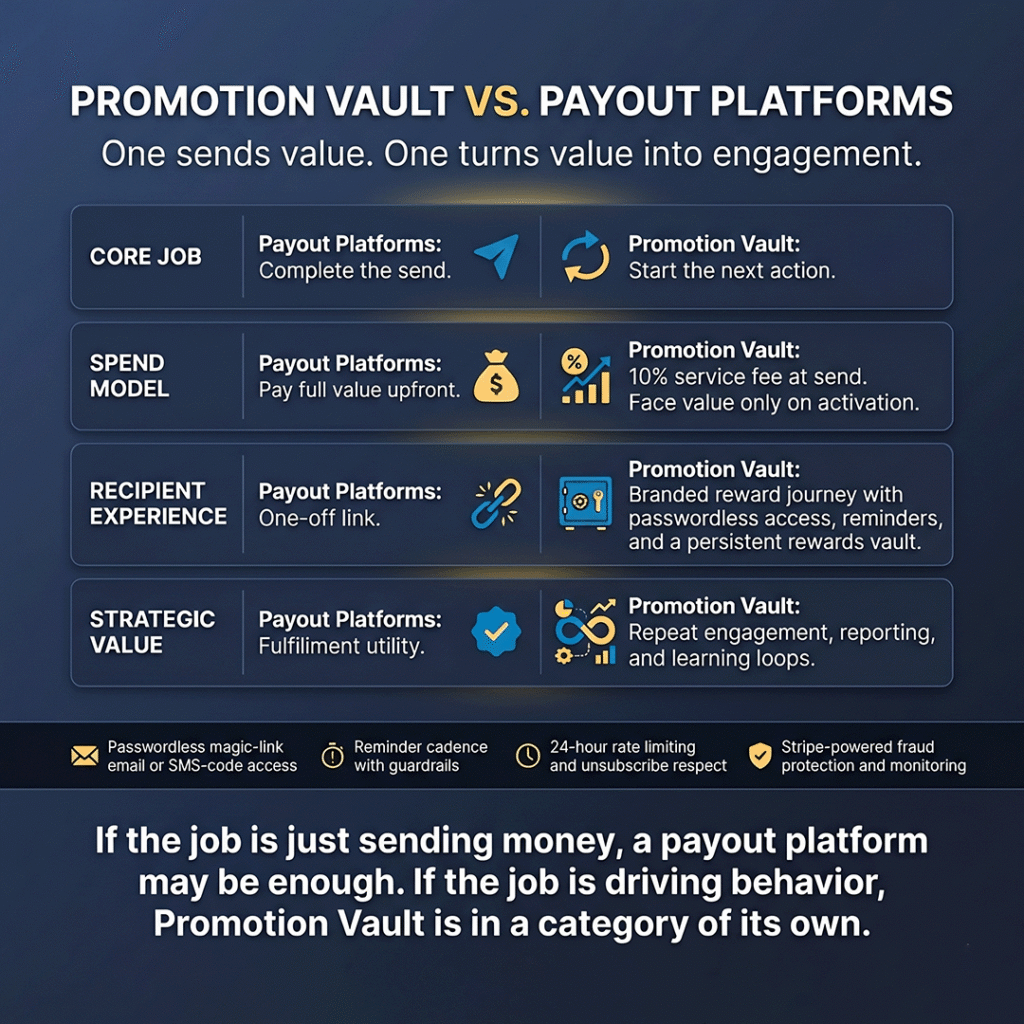
If your next campaign only needs a one-time payout, compare Tremendous and Tango on coverage, methods, catalog, API fit, and fees.
Casey Rock is Content Director at Promotion Vault, where he builds the content, SEO, and messaging systems behind the company’s rewards engagement platform. He specializes in turning product value into proof-first stories that drive discovery, trust, and conversions.