The best referral software manages sharing, attribution, and referral campaign rules. But it should go even farther by turning referrals into a reward-powered growth loop — with lead capture, validation, instant rewards, branded follow-up, and repeat engagement.
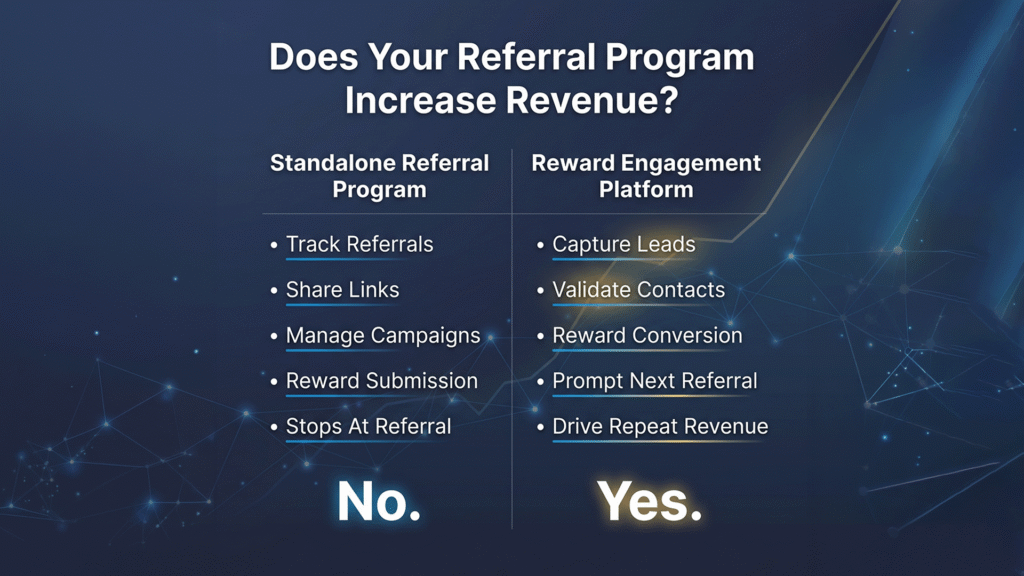
TLDR — Top Takeaways For Leveraging Referrals For Growth
- Referral programs should move qualified actions — not just collect more names.
- Treat every referral as a trust transfer that deserves fast, clear follow-up.
- Standalone referral tools can make sense for short campaigns; but Promotion Vault drives growth.
- Build rewards into the same system that captures, validates, and tracks referrals.
- Reward the behavior that matters most: validated lead, conversion, repeat referral, or retention milestone.
- Validate referral data before rewarding to protect lead quality and program economics.
- Use double-sided rewards when both the referrer and referred person need motivation.
- Prompt the next referral inside the reward moment while motivation is still fresh.
- Evaluate platforms by workflow fit, quality controls, reward timing, and defensible reporting.
- Book a Promotion Vault demo to map your referral capture, validation, rewards, and repeat loop.
- What Should We Be Looking At When We Compare Platforms For The Best Referral Software?
- When Are Extole, Friendbuy, And Referral Rock A Great Choice For Referral Software?
- Where Does Promotion Vault Beat Standalone Referral Tools?
- Why Do Built-In Referral Rewards Matter?
- How Does Referral Vault Help Us Protect Referral Quality?
- How Do We Turn One Good Referral Into A Repeat Referral Loop?
- How Should We Evaluate Referral Software Without Getting Distracted By Features?
- What Referral Program Should We Build First If We Want Measurable Lift?
- What Should We Ask Before Choosing Referral Software?
- Frequently Asked Questions About Referral Software
- So What Is The Best Software For Referrals?
A healthy referral program doesn’t necessarily give us more qualified people taking the next step. This is because most referral programs are really only about increasing referrals — which is only half the battle. The other half is getting them to start a trial, sign up for a subscription, make a purchase, or refer yet another individual.
That distinction matters because referrals are not just a source channel. They are a trust transfer. Nielsen’s 2021 Trust in Advertising study found that recommendations from people we know are the most trusted advertising channel globally. That is the emotional advantage.
At Promotion Vault, we believe referral software should do more than encourage a customer to refer a friend or family member. It should help us create the next moment of movement — the lead submitted, the friend validated, the member joined, the referrer rewarded, the new customer invited into the loop. And even beyond, to the new customer’s first purchase, upsell, or ongoing retention.
What Should We Be Looking At When We Compare Platforms For The Best Referral Software?
When we compare referral platforms, we shouldn’t just ask which tools track referrals. We should ask which system turns customer trust into measurable revenue action.
That means we should evaluate more than link sharing, attribution, campaign rules, and reward eligibility. Those matter. But they are only the referral layer. The deeper question is whether the platform can carry a referral all the way through the growth journey: from lead capture, to validation, to follow-up, to conversion, to reward delivery, to repeat engagement.
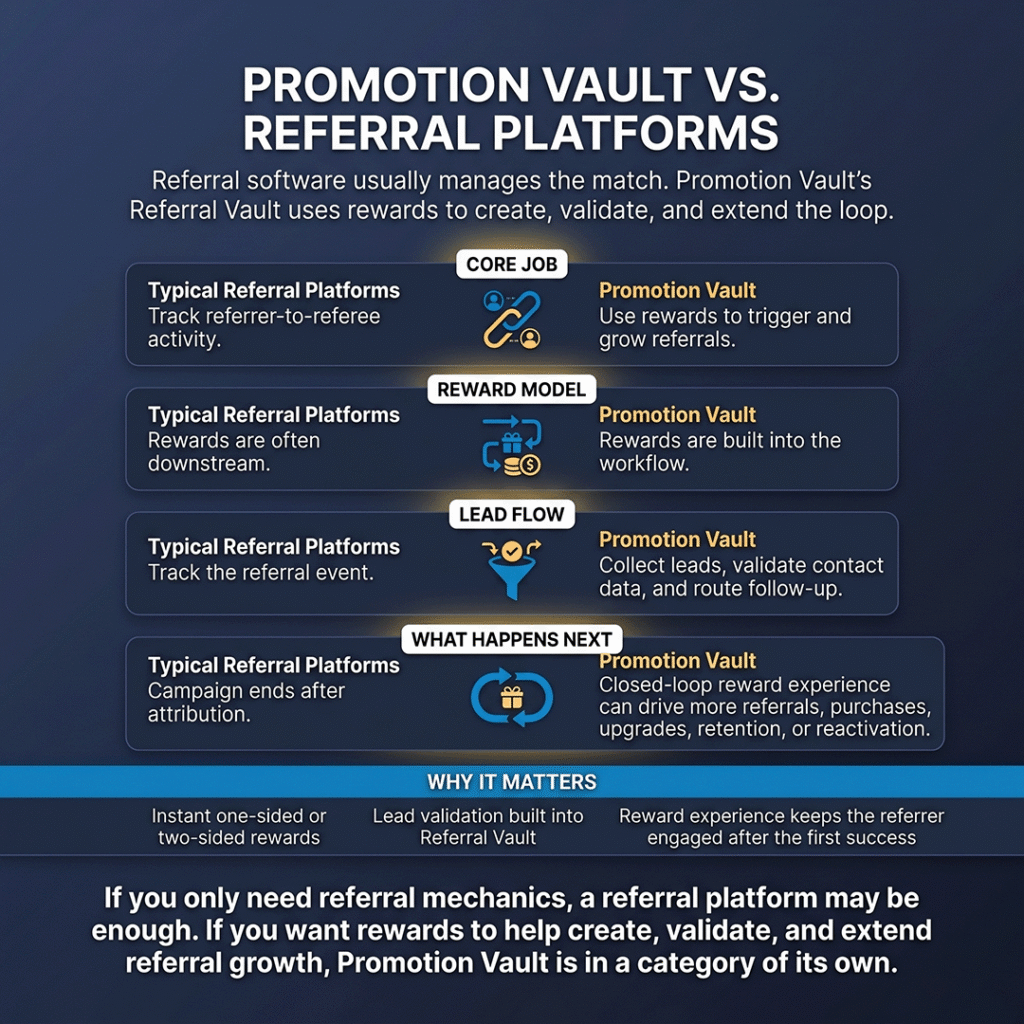
Standalone referral platforms can be effective when the job is referral orchestration. They help businesses build referral flows, manage sharing, track attribution, configure reward rules, test campaign variations, and measure referral performance.
Extole publicly positions its platform around flow building, cross-channel referral experiences, fraud protection, configurable rewards, A/B testing, and real-time analytics. Friendbuy highlights branded referral assets, flexible rewards, integrations, analytics, A/B testing, and APIs. Referral Rock emphasizes end-to-end referral programs, one-click sharing, nudge reminders, program advisors, automated reward fulfillment, CRM integration, and referral tracking.
These are excellent features. But they still raise the more important buying question: Are we hiring the platform to run a referral campaign, or are we hiring it to turn referrals into revenue?
When the job is revenue growth through rewarded action, Promotion Vault is in a category of its own. Its referral tool, Referral Vault, does more than just collect a name and track a referral event. It helps businesses capture leads, validate them, route them for follow-up, connect referrals to conversion events, and trigger built-in rewards when the desired action happens. The reward is not bolted on after the fact, it is a critical part of the system.
When Are Extole, Friendbuy, And Referral Rock A Great Choice For Referral Software?
Extole, Friendbuy, and Referral Rock are strong fits when referral orchestration is the main job. We should consider them when we need advanced referral flows, advocate sharing, referral campaign testing, fraud controls, portals, or platform-specific integrations. They are especially useful when the referral program can operate as its own channel.
Extole looks especially relevant for enterprise teams that need referral flow control, cross-channel referral experiences, fraud protection, configurable rewards, and referral analytics. Friendbuy looks especially relevant for ecommerce, subscription, and consumer brands that want branded referral widgets, flexible reward rules, integrations, email and SMS journeys, and A/B testing. Referral Rock looks especially relevant for service, B2B, ecommerce, and tech teams that want guided setup, one-click sharing, nudge reminders, CRM sync, and automated reward fulfillment.
If the work is a short promotional window, a focused campaign, or a referral-only motion, these tools may be a clean fit. Brian Mitchell, CEO of Promotion Vault, even says as much. “These are great one-off referral platforms if you were going to do a campaign,” he says.
But for many operators, the referral is not the whole story. It is the front door. The real question is what happens after someone walks in. That requires a full lifecycle engagement platform like Promotion Vault.
Where Does Promotion Vault Beat Standalone Referral Tools?
Promotion Vault becomes stronger when referrals need to become an ongoing growth loop, not a one-time campaign. Its referral tool, Referral Vault, can collect leads, validate contact information, connect referrals to conversion events, issue rewards, and keep recipients engaged inside a branded reward experience. That makes referrals part of the customer lifecycle.
Brian Mitchell, CEO of Promotion Vault, described the difference this way: “With Promotion Vault, there’s more of a process of building your business than just the tech stack of where did you get the referral and how did it match the referrer and the referee.”
A referral platform often starts with the connection: Who referred whom? Did the referred person convert? What reward should trigger?
A lifecycle reward engine asks more:
- Did we capture enough lead information to follow up?
- Did we validate that information before we rewarded it?
- Did the referrer get rewarded in a way that felt immediate and legitimate?
- Did the reward experience invite the referrer to refer again?
- Did the referred person become the next referrer?
- Did we connect this referral to retention, upgrade, or reactivation later?
That is where Promotion Vault makes a huge operational difference for business growth. We are not trying to run just a referral program, or even simply be the referral reward fulfillment platform. Though we do both. At the end of the day, we are trying to make the reward moment do more work.
Inside Promotion Vault’s referral tool, Referral Vault, businesses can create configurable referral forms, collect lead and referrer data, validate leads, send lead information to the right people, track lead status, and connect converted leads to rewards through the broader Promotion Vault system. That means the referral program can start at lead generation, continue through validation, reward the right event, and then invite more action.
This is not a small difference. It changes the program from “thanks for the referral” into a lifecycle engine that can move that referral toward a purchase, membership, or retention milestone.
Why Do Built-In Referral Rewards Matter?
Built-in referral rewards matter because they reduce the gap between action and recognition. When the reward sits inside the same system that captures, validates, and tracks the referral, we can reward faster, reduce manual work, and create a cleaner experience for both the referrer and the referred person.
The emotional logic is simple. When a customer refers someone, they are doing more than filling out a form. They are lending us trust. If the reward is delayed, confusing, manual, or disconnected, that trust is quickly eroded.
Brian Mitchell, CEO of Promotion Vault, said Referral Vault solves for that moment: “If you’re rewarding one side, they get it. If it’s two sides, they get it. So it’s all built in.”
That is especially important for double-sided referral rewards. A double-sided referral rewards both parties — the existing customer and the referred friend — when the right action happens. This can work well because it removes the awkward feeling that the referrer is only helping themselves. The friend gets value, too.
But double-sided rewards also create more moving parts. We need to know who submitted the referral, who was referred, whether the lead was valid, whether the referred person completed the qualifying action, and which side earns what. If that logic lives across disconnected systems, errors creep in. If the referrer has to wait, confidence drops.
The better approach is to design the reward around the behavior we want:
- Reward a validated lead when lead quality matters.
- Reward a converted customer when revenue matters.
- Reward both sides when the friend needs a nudge to act.
- Reward a second referral when repeat advocacy matters.
- Reward a post-join milestone when retention matters.
The reward is a lever. We should place it where hesitation appears and where the business value becomes clear.
How Does Referral Vault Help Us Protect Referral Quality?
Referral Vault helps protect referral quality by collecting structured lead data, validating contact information, tracking lead status, and tying rewards to meaningful outcomes. That gives operators more control than rewarding every form fill. The goal is not more names in a spreadsheet; it is more legitimate leads becoming customers.
Low-quality referrals usually come from sloppy reward rules. When we reward the easiest action, we get more of the easiest action. If the action is “submit any name,” people will submit names. If the action is “submit a valid lead who can be contacted,” quality improves. If the action is “that lead becomes a customer,” the program gets even cleaner.
Brian Mitchell, CEO of Promotion Vault, describes Referral Vault’s lead-quality role directly, noting that “our referral form has the ability to collect and validate leads.” He gives a simple example: A referrer submits a lead with a phone number and email, the system validates the information, and the business can reward that validated lead right away.
That is the operating principle: reward the proof point that matches the business goal.
Referral Vault’s referral forms are configurable forms that can control required fields, visual presentation, email communications, staff selection, validation requirements, referral limits, and timeframes. Leads can carry contact information, referrer information, status, and timestamps. Validation can include email verification services, phone validation, and custom rules.
For an operator, that becomes a practical quality framework:
- Require The Fields We Actually Need
If our sales team needs phone follow-up, we should require phone. If email is enough, we should not add unnecessary friction. - Validate Before We Reward
If we reward lead submission, we should validate the lead first. This keeps the program grounded in actual leads we can nurture. - Separate Lead Status From Reward Status
A submitted lead, validated lead, and converted lead are not the same thing. We should track each stage clearly. - Limit Abuse Without Punishing Good Customers
Referral limits, duplicate checks, and validation rules protect the program while preserving a smooth experience for honest referrers. - Reward The Business Outcome We Can Defend
If finance asks why we paid the reward, the answer should be simple: the lead was validated, the customer converted, or the milestone was completed.
Referral fraud is not imaginary. Prevention includes watching for self-referral, duplicate account creation, referral link hijacking, referral farming, and reward trigger manipulation. While we should take that seriously, the answer is not to make referral programs stingy — it’s to build the right checkpoints.
A good referral program should feel generous to honest customers and difficult to exploit for everyone else.
How Do We Turn One Good Referral Into A Repeat Referral Loop?
We turn one good referral into a repeat referral loop by treating the reward moment as the next invitation. After someone earns a referral reward, we should prompt them to refer again and make the next referral easy. The loop grows when both referrers and referred customers can become advocates.
This is where Promotion Vault’s view of referrals gets more ambitious than a normal referral campaign. We do not want one isolated referral. We want the system to recognize a pattern and help the operator compound it.
Brian Mitchell, CEO of Promotion Vault, said Promotion Vault sees that “people who refer are 86% more likely to refer more than one” and that “people who are referred successfully are 40% more likely to then be the ones that start referring.” All this is to say: referrals can compound if the right infrastructure is in place.
In fact, the American Marketing Association notes that referred customers make 31% to 57% more referrals than customers acquired through other channels. The same summary reported that firms can undervalue referral programs by 20% to 36% when they ignore secondary referrals.
So our referral program should not stop at the first conversion. We should build for the second action.
Here is the practical loop:
- Capture The Referral
Give customers a simple referral form or referral path that collects the right information without making the act feel like paperwork. - Validate The Lead
Check email, phone, duplicates, and business rules before we reward low-quality submissions. - Route The Lead Fast
Send the lead to the right location, staff member, team, or CRM path so follow-up happens while intent still exists. - Reward The Right Moment
Reward the validated lead, conversion, or post-join milestone based on the behavior we actually need. - Use The Reward Experience To Prompt The Next Referral
When the referrer claims the reward, remind them they can earn again by referring another friend. - Invite The Referred Customer Into The Same Loop
Once the referred person becomes a customer, give them a clean path to refer someone else. - Measure The Chain, Not Just The First Link
Track submitted leads, validated leads, conversions, activated rewards, repeat referrers, and referred customers who later refer.
Brian Mitchell, CEO of Promotion Vault, describes the post-reward moment reward recipients can experience through Referral Vault: while the referrer receives the reward, they can see a reminder that they can “earn unlimited rewards” and refer more friends. That is the loop. A well-timed invitation while the value is fresh.
This is the part many programs miss. The reward is not the finish line. It is the best moment to ask for the next action.
How Should We Evaluate Referral Software Without Getting Distracted By Features?
We should evaluate referral software by workflow fit, not feature volume. The right platform should match the behavior we need to move, the quality controls we need, the reward timing we want, and the reporting we must defend. A long integrations page does not matter if the referral workflow still breaks.
Most software evaluations get messy because we compare visible features instead of operational outcomes. We ask who has more integrations. We ask who has more templates. We ask who says “AI” more often. Then we forget the actual business question: Can this system help us get more qualified referrals and prove what happened?
Brian Mitchell, CEO of Promotion Vault, gave a useful standard: buyers should evaluate “workflow fit and outcome automation,” not just public integration breadth. He also said Promotion Vault’s strength includes “white labeled secure magic link,” “efficient transaction tracking reporting,” recurring rewards, customer profiles, and using rewards “not just as the end result of a payout, but actually using the rewards for engagement.”
Here is a scorecard for a clean evaluation:
| Evaluation Question | Why It Matters | What We Should Look For |
|---|---|---|
| What exact referral behavior are we trying to move? | Vague goals create weak programs. | Submitted lead, validated lead, converted customer, second referral, or post-join milestone. |
| When should the reward trigger? | Timing changes motivation and cost. | Instant reward for validation, reward on conversion, or staged rewards across the journey. |
| How do we protect lead quality? | Bad rewards attract bad submissions. | Required fields, duplicate checks, validation, status tracking, and limits. |
| Can the referred customer become a referrer? | Referrals can compound. | Post-conversion prompts, persistent reward experience, and repeat referral paths. |
| What does the recipient experience feel like? | Trust affects activation. | Branded delivery, clear sender identity, secure access, and simple redemption. |
| Can finance understand the spend? | Defensible programs survive scrutiny. | Eligible, validated, activated, completed, and conversion reporting. |
| Can the team run this without babysitting it? | Manual work kills scale. | Automations, integrations, reminders, routing, and reporting exports. |
All we really need is a platform that makes the desired behavior easier, more measurable, and more repeatable.
What Referral Program Should We Build First If We Want Measurable Lift?
We should build our pilot referral program around one measurable action, one clean reward rule, and one follow-up path. Start with the moment closest to revenue: a validated lead, booked appointment, completed tour, paid join, or first retained milestone. Then measure quality before expanding reward complexity.
It should simply be clear enough for a customer to explain in one sentence.
For example:
- “Refer a friend. When we validate their contact information, earn a reward.”
- “Refer a friend. When they join, both of you earn a reward.”
- “Refer a friend. When they complete their first visit, you earn a reward.”
- “Refer two friends who join this month, earn a higher reward.”
Each version can work. The right one depends on our economics and our sales cycle.
Brian Mitchell, CEO of Promotion Vault, said referrals work best when the reward narrative helps customers take action: “We understand that you’re going to use rewards to get referrals.” When the customer gives us trust, we should give them real recognition.
Here is a practical first-program build:
- Choose One Referral Outcome
Pick the action that creates business value. Do not reward every possible step unless each step deserves it. - Define Who Can Refer
Choose all active customers, members from specific locations, recent customers, or high-fit segments. - Define Who Counts As A Valid Referral
Decide whether the lead needs a valid email, phone, location match, plan type, appointment, or completed purchase. - Choose One Reward Structure
Start with one-sided or double-sided rewards. Add tiers only after the basic program proves clean. - Set The Reward Trigger
Trigger on validated lead, conversion, or another measurable event. Avoid paying for vague intent. - Build The Follow-Up Path
Route the lead to the right person or system. A validated lead still needs human or automated follow-up. - Prompt The Next Referral Inside The Reward Moment
When the referrer claims the reward, invite the next referral while motivation is high. - Review The Data Weekly At First
Look at submitted leads, validated leads, conversions, rewards activated, and repeat referrers.
The best pilot program should provide insights quickly. It should show where lead quality is strong, where follow-up breaks, and whether the reward is motivating the right behavior.
What Should We Ask Before Choosing Referral Software?
Before choosing a referral platform, we should ask whether the platform only manages referral mechanics or helps us move lifecycle outcomes. The strongest choice depends on our needs: standalone referral orchestration, built-in rewards, lead validation, branded reward activation, financial control, repeat referrals, and downstream reporting.
Here are the questions we should ask in the sales process:
- Can we reward a validated lead, not just a completed purchase?
- Can we reward the referrer, the referred person, or both?
- Can we validate email and phone information before rewarding?
- Can leads route to different locations, staff members, or teams?
- Can the reward experience prompt the referrer to refer again?
- Can we see lead status and reward status separately?
- Can we measure submitted, validated, converted, activated, and completed?
- Can we connect referrals to retention, upgrades, or reactivation later?
- Can our team run this without manual reward chasing?
- Can the reward experience feel branded, secure, and legitimate?
Brian Mitchell, CEO of Promotion Vault, put the broader point this way: Promotion Vault treats rewards as “a living breathing part of your strategy, your marketing, your communication, your finances.”
That is the bar. A referral program should not live off to the side, disconnected from everything else we are trying to move. If referrals are one of our best acquisition channels, then they deserve infrastructure that respects the full journey.
Frequently Asked Questions About Referral Software
What Is The Best Referral Program Software With Automated Rewards?
The best referral program software with automated rewards depends on the job. If we need referral sharing and attribution, a standalone referral platform may fit. If we need lead validation, instant rewards, branded activation, repeat referral prompts, and lifecycle reporting, Promotion Vault is built for that broader reward-powered workflow.
Does Promotion Vault Replace Extole, Friendbuy, Or Referral Rock?
When our main need is referral rewards tied to measurable lifecycle actions, then yes: Promotion Vault can replace a standalone referral platform.
Can Promotion Vault Run Double-Sided Referral Rewards?
Yes. Promotion Vault can support referral programs where the referrer, the referred person, or both sides receive rewards when the qualifying action occurs. The key is defining the trigger clearly — such as lead validation, appointment completion, purchase, join, or another measurable conversion event.
How Do We Prevent Low-Quality Referrals From Getting Rewarded?
We prevent low-quality referrals by rewarding validated or converted outcomes instead of every submission. Referral Vault can collect structured lead data, apply validation rules, track statuses, and help teams separate submitted leads from validated leads and completed conversions.
What Should We Measure In A Referral Rewards Program?
We should measure submitted referrals, validated leads, conversion rate, reward activation rate, cost per activated reward, repeat referrers, referred customers who later refer, and downstream revenue or retention. “Sent” is not enough. We need to know which referrals became real business.
Is Referral Software Enough For Multi-Location Businesses?
Referral software can be enough if the program only needs basic referral tracking. Multi-location businesses often need more: location routing, lead validation, staff visibility, reward automation, reporting, and repeat engagement. That is where Referral Vault inside Promotion Vault becomes especially useful.
So What Is The Best Software For Referrals?
The best referral platform for automated rewards and repeat referrals is the one that matches the behavior we need to move. Standalone referral tools are strong for sharing, attribution, and campaign orchestration. Promotion Vault is the better fit when referrals need built-in rewards, lead validation, branded reward activation, and lifecycle follow-up. The goal is not just to know who referred whom — it is to turn trusted recommendations into measured, repeatable growth.
If our referral program already produces names but not enough qualified customers, then we should start by validating the lead before rewarding it. If our customers refer once but rarely again, then we should add the next referral prompt inside the reward moment. If our team spends time reconciling referral rewards by hand, then we should move the reward trigger into the same system that tracks the referral outcome.
Casey Rock is Content Director at Promotion Vault, where he builds the content, SEO, and messaging systems behind the company’s rewards engagement platform. He specializes in turning product value into proof-first stories that drive discovery, trust, and conversions.