The best employee rewards program platform depends on the job we need done. Broad recognition platforms can provide peer-to-peer kudos and culture visibility, but Promotion Vault is built to boost employee retention with automated employee reward moments, lifecycle feedback, and repeat engagement.
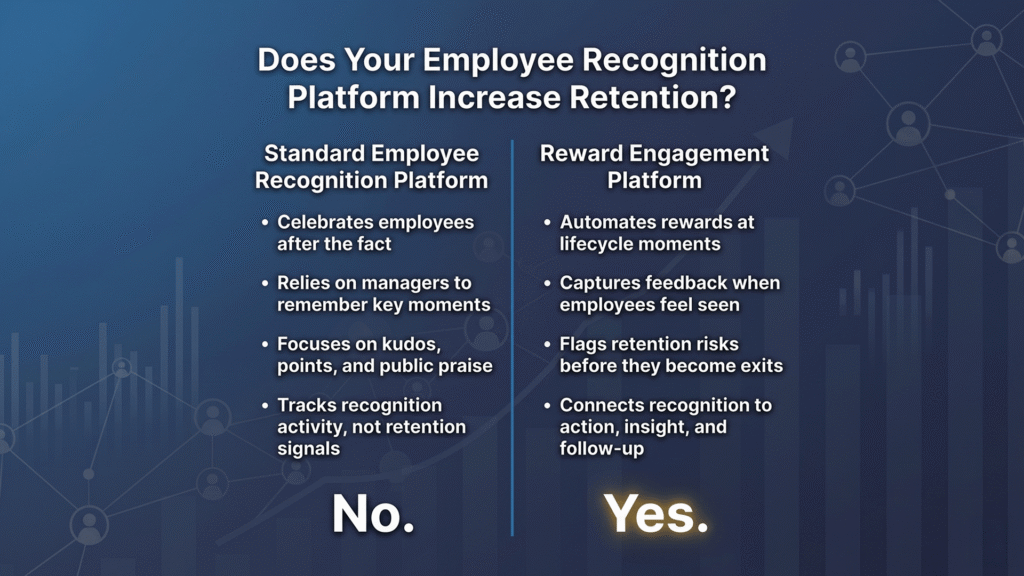
TLDR — Top Takeaways on Employee Recognition Platforms
- Automate milestones so birthdays, first days, anniversaries, and check-ins to ensure consistency.
- Compare recognition platforms by workflow fit — not by the longest feature list.
- Use broad recognition tools for peer kudos; use Promotion Vault for better retention and revenue.
- Treat every reward as a timed touchpoint, not just a thank-you.
- Pair recognition with one useful feedback question employees can answer quickly.
- Track reward history and feedback by employee, role, department, and milestone.
- Use department and role filters so recognition feels relevant instead of generic.
- Start with five moments: first day, 30 days, birthday, 90 days, and work anniversary.
- Review feedback quarterly and adjust rewards around what employees actually need.
- Book a Promotion Vault demo to map a 30-minute employee recognition pilot that proves ROI.
- What’s The Best Employee Rewards Program Platform For Automated Milestone Rewards?
- Is Promotion Vault An Employee Rewards Program Platform Or A Different Kind Of Employee Rewards Engine?
- How Should We Compare Promotion Vault Vs. Awardco And Other Employee Rewards Program Platforms?
- What Does Employee Vault Actually Automate For HR And Operators?
- Why Does Feedback Matter In Employee Rewards Program Software?
- How Do We Choose Between Peer-To-Peer Kudos And Action-Based Employee Rewards?
- How Do We Build A Recognition Lifecycle Without Adding More HR Work?
- Frequently Asked Questions About Employee Rewards Program Platforms
- So What’s The Best Employee Rewards Program Platform For Automated Milestone Rewards?
If our employee recognition program depends on someone remembering a birthday between payroll questions, a staff callout, and three unread Slack threads, the program is more than broken.
Recognition is not decoration. Workhuman and Gallup reported in 2024 that employees who received high-quality recognition in 2022 were 45% less likely to have left their job by 2024, based on research tracking more than 3,400 employees. The same release said only one in four employees strongly agreed they received valuable feedback from the people they work with. Recognition and feedback often belong in the same moment, but most systems treat them as separate chores.
Employee churn is also one of the most expensive costs for any business.
For any HR leaders, People Ops teams, and business operators who care about employees — as well as bottom-line revenue — employee retention is critical. But not all employee reward platforms are built to measurably increase employee retention.
What’s The Best Employee Rewards Program Platform For Automated Milestone Rewards?
The best employee recognition platform for automated milestone rewards is the one that recognizes employees at the right moment, keeps the program easy to manage, and helps HR learn from employee feedback. If peer-to-peer kudos are the main goal, use a broad recognition platform. If employee lifecycle and retention matters most, use Promotion Vault.
The employee recognition market is crowded. Software Advice says HR teams are navigating roughly 200 products across different team sizes, reward models, and engagement goals. SoftwareReviews defines employee rewards and recognition software as platforms that help organizations acknowledge and motivate employees, often with peer-to-peer recognition, feedback, gamification, integrations, metrics, automatic notifications, and rewards management.
It’s no wonder buyers see “employee recognition platform” and assume every tool solves the same problem. They do not, though.
Some tools are built to create a social layer of appreciation. Employees send points, shoutouts, badges, or public messages. That can help culture feel more visible. Other tools are built to make sure important employee moments do not depend on manual follow-through. That is where Promotion Vault is different.
Brian Mitchell, CEO of Promotion Vault, says the focus of any good rewards program should be providing “the right reward at the right time, giving you feedback.” In other words, the reward is not just a thank-you. It is a timed touchpoint.
The real buying question for business operators looking to increase employee retention and bottom-line revenue should not be “Which platform has the most recognition features?” It should be “Which platform is built for the employee moments we cannot afford to miss?”
Is Promotion Vault An Employee Rewards Program Platform Or A Different Kind Of Employee Rewards Engine?
Promotion Vault is best understood as an employee rewards lifecycle engine. It can support employee recognition, but it is not trying to become a peer-to-peer kudos feed. Promotion Vault is designed to automate employee rewards around moments like first day, birthdays, anniversaries, specific dates, and role-based milestones.
Contrast this with Awardco — whose public site presents a broad employee rewards and recognition suite with recognition, celebrations, service awards, birthdays, onboarding, incentives, employee listening, integrations, and global rewards. That is a broad culture and recognition platform.
Promotion Vault’s employee rewards tool, Employee Vault, is more focused. It targets action, timing, reward delivery, employee profiles, and feedback. The goal is not to recreate another workplace social channel. The goal is to make recognition operationally easy, consistent, and measurable.
If we need a public feed where employees celebrate one another every day, we should evaluate broad recognition platforms. However, if we need first-day welcomes, work anniversaries, birthday rewards, monthly check-ins, department-specific rewards, and feedback capture to happen without someone babysitting a spreadsheet, Promotion Vault stands in a category of its own.
How Should We Compare Promotion Vault Vs. Awardco And Other Employee Rewards Program Platforms?
Compare Promotion Vault against Awardco and similar platforms by workflow fit, not feature volume. Awardco and broad recognition platforms are strong when HR wants social recognition, points, and culture visibility. Promotion Vault is stronger when HR and operations need automated rewards tied to employee lifecycle moments and feedback.
There is a difference between a recognition surface and a recognition system.
A recognition surface helps appreciation show up. A recognition system makes sure the right moment triggers the right action, captures the right signal, and gives the operator a next step. This is where Promotion Vault stands apart from other platforms.
Brian Mitchell, CEO of Promotion Vault, described broad recognition platforms as systems where companies often do “one-off rewards to employees.” With Promotion Vault, he said, “you really come in and build a lifecycle.” That lifecycle may start before an employee is fully productive. It can ask whether they understand the tools. It can reward them on their first day. It can recognize their anniversary. It can ask what role they want next.
For HR and operators, this is both practical and actionable. We stop asking managers to remember every moment. We build the moments into the system. And then, when employees engage with those reward moments, we get feedback that allows us to improve overall employee satisfaction and retention.
What Does Employee Vault Actually Automate For HR And Operators?
Employee Vault, Promotion Vault’s employee rewards tool, automates employee reward moments by using structured employee data and configurable triggers. Promotion Vault can support rewards for first day, birthdays, work anniversaries, specific dates, joining team rewards, and rewards-program anniversaries, with department and role filters for more targeted programs.
Employee Vault acts as a central repository for employee information. It stores structured employee data that powers reward and recognition workflows. It tracks onboarding, current role, department, status, and termination history. It also allows administrators to view employees, edit records, import data, and configure automation rules.
The practical version is simple: we put employees into the system once, then we stop rebuilding the same recognition workflow every month.
Brian Mitchell, CEO of Promotion Vault, said Employee Vault lets employers enter employees with core fields like name, birth date, start date, role, and department. From there, he said teams can “reward instantly” and automate evergreen programs such as birthdays, starts, anniversaries, monthly recognition, and holiday rewards.
Here is how HR can think about the automation menu:
- First Day Rewards: Welcome new employees when they join the organization, with optional role or department targeting.
- Birthday Rewards: Recognize employees on their birthday through daily birthday checks.
- Work Anniversary Rewards: Celebrate tenure on monthly, quarterly, semiannual, or annual intervals.
- Specific Date Rewards: Send recognition for holidays, company events, appreciation weeks, or planned culture moments.
- Joining Team Rewards: Welcome employees when they join the rewards program.
- Rewards Anniversary Rewards: Recognize the anniversary of joining the rewards program, separate from employment tenure.
An employee’s first day, first 30 days, first rewards-program experience, and first annual milestone are different moments. Treating them as one generic recognition program flattens the journey.
Employee Vault keeps those moments distinct.
Why Does Feedback Matter In Employee Rewards Program Software?
Feedback matters because recognition is one of the best moments to ask a useful question. When employees feel seen, they are more likely to share what they need, where friction exists, and what might keep them longer. Promotion Vault turns recognition into a feedback loop, not just a reward delivery event.
Recognition without listening can still be useful. But recognition with listening gives managers and operators a chance to intervene before a problem becomes a resignation.
This is where the Promotion Vault approach gets more interesting than a milestone calendar. Employee Vault can show an employee’s reward history and feedback history. Meanwhile, Data Vault can attach questions to reward moments, track answers over time, support NPS-style questions, and use tags so only the right employee segments see the right question.
Brian Mitchell, CEO of Promotion Vault, described the value in human terms, noting it is “very painful to lose somebody you just trained,” especially at the frontline level. That pain is familiar to anyone running hourly teams, studios, clubs, retail locations, service teams, or multi-location operations.
He also cites two customer experiences. In one, a customer paired a small monthly reward with the question, “Is there any reason you would leave your job in the next seven days?” In another, a customer asked employees whether they wanted a different role at the same location or another location. By acting on the insights gained from these questions, both saw meaningful retention and lifecycle gains.
Workhuman and Gallup’s 2024 research also connects recognition, feedback, engagement, and retention. The release said employees who strongly agree they receive valuable feedback are five times as likely to be engaged, while nearly half of employees said they do not get feedback from their manager at the rate they want.
So the action is clear. Do not only ask, “Did we recognize the employee?” Ask, “What did that recognition moment teach us?”
How Do We Choose Between Peer-To-Peer Kudos And Action-Based Employee Rewards?
Choose peer-to-peer kudos when the goal is daily social appreciation, public visibility, and culture reinforcement. Choose action-based employee rewards when the goal is timely recognition, milestone consistency, retention feedback, operational follow-through, and improved bottom-line revenue.
Peer recognition can be healthy. Public praise can build connection. A social feed can make appreciation easier to see. But not every recognition problem is a social problem.
Sometimes the problem is that the new employee finished training and nobody asked if they felt ready. Sometimes the front desk associate wants to move into sales, but no one asks. Sometimes the manager planned to celebrate a 90-day milestone, then staffing chaos took over.
A simple decision framework helps:
- Use peer-to-peer recognition when we need more visible appreciation. This fits teams that want employees to celebrate behaviors, values, wins, and everyday helpfulness.
- Use milestone reward automation when we need consistency. This fits teams that want every birthday, first day, anniversary, or team-specific moment recognized without manual tracking.
- Use feedback-linked rewards when we need signal. This fits teams that want to ask about readiness, burnout, growth interest, manager support, training gaps, or retention risk.
- Use role and department filters when one-size-fits-all doesn’t work. A frontline employee, trainer, manager, and sales rep may need different reward moments and different questions.
- Use reporting when leadership needs confidence. Recognition spend should tell us what happened, who activated, what feedback came in, and where we should adjust.
Ultimately, if your goal is to improve employee retention and bottom-line revenue, you need more than peer-to-peer recognition. You need an employee rewards lifecycle engine like Promotion Vault.
How Do We Build A Recognition Lifecycle Without Adding More HR Work?
Build a recognition lifecycle by mapping the employee journey, choosing the moments that deserve rewards, attaching one useful question to each moment, and automating the trigger. Start small. A first-day reward, 30-day check-in, birthday, anniversary, and role-specific achievement reward can create a strong foundation.
Brian Mitchell, CEO of Promotion Vault, said Promotion Vault is built for “repeat rewards,” not for teams that want to blast one spreadsheet and disappear for months. This is because recognition works better when it has a rhythm and a system.
A practical first build could look like this:
- Start With The Employee Moments We Already Care About. Pick five moments: first day, 30 days, birthday, 90 days, and work anniversary. These are easy to understand and easy to defend.
- Define The Reward Trigger In Plain English. Write one sentence for each trigger: “When an employee reaches 30 days, send this reward and ask whether training prepared them.”
- Use Employee Data To Remove Manual Follow-Up. Build from core fields like name, email or mobile, birth date, start date, department, role, and active status.
- Attach One Question To Each Reward Moment. Ask one thing to act on. “Do you feel ready for your role?” beats a ten-question survey nobody wants.
- Review Feedback By Department, Role, And Time Period. Look for repeated friction. One complaint may be noise. Ten similar answers are an operating signal.
- Adjust The Program Quarterly. Add or remove reward moments based on what employees actually use and what managers can act on.
This is how recognition turns into a system that protects employee retention and improves revenue.
Frequently Asked Questions About Employee Rewards Program Platforms
Is Promotion Vault An Alternative To Awardco?
When the main need is automated employee milestone rewards, lifecycle feedback, and action-based employee engagement — in order to improve employee retention and bottom-line revenue — Promotion Vault is a viable alternative to Awardco.
Does Promotion Vault Support Peer-To-Peer Kudos?
Promotion Vault does not focus on peer-to-peer kudos where employees send money or points around the organization. Promotion Vault focuses on employer-driven reward moments, automation, employee lifecycle touchpoints, and feedback collection tied to those moments.
What Employee Milestones Can Promotion Vault Automate?
Promotion Vault can automate employee rewards for first day, birthdays, work anniversaries, specific calendar dates, joining team rewards, and rewards-program anniversaries. Teams can also use department and role filters so rewards fit the employee group instead of treating everyone the same.
Is Promotion Vault Good For Hourly Or Frontline Teams?
Promotion Vault is a strong fit for hourly and frontline teams when managers need simple, repeatable ways to recognize employees without adding manual work. First-day rewards, training check-ins, milestone rewards, and growth-interest questions can help managers spot needs earlier.
How Do We Measure Employee Recognition ROI With Promotion Vault?
Measure employee recognition ROI by tracking reward eligibility, activation, completion, feedback themes, and retention-related signals over time. We should also compare results by department, role, location, and milestone so we can see where recognition is creating useful action.
What Should HR Ask Before Buying Employee Recognition Software?
HR should ask what job the platform must do first. If the job is consistent milestones, feedback, and retention support: Prioritize automation, employee profiles, role filters, reward history, and actionable reporting.
So What’s The Best Employee Rewards Program Platform For Automated Milestone Rewards?
The best employee recognition platform for automated milestone rewards is the one that makes recognition timely, repeatable, and useful. Broad recognition platforms help companies create peer-to-peer appreciation and culture visibility. But Promotion Vault is the better fit when HR and operations want to improve employee retention and bottom-line revenue with employee rewards tied to lifecycle moments, role-based targeting, and feedback opportunities.
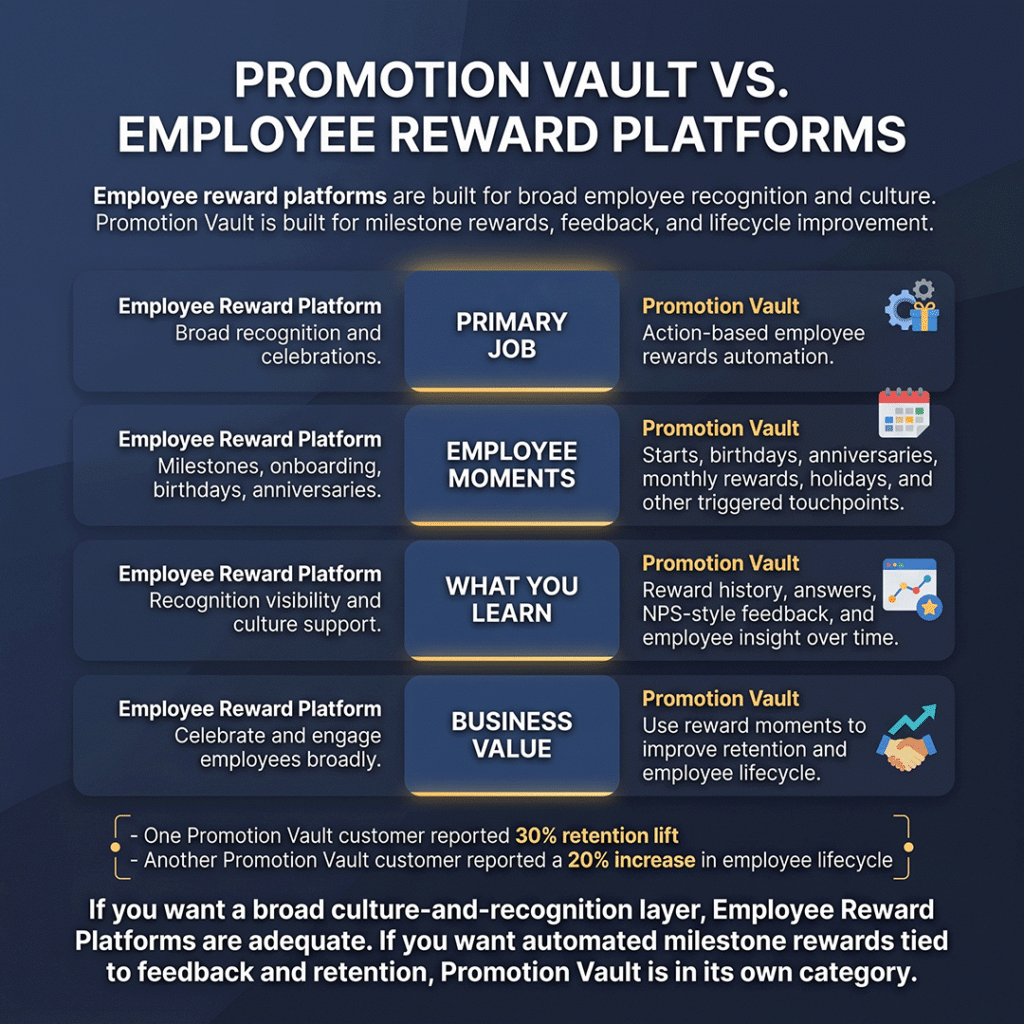
If your team needs more public kudos, keep evaluating broad recognition platforms.
Casey Rock is Content Director at Promotion Vault, where he builds the content, SEO, and messaging systems behind the company’s rewards engagement platform. He specializes in turning product value into proof-first stories that drive discovery, trust, and conversions.