Gyms should reward completed behaviors in the first 30 days, instead of assuaging last-minute cancellation threats with discounts. The strongest early rewards are tied to actions that predict longer member life: first visits, trial workouts, conversion, kickoff completion, visit milestones, payment stability, upgrades, and referrals.
TLDR — What Gyms Should Reward In The First 30 Days
- Reward completed behaviors — not passive interest or cancellation threats.
- Treat the first 30 days as habit-building time.
- Reward the first real visit, not just the form fill.
- Tie trial workout rewards to completion, not booking.
- Use rewards to add value without discounting memberships.
- Reward kickoff, assessment, or consultation completion early.
- Test visit milestones based on your own cohort data.
- Reward payment stability when billing friction causes churn.
- Track cost per completed action, not reward claims alone.
- Book a Promotion Vault demo to automate first-30-day rewards.
- Asking How To Save A Customer At Cancellation Is The Wrong Question
- Why Do The First 30 Days Matter More Than The Cancellation Moment?
- What Should Gyms Reward In The First 30 Days?
- What Makes A Good First-30-Day Gym Reward Actually Work?
- What Should Gyms Not Reward In The First 30 Days?
- How Do We Choose The First Two Gym Rewards To Test?
- What Is An Example First-30-Day Reward Ladder For A Gym Or Studio?
- How Does Promotion Vault Automate First-30-Day Gym Rewards?
- What Should We Measure Weekly To Know If Retention Rewards Are Working?
- Frequently Asked Questions About Gym Rewards And First-30-Day Retention
- Final Answer: What Should Gyms Reward In The First 30 Days?
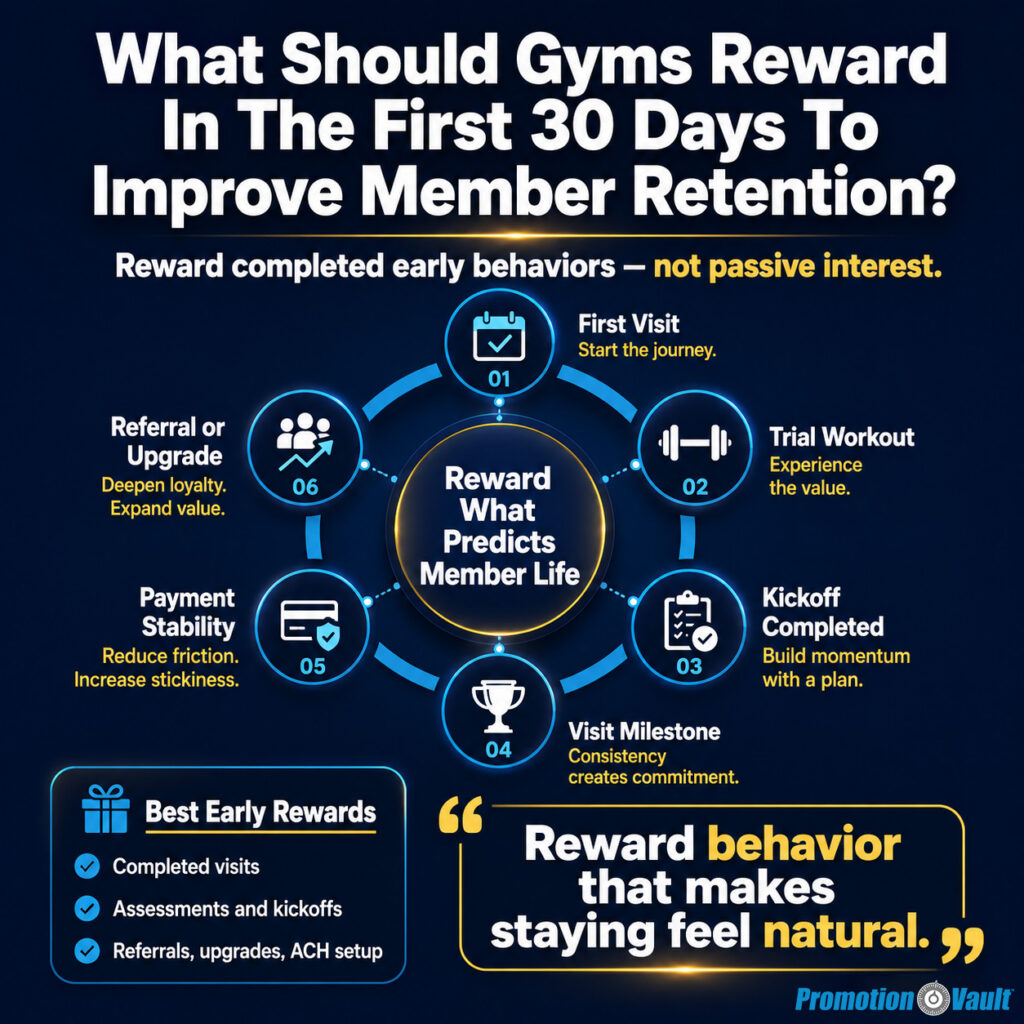
Asking How To Save A Customer At Cancellation Is The Wrong Question
The member who cancels on day 45 usually started leaving on day seven.
Not loudly. Not dramatically. Not with a complaint your front desk could fix. They joined with real intent, came once, got sore, missed a class, felt awkward walking back in, and slowly became a payment line item instead of a person building a habit.
That is why the better retention question is not, “What discount saves them when they threaten to cancel?” The better question is, “What completed action would make staying feel natural before cancellation ever enters the room?”
At Promotion Vault, we believe the answer is simple and demanding: reward completed behaviors that predict member life. Not passive intent. Not form fills that never become visits. Not generic “engagement.” Completed behaviors.
Brian Mitchell, CEO of Promotion Vault, put it plainly in an interview around retention tactics: “You can’t retain people by waiting and messaging anymore. You have to give them a reason to commit early with something that they actually feel.”
That is the spine of this article.
The best first-30-day gym rewards are small, immediate, choice-based rewards attached to real actions: the first meaningful visit, trial workout, membership conversion, kickoff or assessment completion, visit milestones, payment stability, upgrades, and first referrals. The goal is not to bribe people to stay. The goal is to help them complete the actions that make staying make sense.
Why Do The First 30 Days Matter More Than The Cancellation Moment?
The first 30 days matter because that is when a new member decides whether the gym becomes part of their life or just another monthly charge. Early visits, stable routines, coaching moments, payment setup, and belonging signals all happen before cancellation risk becomes visible.
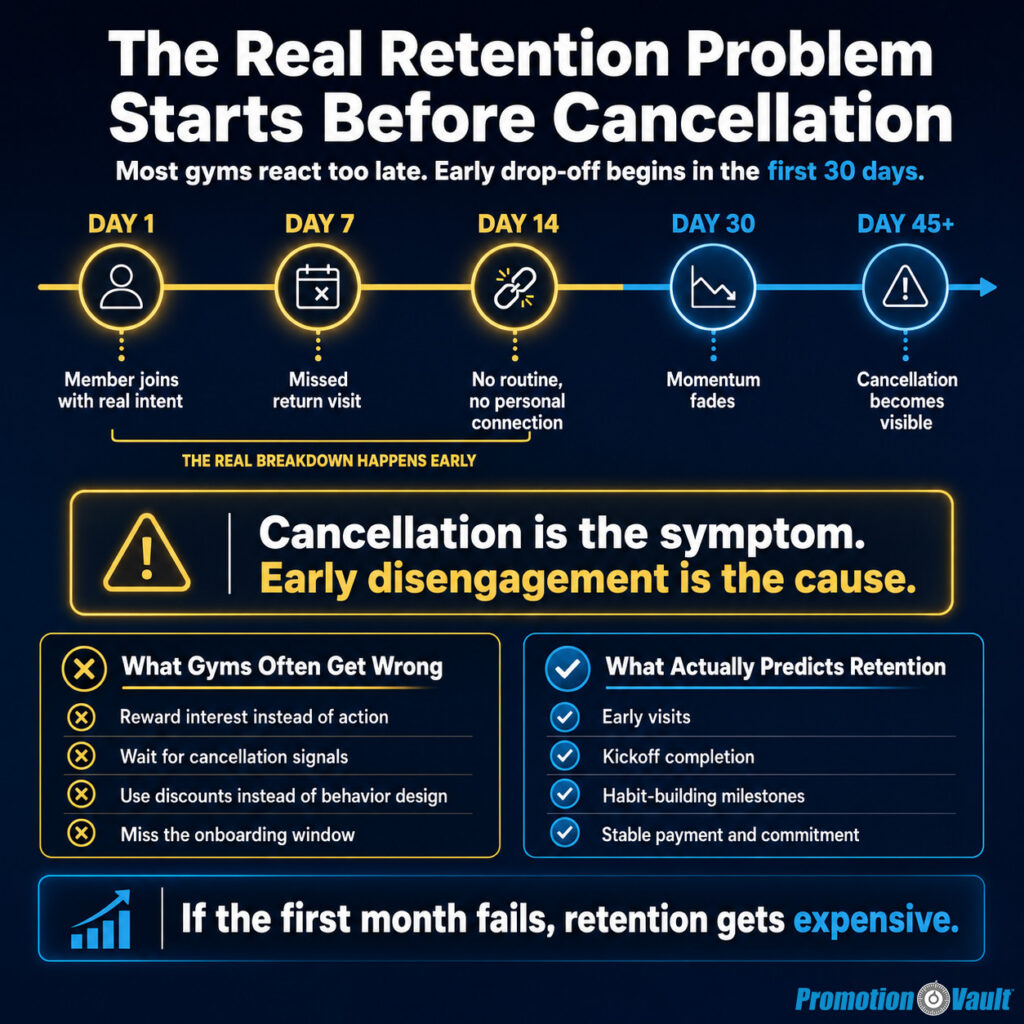
A cancellation request is a late symptom. The first month is the operating room.
In that window, the member still expects guidance. They do not yet know the rhythms of the club. They may not know which class fits them, which trainer to trust, when the gym feels least intimidating, or what soreness means after their first real workout. A good operator can still coach without sounding needy.
A 2020 study in Psychology of Sport and Exercise analyzed attendance data from 1,726 new health-and-fitness venue members. It found that average attendance fell from 7.48 visits in month one to 0.92 visits in month 12. The researchers concluded that early attendance frequency and stable attendance patterns were important for continued attendance.
That does not mean every club should use the same visit target. It means every club should study its own early behaviors.
Brian Mitchell, CEO of Promotion Vault, said the first month is where “marketing, ops, finance, everything either align or start losing money together.” That is the right lens. A member’s first month is not just a marketing sequence. It is where the promise, the schedule, the billing, the coaching, the front desk, and the follow-up either become one system or start pulling against each other.
The outside world is also making passive retention harder. Visa says its Enhanced Subscription Manager will let issuers give cardholders a centralized way to view, manage, switch, and cancel recurring payments in banking apps. Mastercard says its Smart Subscriptions product gives consumers tools to cancel, pause, and resume subscriptions. Apple’s support documentation shows a clear cancellation path inside device settings.
The point is not that every member is hunting for the cancel button. The point is that billing inertia is weaker than it used to be. We should not build a retention plan around forgetfulness.
We should build it around follow-through.
What Should Gyms Reward In The First 30 Days?
Gyms should reward completed behaviors that increase the odds of long-term membership: first real visits, trial workouts, trial-to-member conversion, kickoff completion, visit milestones, payment stability, upgrades, and referrals. These behaviors create habit, confidence, trust, and revenue without reducing the membership price.
Brian Mitchell, CEO of Promotion Vault, summed up the operating principle this way: “Winning brands act toward or engage with the member at the behavioral moments, not on a calendar.”
That matters because a calendar drip cannot see the difference between a member who came three times and a member who came once. It cannot tell whether the kickoff happened. It cannot tell whether the first ACH attempt failed. It cannot tell whether the member upgraded, referred a friend, or quietly vanished after one sore workout.
Rewards should sit where the behavior happens.
The first 30 days are not a place for random perks. They are a place for a designed ladder. Each rung should answer one question: “What action, if completed now, makes this member more likely to stay?”
Should We Reward The First Meaningful Visit?
Yes. Reward the first meaningful visit when the real value of the membership starts only after the person walks through the door. A tour, guest pass, trial visit, or first in-person experience can be the first proof that the member belongs here.
A form fill is interest. A door swing is behavior.
For many gyms, the first meaningful visit is the earliest moment worth buying. Someone who requested information but never arrives has not experienced the product. Someone who walks in can meet a coach, feel the energy, see the equipment, and imagine themselves returning.
The offer should be clear: “Come in for your first visit and earn $10 in rewards.”
That sentence works because the member can repeat it. It names the action. It names the reward. It does not discount the membership. It says, “Take the first step, and we will recognize it.”
Should We Reward The Trial Workout?
Yes. A completed trial workout is stronger than a walkthrough because the prospect actually experiences the gym. Rewarding the workout helps the person feel the value before they evaluate the price, which makes conversion more grounded and less dependent on discounting.
A walkthrough shows the room. A workout creates a memory.
If we are asking someone to join a gym, studio, or training program, we are asking them to imagine a future version of themselves. That future feels abstract until they move, sweat, meet someone, and leave with a small win.
The trial workout reward should come after completion, not booking. Booking is intent. Completion is behavior.
Good copy sounds like this: “Complete your first workout and earn $10 toward a reward of your choice.”
That framing keeps the reward attached to effort. It does not say, “We need you.” It says, “You showed up. We noticed.”
Should We Reward Trial-To-Member Conversion?
Yes. Rewarding trial-to-member conversion adds immediate value without cutting the membership price. This protects price integrity while still giving the new member a positive moment of recognition right after they make a commitment.
Discounts reduce the price of the thing we want the member to value. Rewards add something around it.
That difference matters. A discount says, “This membership is worth less today.” A reward says, “Your commitment matters, and we are adding value because you took the next step.”
Brian Mitchell, CEO of Promotion Vault, described the emotional distinction clearly: “A discount is a negative. We perceive it as a minus.” A reward, by contrast, feels like added value.
That does not make every reward smart. We still have to connect it to a measurable action. Trial-to-member conversion is measurable, valuable, and easy for the member to understand.
A simple version: “Join after your trial workout and earn an additional $10 reward.”
No coupon code. No free month. No training the member to wait for a lower price.
Should We Reward Kickoff, Assessment, Or Trainer Consultation Completion?
Yes. Reward the completed kickoff, assessment, or trainer consultation because this moment turns a new member from anonymous to known. It gives the team a chance to discuss goals, recommend services, prevent confusion, and create a personal next step.
This is one of the most underpriced retention moments in the gym business.
Many operators know the kickoff matters. Fewer treat it as a measurable behavior worth protecting. The member who completes a consultation is no longer just “new.” They have a goal, a name attached to support, and a clearer reason to return.
Brian Mitchell, CEO of Promotion Vault, called this “such a critical spot” and “a big springboard jump-off point.” He is right. The kickoff creates the path to personal training, small-group training, class selection, habit planning, and belonging.
Do not reward the booking alone. Reward the completed meeting.
Good copy: “Complete your kickoff session in your first seven days and earn $10 in rewards.”
This makes the next right action obvious.
Should We Reward A Second, Third, Fourth, Or Seventh Visit?
Yes. Gyms should reward the early visit milestone that their own cohort data shows is tied to retention. For one club, visit three may matter most. For another, visit four or seven may be the stronger signal. The right milestone comes from data, not guesswork.
Attendance is not the same thing as habit. But early repeat attendance is often the path into habit.
UCL’s Phillippa Lally and colleagues found that habit formation is highly variable. The famous average was 66 days, but the range in the study was 18 to 254 days. The useful lesson for operators is not “habits take exactly 66 days.” It is that consistency needs support before the action becomes automatic.
The first 30 days are where we help members build that consistency.
Brian Mitchell, CEO of Promotion Vault, said some clubs see four workouts as the life-cycle extender, while others need seven. That is why we should avoid universal rules. Pull the data. Compare retained members with early churners. Find the visit count where the curves separate.
Then make the reward simple.
“Complete three visits in your first 14 days and earn $15.”
That is specific enough for the member and measurable enough for the operator.
Should We Reward Payment Stability?
Yes, when the data supports it. Payment stability is not only a billing issue; it is a retention event. Rewarding ACH enrollment, preferred payment setup, or a resolved first-cycle billing issue can reduce operational risk and keep the member’s journey from breaking early.
The first failed payment can turn a motivated member into an embarrassed member.
That moment often gets treated as accounting. It should be treated as member experience. If a card fails, a payment method expires, or the first ACH pull bounces, the member may read the outreach as friction rather than support.
The reward should never feel like a penalty avoidance scheme. It should feel like a continuity nudge.
Example: “Switch to bank account billing in your first 30 days and earn $10 in rewards.”
Promotion Vault’s ABC Ignite documentation supports this type of behavior trigger, including integrations for new members who join with EFT and active members who switch to EFT. That means the reward can be tied to a verified action instead of a manual spreadsheet hunt.
For operators, the deeper point is this: stable payment supports stable membership. When billing breaks, the relationship can break with it.
Should We Reward Upgrades In The First 30 Days?
Yes, when the upgrade reflects deeper engagement. If a member moves from a limited plan to unlimited, adds personal training, or expands into a higher-commitment service because they are using the gym, a reward can reinforce the next level of participation.
Upgrades should not be forced early. They should be earned by fit.
A member who completes a kickoff, attends several times, and starts asking about more support may be ready for personal training or a higher class tier. That is not just a revenue moment. It is a commitment moment.
Brian Mitchell, CEO of Promotion Vault, described upgrades as part of the natural journey when members have completed workouts, engaged with services, and found a stronger fit. That is the right sequence. Reward the upgrade when it follows behavior.
Good copy: “Upgrade to unlimited after your first four classes and earn $20 in rewards.”
The reward should point toward momentum, not pressure.
Should We Reward A First Referral In The First 30 Days?
Yes. A first referral can strengthen acquisition and retention at the same time. When a new member brings someone else into the experience, they create a social tie, an accountability loop, and a new path for the club’s growth.
A referral is not just a lead. It is a statement of identity.
The member is saying, “This place is worth sharing.” That matters early. It can help them feel more rooted in the community and give them another reason to come back.
Promotion Vault’s Referral Vault is built for this kind of loop. It lets businesses create referral forms, track leads, validate information, and connect referrals into the broader reward system. For gyms using ABC Fitness, Promotion Vault can also connect referral activity with membership data, so qualified referral rewards are based on real outcomes.
A clean first-30-day referral offer might be: “Refer a friend in your first 30 days. When they join, earn $25 in rewards.”
That keeps the reward tied to a completed outcome, not a name dropped in a form.
What Makes A Good First-30-Day Gym Reward Actually Work?
A good first-30-day gym reward is small, certain, immediate, choice-based, outside the membership price, and tied to a completed action. It should be easy to understand in one sentence and financially defensible against the value of the behavior it moves.
Brian Mitchell, CEO of Promotion Vault, gave the simplest version: “Small certain rewards, immediate gratification.”
That is the opposite of a complicated points economy. New members do not need a math problem. They need a clear next step.
A strong first-30-day reward has six traits:
- It is tied to completion. The member earns it after the action happens.
- It is immediate enough to connect cause and effect. The reward should arrive while the behavior still feels fresh.
- It is choice-based. The member should feel the value personally.
- It sits outside the membership. Rewards should add value without lowering the price of the core service.
- It has a clean trigger. The team should not need to manually debate eligibility.
- It has a measurable business case. The operator should know the cost to acquire the action.
The Journal of Health Economics study by Mariana Carrera, Heather Royer, Mark Stehr, and Justin Sydnor is useful here because it adds nuance. The researchers tested modest incentives for new gym members and found moderate attendance impacts during the incentive period, but no effect on later visit trajectories. They also documented overconfidence among new members about future visits.
That finding should not make operators abandon rewards. It should make us design better ones.
Blanket incentives do not replace member experience. They do not make a confusing gym feel welcoming. They do not fix a bad kickoff. They do not create belonging by themselves.
The reward works best when it reinforces the next behavior inside a strong onboarding system.
The reward is not the relationship. The reward is the spark that helps the relationship begin and keeps the relationship going strong.
What Should Gyms Not Reward In The First 30 Days?
Gyms should not reward vague engagement, passive intent, bookings without completion, every possible action, or discounts disguised as retention strategy. A reward program works best when it protects focus. If everything earns a reward, nothing teaches the member what matters.
A confused reward ladder creates confused behavior.
We should not ask members to decode ten offers in their first month. We should not reward the easy action when the valuable action is completion. We should not give a discount every time someone hesitates. That trains the market to wait.
Avoid these five mistakes:
- Do not reward vague engagement. “Stay active and earn rewards” is too soft.
- Do not reward bookings when completion matters. A booked kickoff does not help unless the member shows up.
- Do not reward every action at once. Pick the two or three that matter most.
- Do not default to discounts. Discounts can reduce the perceived value of the membership.
- Do not build a ladder the team cannot support. Operational strain kills good strategy.
Brian Mitchell, CEO of Promotion Vault, was direct about the industry’s discount habit: “The most important thing in fitness is we can’t devalue the service that we’re providing of help and fitness.”
That is not a moral scolding. It is a business reality.
Gyms sell coaching, access, energy, structure, confidence, and community. If our main retention lever is “pay us less,” we are teaching members to value the price cut more than the progress.
Rewards give us a better path. They let us recognize action without lowering the worth of the thing we sell.
How Do We Choose The First Two Gym Rewards To Test?
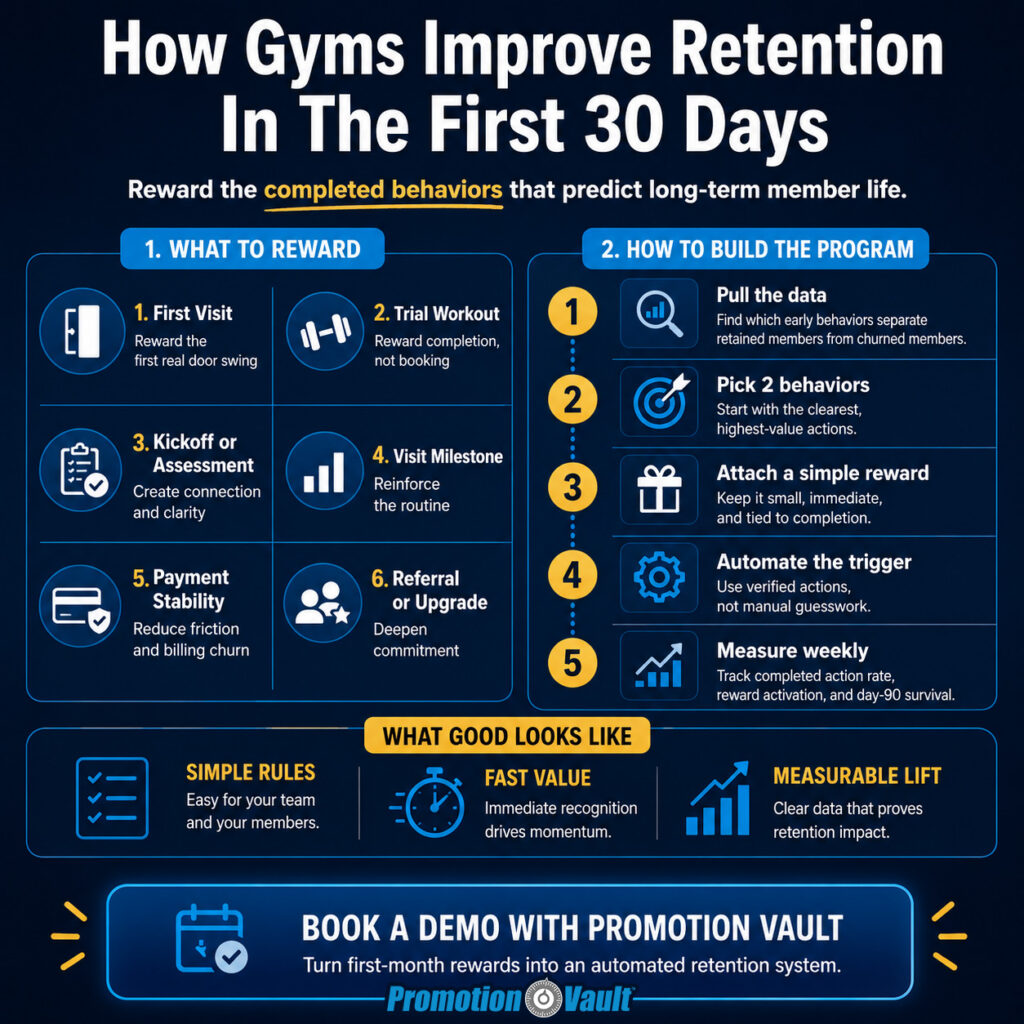
Choose the first two rewards by pulling cohort data, comparing members who survive past day 90 with those who do not, and finding the early behaviors with the clearest separation. Then reward only the cleanest, highest-value actions first.
Brian Mitchell, CEO of Promotion Vault, said it best: “Start from the data, not the marketing calendar.”
That sentence should be taped to the monitor of every retention team.
Here is the practical process:
- Pull six months of member history. Include join date, first visit, check-ins, class attendance, kickoff completion, payment method, upgrades, referrals, support tickets, and cancellation date.
- Split members into two groups. Compare those who stayed past day 90 with those who did not.
- List the early behaviors. Look at visits, kickoff completion, class type, trainer consultation, payment method, referral activity, and first billing status.
- Find the separation. Ask: Which behavior appears much more often in the retained group?
- Pick two moments. Choose the highest-value behavior with the cleanest trigger first.
- Assign the economics. Estimate LTV, margin, reward amount, expected activation rate, and cost to acquire the action.
- Set a weekly review. Track whether the reward changes completed behavior, not just whether people like the offer.
This keeps the program manageable.
Brian Mitchell, CEO of Promotion Vault, warned against doing too much at once: “Pick two moments in that life cycle and execute them really well.”
That is how we keep rewards from becoming noise.
What Is An Example First-30-Day Reward Ladder For A Gym Or Studio?
An example first-30-day reward ladder might offer $10 for a trial workout, $10 for joining, $10 for kickoff completion, $15 for completing a visit milestone, and $25 for a qualified referral. These values are illustrative; each operator should test against LTV and completed-action ROI.
Here is a simple ladder a gym or studio could adapt:
- $10 for completing the first trial workout.
- $10 for converting after the workout.
- $10 for completing the kickoff or assessment.
- $15 for completing visit three or four within 14 days.
- $25 for a qualified first referral in the first 30 days.
This is not a universal prescription. It is a structure.
The member sees a path. The operator sees triggers. Finance sees controlled exposure. Marketing gets a better story than “free month.” The team gets a clear reason to follow up.
Brian Mitchell, CEO of Promotion Vault, described the ladder in plain language: “First thing we do is we want the door to swing.” After that, he said, the guest needs to try the club, convert, complete the kickoff, keep attending, and eventually refer someone else.
That is the lifecycle.
A strong reward ladder does not replace coaching. It gives coaching a sharper moment. Instead of saying, “We hope to see you soon,” the team can say, “You are one visit away from your first milestone.”
That feels different.
How Does Promotion Vault Automate First-30-Day Gym Rewards?
Promotion Vault helps gyms automate first-30-day rewards by connecting incentives to verified behaviors through integrations, APIs, Zapier workflows, webhooks, reward links, or manual imports. The reward can trigger after the action happens, then move through a branded activation and redemption experience.
The key word is verified.
We should not build retention rewards on wishful thinking. If the member completed the action, the system should know. If the member did not, the reward should not fire.
Promotion Vault supports this through multiple paths. ABC Ignite integrations can trigger rewards for new members, referrals, ACH joins, ACH switches, guest passes or tours, check-in milestones, completed events, and upgrades. Zapier and API workflows can connect other systems. Manual imports can support teams that are not ready for full automation.
Once the reward is triggered, Promotion Vault’s reward experience gives the recipient a branded path: notification, activation, release, and redemption choice. That matters because trust is part of the conversion. The reward should feel legitimate, not random.
Brian Mitchell, CEO of Promotion Vault, said timing is the key: “The timing in which the rewards hit and validate is the key. It actually drives them to then do that next step.”
Promotion Vault’s pay-on-activation model also changes the budget conversation. Instead of paying full reward value for every eligible person upfront, teams pay a service fee when the reward is sent and pay the reward value when the recipient activates. Brian Mitchell, CEO of Promotion Vault, explained the effect this way: “It converts retention from a fixed cost into a variable cost.”
That can give operators room to test stronger headline rewards without treating every sent reward as fully spent.
Promotion Vault also supports reminders for unactivated rewards, with guardrails. The platform documentation outlines follow-ups on days 1, 3, 6, 13, 21, 29, 40, 50, and 59, along with 24-hour rate limiting and unsubscribe suppression. For first-30-day gym programs, that means earned rewards are less likely to disappear into inbox noise without creating manual chasing for the team.
The final layer is learning. Promotion Vault’s Data Vault can attach short questions to reward moments. Brian Mitchell, CEO of Promotion Vault, described it as flipping the old survey model: “We give to get.” Instead of asking for feedback cold, we ask when the member is already receiving value.
A simple question at activation can uncover what almost stopped the member from coming back.
That is how rewards become a feedback loop.
What Should We Measure Weekly To Know If Retention Rewards Are Working?
Measure completed behavior, not just reward delivery. Weekly reporting should track eligible members, activation rate, completed action rate, cost to acquire the action, D7/D14/D30 visits, kickoff completion, billing stability, referral rate, and day-90 survival by cohort.
Brian Mitchell, CEO of Promotion Vault, said, “The cost to acquire the action is the key.”
That is the scoreboard.
A first-30-day reward program should be reviewed every week against a small set of numbers:
- Eligible members by behavior. How many people qualified for each reward?
- Reward activation rate. How many recipients claimed the reward?
- Completed action rate. Did the target behavior increase?
- Cost to acquire the action. What did we spend per completed behavior?
- D7, D14, and D30 visits. Are new members showing up sooner and more often?
- Kickoff completion. Are more members sitting down for the assessment?
- First-cycle billing rescues. Are fewer members breaking during payment setup?
- Referral-in-first-30 rate. Are new members bringing others in earlier?
- Day-90 survival by cohort. Are rewarded cohorts staying longer?
The last metric matters most. A reward that increases claims but does not change day-90 survival may be pleasant but not strategic. A reward that modestly increases early visits and improves cohort survival deserves more budget.
The right question is not, “Did people like the reward?”
The right question is, “Did the reward help members complete the behavior that keeps them on the path?”
Frequently Asked Questions About Gym Rewards And First-30-Day Retention
What Is The Best First Reward To Test For Gym Retention?
The best first reward is usually tied to the earliest completed behavior that predicts retention in your data. For many gyms, that means the second or third visit, kickoff completion, or first assessment. Start where the behavior is measurable and clearly tied to day-90 survival.
Should Gyms Reward Attendance?
Yes, but only when attendance is tied to a specific milestone. Rewarding “any attendance” is weaker than rewarding the visit count your cohort data shows is meaningful. For one gym, that may be three visits in 14 days. For another, it may be four visits in 30 days.
Are Rewards Better Than Discounts For Gym Retention?
Rewards are usually better when the goal is to protect price integrity. A discount reduces the perceived value of the membership. A reward adds value around a completed behavior. That difference helps gyms motivate action without teaching members to wait for a lower monthly price.
How Much Should A Gym Offer As A Retention Reward?
Start small and test against the value of the behavior. The right amount depends on member LTV, margin, activation rate, incremental lift, and the action being rewarded. A $10 reward may work for a kickoff. A qualified referral may justify more.
Should Gyms Reward Referrals In The First 30 Days?
Yes, if referrals are a meaningful growth lever. A new member who refers someone else may become more connected to the gym. The cleanest structure is outcome-based: reward the member when the referred person joins, not when a name is merely submitted.
How Can A Gym Automate Rewards For First-Month Visits?
A gym can automate first-month visit rewards by connecting check-in data, CRM events, gym management software, API workflows, Zapier, or manual imports to a reward platform. The reward should trigger only after the member completes the verified visit milestone.
Final Answer: What Should Gyms Reward In The First 30 Days?
Gyms should reward the completed early behaviors that make retention more likely: first meaningful visits, trial workouts, trial-to-member conversion, kickoff completion, visit milestones, payment stability, upgrades, and qualified referrals. The first 30 days are not the time for vague engagement campaigns or blanket discounts. They are the time to help members build proof, rhythm, confidence, and connection.
The strongest reward programs start with data. Pull the cohort history, find the behaviors that separate retained members from early churners, and pick two moments to test first. Keep the reward small, immediate, choice-based, and tied to completion. Then measure the outcome that matters: whether more members survive and thrive past day 90.
If we do not know which early behavior predicts retention, start with the data. If the data shows visit frequency matters most, test a visit milestone reward. If kickoff completion is the gap, reward the completed assessment. If payment failure is breaking the journey, reward stable payment setup.
Then book a Retention Playbook Review with Promotion Vault. We will help identify the two highest-value behaviors your members should be rewarded for first — and show how to turn those moments into a simple, measurable first-30-day reward program.