Automotive dealerships can use rewards to improve retention by tying incentives to completed behaviors that create future value. The best rewards drive appointment show-ups, test drives, first service visits, declined-service returns, referral conversions, and trade-in conversations.
TLDR — How Can Auto Dealerships Improve Retention?
- Reward completed behaviors — not vague interest or blanket promotions.
- Treat the sale as the handoff, not the finish line.
- Use rewards to drive show-ups, test drives, and first service.
- Reward first service completion to keep buyers in your ecosystem.
- Use declined-service rewards to bring customers back with care.
- Build referral rewards in stages: submit, show, test drive, buy.
- Use service visits to trigger trade-in valuation conversations.
- Measure cost per completed action, not just reward spend.
- Keep reward rules clear, compliant, trackable, and easy to run.
- Book a Promotion Vault demo to automate dealership rewards that move revenue.
- Why Should Dealerships Treat Rewards As A Retention Strategy?
- Why Should Automotive Rewards Focus On Behaviors Instead Of Promotions?
- Which Automotive Lifecycle Moments Should Dealerships Reward?
- Why Should Dealerships Be Careful With Discounts?
- What Dealership Reward Playbooks Can We Launch First?
- What Should Dealerships Measure Every Week?
- How Do Dealerships Keep Reward Programs Compliant And Operationally Clean?
- How Does Promotion Vault Help Automotive Teams Run Dealership Rewards?
- What Is The Best First Dealership Reward Program To Launch?
- FAQ: Dealership Rewards, Service Retention, And Referral Programs
- So, How Can Auto Dealerships Improve Retention And Drive Revenue?
Why Should Dealerships Treat Rewards As A Retention Strategy?
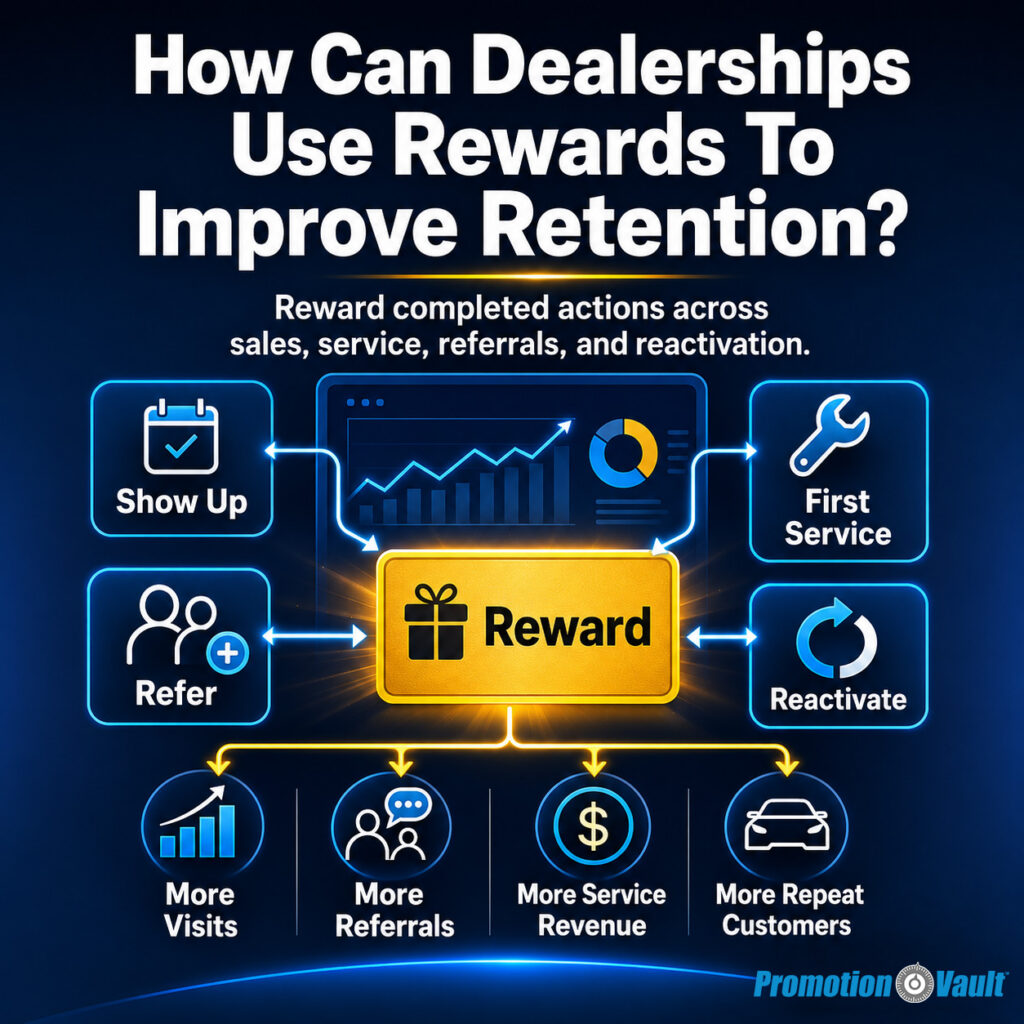
Dealership rewards work when they are tied to completed behaviors, not broad promotions. The goal is not to give something away. The goal is to move the next action that keeps the customer inside the dealership ecosystem — show up, test drive, complete first service, return after declined service, refer a buyer, or request a trade-in valuation.
The sale is not the end of the customer journey. It is the handoff.
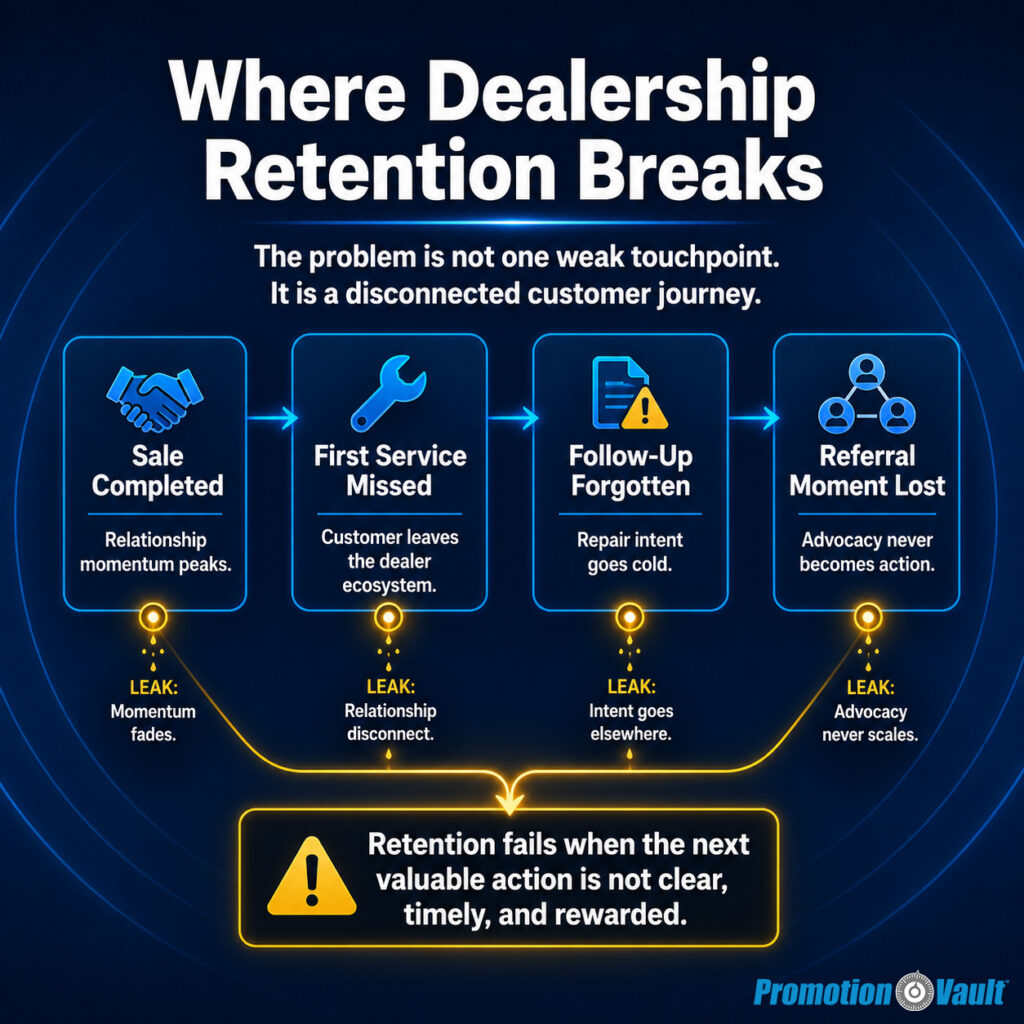
That handoff is where many dealerships quietly lose future revenue. Sales wins the customer. Delivery creates excitement. Then the customer leaves with a vehicle, a payment, and a vague promise that service will call later. A few months pass. The customer needs maintenance, gets a faster appointment somewhere else, and the dealership becomes “where I bought the car,” not “where I take care of the car.”
That distinction matters. NADA’s 2025 full-year data says franchised light-vehicle dealerships wrote more than 276 million repair orders, with service and parts sales exceeding $164 billion. Cox Automotive’s 2025 Service Industry Study reported that dealerships have lost 12% of service visits to competitors since 2018, even as the need for service has grown. Cox also reported that only 54% of owners with vehicles two years old or newer returned to the dealership where they bought the vehicle for service, down from 72% in 2023.
So the opportunity is not abstract. It is sitting in the service lane, the BDC queue, the referral ask, the declined-service report, and the trade-in conversation.
Brian Mitchell, CEO of Promotion Vault, framed the deeper issue this way in a Promotion Vault retention interview: “Winning brands act toward or engage with the member at the behavioral moments, not on a calendar.” He was talking about membership retention, but the lesson fits dealerships cleanly. Customers do not stay connected because we sent another monthly email. They stay connected because we acted at the moment when the next useful behavior was ready to happen.
For dealerships, that means we stop treating rewards like generic promos. We use them like signal markers.
A good dealership reward says: we value that you followed through. It should feel like recognition, not a price apology.
Why Should Automotive Rewards Focus On Behaviors Instead Of Promotions?
Automotive rewards should focus on behaviors because behaviors create measurable future value. A promotion says, “Here is a deal.” A behavior-based reward says, “Complete this action and we will recognize it.” That difference protects margin, reduces waste, and gives managers a cleaner way to measure cost per completed action.
Dealerships already know how to run promotions. We have seasonal service offers, conquest offers, manufacturer incentives, coupons, rebates, payment specials, and email campaigns built around urgency. Some of those tools have a place. But they can also create noise.
A reward works differently when it is tied to proof.
Did the shopper show up for the appointment? Did the buyer complete the test drive? Did the customer schedule first service before delivery? Did they return after declining recommended work? Did they refer someone who actually visited? Did they request a trade-in valuation during service?
Those are not vanity actions. They are dealership behaviors with economic value.
Brian Mitchell, CEO of Promotion Vault, put the same principle plainly: “The cost to acquire the action is the key.” That is the mindset shift. We are not asking, “How much can we afford to give away?” We are asking, “What is this completed action worth to us?”
That question helps every department speak the same language.
Sales cares about showroom traffic and test drives. Fixed ops cares about first service, repeat ROs, declined-service recapture, and repair order value. Marketing cares about acquisition cost, attribution, and conversion. Finance cares about whether the program has controllable downside. The reward becomes the bridge because it attaches cost to a verified behavior.
This is where dealerships can mature past “campaign thinking.”
A campaign starts with a date. A behavior-based reward starts with a moment. That moment might be the first service appointment, the second declined-service reminder, the referral handoff, or the appraisal request during a high-mileage service visit.
The best dealership reward is not a discount in nicer packaging. It is a measured nudge attached to a completed action that makes the customer relationship more valuable.
Which Automotive Lifecycle Moments Should Dealerships Reward?
Dealerships should reward the moments that move customers from interest to action, and from one transaction to the next relationship step. The highest-value moments include showroom show-up, test drive completion, purchase, first service scheduling, first service completion, declined-service return, referral conversion, and trade-in valuation.
We should not reward everything. That makes the program expensive and forgettable.
Instead, we should build around the moments where customers commonly drift.
Brian Mitchell, CEO of Promotion Vault, said the first mistake in retention is “the silence after the sale.” In automotive, that silence can start the moment the customer drives away. A behavior-based reward program gives the dealership a reason to keep acting with purpose.
How Should Dealers Reward Lead-To-Appointment Show-Up?
Dealers should reward completed showroom visits, not appointment-setting alone. A small reward for showing up helps the BDC and sales team focus on real traffic instead of inflated appointment counts. The action we buy is the physical or verified digital visit, because that is where the sales process can actually begin.
Example offer: “Complete your appointment and receive a $15 reward.”
Keep the language plain. We do not need to over-explain it. We need the customer to know exactly what action earns the reward.
This reward should trigger only after the customer shows. If the lead cancels, no reward. If the lead reschedules and completes the visit, reward the completed visit. That keeps the economics clean.
How Should Dealers Reward Test Drive Completion?
Dealers should reward a completed test drive when it marks a real commitment signal. A test drive moves a shopper from online research into lived experience. It also gives the sales team a legitimate moment to learn what matters: payment comfort, vehicle fit, trade-in status, timing, and objections.
Example offer: “Take your scheduled test drive and receive a $20 reward.”
This is especially useful for high-intent leads who are comparing multiple stores. We are not trying to bribe someone into buying. We are creating enough momentum for a serious shopper to take the next step.
How Should Dealers Reward Purchase Completion?
Dealers should use a post-purchase reward as a thank-you moment and a transition into ownership. The reward should not replace a fair deal or strong delivery. It should make the customer feel remembered after the paperwork ends and open the door to first service, feedback, and referral conversations.
Example offer: “Thank you for buying with us. Your $25 reward is waiting.”
That moment matters because it creates a positive second touchpoint. It also gives the dealership a clean place to ask one simple question: “What made you choose us?”
The answer helps marketing, sales training, and referral messaging.
How Should Dealers Reward First Service Scheduling Before Delivery?
Dealers should reward first service scheduling before delivery because the sales-to-service handoff is a retention event. The customer should leave with a vehicle and a next appointment. A small reward can make that next appointment feel expected, valuable, and easy to remember.
Example offer: “Schedule your first service before you leave today and receive a $15 reward after completion.”
The key is completion. Scheduling is useful, but the business outcome happens when the customer returns.
How Should Dealers Reward First Service Completion?
Dealers should reward first service completion because it is the first real proof that the customer still belongs to the dealership ecosystem. The first service visit builds familiarity with advisors, convenience, pricing, communication, and trust. If that visit goes well, the second one becomes easier.
Example offer: “Complete your first service visit and receive a $20 reward.”
Cox Automotive reported that customers are often frustrated by unexpected costs and poor communication in dealership service. That means the reward alone is not enough. We need transparent pricing, clear updates, and a simple follow-up question: “What would make servicing with us easier next time?”
How Should Dealers Reward Declined-Service Follow-Up?
Dealers should reward customers for returning to complete previously declined work when the work is still appropriate. The message should focus on care, safety, convenience, and follow-through. It should not feel like pressure. The customer already said no once, so the return path must feel respectful.
Example offer: “Come back within 14 days to complete your recommended service and receive a $20 reward.”
This is where fixed ops can turn a missed RO into a second chance. The advisor should explain the recommendation clearly, document the decline, and trigger the reward only when the customer returns and completes the work.
How Should Dealers Reward Referrals?
Dealers should use tiered referral rewards because referrals happen in stages. Reward a qualified referral submission with a small amount, then reward larger milestones like showroom visit, test drive, or purchase. This keeps customers engaged before the final sale while protecting the dealership from paying for low-quality leads.
Example structure:
- $10 when a customer submits a qualified referral.
- $25 when the referral completes a showroom visit or test drive.
- $75 to $150 when the referral buys, depending on margin, rules, and local compliance.
Promotion Vault’s internal Referral Vault documentation describes referral forms, lead validation, referral limits, statuses, reporting, and conversion-triggered rewards. That matters because referral programs break when they rely on memory, spreadsheets, or loose promises.
A tiered system respects the journey. It says, “Thank you for opening the door,” then rewards the deeper behaviors as they happen.
How Should Dealers Reward Trade-In Valuation Requests During Service?
Dealers should reward trade-in valuation requests during service because service customers already have the vehicle, the relationship, and the timing context. A reward can turn a passive service visit into an appraisal conversation, inventory sourcing opportunity, or future purchase signal.
Example offer: “Complete a trade-in valuation during your service visit and receive a $15 reward.”
This should not be a hard sales trap. It should be framed as helpful information: “Your vehicle may be worth more than you think. We can appraise it while you are here.”
If the customer sells or trades, a larger reward may make sense. But the first behavior is simple: get the valuation conversation started.
Why Should Dealerships Be Careful With Discounts?
Dealerships should be careful with discounts because discounts train customers to wait for price concessions. Rewards can add value without lowering the perceived value of the vehicle, service, or dealership relationship. The strongest framing is appreciation for completed action, not a permanent reduction in price.
Discounts are familiar because they are easy to explain. They are also easy to overuse.
Brian Mitchell, CEO of Promotion Vault, said, “Discounting as a retention lever has a half-life and we’re way past it.” In automotive, we can feel that half-life in the way customers wait for coupons, ask for service specials, or assume the dealership is too expensive unless a discount appears.
A discount changes the price story. A reward changes the follow-through story.
That distinction protects the dealership’s value. If we discount the oil change, the customer remembers the cheaper oil change. If we reward first service completion, the customer remembers that the dealership recognized them for coming back.
One subtracts from the transaction. The other adds to the relationship.
That does not mean every coupon is bad. It means coupons should not be the only retention lever. If we use discounts for every stalled moment, we teach customers to negotiate every next step. If we use rewards for completed behaviors, we teach customers that follow-through is valuable.
Promotion Vault’s internal positioning describes this as rewards tied to specific actions, delivered through a branded recipient journey, and measured by activation and downstream outcomes. That is the operating model dealerships need: action, reward, measurement, next step.
What Dealership Reward Playbooks Can We Launch First?
Dealerships should start with two or three reward playbooks, not a giant loyalty system. The easiest starting points are sales show-up, fixed ops retention, referrals, and service-to-sales. Each playbook should define the action, reward value, trigger, timing, message, and weekly metric before launch.
Brian Mitchell, CEO of Promotion Vault, warned teams not to try every reward moment at once: “Pick two and execute them well.” That is the right advice for dealerships.
We do not need a sprawling program to begin. We need one tight loop that proves the model.
How Do We Build A Sales Show-Up Reward Playbook?
A sales show-up playbook rewards verified showroom actions that move a lead into the buying process. Start with completed appointment, completed test drive, and post-purchase thank-you. Measure show rate, test-drive rate, purchase rate, reward activation rate, and cost per completed action.
Recommended structure:
- $10 to $15 for a completed appointment.
- $20 for a completed test drive.
- $25 after purchase as a thank-you.
- One reward-activation question: “What nearly stopped you from coming in?”
This gives the BDC a stronger reason to confirm appointments. It gives sales a cleaner way to drive test drives. It gives marketing better data about friction.
The reward should never replace the salesperson’s follow-up. It should sharpen it.
How Do We Build A Fixed Ops Retention Reward Playbook?
A fixed ops retention playbook rewards the behaviors that keep customers returning after the sale. Start with first service scheduling, first service completion, and declined-service return. Measure first service scheduled before delivery, first service completion, repeat RO rate, declined-service recapture, and repair order value.
Recommended structure:
- $15 for scheduling first service before delivery.
- $20 for completing the first service visit.
- $20 for returning after a declined-service reminder.
- One reward-activation question: “What would make servicing with us easier next time?”
This playbook turns service retention into a managed system. It also helps sales and service share accountability.
How Do We Build A Referral Reward Playbook?
A referral playbook should reward the referral journey in stages. Start with qualified referral submitted, referral showroom visit, and referral purchase. Measure referral submissions, valid referrals, referral show-up rate, referral sales, cost per sold referral, and downstream service retention.
Recommended structure:
- $10 for submitting a qualified referral.
- $25 when the referral completes a showroom visit or test drive.
- $75 to $150 when the referral buys, if economics and compliance allow.
- One reward-activation question: “Who did you refer: family, coworker, neighbor, or friend?”
This creates better data than “Where did you hear about us?” asked after the fact. It also helps the dealership learn which social circles drive growth.
Brian Mitchell, CEO of Promotion Vault, gave a similar example from a rewards program where a customer asked who the member referred. The data showed 76% were family members, which helped the operator rethink local referral creative. That is the kind of learning loop dealerships should want.
How Do We Build A Service-To-Sales Reward Playbook?
A service-to-sales playbook rewards customers for taking the next appraisal or trade-in step while they are already in the dealership. Start with valuation request, appraisal appointment, and trade or sale completion. Measure valuation requests, appraisal completions, trade-in opportunities, sold units, and inventory sourced.
Recommended structure:
- $15 for completing a trade-in valuation during service.
- $25 for completing an appraisal appointment.
- Larger reward only if the customer sells or trades, and the economics support it.
- One reward-activation question: “Are you considering replacing this vehicle in the next six months?”
This is not a pressure tactic. It is a service-lane intelligence play.
The customer gets useful information. The dealership gets purchase intent, inventory signal, and a reason to follow up with relevance.
What Should Dealerships Measure Every Week?
Dealerships should measure cost per completed action, not just reward spend. Track the customer behavior, the reward activation, and the downstream value. The weekly dashboard should connect sales, fixed ops, marketing, and finance around the same question: did this reward move a behavior worth paying for?
Brian Mitchell, CEO of Promotion Vault, said, “Data, data, data. Start from the data. Start from the data, not the marketing calendar.” That is the measurement standard.
A dealership reward program should have a weekly readout that includes:
- Leads eligible for reward.
- Appointment show-up rate.
- Test-drive completion rate.
- Purchase completion rate.
- First service scheduled before delivery.
- First service completed.
- Declined-service return rate.
- Average repair order value.
- Referral submissions.
- Referral appointment show-up.
- Referral sales.
- Trade-in valuation requests.
- Appraisal appointments completed.
- Repeat service visit rate.
- Reward activation rate.
- Cost per completed action.
- Downstream purchase or service retention.
Do not bury this in a giant marketing report. Keep it visible.
The dealership should be able to answer four questions quickly:
- Which action did we reward?
- How many customers completed it?
- How much did each completed action cost?
- What downstream revenue or retention signal followed?
That is how we protect the program from becoming “nice to have.”
Promotion Vault’s internal activation model defines activation rate as activated rewards divided by eligible rewards. That gives operators a cleaner way to forecast cost, spot campaign friction, and compare reward values. If customers earn the reward but do not activate it, the dealership learns something. If they activate quickly but do not complete the next action, the follow-up path needs work.
Measurement is not a punishment tool. It is how we make the program stronger.
How Do Dealerships Keep Reward Programs Compliant And Operationally Clean?
Dealerships should keep reward programs compliant by using clear terms, verified triggers, duplicate prevention, recordkeeping, and legal review. Sales-related incentives, referral rewards, review requests, and trade-in offers can touch state, OEM, and consumer-protection rules. Treat compliance as program design, not cleanup.
This matters because automotive is not a casual category. Deals, referrals, reviews, advertising claims, and financing language all carry weight.
The FTC’s business guidance on endorsements, influencers, and reviews stresses clear disclosure when there is a material connection. That principle matters for referral and review-related reward programs. If a customer is rewarded for a referral, testimonial, or public recommendation, the dealership should not hide that relationship.
We are not lawyers, and this is not legal advice. But operators can build safer programs by following a few practical rules:
- Confirm state, OEM, and dealership group rules before launch.
- Make eligibility terms simple and visible.
- Reward verified events only.
- Keep records by customer, VIN, campaign, location, and action.
- Prevent duplicate rewards.
- Use clear activation and expiration windows.
- Avoid language that sounds like a hidden price term.
- Avoid deceptive “free” language if the reward has conditions.
- Align finance, legal, sales, fixed ops, and marketing before launch.
- Train staff on the exact promise they can make.
This is also why rewards should be tied to completed actions. Completion gives the dealership a cleaner audit trail.
A customer showed. A test drive happened. A first service visit was completed. A referral reached a defined status. A trade-in valuation was requested. Those events are easier to verify than vague engagement.
Clean operations build trust inside the store, too. Advisors and salespeople support programs when they know the rules are fair, the triggers are clear, and the customer experience will not create extra chaos.
How Does Promotion Vault Help Automotive Teams Run Dealership Rewards?
Promotion Vault helps automotive teams run dealership rewards by automating reward triggers, branded reward delivery, reminders, activation tracking, segmentation, and feedback capture. Dealers can connect CRM, webhook, Zapier, API, lead lists, appointment data, service data, or manual uploads to reward the behaviors that matter.
Promotion Vault is built for action-based rewards. That means we can start with a dealership behavior and build backward.
What do we want the customer to do? Show up. Test drive. Complete first service. Return after declined work. Refer a qualified buyer. Request a trade-in valuation. Complete an appraisal.
Then we decide how to verify it, trigger it, deliver it, measure it, and learn from it.
Promotion Vault’s internal platform documentation describes the reward experience as a branded journey: notification, activation, release, and redemption choice. That matters for dealerships because customers are trained to be suspicious of random reward messages. A branded reward experience helps the offer feel legitimate, professional, and connected to the dealership.
Promotion Vault also supports pay-on-activation economics. A 10% service fee is charged when a reward is sent, and the reward face value is charged when the recipient activates. Brian Mitchell, CEO of Promotion Vault, summarized the finance benefit this way: “Pay on activation… converts retention from a fixed cost into a variable cost.”
That changes campaign design. If we only pay full value when a customer activates, we can test stronger reward values with more confidence. We can also track activation rate by campaign, store, reward amount, and lifecycle moment.
Promotion Vault can also automate reminders for unactivated rewards. Internal notification documentation lists reminder days after the initial reward notification, with guardrails like 24-hour rate limiting and unsubscribe suppression. That protects follow-through without turning the program into spam.
Then there is Data Vault.
Brian Mitchell, CEO of Promotion Vault, said reward activation is “the highest attention moment” outside the business because the recipient is engaging with money they earned. Promotion Vault’s Data Vault can attach mini-survey questions to that moment. Internal documentation describes question types like NPS, rating scales, yes/no, multiple choice, dropdown, and text responses, targeted by tags.
For dealerships, that means every reward can also become a learning moment:
- “What nearly stopped you from coming in?”
- “What would make service easier next time?”
- “Who did you refer?”
- “Are you considering replacing this vehicle in the next six months?”
- “Why did you decline the recommended service today?”
A reward is not just a payout. It is a feedback loop.
Promotion Vault’s internal Hyundai service-retention case study shows why this matters in automotive. The case study reported that Hyundai used $25 for a first service check and $50 for a second visit, with rewards paid only on redemption. It reported a 24% increase in first-time repair orders, 300 additional repair orders, and $81,000 in additional profit over six months. It also reported an 18% increase in second-time repair orders, 570 additional services, and $153,900 in additional profit.
Those numbers are not a promise for every dealership. They are proof of the mechanism: reward the service behaviors that create future value, then measure the profit that follows.
What Is The Best First Dealership Reward Program To Launch?
The best first dealership reward program is usually a first-service completion playbook. It is simple, measurable, and connected to long-term retention. Reward the customer after they complete their first service visit, ask one feedback question, and track whether they return for the next service interval.
Start there because first service is the bridge between sales and fixed ops.
The buyer already trusted the dealership once. The vehicle is still new to them. The dealership has a natural reason to communicate. The service team has a chance to prove convenience and transparency before an independent shop becomes the default.
Brian Mitchell, CEO of Promotion Vault, said, “Those moments deserve a little more than just a confirmation email.” First service is one of those moments.
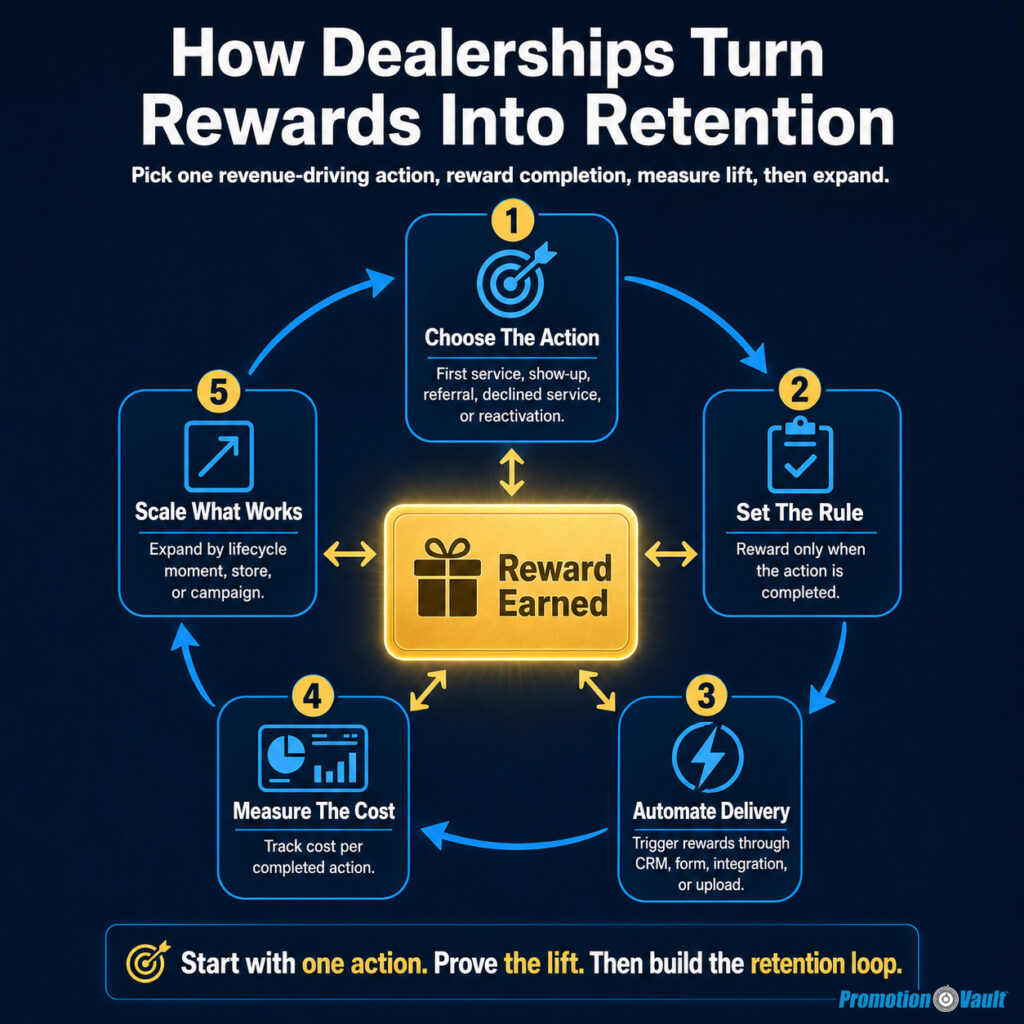
A simple first-service launch can look like this:
Step 1: Define the completed action. The customer must complete the first service visit after purchase. Booking alone does not qualify.
Step 2: Set the reward. Start with a modest value, such as $15 to $25, depending on customer value and local rules.
Step 3: Trigger the reward. Trigger from service completion data, CRM update, webhook, Zapier workflow, API, or weekly upload.
Step 4: Send a branded reward. Make the sender name, logo, and message match the dealership or group.
Step 5: Ask one question. Ask, “What would make servicing with us easier next time?”
Step 6: Track the next visit. Measure first-service completion, activation rate, second-service return, RO value, and cost per retained service customer.
That is enough to start. Do not wait for the perfect lifecycle map. Ship the cleanest behavior first, then expand.
FAQ: Dealership Rewards, Service Retention, And Referral Programs
What Dealership Actions Should We Reward?
Dealerships should reward completed actions that create future value. The strongest starting points are appointment show-up, test drive completion, first service completion, declined-service return, qualified referral conversion, and trade-in valuation. Avoid rewarding passive intent unless it creates a clear next step.
Should Dealerships Reward Service Appointments?
Yes, especially first service completion after purchase. The first service visit keeps the customer connected to the dealership’s service lane, advisor relationship, maintenance cadence, and future purchase pipeline. Reward completion, not just booking, so the program pays for real customer follow-through.
Are Dealership Rewards Better Than Coupons?
Dealership rewards can be better than coupons when the goal is behavior change and retention. Coupons reduce price. Rewards recognize completed action. That helps preserve the perceived value of the dealership relationship while still giving customers a clear reason to follow through.
How Do Dealership Referral Rewards Work?
The strongest dealership referral rewards usually pay in stages. A small reward can recognize a qualified referral submission. A larger reward can trigger when the referral completes a showroom visit, test drive, service action, or purchase. This reduces waste and rewards the journey, not just the final sale.
How Should Dealerships Measure Reward ROI?
Dealerships should measure reward ROI by cost per completed action and downstream value. Track show-up rate, first service completion, declined-service return, referral conversion, RO value, repeat service, trade-in valuation requests, reward activation rate, and future purchase behavior.
How Can A Dealership Automate Customer Rewards?
A dealership can automate customer rewards by connecting reward triggers to CRM stages, appointment data, service data, referral forms, webhooks, Zapier workflows, APIs, or manual uploads. The cleanest setup rewards only verified actions, prevents duplicates, and tracks activation and downstream outcomes.
So, How Can Auto Dealerships Improve Retention And Drive Revenue?
Automotive dealerships can improve customer retention and drive revenue by rewarding the completed behaviors that keep customers in the dealership ecosystem. The highest-value reward moments are showroom show-up, test drive completion, first service completion, declined-service return, referral conversion, and trade-in valuation. Rewards work best when they are clear, immediate, branded, compliant, and measured by cost per completed action.
The point is not to hand out money. The point is to build a system where customers feel recognized for follow-through, and the dealership can prove which behaviors create future revenue.
Promotion Vault helps dealerships run that system with branded reward experiences, pay-on-activation economics, automated reminders, segmentation, referral support, and Data Vault feedback questions. That gives sales, fixed ops, marketing, and finance one shared scoreboard.
If we want more show-ups, reward show-ups. If we want more first service visits, reward completed first service. If we want more referrals, reward the referral journey in stages. If we want more trade-in conversations, reward valuation requests during service.
Then measure the next action.
If we need one low-friction place to start, launch a first-service completion reward this month. If that improves completion and second-service return, add declined-service recapture next. If both work, expand into referrals and trade-in valuations.