A good Likert scale question measures one attitude at a time, uses clear balanced wording, and lands at a moment when people want to answer — like right after they claim a reward. Keep each survey to two to four questions.
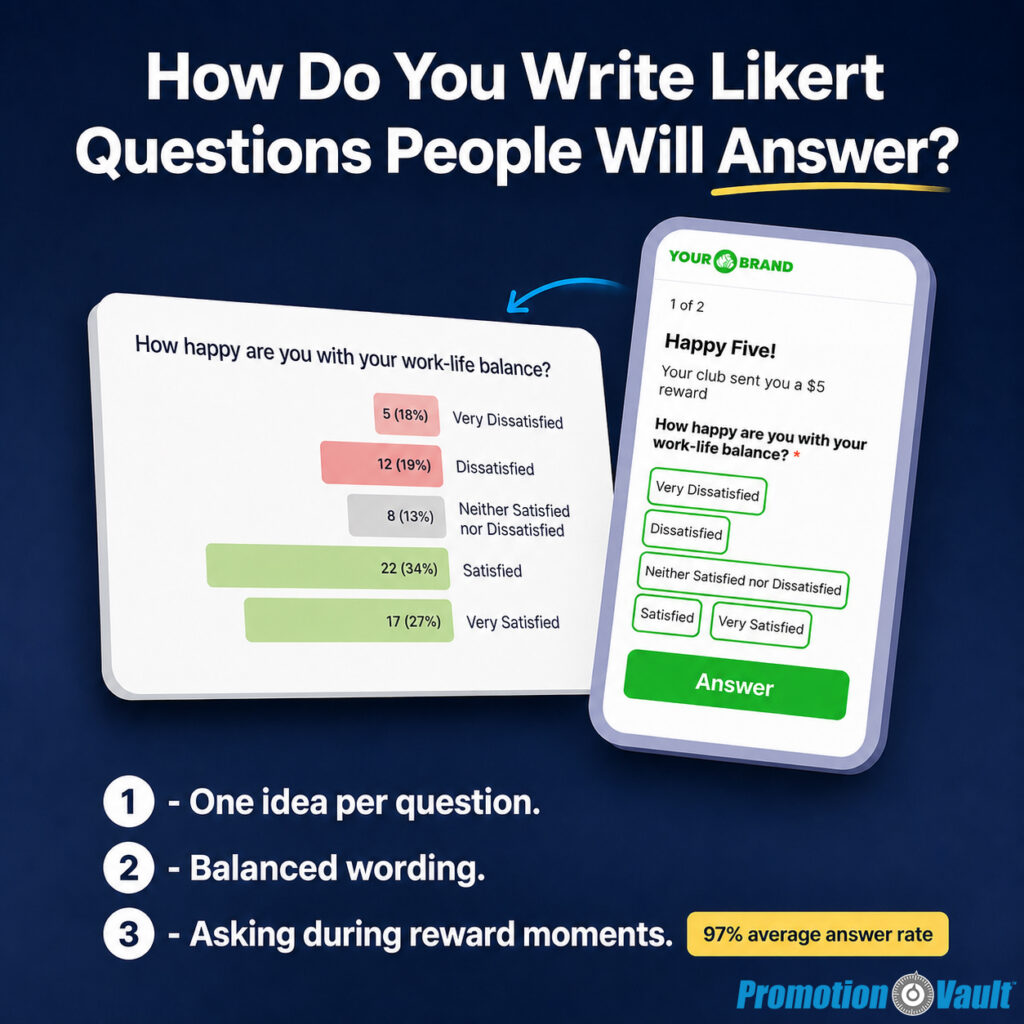
TLDR — How To Write Likert Questions People Will Answer
- Measure one clear attitude with each Likert question.
- Choose the response category before writing the question.
- Use plain language and remove jargon, ambiguity, and double negatives.
- Balance positive and reverse-worded items to reduce agreement bias.
- Keep reward-moment surveys to only two to four questions.
- Ask during reward activation, when attention and goodwill are highest.
- Match each question to the recipient’s current journey stage.
- Reward participation—not positive answers, ratings, or public reviews.
- Segment responses by location, tenure, campaign, and question.
- Book a demo to turn reward moments into actionable feedback loops.
- What Makes a Likert Scale Question “Good”?
- Why Does the Reward Moment Change How You Write Survey Questions?
- How Do You Write Likert Questions People Answer Honestly?
- When Should You Ask Likert Questions in the Reward Journey?
- How Do You Turn Likert Answers Into Action?
- Doesn’t Rewarding People Bias Their Survey Answers?
- Frequently Asked Questions About Likert Scale Questions
- Write Likert Questions That Get Answered By Leveraging Reward Moments
Send a five-question survey to a member’s inbox and, on a strong day, one in five people open it — far fewer finish. Ask that same member one question the moment they claim a $25 reward, and our data shows 97% answer. Same person, same question, wildly different result. The difference is where you were standing when you asked.
That gap is the whole point of this guide. Most advice on Likert scale questions treats response rate as the enemy you fight with clever wording and reminder emails. When you tie your questions to a reward people already wanted, that fight is mostly over before it starts. Ask your Likert questions at the reward moment, and response rate stops being the problem — the quality and timing of your questions becomes your entire advantage.
We’re writing this for the operator or member-experience lead who runs retention at a multi-location gym, studio, or membership business — the person who needs feedback that predicts churn, not a data project that eats a week. The same rules carry over cleanly to HR and People Ops teams measuring employee sentiment, and we’ll flag those crossovers as we go. Everything below is built to be copied into your next campaign.
What Makes a Likert Scale Question “Good”?
A good Likert scale question measures one attitude on a clear scale — usually five points from “strongly disagree” to “strongly agree” — using plain wording anyone can answer in a glance. It names a single, specific idea, avoids leading language, and produces a real spread of answers instead of everyone picking “agree.”
The scale itself is old and well understood. Social psychologist Rensis Likert introduced it in 1932, and it’s been the default way to turn opinions into numbers ever since. A statement like “The onboarding process was easy to follow” gives people graded options between two extremes, so you capture how strongly someone feels — not just yes or no.
Here’s what separates a question that earns useful data from one that wastes time: it can be answered honestly, quickly, and consistently. If a respondent has to reread it, guess what you mean, or answer two things at once, your numbers are already compromised.
At Promotion Vault, we give teams a set of ready Likert categories so every question maps to something measurable rather than a vague “how’s it going.”
| Likert category | What it measures | Example item |
|---|---|---|
| Satisfaction | How happy someone is with an experience | “How satisfied are you with your onboarding?” |
| Agreement | Whether a statement matches their view | “The classes fit my schedule.” |
| Frequency | How often a behavior happens | “How often do you attend each week?” |
| Likeliness | Odds of a future action | “How likely are you to renew?” |
| Importance | What a person values most | “How important is class variety to you?” |
| Quality | Perceived standard of something | “How would you rate the equipment?” |
| Awareness | Whether they know an offering exists | “I know what my membership includes.” |
| Familiarity | How well they understand something | “How familiar are you with our app?” |
| Concern | Worry or hesitation about something | “I worry about finding a spot in class.” |
Pick the category first, then write the item. That one habit kills half the vague questions before they reach a survey.
Why Does the Reward Moment Change How You Write Survey Questions?
The reward moment changes everything because attention is scarce and, right then, it’s yours. Someone who just earned a reward is engaged, warm toward your brand, and holding their phone. Industry benchmarks put typical email survey response rates around 20% to 30% in 2025, and lower on many channels. Our reward-triggered questions average a 97% response rate.
That number is worth sitting with. Promotion Vault’s platform has sent more than 2 million rewards for over 5,000 companies, and across those reward-triggered mini-surveys, 97% of people answer — because the question rides a moment of genuine goodwill instead of interrupting a busy inbox. In our Hyundai service work, the same mechanic pairs short questions with instant rewards to surface who’s ready to book recommended maintenance.
The practical takeaway shapes how you write. You have a few seconds of real attention, not a research panel with time to spare. So every question needs to reward that attention, not drain it. Survey-length research shows completion drops sharply once a survey passes roughly twelve questions or five minutes — one analysis measured a 17% drop.
When the reward is the goodwill you’re spending, a bloated survey spends it fast. Write fewer questions, make each one land, and treat the reward moment as the most valuable real estate you have. This is the same logic behind rewarding the completed behaviors that predict retention in a member’s first 30 days — attention and action are highest right after a meaningful moment.
How Do You Write Likert Questions People Answer Honestly?
You write honest-answer Likert questions by making each one easy to read, impossible to misread, and free of pressure to agree. Ask about one idea, mix statements with questions, balance positive and negative wording, and cut anything that needs a second read. These moves protect your data from bias far more than a longer scale ever will.
Here are the rules that matter most, each written so you can apply it on its own:
- Ask about one thing at a time. A double-barreled question forces two answers into one box. Replace “How satisfied are you with your job and work-life balance?” with “How satisfied are you with your work-life balance?” Now the score means something you can act on.
- Mix questions and statements. A run of identical “how satisfied” prompts lulls people into autopilot. Alternate a statement — “The app makes booking easy” — with a question — “How likely are you to recommend us?” The change of shape keeps attention alive.
- Balance positive and negative wording. If every item is flattering, people agree to feel agreeable, and you get a wall of fives. Pair “The rewards program keeps me engaged” with a reverse-worded item like “The rewards program doesn’t add much to my experience.” Agreement that survives both directions is agreement you can trust.
- Cut double negatives. “I don’t disagree with the new policy” makes people stop and decode. Write “I agree with the new policy” and let the answer flow.
- Choose plain over clever. Swap jargon for the words your members use. “How often do you engage with ancillary benefits?” becomes “How often do you use the extra perks in your membership?” Clear beats impressive every time.
- Keep it to two to four questions. The reward buys you a short window of attention. Spend it on the two to four items that will actually change a decision, and stop there.
For HR and People Ops teams, the same rules apply to employee sentiment — a reverse-worded item like “I don’t feel recognized for my work” belongs right next to “I feel recognized for my contributions.” Balanced wording is how you separate real morale from polite agreement, whether you’re measuring members or staff.
When Should You Ask Likert Questions in the Reward Journey?
Ask Likert questions at the reward moments you already run, placed right at activation or unlock when engagement peaks. Three moments do most of the work: a welcome reward to measure onboarding, a recurring “monthly high five” to track ongoing sentiment, and a holiday or milestone reward to gauge loyalty heading into a new season. Match one category to each moment.
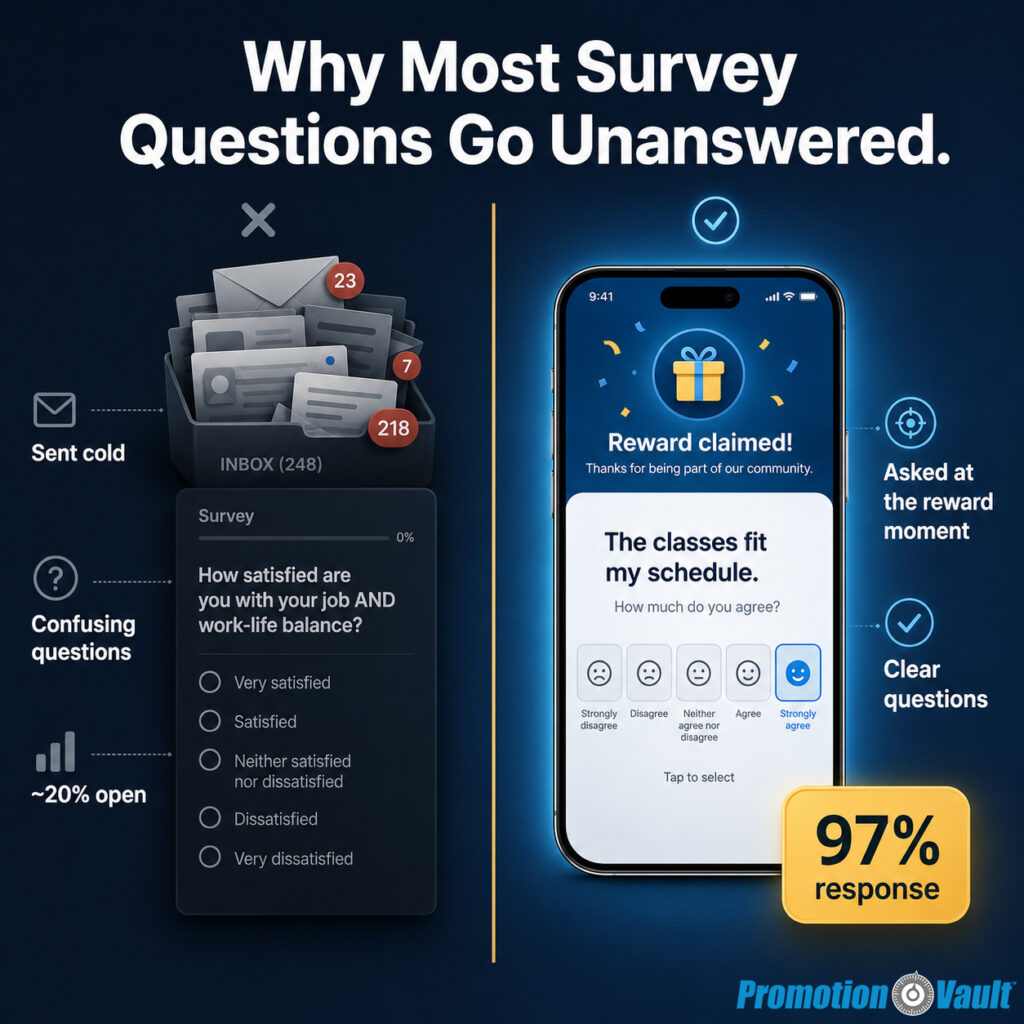
The reason this works is placement. In our platform, questions appear at the activation or unlock step — the exact second someone is paying attention — and they only show to recipients whose tags match, so nobody sees a question meant for a different segment. Below is a simple cadence you can copy, using the categories from earlier.
| Reward moment | What to measure | Example item (category) |
|---|---|---|
| Welcome reward | Onboarding clarity and early confidence | “The signup process explained my benefits clearly.” (Agreement) |
| Monthly high five | Ongoing satisfaction and engagement | “How satisfied are you with your experience this month?” (Satisfaction) |
| Holiday / milestone reward | Loyalty and intent for the year ahead | “How likely are you to continue your membership next year?” (Likeliness) |
Keep each moment to a single category and a couple of items. A welcome reward is not the place to ask about renewal — the member has no basis to answer yet. A holiday reward is a poor time to ask about onboarding they finished months ago. The right question at the wrong moment still gives you noise. On the employee side, the same cadence maps to first day, work anniversaries, and program milestones — the moments behind automated milestone recognition that runs without anyone remembering the date.
How Do You Turn Likert Answers Into Action?
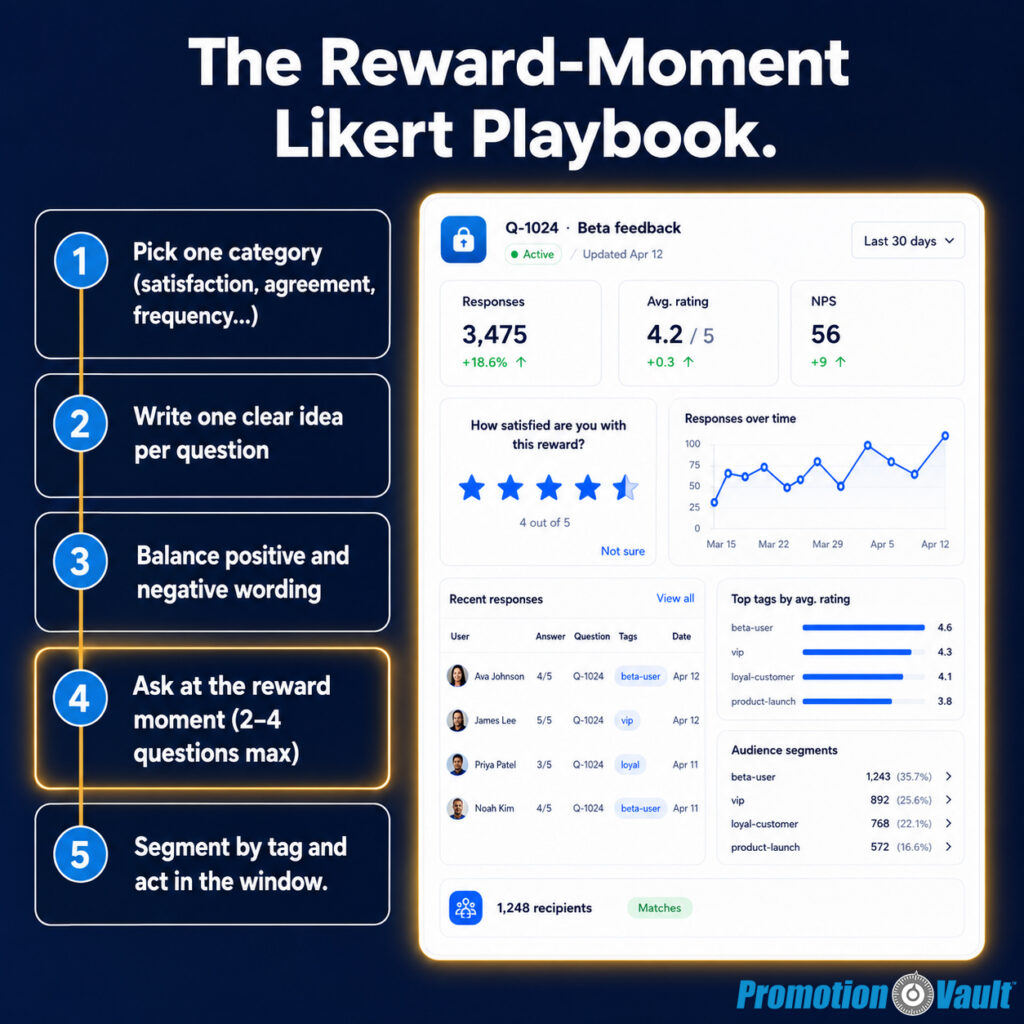
You turn Likert answers into action by segmenting them the moment they arrive and routing the signal to someone who can respond. Tag responses by location, tenure, or campaign, read the question-level pattern rather than one blended average, and act inside the same window while the experience is fresh. A score you never act on is a cost, not an insight.
This is where reward-linked feedback earns its keep. Our platform attaches tags to every response and runs AI-supported summaries, so a member-experience lead sees which question is dragging at which location — not a single satisfaction number with no home. That question-level view is the difference between “satisfaction slipped” and “the 6 a.m. crowd at two clubs can’t get a spot in class.” One is a shrug; the other is a schedule change. This is the heart of how AI can improve reward programs — better questions, cleaner segments, and a clear read on what to fix next.
The habit that separates teams who improve from teams who collect dashboards is the follow-up. When a concern item spikes, route that member to a real fix — a callback, a schedule change — before the feeling hardens into a cancellation. Our own reward intelligence tools are built for exactly this loop: ask at the reward moment, read the signal by segment, and close the gap while it still matters.
Doesn’t Rewarding People Bias Their Survey Answers?
It’s a fair worry, and the answer depends entirely on what you reward. Bias creeps in when the reward is tied to the content of an answer — paying for a five-star rating, for example. It doesn’t creep in when the reward rides a moment that was already happening and the answer changes nothing about what someone receives.
That distinction is the whole design. The reward is for a completed behavior — a class attended, a milestone reached, a signup finished — not for saying something nice. The question simply travels along with a reward the person already earned. Because payment isn’t conditioned on the response, people have no incentive to inflate it. Balanced wording does the rest: when you pair positive and reverse-worded items, someone answering on autopilot contradicts themselves, and you can see it in the data.
One firm line keeps this clean, especially for public reviews. Reward feedback participation, never the sentiment of the feedback — don’t offer anything for a positive answer, a specific rating, or a public review. That’s both an accuracy safeguard and a compliance one; the U.S. Federal Trade Commission and platforms like Google restrict incentives tied to reviews. Ask honestly, reward the moment, and your data stays worth trusting.
Frequently Asked Questions About Likert Scale Questions
How many points should a Likert scale have — 5 or 7?
Five points is the standard for most feedback: it’s fast, familiar, and easy to report, with a neutral middle for people who truly have no strong view. Use a seven-point scale only when you need finer gradations and your audience can tell “slightly” from “somewhat.” For reward-moment surveys answered on a phone, five points wins.
Should I include a neutral middle option?
Include it when genuine neutrality is a real answer, which is most of the time. A five- or seven-point scale gives unsure respondents an honest place to land instead of forcing a verdict they don’t hold. Use an even-numbered scale — four or six points — only when you deliberately want to push people to lean one way.
What’s the difference between a Likert scale and a Likert-type question?
A Likert-type question is a single item using the agree-to-disagree format. A true Likert scale combines several related items that measure the same underlying attitude, then reads them together. For quick reward-moment feedback, you’re usually writing Likert-type questions — and that’s fine, as long as each one is clear and single-topic.
How many Likert questions should one survey have?
Two to four. Response rates fall sharply as surveys get longer, and at the reward moment you’re spending real goodwill with every extra question. Ask only the items that will change a decision, then stop. A short survey people finish beats a thorough one they abandon.
Can I reward people for completing a survey without biasing results?
Yes, as long as the reward is for participating, not for the content of the answer. Never tie a reward to a positive response, a rating, or a public review. Pair positive and reverse-worded items so autopilot answers reveal themselves, and your data holds up.
What counts as a good survey response rate?
For cold email surveys in 2025, industry benchmarks land around 20% to 30%, and lower on many channels. Feedback tied to a reward moment performs far above that band — Promotion Vault’s reward-triggered questions average a 97% response rate, because the question meets people when their attention is already yours.
Write Likert Questions That Get Answered By Leveraging Reward Moments
Good Likert scale questions measure one attitude at a time, use clear and balanced wording, and avoid double negatives and double-barreled phrasing. Keep each survey to two to four questions, match every question to a specific category like satisfaction or likeliness, and — most of all — ask at the reward moment, when attention and goodwill peak. Reward participation, never sentiment. Do that, and response rate stops being your problem so question quality can become your advantage.
If your feedback is landing in cold inboxes and getting ignored, put your next two-to-four questions where people are already paying attention: the moment they claim a reward. Book a demo and we’ll map your reward moments to the questions worth asking — and show you how to act on the answers before they turn into cancellations.
Casey Rock is Content Director at Promotion Vault, where he builds the content, SEO, and messaging systems behind the company’s rewards engagement platform. He specializes in turning product value into proof-first stories that drive discovery, trust, and conversions.