The best customer retention software for gyms does more than flag members who are slipping. It gives staff a reason to follow up, checks the visit or renewal that follows against club records, and rewards members for real progress. Built on top of your club management system, it shows which floor conversations kept revenue.
TLDR — How to Choose Customer Retention Software for Gyms
- Choose tools that turn alerts into staff follow-up.
- Keep your club management system as the record.
- Make staff conversations a tracked retention step.
- Verify each visit, renewal, or referral first.
- Reward progress members make, not cancel threats.
- Give staff credit when their members come back.
- Show members their progress in one branded place.
- Pay reward value only when a member claims it.
- Judge results by cohorts at 30, 60, and 90 days.
- Explore PLAYBOOK to map your retention journey.
- What Is Customer Retention Software?
- Why Do Gym Retention Tools Fall Short on Their Own?
- What Does Customer Retention Management Software Do?
- What Is a Customer Retention Platform?
- What Should Gym Retention Software Do?
- What Should Member Retention Software Do for Studios, Franchises, and Multi-Location Brands?
- How Does PLAYBOOK Work as Customer Retention Software for Gyms?
- How Should Operators Compare Customer Retention Software Before Buying?
- What Do Operators Ask About Customer Retention Software?
- So, What Is the Best Customer Retention Software for Gyms?

Who Says Hello When the Dashboard Flags a Member?
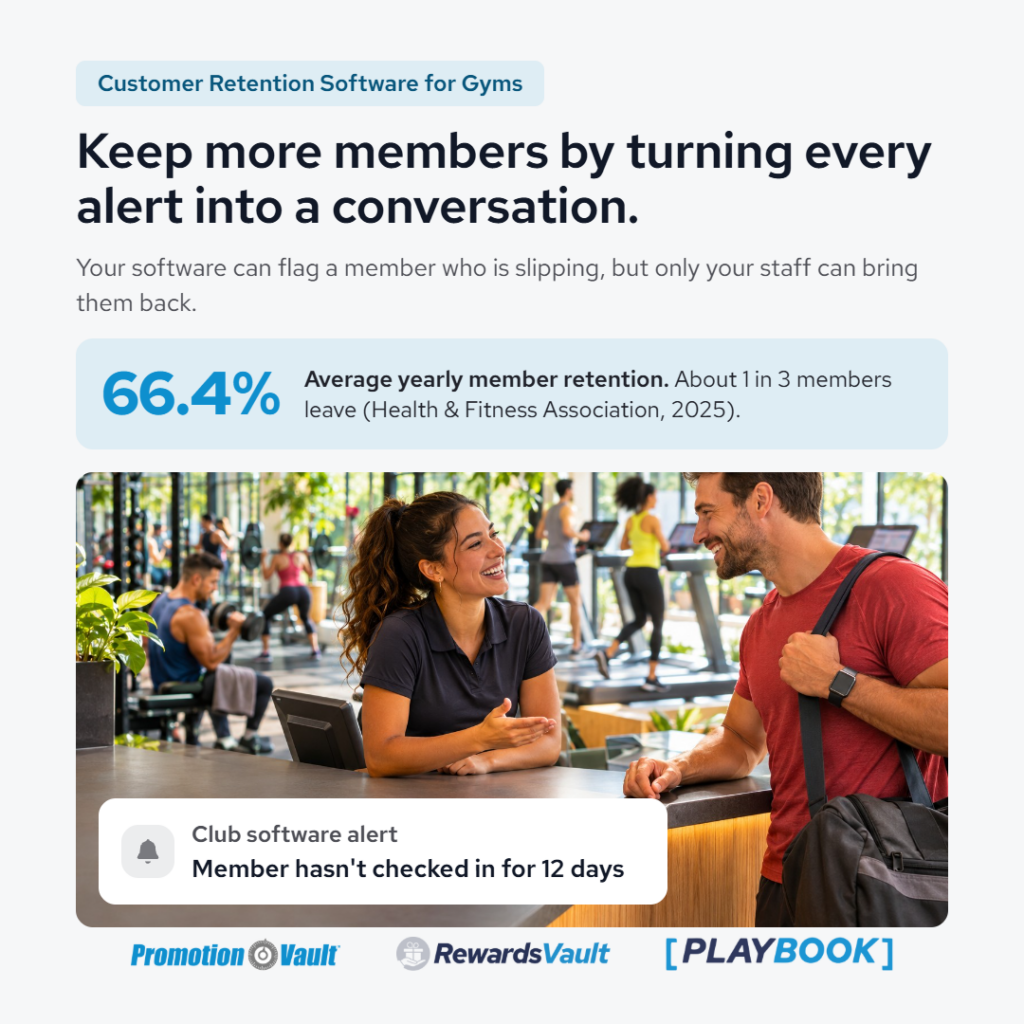
Most gyms already pay for some kind of retention software. The club management system logs every check-in, flags failed payments, and sends a text when a member goes quiet. Members still leave. The Health & Fitness Association (HFA) studied 175 companies and more than 17,000 facilities for its 2025 Fitness Industry Benchmarking Report. On average, operators kept 66.4% of their members for the year. Roughly one in three members left.
A report can tell a manager that a member has not checked in for 12 days. It cannot say her name at the front desk or book her next class. Years of gym research point to that conversation as the moment that keeps people coming back, yet most software stops one step short of it.
In this guide, we define customer retention software, customer retention management software, and customer retention platforms. Then we lay out what gym retention software and member retention software should do in a club, a studio, or a franchise network.
Key Terms for Customer Retention Software
- Customer retention
- The share of customers who keep buying over a set period. For a gym, it means members who are still paying (and ideally still visiting) after 30, 90, or 365 days.
- Churn
- The opposite of retention: members who cancel or stop paying in a set period. Involuntary churn comes from failed payments, not a choice to leave.
- Customer retention software
- Any tool that helps a business keep existing customers, such as a CRM, a messaging tool, a survey tool, a loyalty program, or a churn report.
- Customer retention management software
- Software that runs the full retention routine. It spots a signal, assigns someone to act, confirms the action happened, and reports the result.
- Customer retention platform
- One connected system for retention work across the whole customer journey, with a shared member record, one place for earned rewards, and one set of reports.
- Gym retention software
- Retention software built around gym records, such as check-ins, class bookings, agreements, and dues payments.
- Member retention software
- Retention software for any business that sells memberships, including boutique studios, franchise groups, and multi-location fitness brands.
- Verified action
- A visit, renewal, referral, or purchase confirmed by a business record and matched to an opted-in person who confirmed their phone number.
- Loop
- A repeatable cycle inside PLAYBOOK. A person does something valuable, PLAYBOOK verifies it, recognizes the person, and shows the next step.
- Rewards Vault
- Promotion Vault’s branded page where members see, choose, and redeem earned reward value. Its Momentum view shows completed steps and what comes next.
What Is Customer Retention Software?
Customer retention software is any tool a business uses to keep existing customers buying. Across industries, that includes CRMs, marketing automation, feedback surveys, loyalty programs, and churn reports. In fitness, most of these features live inside club management software, which records attendance and billing but still relies on staff to act.
Search for the term and you will find lists that mix help desks, email builders, and product analytics. That range makes sense for software companies. A gym owner has a narrower goal: members who keep paying and keep showing up. The table below sorts the main tool types by what they do in a club and where each one tends to stop.
Types of Customer Retention Software in a Gym
| Tool Type | What It Does in a Gym | Where It Stops |
| Club management system | Records check-ins, bookings, agreements, and dues. Flags failed payments. | Shows who drifted, not whether anyone followed up. |
| CRM and marketing automation | Sends welcome series, class reminders, and win-back texts. | Cannot confirm the member actually came back. |
| Churn scoring and analytics | Ranks members by risk using visit and payment patterns. | A risk score still needs a person to act on it. |
| Feedback and review tools | Collects ratings and comments after visits. | Feedback helps only when someone closes the loop. |
| Loyalty and points programs | Awards points for visits or spending. | Points may not tie to the next step the club needs. |
| Staff recognition tools | Lets managers thank and reward employees. | Staff credit often sits apart from member results. |
Each tool solves a real problem. The gap sits between them. A churn score lives on one screen and the follow-up text on another. The coach who actually talked to the member shows up in neither one. That gap is where retention programs lose people.
Why Do Gym Retention Tools Fall Short on Their Own?
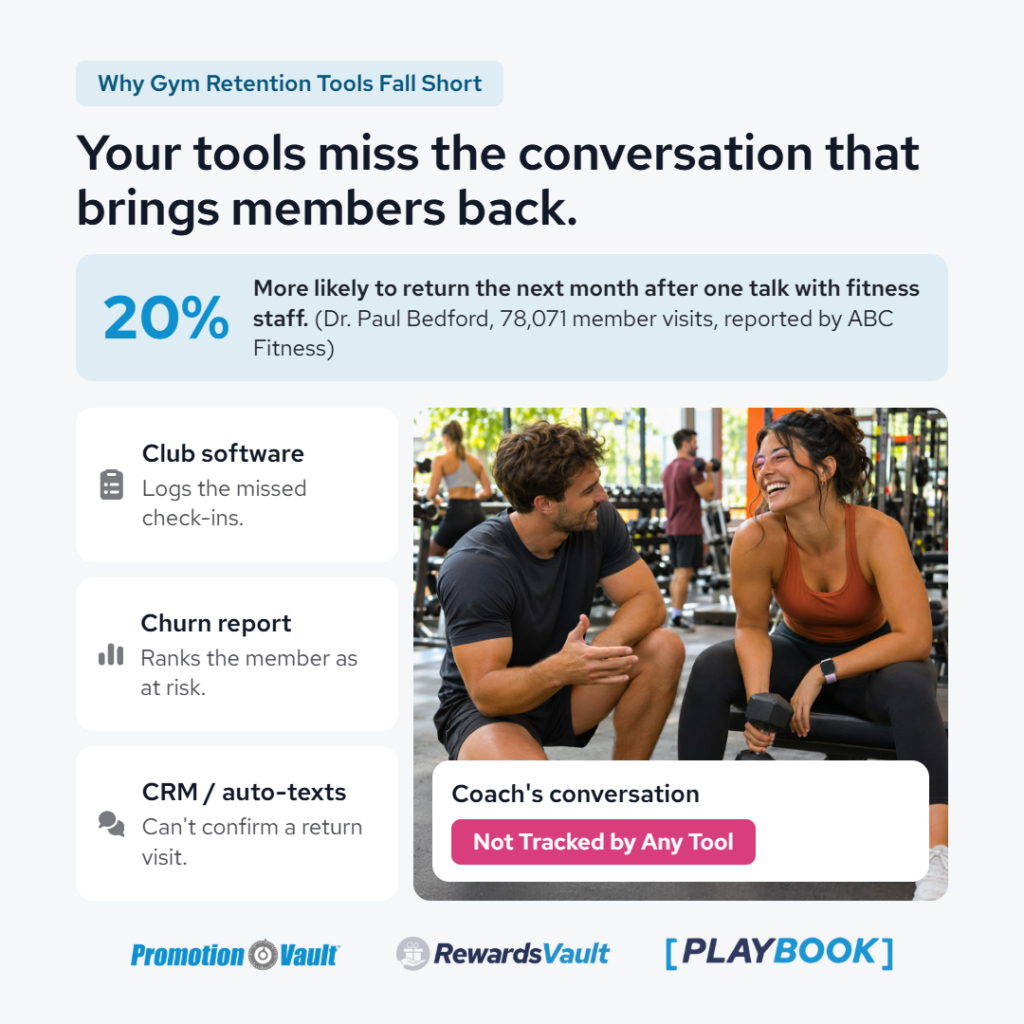
Retention tools fall short when they stop at the alert. Software can spot a member who skipped two weeks, but gym research keeps showing that staff conversations bring members back. Without a way to prompt that follow-up, confirm the return visit, and credit the person who made it happen, alerts pile up unread.
Why Staff Conversations Move the Numbers
Dr. Paul Bedford, a UK researcher known in the industry as the Retention Guru, has measured this effect for years. In one dataset of 78,071 member visits, a single conversation with fitness staff made a member 20% more likely to return the next month, ABC Fitness reported. Four or more conversations made a return 80% more likely. Bedford has also stressed that those talks need to happen on separate visits, Sports Management magazine reported.
Club leaders who run on data say the same thing. In a 2018 feature for the HFA’s Club Business International, Todd Thorson, then chief technology officer of Chicago’s Midtown Athletic Club, was blunt: “Technology, in and of itself, doesn’t affect retention.” His colleague Dustin Davis added that the gains depend on how well the club team uses the tools, the HFA reported.
Newer platform data fits that pattern. ABC Fitness drew on 30,000 fitness businesses and 40 million members for its Mid-Year 2026 Wellness Watch report. Gym cancellations rose 8% year over year in the first half of 2026. Over the same stretch, studio check-ins jumped 27% and studio cancellations fell 6%, ABC Fitness found. The report does not isolate a cause. Still, studios run small classes where instructors learn names, and we read the split as consistent with what Bedford measured.
A dashboard can tell you who is drifting. Bringing them back takes a coach who knows their name.
Why Discounts Make a Weak Backstop
When follow-up fails, some clubs fall back on a discount at the cancel desk. Research suggests that habit carries a long-term cost. Carl Mela, Sunil Gupta, and Donald Lehmann studied more than eight years of household purchase data for a packaged-goods category, published in the Journal of Marketing Research in 1997. Consumers grew more sensitive to price and promotions as promotions increased. That is one reason we favor rewards tied to completed actions over blanket discounts. Our article on what gyms should reward in the first 30 days shows how to build that habit long before a cancel request.
What Does Customer Retention Management Software Do?
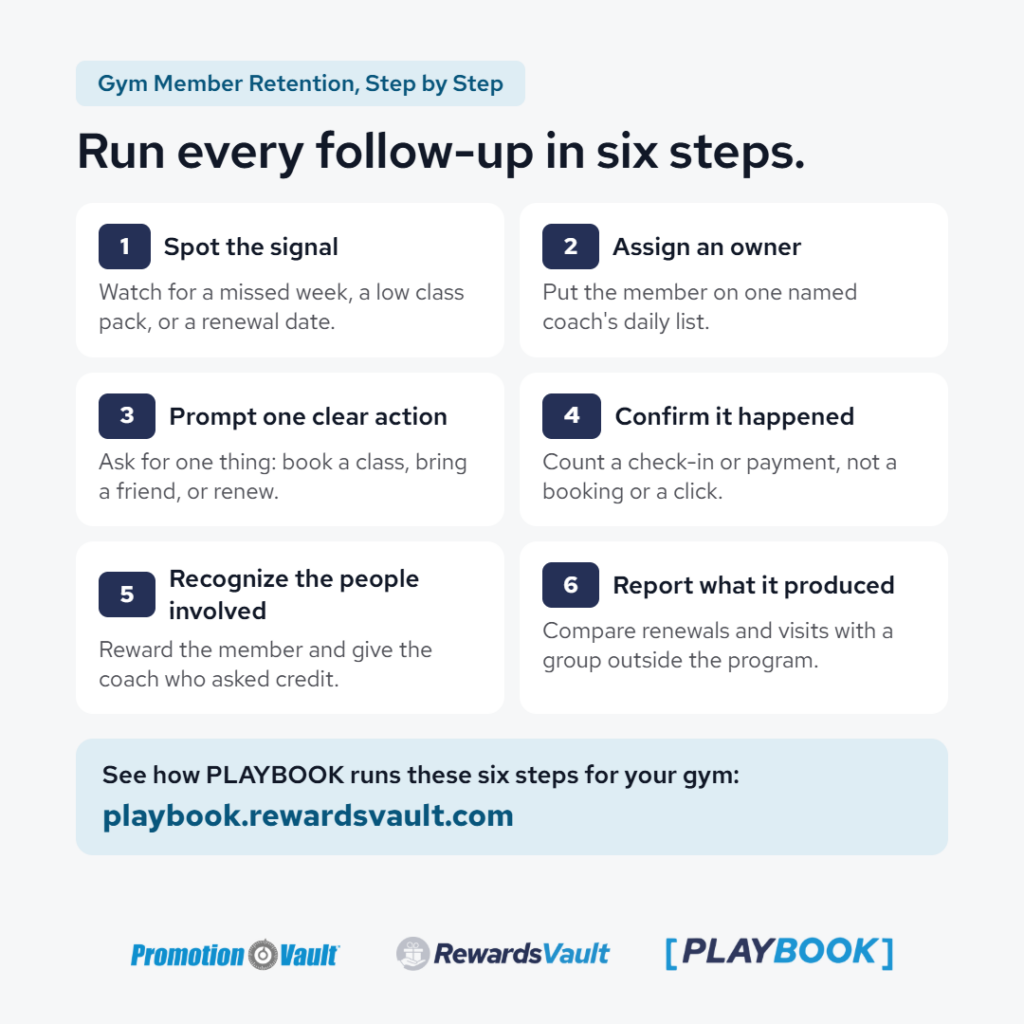
Customer retention management software runs the full retention routine, from signal to result. It spots a warning sign or an opening, assigns a person to act, prompts one clear step, confirms the step happened, recognizes everyone involved, and reports what it produced. Most of its value comes from connecting those steps.
Our CEO, Brian Mitchell, made this case in Athletech News. Gyms are rarely short on data. What they lack is the loop that turns one recorded action into the next, still tied to the same person. In practice, a working retention routine has six steps:
- Spot the signal. A member misses a week, a class pack runs low, a renewal date nears, or a member finishes a milestone.
- Assign an owner. A named coach or front-desk lead gets the member on a short daily list. “The team” is not an owner.
- Prompt one clear action. Book the next class, try a new format, bring a friend, or renew. One ask per touch makes yes easy.
- Confirm it happened. A check-in, payment, or agreement record proves the action. Bookings and link clicks do not count.
- Recognize the people involved. The member earns something they want. The staff member who made the ask gets credit.
- Report what it produced. Track repeat visits, renewals, and retained dues for members in the program against a similar group outside it.
Most gym tech stacks handle steps one and three well, since alerts and automated texts cost little to send. Steps four and five are where programs stall. Confirming a return visit and crediting the right coach means matching records across systems, and many tools skip it. Teams often drop step six entirely. Our guide to measuring retention rewards ROI walks through cohorts and holdout groups in detail.
What Is a Customer Retention Platform?
A customer retention platform connects retention work across the whole member journey in one system. Instead of separate tools for referrals, reviews, staff incentives, and rewards, it shares one member record, one place for earned rewards, and one set of reports. That matters because each retention moment tends to set up the next one.
Point tools each see one moment. A referral app knows a friend signed up. The review tool knows a survey came back. Meanwhile, the staff bonus spreadsheet knows who hit quota last month. None of them sees that the same member referred a friend, trained with that friend twice, and then renewed.
Those links carry real value. Philipp Schmitt, Bernd Skiera, and Christophe Van den Bulte followed referred and non-referred customers at one bank for a 2011 study in the Journal of Marketing. Referred customers had a higher retention rate, and their average value was at least 16% higher. A 2018 follow-up in the Journal of Marketing Research found that the retention edge narrowed or vanished once the referring customer left. The practical lesson for gyms: keeping the referrer engaged may help keep the friend, too.
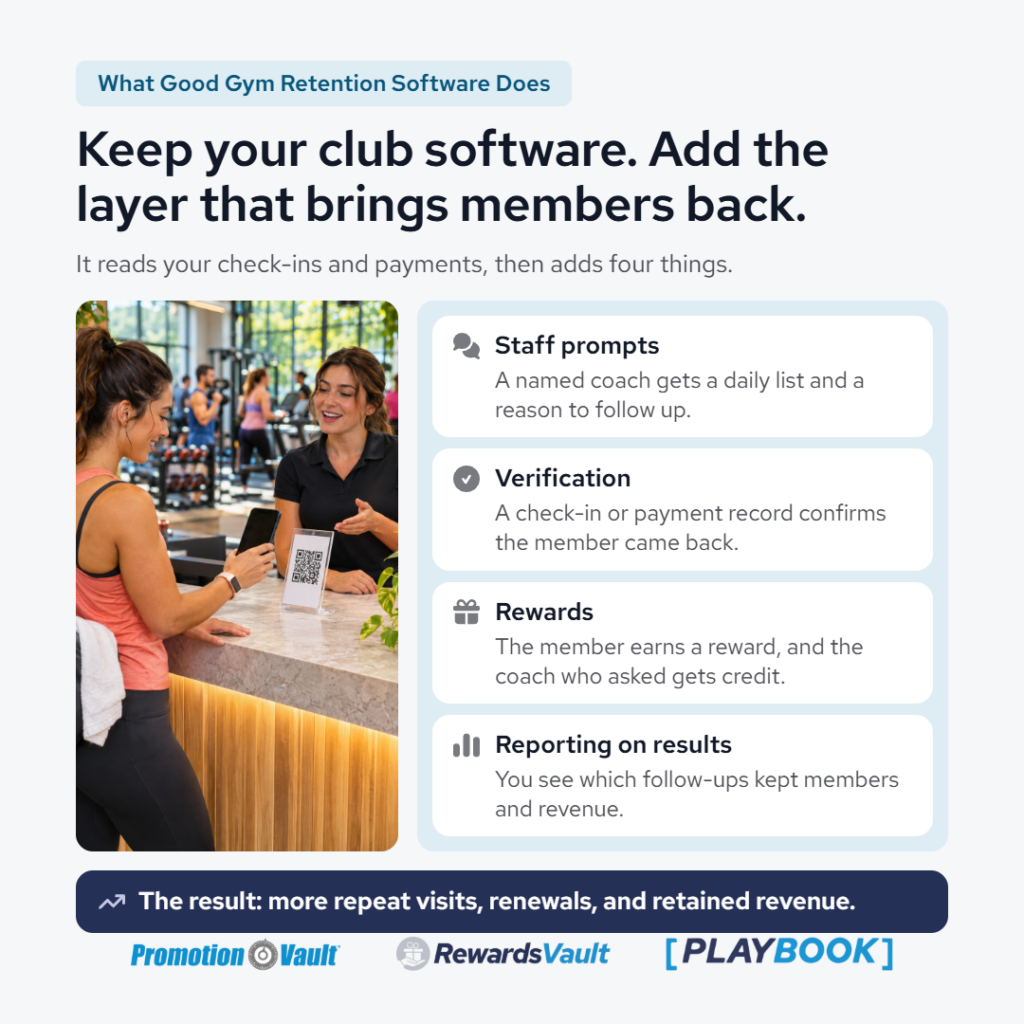
A platform also needs a clear relationship with the systems a club already runs. We do not think a retention platform should force anyone to rip out club management software. The better model reads the records those systems keep and adds what they lack: staff prompts, verification, rewards, and reporting on results.
What Should Gym Retention Software Do?
Gym retention software should turn check-in data into staff conversations and confirm repeat visits with real club records. It should reward attendance goals members can see and credit the coach who made the difference. Renewals, referrals, feedback and reviews, and win-backs belong in the same program, with no forced switch away from your club management system.
What to Require on the Gym Floor
- A short daily list for each staff member. Show who missed their usual week, who sits three visits from a goal, and who renews soon. Five names a coach can reach today beat 200 names on a report.
- A reason for staff to act. Credit, a leaderboard spot, or a reward when the member they invited comes back gives staff a reason to follow up tomorrow. Gallup and Workhuman tracked nearly 3,500 employees from 2022 to 2024 and found that well-recognized workers were 45% less likely to have left after two years. Replacing a frontline worker costs about 40% of salary, Gallup estimates.
- Simple member actions with quick payoffs. A QR code at the front desk, a phone check, and a reward that shows up soon after the visit counts. Research by Kaitlin Woolley and Ayelet Fishbach found that immediate rewards predict whether people stick with long-term goals better than delayed rewards do, Cornell’s business school reported.
- Goals built on repeat visits. Streaks, weekly targets, and tiers reward the second, fourth, and tenth visit. Bedford’s research found that members who visit four or more times a month stay an average of seven months longer, ABC Fitness reported.
What to Require Behind the Scenes
- Verification before value goes out. The person confirms their phone and opts in. The action matches a check-in, payment, or agreement record. Anything less pays for intentions.
- Coverage beyond the save. Renewals, referrals, upgrades, feedback and reviews, and win-backs should run in one program. Review requests need care: rewards can recognize feedback, but never a rating. Our guide to whether you can incentivize reviews covers the rules.
- Reporting by cohort. Group members by join month or program start date. Then compare them with a holdout group at 30, 60, and 90 days.
- Pricing tied to results. Ask what you pay when nothing happens. Setup fees and monthly seats bill you for the tool, whether or not members come back.
What Should Member Retention Software Do for Studios, Franchises, and Multi-Location Brands?
Member retention software should match how each business earns recurring revenue. Boutique studios need close tracking of class attendance, package renewals, and intro-to-member conversion. Franchise groups and multi-location brands need one program with shared rules, local staff credit, and reports that roll up, so leaders can compare sites and copy what works.
The money behind each membership differs by format. In the same mid-year report, ABC Fitness found that enterprise gym members spent an average of $17 a month, small and boutique gym members $27, and studio members $69. A $10 reward means something different at each price point, so operators need to set reward values by location and membership type.
Boutique Studios
Studios live on class attendance and package renewals. The key retention moments are the second class, the switch from an intro pack to a membership, and the renewal of a class package before it runs out. We cover the intro window in How Do Fitness Studios Convert Intro Offers Into Memberships? In one Promotion Vault program with a Pilates franchise, a three-stage plan paid $10 for attendance, $30 for joining, and $30 for upgrading. The program reported 36% more intro-class attendance, 43% more new-member conversions, and 23% more upgrades.
Franchise Groups and Multi-Location Brands
Franchise and multi-site operators face a different challenge: consistency. The brand wants one program and clean data. Each location wants control over its own staff and offers. Good member retention software lets the brand set the Playbook (the journey map and its rules) while each site runs it with its own team. Staff credit stays local, and reports roll up, so a regional manager can see which club turned referrals into members.
In a referral program with a national boutique fitness franchise, rewards at three stages (referral submitted, friend attended, friend joined) paid $5, $15, and $55. The program reported 78% more referrals and 42% more new members. The same logic works outside fitness. In a program with a national insurance brand, rewards for new business, referrals, annual renewals, and birthdays reported 18% more renewals and 20% more referrals.
How Does PLAYBOOK Work as Customer Retention Software for Gyms?
PLAYBOOK, Promotion Vault’s engagement platform, turns retention moments into Loops. Staff invite a member to act, and PLAYBOOK checks the action against club records. Then it rewards the member and credits the staff. Earned value collects in a branded Rewards Vault, where Momentum shows the next step. Clubs keep the systems they already use.
What a Retention Loop Looks Like
Here is an illustrative example. A member’s visits drop from three a week to one. Her coach catches her after class and invites her to a four-week Streaks and Tiers challenge. She scans a QR code at the front desk, confirms her phone with a six-digit text code, and opts in. PLAYBOOK logs the time and method of that consent.
Each week, check-ins from the club’s own system confirm her visits. When she hits a weekly target, a game reveals her reward, and the value lands in her Rewards Vault. Momentum tracks her progress and shows the next goal. When she finishes week four, her coach gets credit through a Recognition Loop. Her next step might be bringing a friend through a Referral Loop, which starts the cycle for someone new.
The same structure covers other retention moments. Custom Loops handle renewals, win-backs, and repeat visits. Upgrade Loops encourage the next service or membership tier. Review Loops collect private feedback and invite public reviews in compliant ways, and the reward never depends on the rating. Members can choose gift cards from the club’s catalog, and clubs can also offer merch, discounts, passes, and other benefits.
How the Pricing Follows Results
PLAYBOOK has no setup costs or monthly fees. For applicable Rewards Vault rewards, a 10% service fee applies when we send a reward. We charge the reward’s face value only when the member claims it, and unclaimed value stays in the operator’s wallet. Other reward types follow their own terms. We call it pay for results, not rewards.
Why Operators Trust It
Promotion Vault grew up inside fitness, with family roots at Powerhouse Gym going back to the 1980s. Across more than 5,000 customers, our programs have helped drive more than $250 million in increased customer revenue. Our mini-surveys average a 97% response rate. We help configure each program, connect the records, and run it with your team. PLAYBOOK can replace overlapping engagement tools where that makes sense, but it never requires it. Payments run through Stripe, so we never store payment account data, and members can reply STOP to opt out at any time.
“Excellent customer support beyond a normal tech platform.” — Jeff Miller, CMO, YogaSix
How Should Operators Compare Customer Retention Software Before Buying?
Compare retention software by asking what happens after the alert. Find out which records confirm a visit or renewal, what staff see each morning, how they earn credit, and what you pay when members do nothing. Then run a short pilot against a holdout group at one or two locations before you scale.
Bring these questions to every demo:
- Which of our records will confirm a visit, payment, renewal, or referral, and who maps them?
- What does a coach or front-desk lead see at the start of a shift?
- How does a staff member earn credit, and how do you prevent double counting?
- Where do members see their progress and earned rewards?
- What do we pay for rewards that members never claim?
- Do we have to replace our club management software or CRM?
- Who helps us run the program after launch?
For the pilot, start with one retention moment that already costs you money. Good candidates include members who stop visiting in month two or class packs that lapse without a renewal. Run it for a full cycle, then compare those members with a similar group outside the program.
Frequently Asked Questions About Customer Retention Software
Operators most often ask about cost, whether they must replace their club software, what retention rate to target, whether rewards beat discounts, and how fast results show. The short answers: pay for results where you can, keep your systems, benchmark against your own cohorts, reward completed actions, and judge results over a full renewal cycle.
How Much Does Gym Retention Software Cost?
Pricing varies widely. Club management platforms usually charge a monthly subscription, and some sell marketing and retention features as add-ons or higher tiers. PLAYBOOK has no setup costs or monthly fees. For applicable Rewards Vault rewards, you pay a 10% service fee when a reward is sent, plus face value only when a member claims it.
Do We Need to Replace Our Club Management Software to Improve Retention?
No. Your club management system should stay the record of check-ins, agreements, and dues. Retention software should read those records through reports, data feeds, or an API such as the Vault API. Then it can add what the system lacks: staff prompts, verification, rewards, and reporting on results.
What Is a Good Member Retention Rate for a Gym?
The HFA’s 2025 benchmarking report put average annual retention at 66.4% across 175 operators. Treat that as context rather than a goal. Retention varies by format, price, and contract type, so the most useful benchmark is your own recent cohorts, measured the same way each time.
Do Rewards Work Better Than Discounts for Retention?
Rewards tied to completed actions protect your price, while repeated discounts can teach members to wait for a deal. A reward for finishing a four-week streak or renewing on time recognizes behavior you want. By contrast, a discount at the cancel desk rewards the threat to leave. Our rewards versus discounts guide covers the economics.
How Long Before Retention Software Shows Results?
Leading signals, like second visits and completed staff follow-ups, show up within weeks. Retention itself takes longer. Measure each group at 30, 60, and 90 days, and give renewal programs at least one full renewal cycle before you judge them. Compare every result with a similar group outside the program.
So, What Is the Best Customer Retention Software for Gyms?
The best customer retention software for gyms closes the gap between knowing a member is drifting and bringing that member back. It gives staff a reason to follow up and verifies the return visit or renewal against club records. Members earn rewards for real progress, the team gets credit, and pricing follows results instead of seats.
If you want to see how that would work with your club’s records, your staff, and your members, we will map it with you. In a personalized demo, we walk through the retention moments that matter most to your business, the Loops that fit them, and how we would measure what they produce.
Casey Rock is Content Director at Promotion Vault, where he builds the content, SEO, AEO, and messaging behind the company’s rewards engagement platform. He specializes in turning product value into proof-first stories that drive discovery, trust, and conversions.