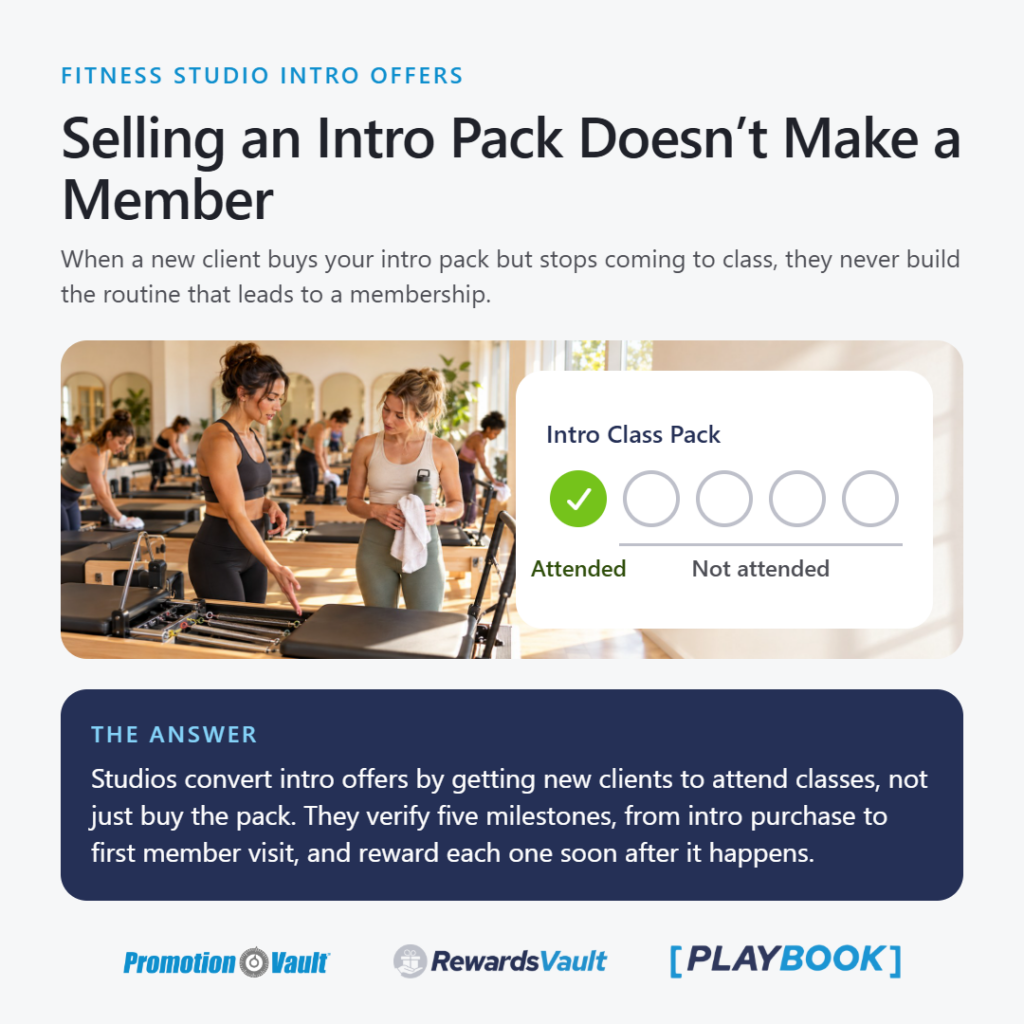
Fitness studios convert intro offers into memberships by getting new clients to attend classes, not just buy the pack. Verify five milestones: the intro purchase, orientation, three attended workouts, the first membership payment, and the first membership visit. Recognize each one soon after it happens. Then measure conversion at 30 days and retention at 60 and 90 days.
TLDR — How Fitness Studios Convert Intro Offers Into Memberships
- Judge intro offers by classes attended, not packs sold.
- Get new clients to a second class within a week.
- Aim for three to five visits in the intro window.
- Verify each milestone before releasing a reward.
- Put the biggest reward on the first membership payment.
- Reward the first member visit to start the habit.
- Show every step and its value in one branded Vault.
- Pay reward value only when a client claims it.
- Track 30-day conversion and 60/90-day retention.
- Explore PLAYBOOK to map your intro-to-member path.
- What Is Fitness Studio Intro Offer to Membership Conversion?
- What Does the Intro-to-Membership Conversion Funnel Look Like?
- Why Do Attended Classes Matter More Than Intro Sales?
- Which Verified Milestones Should Studios Track From Intro to Membership?
- How Do You Convert Intro Class Packages to Memberships?
- How Should a Pilates Studio Approach Intro Offer Conversion?
- What Could an Intro-to-Membership Journey Look Like at Studio Pilates?
- What Are the Full Reward Economics of an Intro-to-Membership Program?
- How Should Studios Measure Conversion at 30 Days and Retention at 60 and 90 Days?
- How Does PLAYBOOK Help Studios Convert More Intro Clients?
- What Do Studio Owners Ask About Intro Offer Conversion?
- So, How Do Fitness Studios Convert More Intro Offers Into Memberships?
What Is Fitness Studio Intro Offer to Membership Conversion?
Intro offer to membership conversion is the share of new clients who buy a recurring membership after an introductory class package. Studios measure it inside a set window, such as 30 days from the first class. No audited industry benchmark exists, so the most useful comparison is your own recent intro buyers.
The math is simple. Group the intro buyers who took their first class in the same week, then divide the memberships they bought by the size of that group. If 100 people started your intro in September and 34 joined within 30 days of their first class, your conversion rate is 34%. That number tells you how well the intro worked. It cannot tell you why, so we track the steps in between.
Two details move the number more than most owners expect. The first is price. We recommend a paid intro over a free one. A small fee gives a client a stake in showing up, and a multi-class package gives them time to build a routine. The second is the channel. A client who found you on a booking app may be sampling several studios at once. That is why we track conversion by source as well as by offer.
Key Terms for Intro-to-Membership Conversion
- Intro offer
- A discounted, time-limited package for first-time clients, such as two weeks of unlimited classes or a small class pack.
- Conversion window
- The number of days after a client’s first class in which a new membership counts. We use 30 days.
- Attended class
- A class the client showed up for, confirmed by a check-in or sign-in record. A booking alone does not count.
- Verified milestone
- A step confirmed by a studio record and matched to a client who opted in and confirmed their phone with a six-digit text code.
- Cohort
- A group of intro buyers who took their first class in the same week, tracked together over time.
- Retention at 60 and 90 days
- The share of converted members still paying and attending 60 and 90 days after their first class.
- Rewards Vault
- Promotion Vault’s branded page where clients see, choose, and redeem the reward value they earn. Its Momentum view shows each step, its reward, and what comes next.
What Does the Intro-to-Membership Conversion Funnel Look Like?
The funnel runs from the intro purchase to orientation, repeat classes, a membership offer, the first payment, and the first class as a member. Each step can leak. Most studios watch the first and last numbers. The middle, where a new client either builds a routine or drifts, gets the least attention.
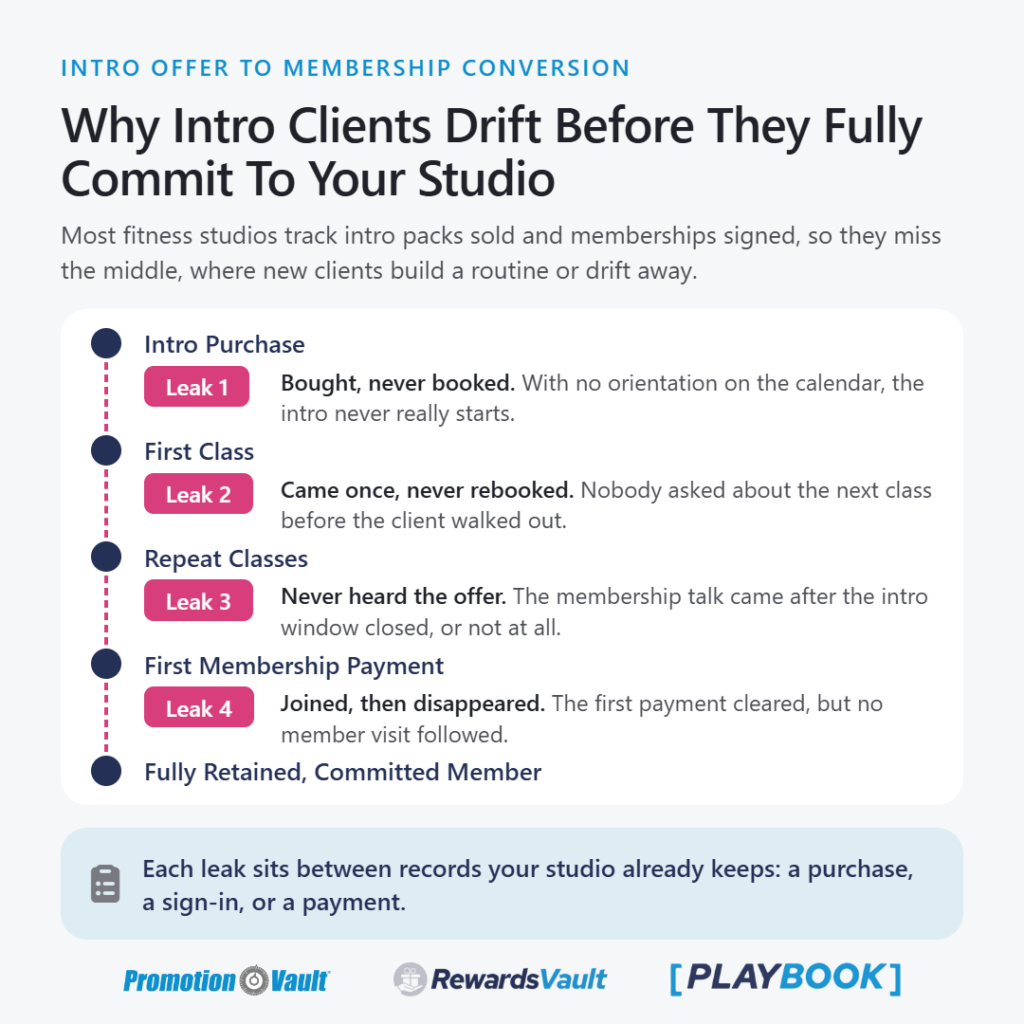
Most owners know this funnel by heart, so we will go straight to the leaks:
- Bought, never booked. The client paid on a Sunday night, then the week got busy. With no orientation on the calendar, the intro never really starts.
- Came once, never rebooked. The first class felt hard or awkward. Nobody asked about the next one before the client walked out.
- Used the classes, never heard the offer. The client loved the workouts, but the membership talk came after the window closed, or not at all.
- Joined, then disappeared. The first payment cleared, but no member visit followed. This leak is quiet, because the sale looks done.
Every leak sits between records your systems already keep: a purchase, a sign-in, or a payment. We like to say the gym floor is the new CRM. In a studio, that floor is the minute after class. An instructor learns a new client’s name, asks how the springs felt, and books the next class before the client reaches the door. Those minutes shape what happens next, yet they rarely show up in a report.
Why Do Attended Classes Matter More Than Intro Sales?
Attendance is the clearest early sign that an intro client will join. Research on exercise habits shows that one visit rarely changes behavior, while a run of visits can. A pack that sits unused gives a client nothing to judge, so the classes they attend matter more than the sale itself.
Why One Visit Is Not Enough
Economists Gary Charness and Uri Gneezy paid people to go to the gym in a study published in Econometrica in 2009. A single paid visit produced no lasting change. Paying for eight visits in a month roughly doubled attendance, and the effect held after the payments ended. Nearly all of the gain came from people who had not been exercising regularly. New intro clients are in a similar spot, since they have no routine at your studio yet.
Our own programs show a similar effect. In one Promotion Vault program with a class-booking marketplace, a $10 reward for completing four classes in 30 days lifted 30-day engagement by 16%.
Why Orientation Plus Follow-Up Works
Onboarding studies line up too. Retention researcher Paul Bedford studied two groups of new gym members. One got a standard orientation. The other got the same orientation plus three follow-up sessions with a coach. After six months, 87% of the second group were still active, compared with 60% of the first, GymInsight reported.
A purchase shows curiosity. Three attended classes show a routine starting to form.
Timing matters as much as the count. In 2016 research in the Journal of Consumer Research, Kaitlin Woolley and Ayelet Fishbach found that quick rewards help people stick with long-term goals better than delayed ones. So we recognize each verified step soon after it happens, not at the end of the window.
Which Verified Milestones Should Studios Track From Intro to Membership?
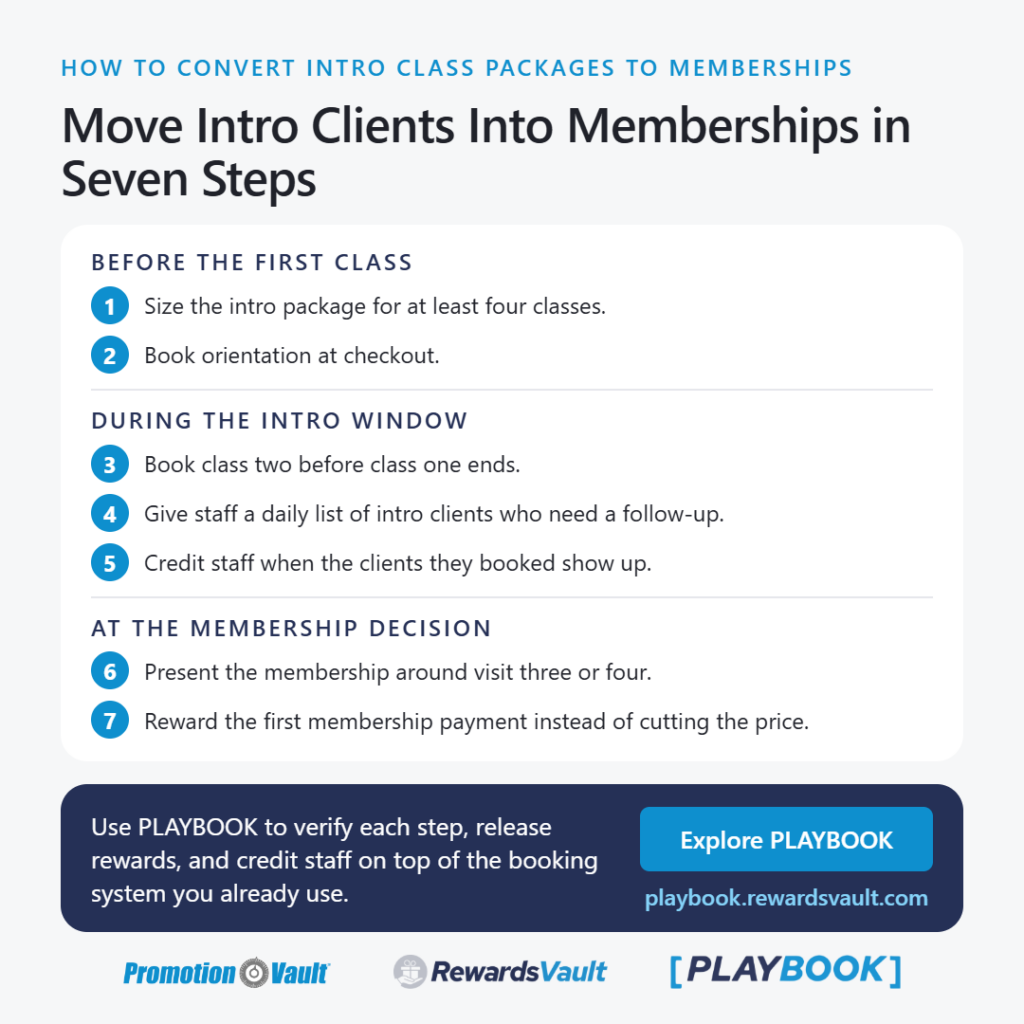
Track five milestones: the intro purchase, orientation, three attended workouts, the first membership payment, and the first membership visit. Confirm each one with a studio record, not a self-report. Then match it to the same opted-in, phone-verified client before any reward goes out.
| Milestone | What Confirms It | Why It Matters |
| Intro purchase | A paid intro order in the booking or point-of-sale system | Starts the relationship and opens the client’s Rewards Vault |
| Orientation | A completed sign-in for the orientation class | Gets the client comfortable with the room and the equipment |
| Three attended workouts | Three more sign-ins inside the intro window | Shows a routine forming before the membership talk |
| First membership payment | The first successful recurring charge, not a pending sale | Marks the conversion the whole program exists to grow |
| First membership visit | The first sign-in that uses the new membership | Turns a sale into a member who shows up |
A few rules keep the records honest. Bookings show intent, so they never count as attendance. Late cancels and forfeited credits do not count either. Refunds and chargebacks should reverse the payment milestone under rules you set before launch. Some records arrive before a client enrolls, such as a pack bought at the front desk. Those still need the client’s opt-in and phone check before any reward goes out. Once a client joins, prospect offers should stop, and each new membership should earn only one conversion reward.
With the milestones defined, the next question is how to move more intro clients through them.
How Do You Convert Intro Class Packages to Memberships?
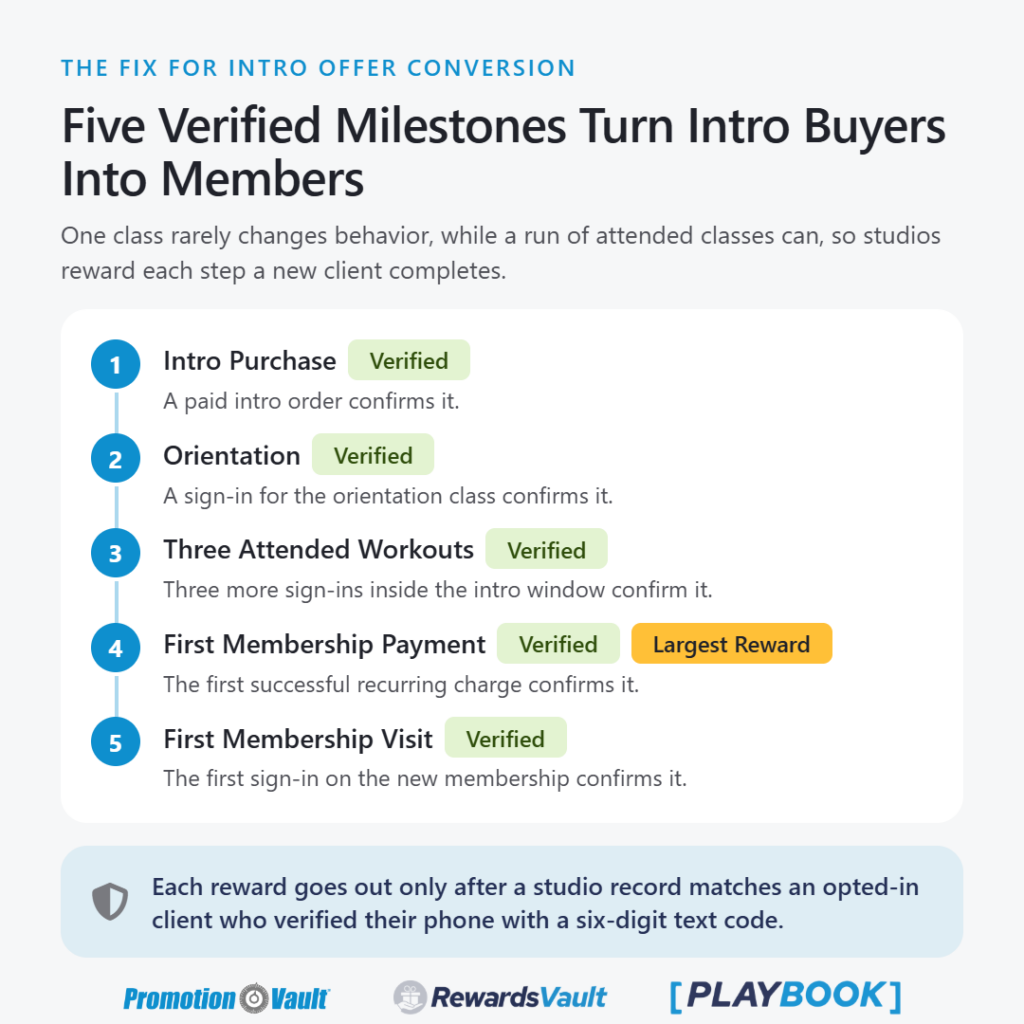
Build the intro package around attendance. Book orientation at checkout, book the second class before the first one ends, and aim for three to five visits in the window. Present the membership while the client still has classes left, and recognize each verified step soon after it happens.
Before the First Class
- Size the package for visits. Decide how many classes you want a new client to attend, then build the package around that number. Orientation plus three workouts needs at least four classes, with room for a fifth. A two-week unlimited pass or a five-to-eight-class pack covers it.
- Book orientation at checkout. The purchase confirmation should hold an orientation time, not a link to go find one. A client with a class on the calendar has a concrete reason to show up.
During the Intro Window
- Book class two before class one ends. The instructor ends the first class with one question: “When can you come back this week?” Booking it on the spot protects the habit before it has a chance to fade.
- Give staff a short daily list. Three groups matter each morning. First are buyers with no orientation booked. Next are clients with one class and no next booking. Last are clients with three classes and no membership talk yet. We recommend a same-day personal text from the instructor who taught the class, not just another automated email.
- Credit the staff who make it happen. When the client an instructor booked shows up, that instructor should get visible credit. Recognition for verified results gives staff a reason to follow up again tomorrow.
At the Membership Decision
- Present the membership around visit three or four. Make the offer while the client still has classes left. Base it on the schedule they have shown you. A client who comes twice a week fits an eight-class plan, so the offer reads as advice about their own routine.
- Reward the decision without cutting the price. Put the largest reward on the first membership payment, then add one more for the first member visit. Rewards add value without teaching clients to wait for a deeper discount. Carl Mela, Sunil Gupta, and Donald Lehmann studied more than eight years of household shopping data. They found that repeated discounting made shoppers more sensitive to price and promotions (Journal of Marketing Research, 1997). We cover that tradeoff in Why Do Rewards Drive Better ROI Than Discounts?
How Should a Pilates Studio Approach Intro Offer Conversion?
Pilates studios start with strong demand and a steep first class. Reformers, springs, and new cues can make a first-timer hesitant. A required orientation, fast booking of the next classes, and steady instructor follow-up turn that early interest into the repeat visits that lead to a membership.
Why Pilates Intros Need More Visits
Demand is not the issue. Pilates was the most-booked workout worldwide on ClassPass for the third straight year in 2025, with bookings up 66% from the year before, ClassPass reported. It was also the class new ClassPass users were most likely to book first, and the most rebooked workout type in every region. Reformer Pilates bookings alone grew 71%, SGB Media reported from the same data.
That popularity cuts both ways. More studios now compete for the same new clients. In a dense city, a newcomer can try intro offers at several reformer studios in a single month. The intro window becomes a comparison period, and the studio that gets the client back into class most often has the edge.
What Pilates Studios Can Do About It
A first class also asks more of a Pilates newcomer than many workouts do. Springs, straps, and cueing take a session or two to feel natural. That is why many reformer studios require an orientation. It is also why orientation gets its own milestone. The sooner a client stops thinking about the equipment, the sooner the workout itself becomes the reason to return.
Small rooms add pressure. A reformer class may have a dozen machines, so intro clients compete with members for the same 6 p.m. spots. Holding a few intro-friendly spots in popular time slots, and booking them during the first visit, keeps a new client from hitting a waitlist at the worst moment.
We have seen the same pattern in our own programs. One Promotion Vault program with a national Pilates franchise brand had three reward stages. It paid $10 for intro-class attendance, $30 for joining, and $30 for upgrading. The brand reported 36% more intro-class attendance, 43% more new-member conversions, and 23% more upgrades.
What Could an Intro-to-Membership Journey Look Like at a Club Like Studio Pilates?
Proposed example, not a customer case study. We are not affiliated with Studio Pilates. This journey comes from the studio’s public offer and shows how the five milestones could work in a real Pilates intro.
Studio Pilates West 57th St in New York sells a $57 Two Week Unlimited Trial that starts with a required orientation. In our proposed journey, a client verifies once, then earns rewards for the purchase, orientation, three workouts, the first membership payment, and the first membership class.
The Offer We Are Working From
The studio opened on September 26 with six classes for $60, WhatNow reported. As of late October 2026, its location page lists a $57 Two Week Unlimited Trial for new clients. It starts with a required Orientation Workout, then 40-minute Reformer Workouts. The trial ends two weeks after the first class. This walkthrough uses the current offer and adds the cohort math and measurement plan.
One detail needs local confirmation. The Studio Pilates brand FAQ says its studios sell class packs rather than lock-in memberships. So the studio would name the recurring plan or next pack that counts as conversion. For round numbers, we use a hypothetical $240 monthly plan with eight classes.
One Client’s Journey, Step by Step
Here is how one illustrative client, whom we will call Maya, might move through it. The whole path runs as a Scavenger Hunt, a guided set of steps that open in order, with a Scratch to Reveal card at each reward. Reward amounts are proposed.
- The night she buys: Maya buys the trial online. A text invites her into the studio’s Playbook, a page that lists every step and what it is worth. She confirms her number with a six-digit code and scratches to reveal $5 for the verified purchase.
- Day 1, orientation: The instructor signs her in and walks her through the reformer. The sign-in record confirms orientation and releases $5. Before Maya leaves, the instructor books her next two classes.
- Days 3 to 7, three workouts: Maya tries three Reformer Workouts at different times to find her slot. The third sign-in releases $5, and the next step opens: choose a membership.
- Day 10, the conversation: At her fifth class, the instructor asks how the week fit. Maya has found two evening slots she likes, so they talk through the eight-class plan.
- Day 13, the first payment: Maya buys the plan before her trial expires. When the first payment clears, $15 lands in her Rewards Vault, and prospect messages stop.
- Day 16, her first member class: Her first sign-in on the new plan releases $5. Momentum now shows her next goals as a member, which is where our guide to first-30-day retention picks up.
What Happens Behind the Scenes
Maya’s instructor counts too. That instructor booked the classes that led to the join. The studio can credit them through a Recognition Loop. It ties staff rewards to verified client results, with separate rules and reports.
Maya keeps booking and paying in the studio’s own app. Her rewards live on a web page, so she has nothing new to download. Our September walkthrough assumed the studio runs Mindbody. If so, its sign-in and sales records could feed PLAYBOOK through the Vault API, which is how our platform receives those events. Mindbody’s December 2025 release notes report 99.99% delivery success for its webhooks, including time-sensitive events like check-ins and bookings. The studio would confirm its system and the exact records before launch.
What Are the Full Reward Economics of an Intro-to-Membership Program?
Count every reward, including those earned by clients who never join. In our proposed Studio Pilates journey, a client who completes all five milestones earns up to $35, plus $3.50 in service fees. Across 100 intro buyers, the maximum cost is $2,183.50, and most early rewards go to clients who do not convert.
Here are the planning inputs. They are assumptions, not forecasts or results. Of 100 intro buyers, 90 attend orientation and 70 finish three workouts. Then 35 make a first membership payment within 30 days, and 32 take a first member class. Swap in your own baseline before you plan. The table assumes every reward gets claimed, so it shows the ceiling.
| Milestone (Clients) | Reward Each | Maximum Cost |
| Intro purchase (100) | $5 | $500.00 |
| Orientation (90) | $5 | $450.00 |
| Three attended workouts (70) | $5 | $350.00 |
| First membership payment (35) | $15 | $525.00 |
| First membership visit (32) | $5 | $160.00 |
| 10% service fee on rewards sent | n/a | $198.50 |
| Total for 100 intro buyers | Up to $35 per client | $2,183.50 |
Promotion Vault charges no setup costs or monthly fees. For applicable Rewards Vault rewards, we charge a 10% service fee when we send a reward and the face value only when the client claims it. Unclaimed value stays in the studio’s wallet. So club operators pay for results, not rewards. (A full budget should also count staff time and other program costs.)
The table also shows where the money goes. Early rewards for the purchase, orientation, and workouts add up to $1,300. Of that, $775 goes to the 65 clients who never join (if every member finished the earlier steps). That spend is fine if it moved more people into membership. It does mean the program has to prove itself on extra members.
The program has to pay for itself in members you would not have signed anyway.
How Many Extra Members Cover the Cost?
What counts is incremental members, meaning those you would not have signed without the program. At a hypothetical $240 a month, the $2,183.50 ceiling equals about nine extra first payments. If those extra members stay through Day 90 and pay three times, just over three extra members per 100 intro buyers cover the maximum cost. For a finance review, swap revenue for contribution margin (revenue minus the cost of serving the member). Our guide to measuring retention rewards ROI walks through that math.
How Can a Studio Lower the Cost Without Weakening the Journey?
- Shift early value to the decision. Keep the intro purchase as a verified step in Momentum with no cash reward, and add its $5 to the membership payment. A converting client still earns $35, but the cohort ceiling drops to $1,826.
- Use non-cash rewards early. Branded merch or a guest pass can recognize orientation, and a guest pass gives the client a reason to bring a friend. Other reward types follow their own terms, so price them separately.
- Close the window on early rewards. Pay the three-workout reward only inside the intro window, so it pushes the pace that predicts conversion.
- Let claims set the bill. A reward the client never claims costs the studio only the 10% fee.
How Should Studios Measure Conversion at 30 Days and Retention at 60 and 90 Days?
Group intro buyers into weekly cohorts by their first class. Measure conversion as first membership payments by Day 30. Then check which converted members kept paying and attending at Days 60 and 90. Compare everything with a holdout group that gets your usual follow-up without rewards.
Conversion alone can flatter a program. A member who joins on Day 13 and quits on Day 45 cost the same to win as one who stays a year. Keeping members is already hard. The Health & Fitness Association’s 2025 benchmarking report found that fitness facilities keep 66.4% of members per year, on average. Day 60 and Day 90 checks also bracket the habit window. In a 2010 study in the European Journal of Social Psychology, Phillippa Lally and her team found that new habits took a median of 66 days to stick.
A Sample Measurement Plan
| When | What We Measure |
| Before launch | Baseline conversion and 90-day retention from the last 8 to 12 weeks of intro buyers. A holdout rule, such as every fifth buyer. Decision thresholds, written down. |
| Every week | Orientations booked at checkout, second classes within seven days, three-workout completions, rewards sent and claimed, and staff follow-ups done. |
| Day 30 | First membership payments divided by intro buyers, program versus holdout, split by source and offer. |
| Day 60 | Converted members who made a second payment and attended in the past 30 days. |
| Day 90 | Third payments and attendance, dues collected, total reward and fee cost, and cost per extra member. |
| After Day 90 | Keep, adjust, or stop. Change one thing at a time, then run the next cohort. |
How to Read the Results
Credit the program only with the difference between the program group and the holdout, since some members would have joined anyway. Read the leading signals first. If second-class bookings did not rise, fix booking help before raising reward values. Split results by source, since website buyers, referrals, and app bookings can convert at very different rates. Finally, watch for gaming: repeat intro buyers using new emails, refunds right after a reward, and duplicate accounts. Phone verification and record matching exist to catch these before any value goes out.
How Does PLAYBOOK Help Studios Convert More Intro Clients?
PLAYBOOK, Promotion Vault’s engagement platform, turns the intro journey into one connected program. It verifies each client and milestone, reveals rewards through games, collects earned value in a branded Rewards Vault, credits staff, and reports results. Studios keep the booking system they already use.
What the Client Sees
Clients join a studio’s Playbook once. From then on, Momentum, the progress view inside Rewards Vault, lists every step, shows what each one is worth, and highlights the next one. Later steps can stay locked until earlier ones are done, which keeps the path clear. Games add a small moment of fun at each milestone. Clients choose gift cards from the brands in the studio’s catalog, and every reward collects in one place that carries the studio’s brand.
“After incentivizing the activation within the first 3 days, guest pass activations increased, and even more importantly our conversion rate to membership increased from 9% up to 17%.”
Stephen Roma, CEO, Jersey Strong
What Staff and Operators Get
Behind the scenes, every reward waits on proof. A client confirms their phone with a six-digit code and opts in, and we log the time and method of that consent. Each milestone then has to match a studio record before value goes out. Staff get credit when the clients they invited and booked actually show up and join. Operators see which steps moved, which staff drove them, and what the program cost.
The conversion step responds to rewards, too. In the class-booking marketplace program mentioned earlier, a $35 join-now reward drove a 62% trial-to-paid activation rate. That worked out to about $13 to win each new subscriber.
We built Promotion Vault from inside fitness, with family roots at Powerhouse Gym going back to the 1980s. Across more than 5,000 customers, our programs have helped drive more than $250 million in increased customer revenue. That history is why we do not hand over software and leave. We help configure the program, connect the records, and run it with your team. PLAYBOOK can replace overlapping engagement tools where that makes sense, but it never requires it.
Frequently Asked Questions About Fitness Studio Intro Offer Conversion
Owners usually ask about benchmarks, free versus paid intros, window length, app-booked clients, clients who stop booking, and software fit. The short answers: measure against your own baseline and charge for the intro. Match the window to the pace you want, invite app clients into your own intro, and tie rewards to records you already keep.
What Is a Good Intro Offer to Membership Conversion Rate?
No audited, industry-wide benchmark exists. Published figures come mostly from software vendors and consultants, and they define the conversion window differently. The most useful benchmark is your own. Measure the last two or three months of intro buyers with the same 30-day window, then judge any new program against that number and a holdout group.
Do Paid Intro Offers Convert Better Than Free Trials?
We recommend paid intros. Clients tend to use what they paid for, and a fee filters out casual browsers before they take a spot in a small class. A free first class can still open the door, as long as it leads straight into a paid package. If you are unsure, test both offers against your own baseline.
Should an Intro Window Last Two Weeks or a Month?
Match the window to the pace you want. If the goal is orientation plus three workouts, with a membership talk around visit four, a two-week window asks for two or three classes a week. That pace suits an unlimited pass. A class pack used once a week may need three to four weeks. Short windows add urgency, while longer ones give busy clients room.
How Do You Convert Clients Who Book Through Third-Party Apps?
Treat app visitors as warm leads. They tried your class, but they have not chosen your studio yet. At the front desk, invite them to scan a QR code, verify their phone, and start your own intro package. Then track them as a separate source, since their path to membership may differ from website buyers.
What Should a Studio Do When an Intro Client Stops Booking?
Reach out within a day or two, person to person, and offer a specific class time instead of a generic reminder. Ask what got in the way. If the window is about to close, staff can help the client fit the remaining classes in. Release any attendance reward only after the client actually comes back.
Can PLAYBOOK Work With Our Booking System?
PLAYBOOK works on top of the systems a studio already uses. Sign-in, sales, and payment records can feed it through the Vault API, existing reports, or supported connections. Clients keep booking and paying the way they do today. Before launch, we map the exact records with your team.
So, How Do Fitness Studios Convert More Intro Offers Into Memberships?
Studios convert more intro offers by treating the intro as a short run of attended classes that ends in a membership decision. They verify the purchase, orientation, three workouts, the first membership payment, and the first member visit, recognizing each soon after it happens. Then they judge the program on extra members still paying and attending at Day 90.
If you want to see how this journey would run with your intro offer, your booking system, and your team, we will map it with you. In a personalized demo, we walk through the milestones, the reward math, and the measurement plan for your studio.
Casey Rock is Content Director at Promotion Vault, where he builds the content, SEO, AEO, and messaging behind the company’s rewards engagement platform. He specializes in turning product value into proof-first stories that drive discovery, trust, and conversions.