To get more customer reviews, build the request into a real customer milestone, give every eligible customer a direct review path, follow up consistently, and respond to what people post. Keep rewards on private feedback or other permitted participation, separate from public reviews. The result is a steadier stream of recent, honest customer experiences.
TLDR — How To Increase Customer Reviews
- Make review requests a repeatable customer workflow — not a staff-memory task.
- Trigger requests after verified customer experiences, when feedback is timely and informed.
- Ask every eligible customer neutrally — never filter requests by predicted satisfaction.
- Reduce friction with direct links, QR codes, mobile testing, and fewer clicks.
- Keep public reviews voluntary, unbiased, and independent of ratings or sentiment.
- Reward private feedback where appropriate — never the Google review itself.
- Route customer feedback to teams that can fix recurring experience problems.
- Automate review workflows through the systems already tracking customer actions.
- Track review volume, recency, engagement, responses, feedback themes, and location performance.
- Explore ReviewBoost and RewardsVault to automate compliant feedback and review workflows.
- What Do The Most Important Customer Review Terms Mean?
- How Do I Get More Customer Reviews Consistently?
- When Should We Ask Customers For Reviews?
- How Do We Make It Easier For Customers To Leave Reviews?
- Should We Ask Every Customer Or Only Customers We Think Are Happy?
- Can We Incentivize More Reviews With Rewards?
- How Can Customer Feedback Help Us Get More Honest Reviews?
- How Do We Build A Review System Our Team Will Actually Run?
- What Should We Measure To Know Whether Our Review Requests Are Working?
- What If We Already Use A Review Or Reputation Management Platform?
- Frequently Asked Questions About Getting More Customer Reviews
- So, What Is The Best Way To Get More Customer Reviews?
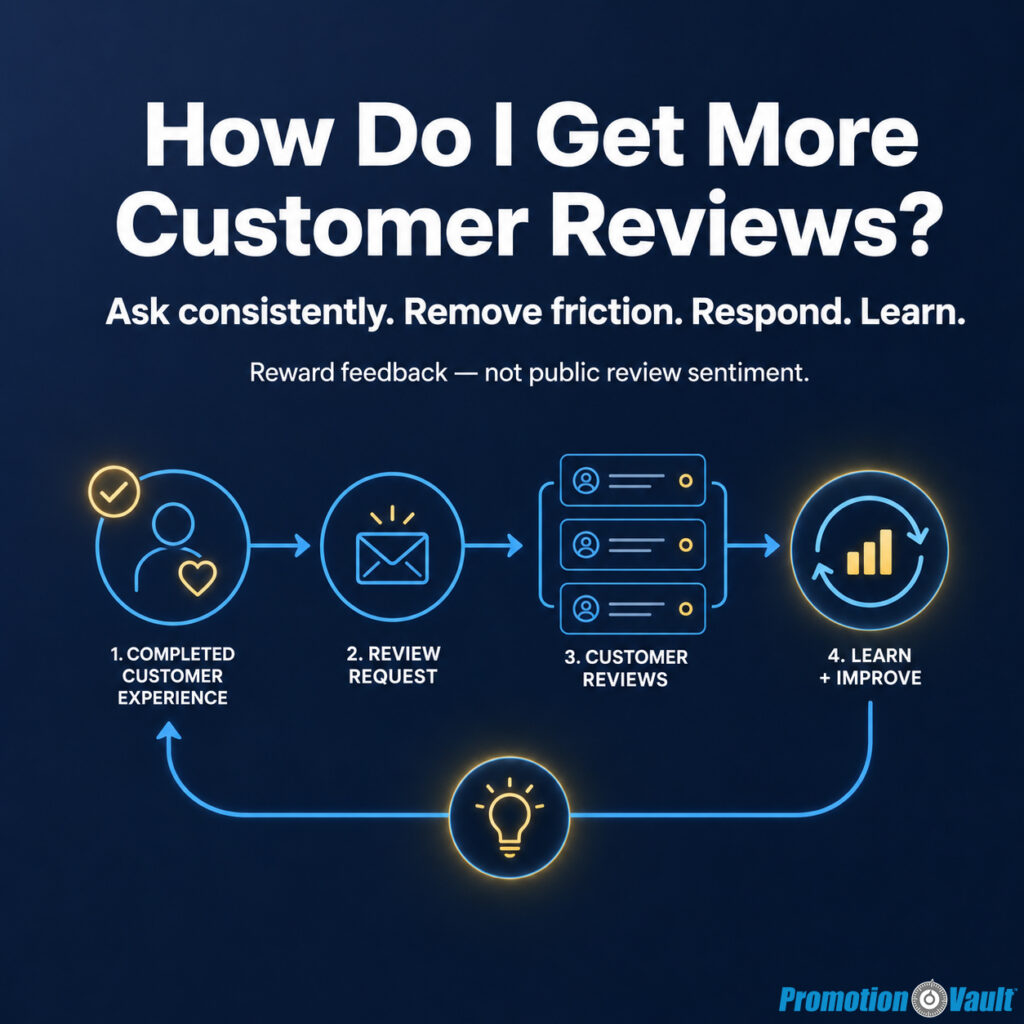
Forty-seven percent of U.S. consumers say they will not use a local business with fewer than 20 reviews. Seventy-four percent look for reviews written within the last three months. Those numbers from BrightLocal’s 2026 Local Consumer Review Survey point to a practical truth: review collection cannot be something we remember to do when the profile looks stale. It needs an operating rhythm.
If we run marketing or customer experience across several locations, the difficult part usually is not customer goodwill. Thousands of real experiences happen every month. The leak appears between the experience and the public review: nobody owns the ask, staff remember inconsistently, links take too many clicks, follow-up disappears, and useful feedback never reaches the people who can act on it.
The most reliable way to get more customer reviews is to make honest review requests a repeatable part of the customer journey. We need a clear trigger, a low-friction path, neutral eligibility rules, consistent follow-up, and a way to learn from what customers tell us.
That gives us more than review volume. It gives future customers a fresher and more representative picture of the experience we are already working hard to deliver.
What Do The Most Important Customer Review Terms Mean?
A strong review program gets easier to manage when everyone uses the same language. These definitions separate the public review itself from the systems we use to request it, learn from it, and improve the next customer experience.
- Customer Review
- A customer review is a public or platform-hosted evaluation of a real experience with a business, product, or service. It may include a rating, written comments, photos, or other feedback. Its distinguishing feature is that other consumers can use it when evaluating the business.
- Review Request
- A review request is a neutral invitation asking a real customer to describe a completed experience on a review platform. A sound request makes participation voluntary, gives the customer a direct path to respond, and does not require a particular rating, opinion, or sentiment.
- Review Gating
- Review gating is a solicitation practice that uses customer sentiment to determine who receives a public review request. A common example is inviting satisfied customers to review publicly while sending dissatisfied customers somewhere private. This can distort the review population and create platform-policy risk.
- Review Recency
- Review recency describes how recently a business has received customer reviews. It matters because prospective customers often want evidence of the experience they can expect now. A large archive of older reviews does not replace a steady flow of current customer experiences.
- Private Feedback Incentive
- A private feedback incentive is a reward offered for completing a survey, questionnaire, or another permitted feedback action rather than for posting a public review. The reward should depend on participation, never whether the customer gives a positive answer, rating, or public endorsement.
How Do I Get More Customer Reviews Consistently?
The most dependable approach is to connect a neutral review request to a repeatable customer event. Ask every eligible customer under the same rules, make the review destination easy to reach, and measure the flow over time. Consistency creates the recent review stream that occasional “review drives” struggle to sustain.
That matters because consumers increasingly judge the shape of a review profile. BrightLocal found that 97% of consumers read online reviews for businesses. Review count, recency, consistency, and business responses all affect trust.
Research also gives us a useful reason to ask more consistently. A Management Science study comparing solicited and unsolicited reviews found that solicitation increased review participation across customer groups. It particularly increased participation among customers with moderate experiences, making the resulting review distribution more representative.
That is an important distinction. If we simply wait for reviews to arrive, the loudest experiences can dominate. People at the emotional edges often have more motivation to post. A consistent request gives everyone else a clearer invitation to contribute.
For a multi-location gym, that trigger might be a completed visit or a meaningful milestone. For a dealership, it could follow completed service. For a home-service company, it could follow a finished job. For a subscription business, it might come after the customer has had enough time to experience the product.
The operating question stays the same:
What verified moment tells us this customer has experienced enough value to give an informed opinion?
Start there.
When Should We Ask Customers For Reviews?
Ask after a real experience becomes complete enough for the customer to judge it fairly. The exact moment varies by business. The operating principle does not: trigger the request from a meaningful customer event rather than relying on staff memory or sending broad review blasts disconnected from the experience.
A request sent before the customer receives value asks them to rate a promise. Wait too long, and memory fades while the moment loses relevance.
We recommend identifying the clearest “experience complete” signal in the customer journey.
| Customer Experience | Useful Review Trigger |
|---|---|
| Appointment or service | Work is completed |
| Product purchase | Customer has received or used it |
| Support interaction | Issue reaches a clear resolution |
| Membership experience | Meaningful visit or milestone occurs |
| Ongoing service | Defined lifecycle moment is completed |
Google itself encourages businesses to make review access available through touchpoints such as receipts, thank-you emails, completed chat interactions, and in-store QR codes.
We do not need to turn every interaction into an ask. That creates fatigue. We need to identify the moments where the customer actually has something useful to say and make the request part of that workflow.
The detailed timing by channel, message structure, and follow-up cadence deserves its own playbook. For this system, the first decision is simpler: pick the completed experience that earns the ask.
How Do We Make It Easier For Customers To Leave Reviews?
Remove every step that does not help the customer complete the review. Send people directly to the intended review destination, keep the message focused on one action, and make the path work cleanly on a phone. Links and QR codes work because they shorten the distance between intention and completion.
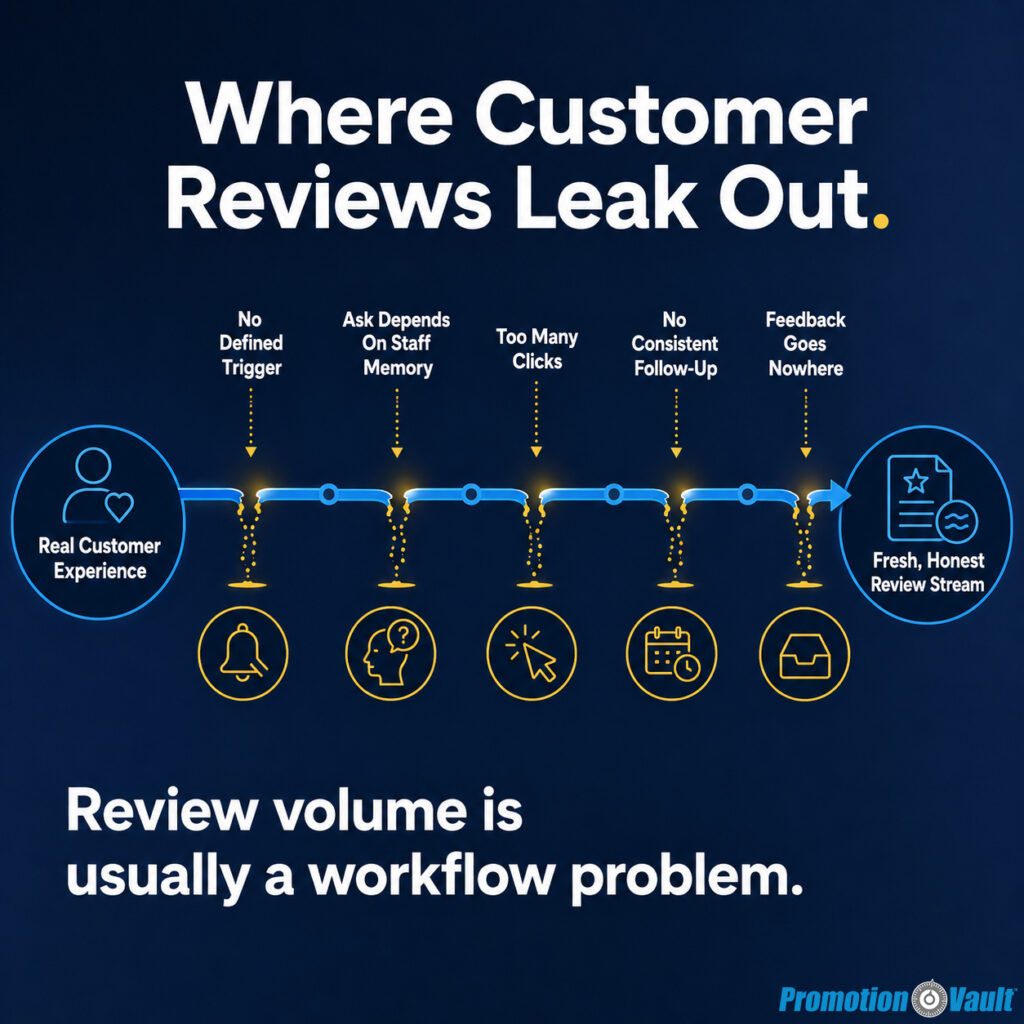
A customer who wants to help us should not have to search our business name, find the right location, hunt for the review button, and wonder whether they landed on the correct page.
Google provides businesses with direct review links and QR codes for exactly this reason. It suggests distributing them through customer touchpoints such as thank-you emails and receipts.
For a multi-location business, accuracy matters as much as speed. Every location should have the correct destination attached to the correct customer event. Sending a member in one city to a corporate review page when they visited a location in a different city creates unnecessary friction and weakens local proof.
We recommend a simple friction test before launch:
- Open the request on an ordinary phone.
- Confirm the customer reaches the correct location.
- Count the actions required before they can begin the review.
- Remove unnecessary landing pages or competing calls to action.
- Test every automated link before scaling the workflow.
The customer has already done the hard part — having an experience worth describing. We should make sharing it easy.
Should We Ask Every Customer Or Only Customers We Think Are Happy?
Use the same neutral eligibility rule for customers who had the same qualifying experience. Filtering people by satisfaction before deciding who gets a public review request can bias the record and create review-gating risk. A durable review strategy earns trust by making room for honest experiences, including imperfect ones.
This is where many well-meaning programs get themselves into trouble. A team asks, “How was your visit?” Then a five-star response gets a public review button while a low score gets only a private complaint form.
Operationally, that feels safe. Strategically, it teaches the system to hide information instead of improve from it.
Our latest ReviewBoost guidance takes the opposite approach: collect honest feedback, route issues internally, and keep any public review request separate and unbiased. Rewards cannot depend on the public review, its rating, its sentiment, or a later change to it.
There is also a business reason to welcome a realistic mix. BrightLocal found that consumers place the most weight on repeated, consistent sentiment across multiple reviews. Only 10% in its 2026 survey said they require a perfect five-star business.
A credible reputation does not require pretending every experience was flawless. It requires showing that good experiences happen consistently and that we pay attention when something goes wrong.
A review system should earn trust twice — first with the customer who experienced us, then with the prospect reading what they wrote.
Can We Incentivize More Reviews With Rewards?
For Google reviews, do not tie a reward, discount, gift, or other incentive to posting the review. Rewards can instead support private feedback or another permitted customer action. Any public review request should remain separate, voluntary, neutral, and independent of the customer’s rating or sentiment.
Google states that offering free or discounted goods or services in exchange for reviews counts as fake engagement and is prohibited. The prohibition also covers incentives tied to changing reviews or removing negative ones.
Federal law requires a little more precision. The FTC’s Consumer Reviews and Testimonials Rule Q&A says incentivized reviews can become testimonials under the rule and expressly prohibits compensation conditioned on a particular sentiment. The FTC also notes that an honest review does not automatically violate the rule merely because an incentive existed. Platform rules can be stricter.
That distinction is why we should resist casual advice like “just offer $10 for a review.”
For a practical operating rule, we recommend keeping the lanes clear:
Reward the private feedback or another permitted participation step. Do not reward the Google review.
There is good evidence for the first lane. A PLOS ONE systematic review of 46 randomized controlled trials involving more than 109,000 participants found that monetary incentives increased survey response rates. That makes survey incentives useful when our real objective is learning from customers.
What matters here is operational clarity: the public review should never become the condition required to earn the reward.
How Can Customer Feedback Help Us Get More Honest Reviews?
Use private feedback to learn from the experience and solve service issues, while keeping the public review request on its own neutral path. This creates a closed loop: capture what happened, route useful information to the right team, invite honest public participation where allowed, and use the resulting patterns to improve the next experience.
This is the system we are building around ReviewBoost. Its current UX model starts with a real experience, collects neutral feedback, routes issues internally, handles the public review request separately, and measures the outcome. The reward can support eligible feedback participation. It does not purchase public sentiment.
That distinction turns feedback into an operating asset.
A customer might tell us that the front desk was excellent but the onboarding instructions were confusing. Another may love a service but struggle with scheduling. We can route those signals to the people who can fix them instead of treating the review profile as a scoreboard.
The questions matter, too. Our guide to writing good Likert scale questions recommends asking about one clear idea at a time and rewarding participation rather than positive answers, ratings, or reviews. The same discipline helps here.
Promotion Vault’s RewardsVault architecture carries that thinking into a broader workflow — public review requests must remain separate, optional, neutral, and independent of posting, rating, sentiment, revision, or removal.
That gives marketing and CX teams a much healthier goal than “get the rating up.”
We can ask: What are customers experiencing, what should we fix, and how do we make it easier for more of them to share an honest account?
How Do We Build A Review System Our Team Will Actually Run?
Build the process around one customer event, automate the repetitive steps, and give the team clear ownership for exceptions. A workable review program should tell us who qualifies, when the request happens, where the customer goes, what happens after feedback arrives, and which numbers determine whether the system is improving.
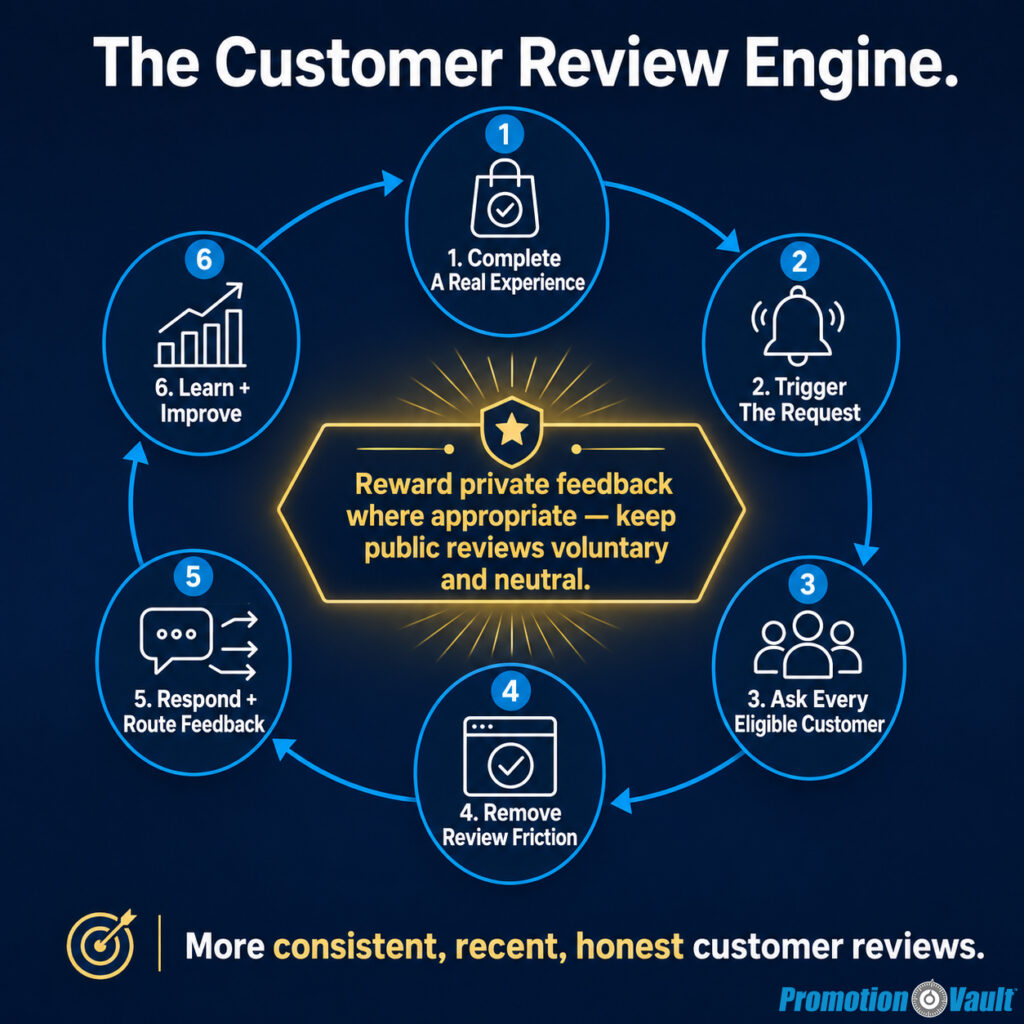
A practical implementation looks like this:
- Choose one completed customer experience. Define the exact event that makes someone eligible for a review request, such as completed service, product delivery, resolved support, or another verified milestone.
- Create the shortest review path. Generate the correct direct review link or QR code, test it on mobile, and confirm that each customer reaches the intended business or location.
- Set one neutral eligibility rule. Apply the same review-request rule to customers who complete the same qualifying experience rather than filtering invitations according to predicted satisfaction.
- Automate the request from the real event. Connect the completed customer action to the review workflow so the process runs consistently without depending on individual staff members remembering every ask.
- Use restrained follow-up. Give customers another reasonable chance to act when appropriate, then stop. The objective is to remove forgetfulness and friction without turning a voluntary review request into pressure.
- Route feedback to someone who can act. Assign service issues, recurring themes, and useful suggestions to an accountable person or team so customer input changes the next experience.
- Review performance by trigger and location. Compare eligible experiences, requests, clicks, new reviews, recency, and response behavior so weak points in the workflow become visible and fixable.
This does not require companies to replace their CRM or reputation platform. Keep the system that already knows the customer event. Add the feedback, reward, engagement, or measurement layer where the workflow needs it. (ReviewBoost makes this easy for any company — it’s a closed-loop journey that can sit on top of any tech stack or work completely standalone.)
What Should We Measure To Know Whether Our Review Requests Are Working?
Measure the path from eligible customer experience to request, engagement, fresh review volume, and response. Break results out by location and trigger. Avoid judging the system only by average star rating. We want to know whether more real customers are participating and whether their feedback helps improve future experiences.
A simple operating dashboard can start here:
| Metric | What It Tells Us | What To Check |
|---|---|---|
| Eligible experiences | Size of the opportunity | Is the trigger correct? |
| Requests sent | Workflow coverage | Are eligible customers being reached? |
| Request engagement | Friction and message fit | Are people reaching the destination? |
| New review volume | Participation | Is the review stream growing? |
| Review recency | Ongoing health | Are recent experiences represented? |
| Response coverage | Customer follow-through | Are we acknowledging reviews? |
| Feedback themes | Operational insight | What should change next? |
Attribution needs some humility. A third-party review platform may not always let us connect an individual request to a posted review cleanly. Where that linkage is unavailable, compare review volume and recency by location, trigger period, or cohort instead of pretending the data is more precise than it is.
Response behavior deserves its own place on the dashboard. BrightLocal found that 89% of consumers expect businesses to respond to reviews, while 81% expect a response within a week. Eighty percent said they are likely to use a business that responds to all reviews. Generic replies can also work against us.
The review itself can become a useful source of operating intelligence. Promotion Vault’s Reward Intelligence workflow supports collecting and analyzing customer feedback, while our guide to using AI to improve rewards shows how teams can segment feedback and turn recurring themes into specific next actions.
The useful question is no longer, “Did we get another five-star review?”
It becomes, “What are customers repeatedly telling us — and what are we changing because we heard them?”
What If We Already Use A Review Or Reputation Management Platform?
Keep it if it handles the job well. A review-growth strategy does not need a rip-and-replace project. We can strengthen the missing part of the journey — feedback capture, reward participation, customer engagement, routing, or measurement — while the existing reputation platform keeps doing the work it already handles well.
That matters for busy operators. Another dashboard is only useful if it removes work or creates better information.
ReviewBoost is built to complement existing review software when there is a real feedback or review-request gap and support that workflow rather than claim every reputation-management job.
The same principle applies to CRM, membership, support, and marketing systems. If the existing tool already knows that an appointment finished or a member hit a milestone, keep that source of truth. Connect the review or feedback workflow after the event.
We should earn the right to add software by making the operating system simpler.
Frequently Asked Questions About Getting More Customer Reviews
How Do I Get More Google Reviews?
Create a consistent request after real customer experiences, give customers Google’s direct review link or QR code, and make the process easy on mobile. Ask eligible customers neutrally rather than filtering by predicted sentiment. Google allows businesses to request genuine reviews but prohibits giving incentives in exchange for those reviews.
How Do I Get Customers To Leave Reviews Without Sounding Pushy?
Treat the request as an invitation to help future customers make informed decisions. Keep it short, connect it to the experience they just had, give them a direct path, and make participation optional. Consistency matters more than pressure. A clear request delivered at a relevant moment can do the work without exaggerated urgency.
How Often Should We Ask Customers For Reviews?
Tie review requests to qualifying experiences rather than an arbitrary calendar blast. A customer with a completed service or meaningful lifecycle milestone has a reason to comment; an untouched database does not. Set sensible rules so repeat customers are not asked so often that a useful invitation starts feeling like noise.
Can I Offer A Gift Card For A Google Review?
No. Google says incentives offered in exchange for reviews count as fake engagement and are prohibited. A safer structure is to reward eligible private feedback or another permitted action, then keep any Google review request separate and voluntary. FTC requirements and other platform policies add separate rules that businesses should evaluate.
What Should We Do With Negative Customer Reviews?
Respond to the experience rather than trying to erase the criticism. Acknowledge the issue, move sensitive resolution details into the proper support channel, and route the underlying problem internally. Then look for repetition. One complaint may be an exception. The same complaint across locations or weeks is operating data worth acting on.
Do We Need Review Management Software To Get More Reviews?
No. A smaller business can start with a defined customer trigger, a direct review link, a consistent request process, and basic tracking. Software becomes more valuable when volume, locations, routing, automation, feedback, or reporting exceed what the team can manage reliably by hand. Start with the workflow and add technology where it removes friction.
So, What Is The Best Way To Get More Customer Reviews?
The best way to get more customer reviews is to build a neutral, low-friction request into real customer moments and run that process consistently. Ask eligible customers broadly, keep the path short, respond to what comes in, and use recurring feedback to improve the experience. If rewards are involved, attach them to private feedback or another permitted action — never to the sentiment of a public review.
If reviews are sparse or aging, then pick one completed customer moment this week and connect it to one direct, neutral review request. Track the flow for 30 days before adding more complexity. If private feedback would also help us understand what customers need next, we can build that into the journey separately.
Casey Rock is Content Director at Promotion Vault, where he builds the content, SEO, and messaging systems behind the company’s rewards engagement platform. He specializes in turning product value into proof-first stories that drive discovery, trust, and conversions.