A stronger retention playbook starts in the first 30 days. Use data to find the behaviors that predict long-term value, then reward those completed actions with small, immediate, choice-based rewards.
TLDR — How To Build A Retention Playbook Using Rewards
- Treat retention as early behavior design, not day-45 rescue work.
- Use cohort data to find actions that predict day-90 survival.
- Reward completed behaviors — visits, kickoffs, ACH switches, referrals.
- Start with two moments, one cohort, and one reward structure.
- Replace discounts with instant rewards that protect perceived value.
- Use pay-on-activation to align spend with real engagement.
- Trigger rewards immediately, while the behavior still feels fresh.
- Personalize follow-up by member behavior, not a generic calendar.
- Ask one activation question to turn rewards into insight.
- Book a Promotion Vault demo to build your retention playbook.
- Today’s Customers Are Cancel Savvy
- Why Are Old Retention Tactics Less Reliable Now?
- Why Do The First 30 Days Decide So Much Of Retention?
- Where Do Operators Lose New Members Early?
- What Should A Retention Playbook Reward Instead Of Discounting?
- How Do We Choose The Right Retention Moments?
- How Do We Build The First 30-Day Retention Playbook?
- How Does Pay-On-Activation Make A Retention Playbook Easier To Defend?
- How Do We Automate Follow-Up Without Spamming Members?
- How Do We Use Reward Activations To Learn, Not Just Pay?
- What Should We Measure Weekly?
- How Can We Launch This Without Overwhelming Our Team?
- Frequently Asked Questions About Retention Playbooks
- So, How Do We Actually Build A Retention Playbook That Keeps Members?
Today’s Customers Are Cancel Savvy
The cancellation save offer at day 45 is not a retention playbook — it is a receipt for a dead relationship.
For years, a lot of membership businesses could rely on friction. Members forgot. Cancellation was inconvenient. Billing kept running. A reactivation email or a discount might catch a few people on the way out.
That world is thinning out. Consumers see subscriptions more clearly. Banks, card networks, app stores, and regulators are all pushing toward more visible subscription management. Visa, for example, says its Enhanced Subscription Manager will let issuers show cardholders subscription details and enable them to manage, switch, or cancel subscriptions inside banking apps. And the FTC’s pursuit of a click-to-cancel rule likely means more changes down the line as well. The agency opened a 2026 public comment process on negative-option rules to help consumers avoid unwanted recurring charges and cancel without unnecessary obstacles.
The direction is clear: we cannot keep people through confusion anymore (and, honestly, we never should have).
Brian Mitchell, CEO of Promotion Vault, put the shift plainly: “You can’t retain people by waiting and messaging anymore.” We have to give people “a reason to commit early with something that they actually feel.”
That is the job of a modern retention playbook. It should identify the few early behaviors that make a member more likely to stay — then help that member complete them while their motivation is still high.
A retention playbook is not a calendar. It is a system for moving the behaviors that decide whether a new member becomes a habit.
Why Are Old Retention Tactics Less Reliable Now?
Old retention tactics are less reliable because billing friction, blanket discounts, and late-stage win-back messages are weaker than they used to be. Members can see and cancel subscriptions more easily, attention is fragmented, and discounts train people to wait for a better deal instead of building commitment early.
Promotion Vault CEO Brian Mitchell names three pressures: billing inertia is fading, discounts have lost power, and trust is lower. A member who once stayed because canceling was hard now gets reminders, banking-app visibility, and simpler ways to review recurring charges.
That means our retention strategy has to move upstream. We have to stop treating retention as a save desk problem. By the time a member says, “I am not using this,” the story is already mostly written.
The more useful question is: What did we help them do in the first two weeks?
If the answer is “we sent a welcome email,” we left too much to chance. A welcome email may be nice, but it’s not a playbook. A playbook maps the member’s early path, names the actions that matter, and makes those actions easier to complete.
The old play was often: sell, wait, notice silence, send discount. The better play is: sell, guide, reward the next right action, learn from the response, and keep moving.
This is especially important because discounts carry a hidden cost. They may look like retention help, but they can teach members that the best value comes from threatening to leave. Mitchell says that the old toolkit of using discounts is too small. “Discounting as a retention lever has a half-life,” he said, “and we’re way past it.”
Studies on sales promotion and brand equity have found that monetary and non-monetary promotions can affect brand value differently, which is why operators should be careful about using price cuts as the default answer to every retention problem.
If the goal is durable retention, we need tools that add value without reducing the perceived worth of the membership itself.
Why Do The First 30 Days Decide So Much Of Retention?
The first 30 days matter because that is when motivation, habit formation, and operational trust are still being built. A new member is open to coaching, but they are also watching every seam — billing, scheduling, recognition, staff handoffs, and early usage — for reasons to stay or drift.
Brian Mitchell, CEO of Promotion Vault, calls the first month “habit formation territory.” In his words, “behavioral commitment locks in by day 30.” He also says the first 30 days are the rare window when coaching still feels welcome instead of pushy.
A person signs up as someone who wants change. Then life tests that decision immediately. Work gets busy. Soreness hits. The first bill runs. The class schedule is different than expected. The front desk may not recognize them. The trainer handoff may be unclear.
While none of these moments may be visible on a marketing dashboard, for each one, the member is asking “Do I belong here? Do I enjoy being here?”
If you use rewards at key moments along their journey, you can create the kind of momentum that will have them answering “Yes!” to those questions.
This is the real retention play. Instead of trying to save them as they churn, we are ensuring they never become a churn risk in the first place — by fostering a satisfying sense belonging.
Where Do Operators Lose New Members Early?
Operators usually lose new members in four places: silence after the sale, first-cycle payment friction, weak early usage, and generic follow-up. The common thread is passivity. The system waits for the member to return instead of acting toward the behaviors that prove commitment.
Promotion Vault CEO Brian Mitchell says it plainly: “Winning brands act toward or engage with the member at the behavioral moments, not on a calendar.” He names onboarding, payment friction, habit formation, and weak follow-up as the core early retention leaks.
The first leak is silence after the sale. The salesperson worked hard. The member said yes. Motivation is high. Then the relationship stalls. That lack of engagement does not feel neutral to a new member. It feels like the business got what it wanted and moved on.
The second leak is payment friction. A failed first ACH pull or card issue often gets treated like a back-office task. It is not. It is a retention event. Mitchell says brands can lose “about eight to twelve percent of new members” to first-cycle billing failures when nobody follows up personally.
The third leak is the activation drop. A member shows up once, gets sore, gets busy, and misses the next week. By week three, they feel guilt instead of momentum. More email is not the fix. A better playbook uses instant rewards to get visit two and visit three to happen before the member starts narrating themselves as someone who wasted money (again).
The fourth leak is generic follow-up. A drip campaign that treats every new member the same is easy to disregard. The member who came in three times, the member who never returned, the member who joined personal training, and the member who referred a friend should not all receive the same message.
A simple audit helps surface the leaks:
- After The Sale: Did we give the member a clear next action within 24 hours?
- First Payment: Did we treat billing failure as a human retention moment?
- First 14 Days: Did we drive the second and third visits before motivation cooled?
- First 30 Days: Did follow-up change based on what the member actually did?
- First Referral Opportunity: Did we make it easy to bring someone else into the journey?
Members become churn risks when their intention collides with friction. We should be removing as much friction as possible while leveraging rewards to encourage actions that move past high-friction points.
What Should A Retention Playbook Reward Instead Of Discounting?
A retention playbook should reward completed behaviors that predict long-term value, not discount the membership after commitment fades. The best rewards are small, certain, immediate, and tied to actions the business already knows matter — visits completed, assessments completed, payment stability, upgrades, referrals, or core product usage.
Brian Mitchell, CEO of Promotion Vault, gives us the simplest rule: “Small certain rewards, immediate gratification.” The reward should feel like added value, not a markdown on the thing the member already chose to buy.
That distinction matters. A discount says, “This costs less than we said.” A reward says, “You did the right thing, and we noticed.” One pulls value out of the membership. The other adds value around the member’s progress.
In Mitchell’s framing, points are not the same as rewards. Points are a ledger. Rewards are what people actually feel when they redeem value — a night out, new workout gear, coffee after a milestone, or a choice-based reward from a brand they already love.
A free month, waived fee, or house credit can train the member to see the membership as negotiable. Alternatively, an instant reward expands the experience. It lets the member keep paying the fair price while receiving something extra for follow-through.
The strongest retention rewards usually share four traits:
- They Are Earned By Completion: Reward the completed assessment, not an assessment booking.
- They Are Immediate: The member should feel the connection between action and recognition.
- They Are Easy To Understand: “Complete three visits in 14 days and earn $15” beats a complicated points economy.
- They Protect Price Integrity: The membership remains worth the fair price.
A field experiment published by the American Economic Association found that financial incentives produced strong short-run effects on gym attendance — reinforcing the notion that membership business operators should use instant rewards to help customers and prospects cross the early gap between intention and routine.
Rewards should never replace coaching, community, or product quality. They should help members reach the moment where those things can do their real work.
How Do We Choose The Right Retention Moments?
We choose retention moments by starting with data, not the marketing calendar. Pull recent cohort history, define what “retained” means, find the two or three early behaviors most correlated with surviving past day 90, and reward those completed behaviors first.
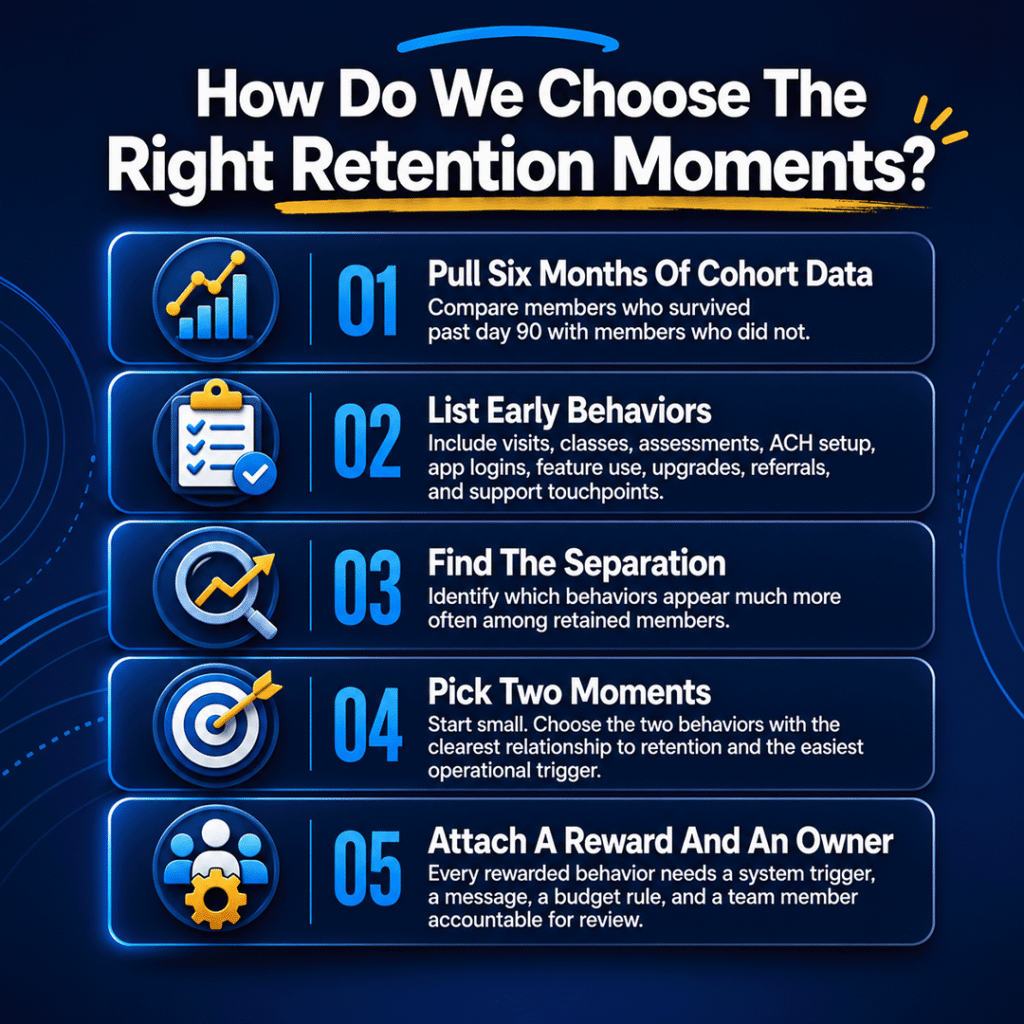
Promotion Vault CEO Brian Mitchell’s instruction is direct: “Start from the data, not the marketing calendar.” He recommends finding the two or three behaviors most correlated with surviving past the three-month mark, then building rewards around those moments.
We are not looking for the prettiest journey map. We are looking for the moments where action changes the retention curve.
For a fitness club, Mitchell says first-30-day usage is often the biggest marker. Some clubs may find that four workouts meaningfully changes the lifecycle. Others may find it takes seven. For SaaS, the moment might be seats activated or a key feature used. For a wellness app, it might be frequency in week one.
Here is the practical selection process:
- Pull Six Months Of Cohort Data: Compare members who survived past day 90 with members who did not.
- List Early Behaviors: Include visits, classes, assessments, ACH setup, app logins, feature use, upgrades, referrals, and support touchpoints.
- Find The Separation: Identify which behaviors appear much more often among retained members.
- Pick Two Moments: Start small. Choose the two behaviors with the clearest relationship to retention and the easiest operational trigger.
- Attach A Reward And An Owner: Every rewarded behavior needs a system trigger, a message, a budget rule, and a team member accountable for review.
The best first moments often include:
- Trial completed
- Trial converted to paid membership
- Second or third visit completed
- Fitness assessment or kickoff completed
- ACH or preferred billing method completed
- First upgrade completed
- First referral made within 30 days
- First friend visit completed
Mitchell cautions against rewarding everything though. “Pick two and execute them well,” he says. Then add more only after the data shows the first hurdles are clearing.
That is what makes this a playbook instead of a promotion. We are not spraying incentives. We are building a sequence.
How Do We Build The First 30-Day Retention Playbook?
Build the first 30-day retention playbook by mapping the member’s path from first intent to early habit. Reward the few completed actions that move them forward: showing up, converting, completing a kickoff, returning enough times to build rhythm, and bringing someone with them.
In Promotion Vault CEO Brian Mitchell’s practical model, the first step is simple: “We need the door to swing.” Then we need the guest trial, the conversion, the completed fitness assessment, the upgrade path, continued usage, and eventually the referral that restarts the lifecycle.
A strong first-30-day playbook might look like this:
- Get The Door To Swing: Reward the prospect for completing the first meaningful visit, not merely filling out a form. The goal is to turn interest into a real experience.
- Reward The Trial Workout: A walkthrough is not the same as trying the service. The member needs to feel the product in their body, schedule, and routine.
- Reward Trial-To-Member Conversion: When someone moves from trial to membership, the reward should reinforce that decision without discounting the membership.
- Reward The Completed Kickoff: The assessment, consultation, or trainer meeting is a springboard. Reward completion, not booking.
- Reward The Usage Milestone: Use the data to decide whether the first target is visit three, four, or seven.
- Reward Payment Stability Where It Matters: If ACH or another payment method improves billing reliability, treat the switch as a retention action.
- Reward The First Referral In 30 Days: A new member who brings someone else into the journey often has another reason to return.
Mitchell gives an illustrative structure: a $10 reward for trying the club, another $10 for converting after the first workout, another $10 for completing the assessment, and a $25 reward for a referral in the first 30 days. To be clear, you should experiment with reward value to find the one that is the best ROI for your company. But you should definitely reward completed actions that you know are worth buying.
Stop asking “How much did we spend on rewards?” and start asking “What did it cost us to acquire the action that extends the member lifecycle?”
How Does Pay-On-Activation Make A Retention Playbook Easier To Defend?
Pay-on-activation makes retention easier to defend because it turns reward spend into a variable cost. We can advertise a stronger reward, send it to eligible members, and pay the full reward value only when the member activates it — which aligns spend with engagement instead of exposure.
Brian Mitchell, CEO of Promotion Vault, says pay-on-activation “converts retention from a fixed cost into a variable cost.” He also says it puts marketing, operations, and finance “on the same scoreboard.”
That is a big shift. In a traditional pay-on-send model, a $25 reward promised to 1,000 people can be treated like a $25,000 expenditure (which doesn’t even include the cost of typical platform service fees). With Promotion Vault’s pay-on-activation model, the service fee (10% — $2,500) is charged when the reward is sent, and the reward face value is charged when the recipient activates. At a 50% activation rate, that changes that charges for rewards from $25,000 to $15,000 ($2,500 + $12,500). That’s a savings of $10,000.
This lets teams design around behavior. We can create a more compelling headline reward without assuming every eligible person will activate it. We can also segment, test, and iterate with less fear of overcommitting the budget.
Most activations happen quickly, with 90% occurring within the first 24 hours. For maximum ROI, activation rate should be segmented by reward value, audience, and campaign type because overall averages hide important differences.
Pay-on-activation also helps assuage concerns from finance. When they ask what you’re paying for, you can point to the exact action you are moving, how much it costs, and how it is lengthening the LTV curve. The budget story gets stronger when the member experience gets stronger.
Promotion Vault’s reward experience also gives the member a branded journey — notification, activation, release, and redemption choice — instead of a generic payout. This ensures that the reward reinforces the relationship with the business sending it, rather than disappearing into a forgettable transaction.
How Do We Automate Follow-Up Without Spamming Members?
Automated follow-up works when it is tied to earned value, clear timing, and guardrails. The point is not to nag members. The point is to help them claim something they earned and move to the next behavior while the action still feels fresh.
Promotion Vault CEO Brian Mitchell says Promotion Vault sends branded email and SMS communications when someone becomes eligible for a reward. He frames the goal as the “right reward to the right person at the right time,” with follow-up designed to help people claim what they have earned.
Follow-up reminders can go out on days 1, 3, 6, 13, 21, 29, 40, 50, and 59 after the initial activation notification, with a 24-hour rate limit, unsubscribe suppression, and eligibility rules based on reward status and activation window. This ensures reward recipients are getting what they are owed — without feeling spammed.
For retention playbooks, we should apply the same discipline to every message:
- Name The Earned Action: “You completed your third visit.”
- Name The Reward Clearly: “Your $10 reward is ready.”
- Name The Next Best Step: “Book your kickoff session” or “Schedule visit four.”
- Keep The Brand Visible: The reward should look and feel like it came from your business.
- Stop When The Moment Ends: A reward that expires should not turn into endless pursuit.
The technology should make the path feel easy. Promotion Vault supports passwordless access through email magic links or SMS codes, which means recipients do not need to create and remember another password just to claim their reward. This further removes friction and supports retention.
How Do We Use Reward Activations To Learn, Not Just Pay?
Reward activations are high-attention moments perfect for getting feedback. When a member activates an earned reward, ask one or two useful questions inside the flow, then use those answers to improve onboarding, referral strategy, service recovery, and future retention offers.
Brian Mitchell, CEO of Promotion Vault, says the reward activation moment is “the highest attention moment” a club has with a new member outside the club. At that moment, the member is engaged because they are receiving money tied to an action they completed.
This is where Data Vault changes the playbook. Mitchell describes Data Vault as mini surveys layered onto the reward experience. Operators can ask NPS, 0-to-10, 1-to-5, Likert, and other question types. In the interview, he said Promotion Vault sees a 97% organic response rate when questions are asked inside the reward flow.
The principle is simple: give to get. We are not asking the member to complete a survey so they can earn value later. We are recognizing the behavior first, then asking for help while goodwill is high.
Good retention questions are short and operational:
- “What almost stopped you from coming back this week?”
- “Which goal matters most in your first 30 days?”
- “Do you want help booking your next visit?”
- “Did anyone on our team make you feel especially welcome?”
- “Would you bring a friend or family member to your next workout?”
- “What is one thing we could make easier before your next visit?”
The answer should go somewhere useful. If the member says scheduling is confusing, that is an ops signal. If they say they want personal training help, that is a sales signal. If they say they have three friends who might join, that is a referral signal. If they say they felt invisible at the front desk, that is a service recovery moment.
Mitchell shared one example from referral data. A customer asked members who they referred, and the data showed 76% were family members. That insight — along with some AI-assisted suggestions provided by Data Vault — provided the customer with an untapped segment to target for referrals: coworkers. This led the customer to institute “Coworker Saturdays” which saw referrals rise meaningfully.
A reward should not be the end of the conversation. It should be the moment where we learn what to improve next.
What Should We Measure Weekly?
Measure the behaviors the playbook is designed to move: eligibility, activation rate, completed action rate, cost to acquire the action, D7/D14/D30 usage, billing rescues, kickoff completion, referrals, upgrades, and 90-day survival by cohort. Retention improves when teams review behavior, not just campaign activity.
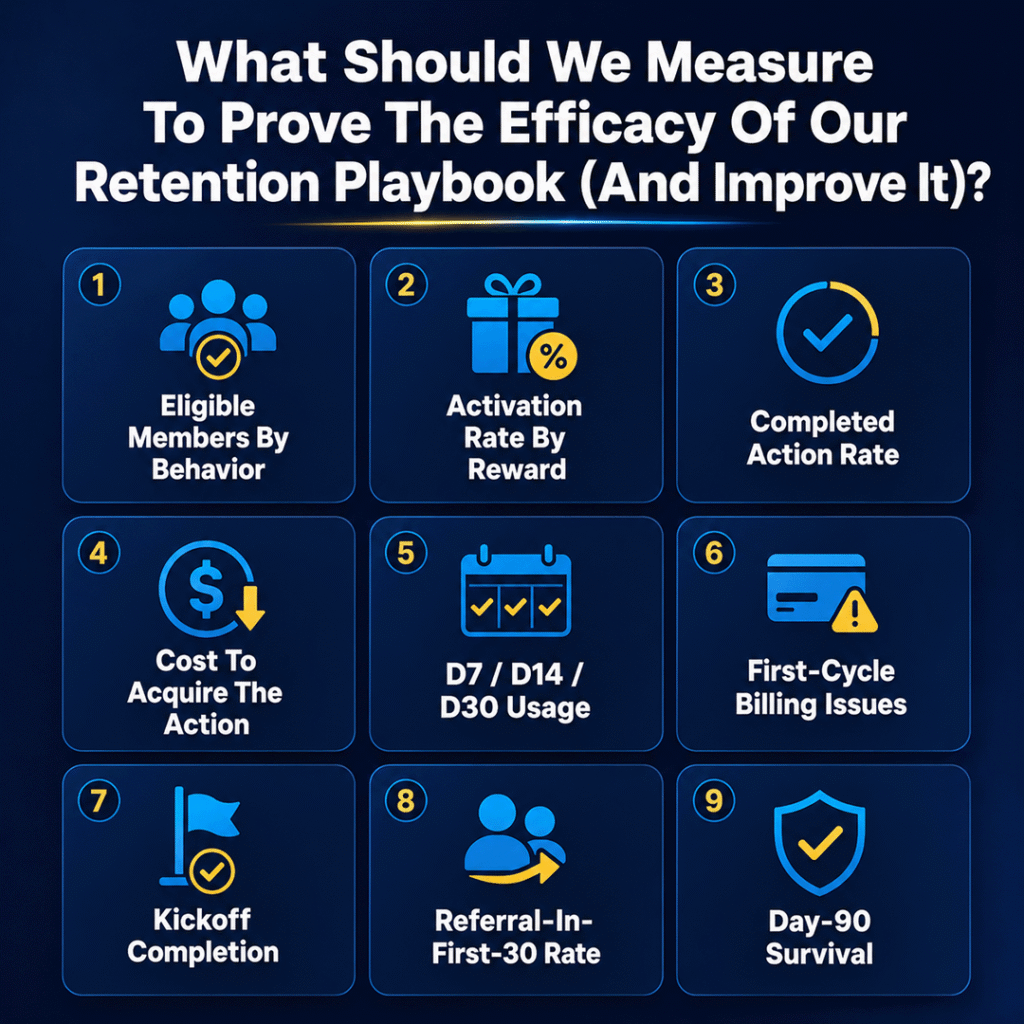
A weekly retention review should fit on one page. If it takes a data team two weeks to assemble, the playbook will not stay alive.
Track these numbers first:
- Eligible Members By Behavior: How many people qualified for each reward?
- Activation Rate By Reward: How many claimed the reward?
- Completed Action Rate: How many completed the behavior we actually care about?
- Cost To Acquire The Action: What did we spend per completed third visit, assessment, ACH switch, upgrade, or referral?
- D7 / D14 / D30 Usage: Did early attendance increase?
- First-Cycle Billing Issues: How many failed, how many were personally rescued, and how many stayed active?
- Kickoff Completion: How many members completed the first coaching or assessment appointment?
- Referral-In-First-30 Rate: How many new members brought someone else into the journey?
- Day-90 Survival: Did the rewarded cohort stay at a higher rate than the comparison cohort?
Promotion Vault’s pay-on-activation model makes this easier to review because activation rate becomes a real operating metric. It is not just “did we send the offer?” It is “who engaged, who did not, what did it cost, and which behavior moved?”
We should also segment. A single average can hide the truth. A $10 reward, a $25 reward, and a $50 reward may behave differently. A first-time member may behave differently than a returning member. A high-intent referral may behave differently than a cold prospect.
And, just to be clear, measurement is not about proving anyone right or wrong. It is about making more fully informed strategies and decisions.
How Can We Launch This Without Overwhelming Our Team?
Launch by choosing two retention moments, one audience, one reward structure, and one weekly review rhythm. Do not build the whole lifecycle at once. Prove the first two behaviors move, then add the next moment only when the team can support it cleanly.
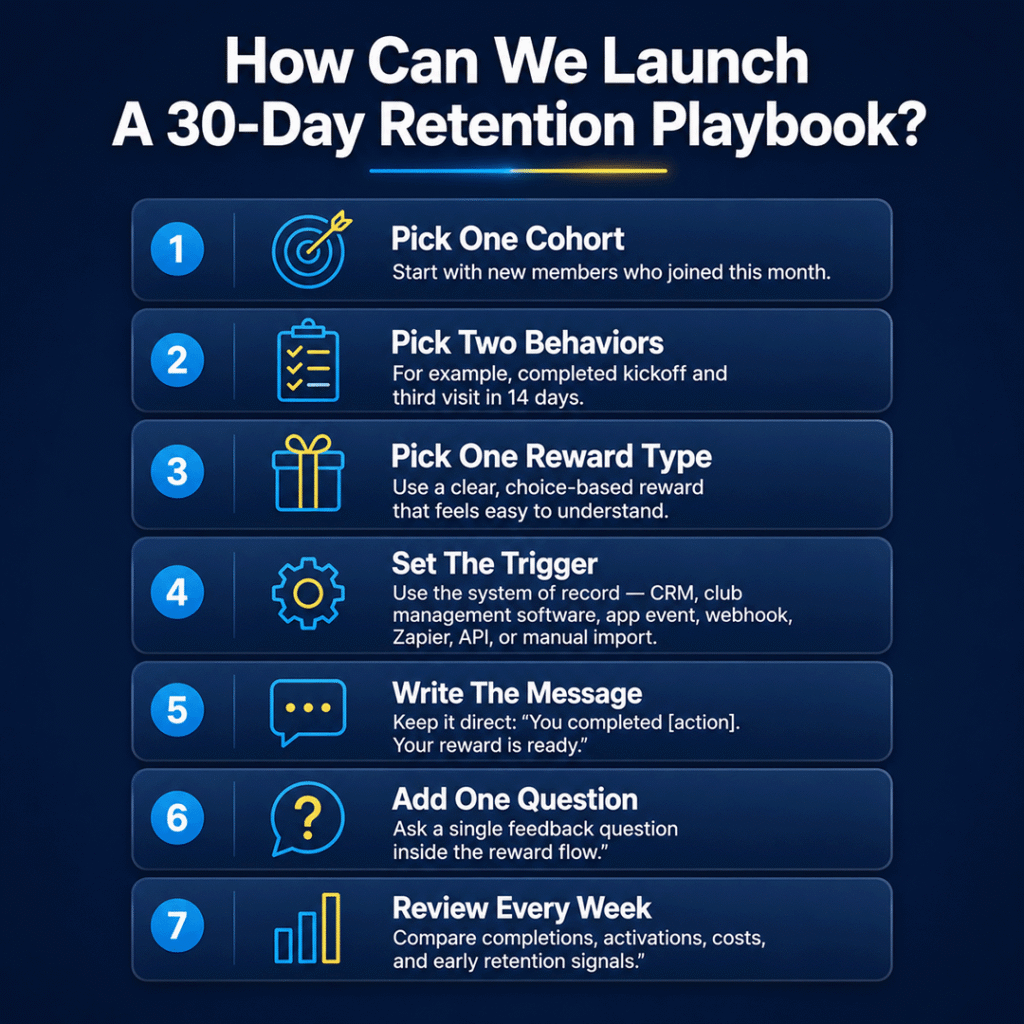
Promotion Vault CEO Brian Mitchell’s advice is deliberately practical: “Pick two and execute them well.” That is the difference between a playbook that ships and a strategy deck that gathers dust.
Here is the lowest-friction launch plan:
- Pick One Cohort: Start with new members who joined this month.
- Pick Two Behaviors: For example, completed kickoff and third visit in 14 days.
- Pick One Reward Type: Use a clear, choice-based reward that feels easy to understand.
- Set The Trigger: Use the system of record — CRM, club management software, app event, webhook, Zapier, API, or manual import.
- Write The Message: Keep it direct: “You completed [action]. Your reward is ready.”
- Add One Question: Ask a single feedback question inside the reward flow.
- Review Every Week: Compare completions, activations, costs, and early retention signals.
Promotion Vault can connect rewards to business workflows through tools like GoHighLevel webhooks, API credentials, Team ID, Promotion ID, and contact fields such as name, email, and mobile. For fitness operators using ABC Ignite, Promotion Vault supports triggers such as new member joins, referrals, ACH-related actions, guest pass or tour events, check-ins within 30 days, completed events, and upgrades.
This is critical because rewards work best for behavioral change when they are instant (delivered right after the action). If the reward shows up days after the behavior, it might be a nice surprise. If it shows up right after the behavior, it becomes reinforcement.
The playbook does not need to be perfect to start. It just needs to be specific, measurable, and transparent enough that it can be improved over time.
Frequently Asked Questions About Retention Playbooks
What Is A Customer Retention Playbook?
A customer retention playbook is a documented system for helping customers complete the behaviors that make them more likely to stay. It includes the target audience, key retention moments, triggers, rewards or interventions, follow-up messages, owner responsibilities, and weekly metrics.
How Do We Reduce Churn In The First 30 Days?
Reduce first-30-day churn by identifying the early behaviors that predict day-90 survival, then helping new members complete those behaviors quickly. For membership businesses, that often means driving second and third visits, completing kickoff appointments, resolving first-cycle billing friction, and personalizing follow-up.
Should We Use Discounts Or Rewards To Improve Retention?
Use rewards when we want to recognize completed behaviors without lowering the perceived value of the membership. Discounts may help in some save situations, but repeated discounting can teach customers to wait for lower prices. Rewards add value around the relationship instead of cutting into the core offer.
What Is The Best First Retention Reward To Test?
The best first retention reward is tied to the earliest behavior with the clearest connection to long-term value. For a fitness club, that may be completing the third visit or finishing a kickoff assessment. For SaaS, it may be activating seats or using a core feature.
How Can We Automate Retention Rewards?
Automate retention rewards by connecting the system that records the behavior to a reward platform. The trigger can come from a CRM, webhook, Zapier, API, club management software, app event, or data import. The reward should send only after the completed behavior is verified.
How Does Pay-On-Activation Protect The Budget?
Pay-on-activation protects the budget by charging the reward face value only when the recipient activates the reward. That lets teams forecast around real engagement, test larger headline rewards, and compare spend against completed behaviors instead of paying full value for every reward sent.
So, How Do We Actually Build A Retention Playbook That Keeps Members?
Build a retention playbook by starting with the first 30 days, not the cancellation moment. Use six months of cohort data to find the two or three early behaviors that best predict day-90 survival, then reward those completed actions with small, immediate, choice-based rewards. Automate the triggers, personalize the follow-up, measure cost to acquire each action, and use reward activation moments to collect feedback. The goal is not to bribe members to stay — it is to help them build enough early momentum that staying feels natural.
If we already know the behavior that predicts retention, then we should build the first reward around that behavior. If we do not know it yet, then the first move is a six-month cohort review. If the team can agree on two moments, Promotion Vault can help turn those moments into automated, branded, measurable rewards.