To engage customers throughout summer, we should reward the behaviors that create business value: repeat visits, referrals, renewals, upgrades, reactivations, and feedback. Instant digital rewards work best when they are tied to completed actions, delivered through a trusted branded experience, and measured against activation and downstream behavior.
TLDR — How Can Businesses Engage Customers Throughout Summer?
- Summer exposes which customer relationships need a next step.
- Reward action — not attention, clicks, or seasonal interest.
- Build a 30-day behavior plan that can stretch all summer.
- Target repeat visits, referrals, renewals, upgrades, reactivation, and feedback.
- Use June for momentum, July for referrals, and August for comeback actions.
- Deliver rewards after the behavior, not before the commitment.
- Use instant rewards to protect price integrity without discounting.
- Segment customers by behavior so each group gets the right next step.
- Measure activation, completed actions, lift, cost, and repeat behavior.
- Book a Promotion Vault demo to launch one behavior-based reward campaign.
- Why Is It Difficult To Maintain A Business-Customer Relationship In Summer?
- What Is The Best Way To Engage Customers Throughout Summer?
- Why Do Summer Engagement Campaigns Usually Lose Momentum?
- Which Customer Behaviors Should We Reward During Summer?
- How Do We Build A Summer Customer Engagement Calendar?
- How Do Instant Digital Rewards Keep Customers Engaged Without Discounting?
- How Can Promotion Vault Make Summer Engagement Easier To Run?
- How Should We Measure Whether Summer Engagement Worked?
- What Hurdles Need To Be Considered Before Launching A Summer Rewards Campaign?
- What Summer Customer Engagement Campaigns Can We Launch This Week?
- Frequently Asked Questions About Summer Customer Engagement
- So, How Can We Actually Engage Customers Throughout Summer?
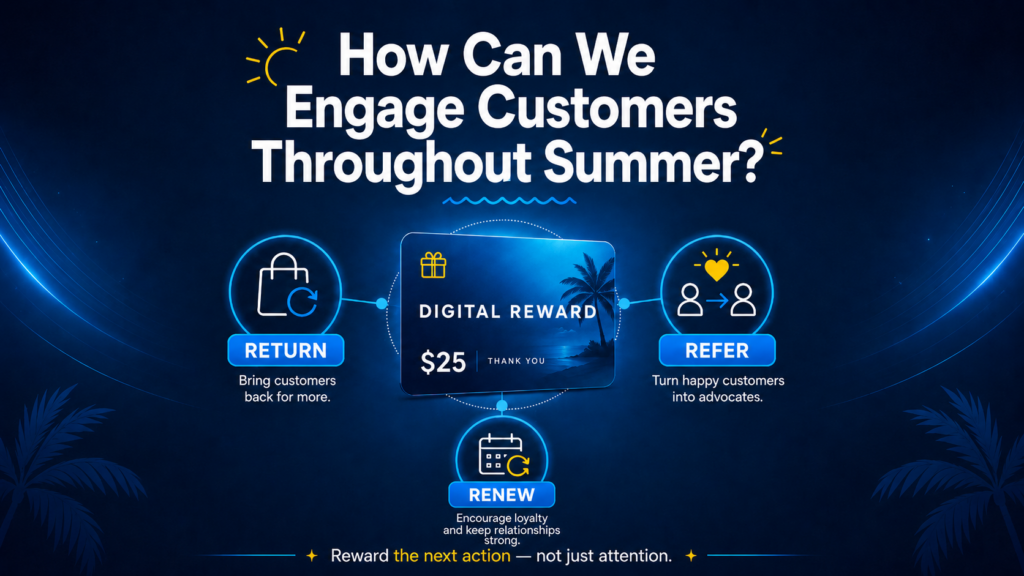
Why Is It Difficult To Maintain A Business-Customer Relationship In Summer?
Summer does not create customer apathy; it exposes which relationships still have a next step. When people travel, change routines, spend differently, or drift into a slower buying rhythm, we shouldn’t adapt by poking more or being louder. Instead, we should make the next useful customer action feel clear, timely, and worth taking.
Summer is a string of competing micro-moments for customers. A gym member misses two weeks for vacation. A SaaS user delays onboarding because the team is half out. A dealership customer postpones service in favor of a holiday trip. A retail customer spends selectively to keep some money in the bank for leisurely activities. A family starts thinking about back-to-school before July is even over. According to Deloitte’s 2025 Summer Travel Survey, more Americans planned summer travel in 2025, but with tighter budgets and shorter trips. People are still active, but their attention and spending have to be earned more than ever.
Instant digital rewards let us earn both. We can reward the behaviors that actually strengthen the relationship — the second visit, the completed onboarding step, the qualified referral, the renewal, the comeback appointment, the feedback response. And we can do succeed using rewards without leaning on blanket discounts or holiday sales — which can teach customers to wait and damage the perceived value of our products and services.
What Is The Best Way To Engage Customers Throughout Summer?
The best way to engage customers throughout summer is to build a 30-day behavior plan that can stretch across the season. Pick the customer actions that create retention, referrals, upgrades, or reactivation. Then reward those completed actions with instant digital rewards, branded follow-up, and simple measurement so the campaign is built and continually iterated for progress.
We’re not trying to keep in touch just for the sake of it. We’re trying to help customers continue a valuable relationship while their routines are disrupted.
A summer engagement system should answer four questions before any message goes out:
- What customer behavior do we want more of?
- When is the customer most likely to take that action?
- What reward would make the action feel immediately worthwhile?
- How will we know whether the reward changed behavior?
That is where instant digital rewards fit. They make motivation tangible without cutting the core price. They also give operators something measurable to manage. Promotion Vault is built around this exact job: helping teams use rewards to drive measurable actions across acquisition, retention, referrals, upgrades, and reactivation.
Why Do Summer Engagement Campaigns Usually Lose Momentum?
Summer engagement campaigns usually lose momentum because they reward attention instead of action. A themed email, giveaway, or discount may create a short spike. But without a behavior trigger, clear qualification rule, and follow-up cadence, the campaign becomes another seasonal message competing with vacations, weather, travel, and budget pressure.
That doesn’t mean seasonal marketing is wrong. However, the mechanism matters. A summer sale asks people to buy because the calendar changed. A reward-powered engagement system asks people to complete an action that benefits both sides.
The common breakdowns are familiar:
| Summer Campaign Mistake | What It Creates | Better Reward-Based Alternative |
|---|---|---|
| Discounting everything | Lower margin and weaker price expectations | Reward a completed behavior, like a second visit or renewal |
| Sending one broad blast | Low relevance and weak response | Segment by lifecycle stage and behavior |
| Running one-off giveaways | Attention without follow-through | Reward referrals, check-ins, upgrades, or feedback |
| Ignoring lapsed customers | Customer churn | Offer a comeback reward after the return action |
| Measuring opens and clicks only | Vanity reporting | Measure activated rewards and downstream behavior |
Harvard Business Review has long noted that acquiring a new customer can cost five to 25 times more than retaining an existing one, depending on the study and industry. That is why summer matters. When attention gets scattered, the customers we already earned deserve a clear path back into momentum.
Which Customer Behaviors Should We Reward During Summer?
We should reward the customer behaviors that actually predict future value. Strong summer reward targets include repeat visits, completed onboarding, qualified referrals, renewals, upgrades, reactivations, feedback responses, and payment or plan changes that improve retention and reduce operational risk.
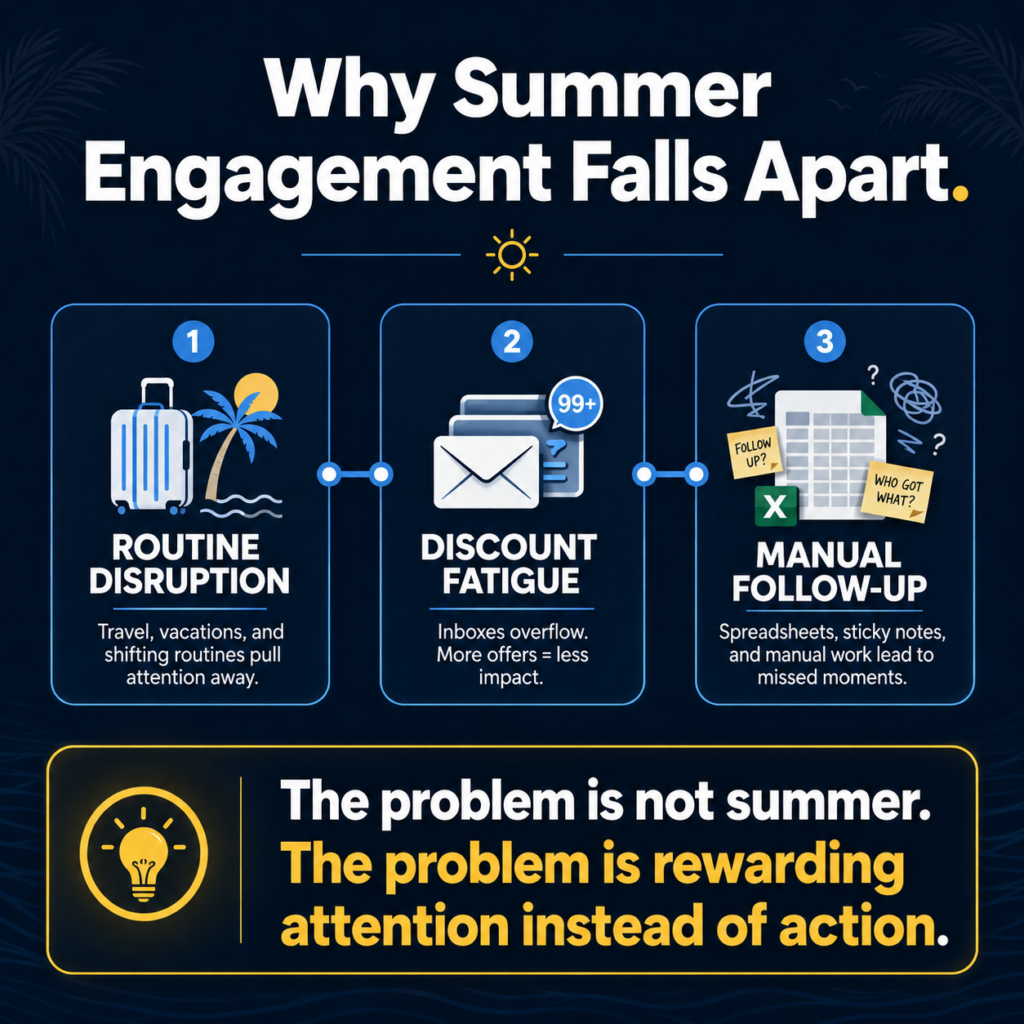
The actions we’re trying to encourage should be operational and practical. For most operators, the summer behavior map looks like this:
| Goal | Customer Behavior To Reward | Example Reward Moment |
|---|---|---|
| Retention | Complete a second visit, second purchase, or second login | “Come back twice this month and earn a reward.” |
| Referral Growth | Submit a qualified referral or refer someone who converts | “Refer a friend who joins, and both of you earn rewards.” |
| Reactivation | Return after 30, 60, or 90 days away | “Come back this week and earn a thank-you reward after your visit.” |
| Renewal | Renew early or complete the first retained billing cycle | “Renew by Friday and earn a reward after renewal is confirmed.” |
| Upgrade | Move to a higher-value plan or service tier | “Upgrade this month and earn a reward after your first upgraded cycle.” |
| Feedback | Answer a short customer pulse question | “Tell us what would make summer easier, and earn a reward.” |
Summer behavior is uneven. Some customers are more active. Some are away. Some are comparison shopping. Some are happy but distracted. If we average them together, we lose the signal. If we segment them by behavior, we can help each group take the next best step.
For referral-specific campaigns, the strongest structure is usually not to simply push them to share with a friend. It is to clarify that they should share with a friend, at which point we will validate the lead, and reward the referral once it converts. That protects spend and keeps trust intact. Referral program software should support that kind of reward-powered referral flow, not force operators to stitch together forms, spreadsheets, and manual sends.
How Do We Build A Summer Customer Engagement Calendar?
We build a summer customer engagement calendar by turning June, July, and August into three behavior sprints. June should activate momentum. July should deepen participation and referrals. August should recover distracted customers and prepare them for the next routine. Each sprint needs one primary behavior, one reward, one audience, and one measurement plan.
This keeps the campaign from becoming a pile of ideas. We are not looking for summer content. We are building a sequence customers can actually follow.
How Do We Use June To Activate Customer Momentum?
Use June to reward the first meaningful summer action. That may be a first visit after school ends, a completed onboarding step, a booked service appointment, a renewed membership, or a second purchase. The goal is to prevent drift before it becomes churn.
A strong June reward campaign might sound like this:
- “Complete your first summer check-in by June 20 and earn a reward.”
- “Finish onboarding before your team’s summer slowdown and earn a reward.”
- “Book your summer service visit this week and earn a reward after completion.”
- “Make your second purchase this month and earn a thank-you reward.”
The key is qualification. The reward should come after the behavior, not before. That turns the message into a commitment path.
How Do We Use July To Increase Referrals And Repeat Engagement?
Use July to reward customers who are already active enough to advocate. Summer is social. People travel, gather, train, dine out, visit local services, and compare recommendations. A referral reward works best when it is easy to understand and tied to a real conversion.
This is where a mid-summer referral push can work well. We can make it simple:
- Reward the existing customer when a referred person becomes qualified.
- Reward the new customer after they complete the first valuable action.
- Add a deadline to create focus, not pressure.
- Use reminders so the program does not depend on staff memory.
A referral program becomes a reward-powered growth loop when the invitation, validation, reward, and follow-up all support the same customer action.
How Do We Use August To Recover Customers Before Fall?
Use August to reward the comeback action. Late summer is when customers begin rebuilding routines. Retailers see back-to-school planning. Fitness operators see schedule resets. SaaS teams see work rhythms normalize. Service businesses see customers catch up on delayed needs.
The National Retail Federation tracks back-to-school as a major seasonal shopping period, and its 2025 coverage showed many shoppers began early. For operators, the lesson is broader than retail. August is a reset month. Customers are not only ending summer. They are deciding what routines deserve space next.
A good August comeback campaign might say:
- “We saved you a spot. Complete your comeback visit this week and earn a reward.”
- “Restart your plan before September and earn a reward after your first completed action.”
- “Book your overdue service appointment and earn a reward after completion.”
- “Tell us what would make fall easier, and earn a reward after your response.”
We shouldn’t shame people for drifting. Instead, we should simply make returning feel easy, respectful, and worth doing in the moment.
How Do Instant Digital Rewards Keep Customers Engaged Without Discounting?
Instant digital rewards keep customers engaged without discounting because they reward the behavior instead of reducing the price. A discount changes what the product is worth. A reward recognizes what the customer did. That distinction helps us protect margin, preserve brand value, and still create immediate motivation.
Discounts can be useful in limited contexts. But when they become the default, they can train customers to wait for a lower price. Instant rewards work differently. They can say:
- “Thank you for coming back.”
- “Thank you for referring someone.”
- “Thank you for renewing.”
- “Thank you for giving us feedback.”
- “Thank you for completing the step that helps you get value.”
That is a stronger relationship signal. It feels like recognition, not a markdown.
Salesforce’s State of the Connected Customer research emphasizes the pressure brands face around customer expectations, trust, and engagement. The Federal Trade Commission also warns consumers about gift-card-style scams, which is why reward delivery has to feel legitimate. A branded, secure, recognizable reward experience matters. The customer should know who the reward is from, why they earned it, and how to claim it safely.
How Can Promotion Vault Make Summer Engagement Easier To Run?
Promotion Vault makes summer engagement easier to run by turning reward ideas into automated behavior campaigns. We define the action, trigger the reward through promotions, reward links, integrations, webhooks, or quick sends, send branded reminders, track activation, and measure what happened after the customer completed the action.
Rewards work best as part of a growth system.
Promotion Vault helps operators do five things that summer campaigns often need:
- Trigger Rewards At The Right Moment: We can tie rewards to specific actions such as joins, referrals, visits, renewals, upgrades, and comeback milestones.
- Deliver A Branded Reward Experience: Customers receive a clear, branded reward journey rather than a disconnected code that gets lost in the inbox.
- Use Activation To Control Spend: With pay-on-activation economics, the reward face value is paid when the recipient activates. That can reduce waste compared with paying full value for every reward sent.
- Automate Follow-Up Without Spamming People: Promotion Vault’s reminder cadence helps unactivated recipients remember the reward, while guardrails help prevent fatigue.
- Turn Reward Moments Into Feedback Loops: With Data Vault, we can ask targeted questions during reward moments and learn what customers need next.
This is why Promotion Vault sits between a payout tool and a loyalty platform. We are not only delivering value. We are helping operators move behavior, protect spend, and learn from every send. For teams that already run CRM workflows, Zapier can help connect reward triggers to the systems operators already use.
How Should We Measure Whether Summer Engagement Worked?
We should measure summer engagement by tracking the full path from eligibility to activation to completed business outcome. Strong metrics include eligible customers, activated rewards, completed behaviors, repeat actions, referral quality, reactivation rate, renewal rate, upgrade rate, incremental lift, reward cost per outcome, and feedback response quality.
This is where many campaigns get too soft. We do not need to reduce engagement to one dashboard number. We need to measure the steps that prove the system worked.
Start with these metrics:
| Metric | What It Tells Us |
|---|---|
| Eligible Customers | How many people qualified for the offer |
| Activation Rate | How many recipients claimed the reward |
| Completed Behavior Rate | How many completed the target action |
| Incremental Lift | Whether the campaign beat baseline or holdout |
| Cost Per Completed Action | Whether the reward economics make sense |
| Repeat Behavior | Whether the action became momentum |
| Referral Quality | Whether referred customers were real and valuable |
| Feedback Themes | What customers told us at the reward moment |
A PLOS ONE systematic review found that even small monetary incentives can increase consent and response rates in research participation. Put simply: When we ask someone to take an extra step, the right incentive can increase follow-through.
The cleaner our measurement, the better our next campaign gets. If the reward moved first visits but not second visits, we change the milestone. If referrals increased but quality dropped, we add validation. If rewards activated but renewals did not lift, we fix the offer timing or audience.
What Hurdles Need To Be Considered Before Launching A Summer Rewards Campaign?
Before launching a summer rewards campaign, we should consider potential hurdles, such as: whether rewards cheapen the brand, attract low-quality customers, create operational work, or fail to prove ROI. Each hurdle can be overcome by tying rewards to verified behaviors, automating delivery, segmenting audiences, and measuring outcomes.
The strongest operators do not ignore potential hurdles. They build their campaigns with them in mind.
Will Rewards Cheapen The Brand?
Rewards cheapen the brand when they act like constant discounts. They strengthen the brand when they recognize meaningful action. We should reward commitment behaviors, not bargain hunting. A reward after a completed visit, renewal, upgrade, or referral says, “We see your action.” That is different from saying, “We are worth less today.”
Will Incentives Attract The Wrong Customers?
Incentives attract the wrong customers when qualification is loose. Gate the reward behind the right action. For referrals, reward after validation or conversion. For reactivation, reward after the comeback visit. For SaaS, reward after onboarding is completed. For service businesses, reward after the appointment is finished.
Will This Add More Work For The Team?
It can, if the team runs everything manually. But reward campaigns should leverage automation, templates, triggers, and reporting. The practical standard is simple: if the campaign cannot run without a spreadsheet scramble, it is not ready to scale.
Can We Prove The Campaign Worked?
We can get much closer if we define success before launch. Use a baseline, a holdout, or a clean before-and-after comparison. Track the target behavior, not just the reward activation. If the goal is retention, measure retained behavior. If the goal is referrals, measure qualified referred customers.
What Summer Customer Engagement Campaigns Can We Launch This Week?
We can launch a summer customer engagement campaign this week by choosing one customer segment, one valuable behavior, one reward, and one follow-up path. The best first campaigns are simple: comeback rewards, referral rewards, second-visit rewards, renewal rewards, upgrade rewards, or feedback rewards.
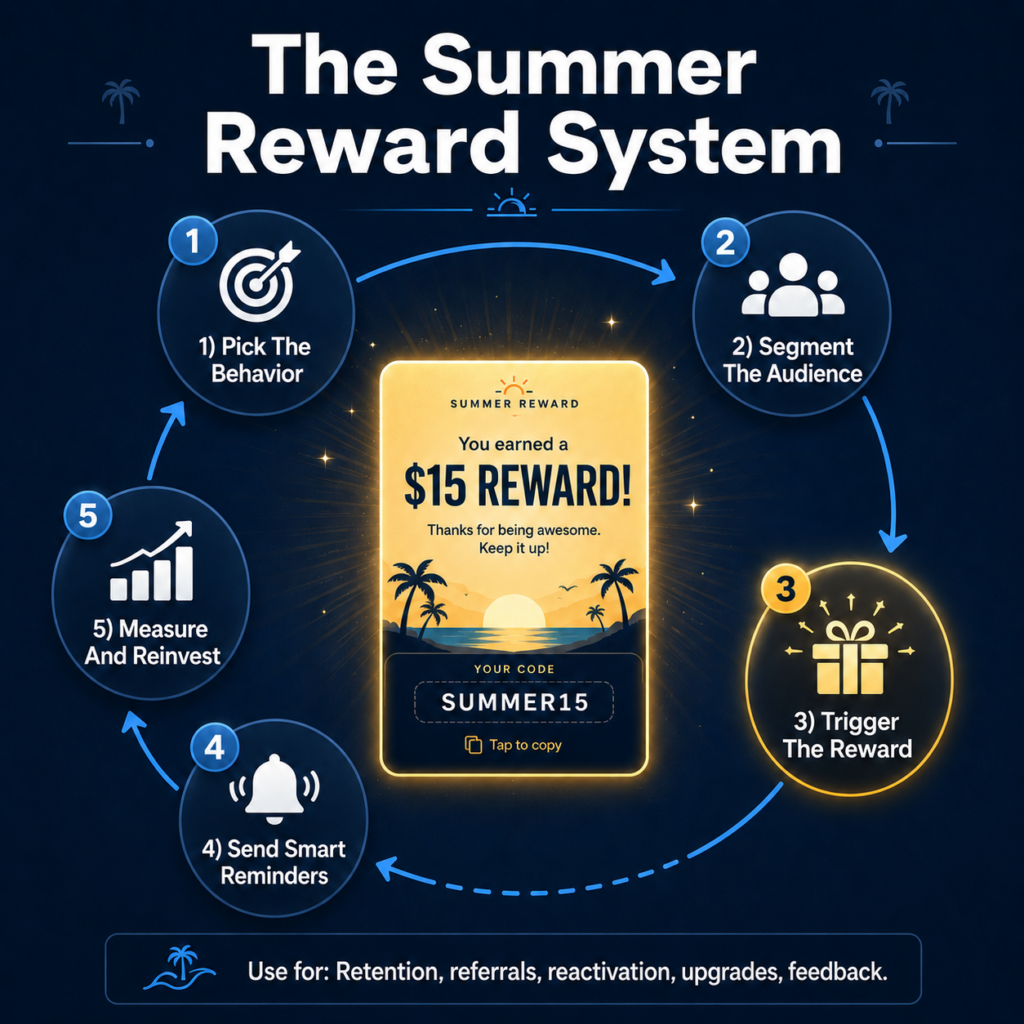
Here are six practical campaign templates.
How Do We Reward A Second Visit Or Second Purchase?
Reward the second action because it proves early momentum. Send the reward only after the customer completes the second visit, purchase, login, class, appointment, or order. This works well for gyms, salons, restaurants, retail, SaaS onboarding, and service businesses.
Campaign Logic: First action shows interest. Second action shows momentum.
How Do We Bring Back Dormant Customers?
Reward the comeback action, not the promise to come back. Send a simple message to customers who have been inactive for 30, 60, or 90 days. Offer a reward after they complete the return visit, booking, purchase, login, or consultation.
Campaign Logic: We lower the emotional friction of returning without giving away value too early.
How Do We Increase Summer Referrals?
Reward customers when their referral becomes qualified. Make the rules clear. Tell customers who qualifies, what both people get, and when the reward arrives. Double-sided rewards can work well when both the referrer and the new customer take meaningful action.
Campaign Logic: Social moments are high in summer. A clear referral reward turns goodwill into action.
How Do We Improve Renewals Without Discounting?
Reward renewal completion instead of reducing the renewal price. This is especially useful for subscriptions, memberships, insurance, SaaS, and service plans. The reward should feel like a thank-you, not a rescue offer.
Campaign Logic: We protect price integrity while recognizing commitment.
How Do We Encourage Upgrades Or Higher-Value Actions?
Reward the first completed action in the upgraded state. For example, reward a member after they upgrade and complete their first premium class. Reward a SaaS user after they activate the advanced feature. Reward an automotive customer after they complete the recommended service.
Campaign Logic: The upgrade matters most when the customer experiences value after upgrading.
How Do We Collect Better Customer Feedback During Summer?
Ask one or two targeted questions at a high-reciprocity moment. Pair the request with a reward when appropriate. Keep the question specific: “What almost kept you from coming in this month?” will teach us more than “How are we doing?”
Campaign Logic: Reward moments create attention, and attention creates a better window for learning.
Frequently Asked Questions About Summer Customer Engagement
How Can We Engage Customers Throughout Summer?
We can engage customers throughout summer by rewarding specific actions that keep the relationship active. The best targets are repeat visits, renewals, referrals, upgrades, reactivations, and feedback. The campaign should be simple, time-bound, automated, and measured against completed customer behavior.
What Are The Best Summer Customer Engagement Ideas?
The best summer customer engagement ideas are behavior-based campaigns: second-visit rewards, comeback rewards, referral rewards, early renewal rewards, upgrade rewards, feedback rewards, and back-to-routine August campaigns. Each idea works best when the reward comes after the customer completes the desired action.
Are Instant Digital Rewards Better Than Discounts For Summer Campaigns?
Instant digital rewards are often better than discounts when the goal is retention, referrals, reactivation, or upgrades. A discount lowers the price. A reward recognizes a completed action. That helps us motivate customers while protecting the perceived value of the core product or service.
How Much Should We Offer For A Summer Customer Reward?
The right reward amount depends on the value of the behavior, the customer segment, and the economics of the campaign. Start with the smallest reward that feels meaningful, then measure activation rate, completed behavior, and cost per outcome. Higher-value behaviors can justify higher rewards.
How Do We Automate Summer Rewards Without Creating More Work?
We automate summer rewards by connecting the trigger system to the reward system. The trigger might be a form, CRM stage, visit, referral, renewal, upgrade, or completed onboarding step. Promotion Vault can then send, remind, track, and report on the reward flow.
How Do We Measure ROI On Summer Customer Engagement Rewards?
Measure ROI by comparing the reward cost against incremental business outcomes. Track eligible customers, activated rewards, completed actions, repeat behavior, conversion lift, retention lift, referral quality, and cost per outcome. Use a holdout group or baseline whenever possible.
So, How Can We Actually Engage Customers Throughout Summer?
We can engage customers throughout summer by treating the season as a behavior system, not a promotional theme. We choose the actions that create value — return visits, referrals, renewals, upgrades, reactivations, and feedback — then reward those actions when they happen. Instant digital rewards work because they make appreciation immediate, protect price integrity, and give operators a clear way to measure customer follow-through.
If we want more repeat visits, reward the second completed visit. If we want more referrals, reward the qualified referral. If we want more renewals, reward the completed renewal. If we want more reactivation, reward the comeback action. If we want better insight, reward the short feedback response.
Then measure what happened and reinvest in what worked.