Activate your rewards here ›

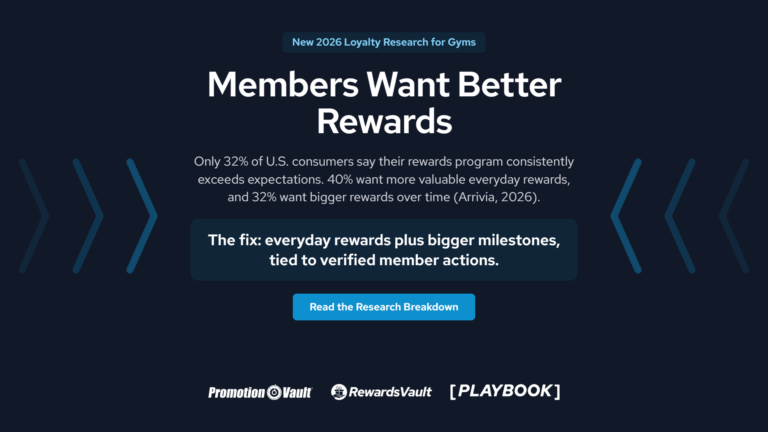
Wide dark navy featured image with centered text framed by rows of faint blue chevrons on the left and right pointing inward. A label reads New 2026 Loyalty Research for Gyms above the headline “Members Want Better Rewards.” Supporting loyalty program statistics from Arrivia’s 2026 research: Only 32% of U.S. consumers say their rewards program consistently exceeds expectations. 40% want more valuable everyday rewards. 32% want bigger rewards over time. A blue panel states the fix in bold: everyday rewards plus bigger milestones, tied to verified member actions. A blue Read the Research Breakdown button appears below. Promotion Vault, Rewards Vault, and PLAYBOOK logos run across the bottom.

New Loyalty Survey Contains Engagement Insights for Gyms

A 2026 arrivia survey found 90% of U.S. consumers expect to stay loyal to their preferred brand (but expecting to stay isn’t necessarily staying). Only 32% say its rewards program consistently exceeds expectations. Businesses plan to spend more, and that spend should be data-backed and performance-based. For gyms, that means rewarding verified actions members value and making rewards easy to claim.
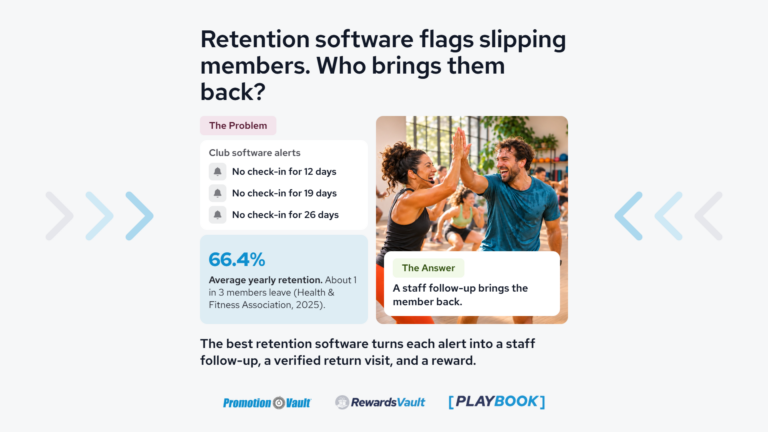
Featured image for a guide to customer retention software for gyms, headlined “Retention software flags slipping members. Who brings them back?” On the left, labeled “The Problem,” a club software alerts card lists three members with no check-in for 12, 19, and 26 days. Below it, a highlighted stat shows 66.4% average yearly retention, with about 1 in 3 members leaving (Health & Fitness Association, 2025). On the right, labeled “The Answer,” a group fitness instructor wearing a headset mic high-fives a laughing member in a teal T-shirt during a busy, sunlit class. The caption reads “A staff follow-up brings the member back.” A closing line states that the best retention software turns each alert into a staff follow-up, a verified return visit, and a reward. Promotion Vault, Rewards Vault, and PLAYBOOK logos run along the bottom.

What Is the Best Customer Retention Software for Gyms?

The best customer retention software for gyms does more than flag members who are slipping. It gives staff a reason to follow up, checks the visit or renewal that follows against club records, and rewards members for real progress. Built on top of your club management system, it shows which floor conversations kept revenue.

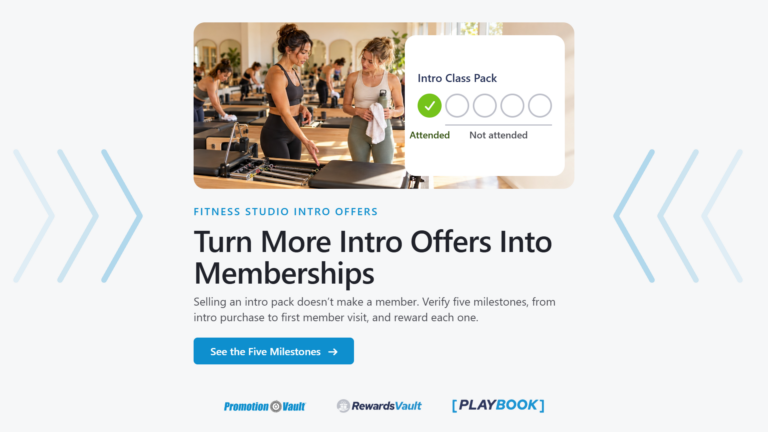
Featured image for a guide on fitness and Pilates studio intro offer conversion. A Pilates instructor and a new client talk beside a reformer in a bright studio. Next to them, an intro class pack card shows one class attended and four not attended. Headline: “Turn More Intro Offers Into Memberships.” The supporting line explains that selling an intro pack doesn’t make a member and that studios should verify and reward five milestones, from intro purchase to first member visit. A blue “See the Five Milestones” button sits below, and soft blue chevrons on both sides point toward the center.

How Do Fitness Studios Convert Intro Offers Into Memberships?

A new studio can turn intro offers into repeat sales by rewarding confirmed visits and encouraging membership, upgrade, or pack purchases. Using Studio Pilates as an example, one PLAYBOOK campaign connects essential milestones to a branded Rewards Vault while booking and checkout stay in the studio’s existing systems.

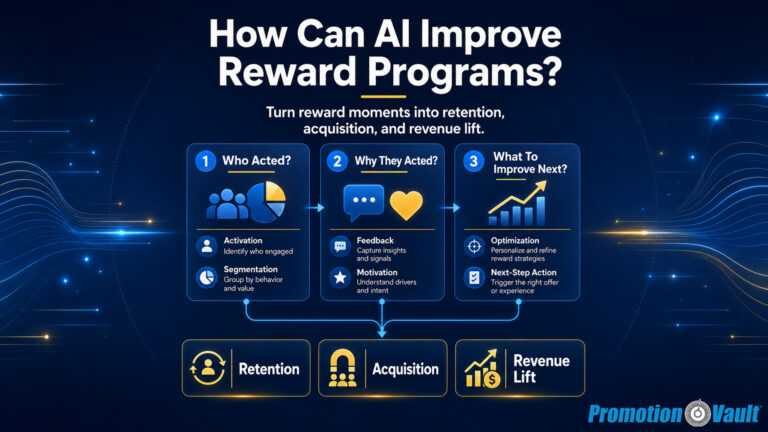
A 16:9 Promotion Vault featured image titled “How Can AI Improve Reward Programs?” with the subhead “Turn reward moments into retention, acquisition, and revenue lift.” The graphic shows three AI insight panels — “Who Acted?”, “Why They Acted?”, and “What To Improve Next?” — feeding into business outcomes labeled “Retention,” “Acquisition,” and “Revenue Lift,” with blue and gold data-flow lines guiding attention to the center.

How Can AI Improve Rewards For Revenue Lift?

AI can improve reward programs when it helps operators choose better reward moments, ask better questions, segment responses, and measure what happens after activation. The goal is not more automation for its own sake — it is a cleaner reward system that drives retention, acquisition, referrals, upgrades, and revenue lift.

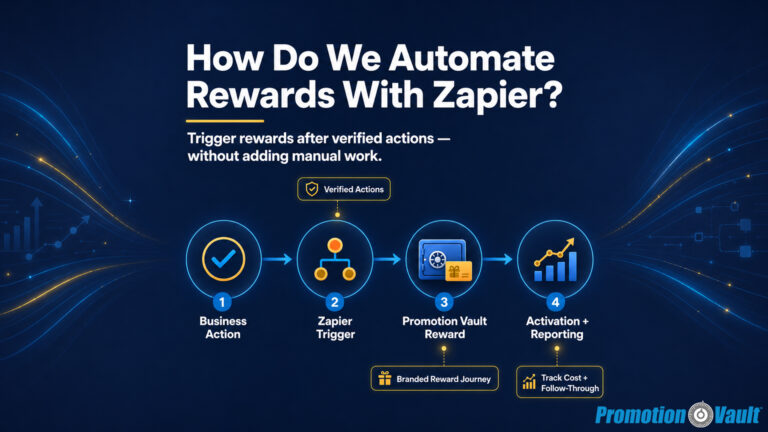
16:9 Promotion Vault featured image with the headline “How Do We Automate Rewards With Zapier?” and the subhead “Trigger rewards after verified actions — without adding manual work.” The central workflow shows four connected steps: “Business Action,” “Zapier Trigger,” “Promotion Vault Reward,” and “Activation + Reporting.” Supporting callouts read “Verified Actions,” “Branded Reward Journey,” and “Track Cost + Follow-Through.” The dark blue, data-driven design uses blue and gold directional graphics to guide attention toward the reward automation process.

How Do We Automate Rewards With Zapier To Lift Revenue?

Reward automation with Zapier works best when a verified business action triggers a reward through Promotion Vault. The right setup reduces manual sending, protects budget, improves follow-through, and turns every reward into measurable engagement.

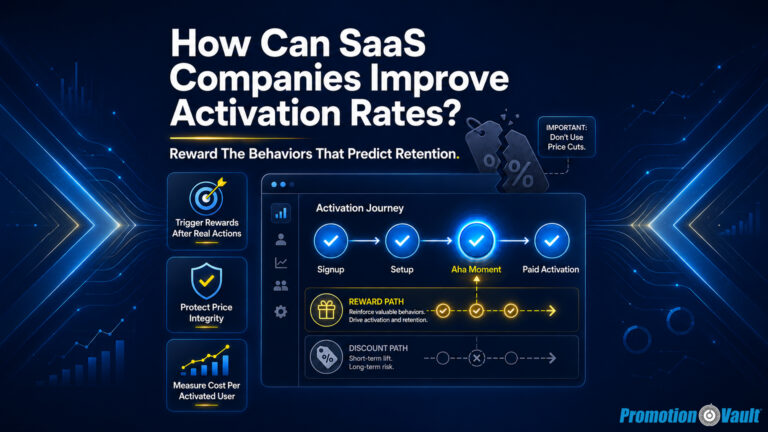
A 16:9 Promotion Vault featured image with a dark blue data-driven SaaS dashboard design. The headline reads “How Can SaaS Companies Improve Activation Rates?” and the subhead reads “Reward The Behaviors That Predict Retention.” A central “Activation Journey” dashboard shows users moving from “Signup” to “Setup” to “Aha Moment” to “Paid Activation,” with glowing checkmarks on each completed step. A highlighted “REWARD PATH” shows “Reinforce valuable behaviors” and “Drive activation and retention,” while a muted “DISCOUNT PATH” shows “Short-term lift” and “Long-term risk.” Three side callouts read “Trigger Rewards After Real Actions,” “Protect Price Integrity,” and “Measure Cost Per Activated User.” A warning label says “IMPORTANT: Don’t Use Price Cuts,” reinforcing that SaaS activation improves by rewarding verified behaviors instead of discounting.

How Can SaaS Companies Improve Activation Rates?

SaaS companies can improve activation by rewarding completed onboarding behaviors that predict retention, such as workspace setup, data import, integration connection, teammate invitation, seat activation, trial conversion, or annual upgrade. The key is to reward verified value moments — not vague engagement — and measure cost per completed action. Discounts should be avoided because they can damage perceived brand value and train prospects and customers to wait for discounts.

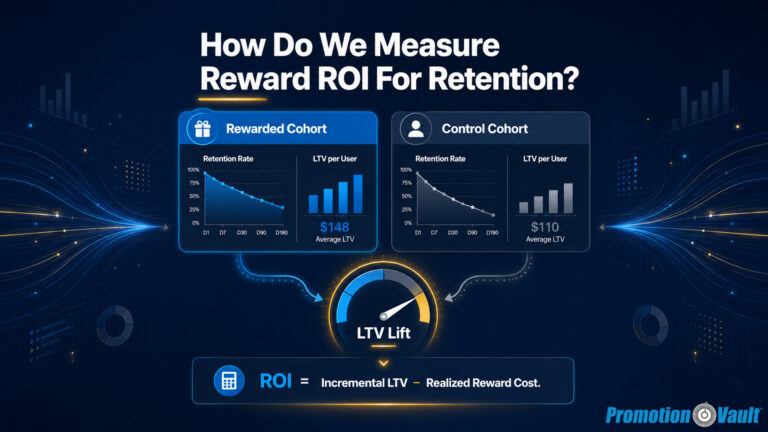
Promotion Vault 16:9 featured image explaining how to measure reward ROI for retention, showing a Rewarded Cohort compared with a Control Cohort, retention-rate and LTV-per-user charts, an LTV Lift gauge, and the formula ‘ROI = Incremental LTV − Realized Reward Cost.’

How Do We Measure Retention Rewards ROI?

To measure the ROI of rewards used for customer retention, compare the lifetime value of a rewarded cohort against a similar control cohort. Then subtract the actual reward cost to identify if ROI is positive or negative (and by how much).

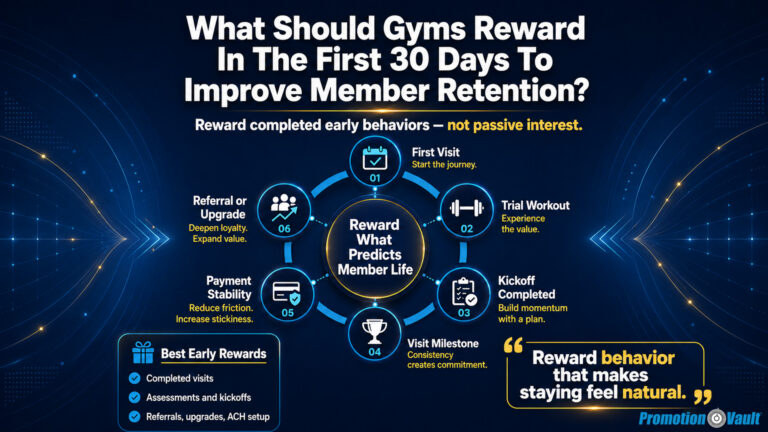
Featured image for an article titled ‘What Should Gyms Reward In The First 30 Days To Improve Member Retention?’ on a dark muted blue gradient background. White bold text states ‘Reward completed early behaviors — not passive interest.’ A central circular graphic reads ‘Reward What Predicts Member Life’ and is surrounded by six labeled milestones: ‘First Visit,’ ‘Trial Workout,’ ‘Kickoff Completed,’ ‘Visit Milestone,’ ‘Payment Stability,’ and ‘Referral or Upgrade.’ A side section titled ‘Best Early Rewards’ lists ‘Completed visits,’ ‘Assessments and kickoffs,’ and ‘Referrals, upgrades, ACH setup.’ A highlighted line says ‘Reward behavior that makes staying feel natural.’ The image uses cerulean blue and warm yellow accents and a premium data-driven editorial style.

How Can Gyms Increase First-30-Day Retention?

Gyms should reward the completed early behaviors that make retention more likely: first meaningful visits, trial workouts, trial-to-member conversion, kickoff completion, visit milestones, payment stability, upgrades, and qualified referrals. The first 30 days are not the time for vague engagement campaigns or blanket discounts. They are the time to help members build proof, rhythm, confidence, and connection.